REVIEW · ATHENS
Athens: Acropolis, Parthenon and Acropolis Museum Guided Tour
Book on Viator →Operated by Athenian Tours · Bookable on Viator
Ancient Athens, explained in the right order. This Acropolis, Parthenon, and Acropolis Museum guided tour strings the story together on-site, with a licensed guide leading you through the monuments and then into the museum so you can understand what you just saw at street level. You start at a simple meetup near the Acropolis Metro and end at the Museum, with a smooth flow designed for tight site entry times and limited daylight.
I love the licensed English guide who turns stone details into clear explanations, including myth, religion, and the political ideas tied to the Parthenon. I also love the Acropolis Museum originals right after the hill, because seeing real archaic statues and the Parthenon frieze makes the top-of-the-hill viewpoint feel way more meaningful.
One thing to plan for: no elevator access on group tours. The Acropolis is steep, and that means comfy shoes and a slower pace on uneven steps.
In This Review
- Key highlights you’ll feel right away
- Getting oriented at Mitseon 2 (and why punctuality is real)
- On the Acropolis hill: Dionysus Theater, Odeon, and the healing sanctuary
- Summit landmarks: Propylaea, Temple of Nike, Erechtheion, and the Parthenon
- The smart mid-tour break before the Museum
- Acropolis Museum: where the stones become objects you can understand
- Tickets and line-skip reality: what’s included and what isn’t
- A note on pace: how the 3 to 4 hours usually feels
- What to pack (so the day doesn’t annoy you)
- Who this tour suits best (and who might want a different plan)
- Should you book this Acropolis + Museum guided tour?
- FAQ
- How long is the Acropolis, Parthenon and Acropolis Museum guided tour?
- Where is the meeting point, and where does the tour end?
- Are Acropolis and Acropolis Museum tickets included?
- Can I skip the lines at the Acropolis and Museum?
- What if I booked the option without entrance tickets?
- Is elevator access available on the Acropolis?
- Is this tour suitable for kids or for mobility needs?
Key highlights you’ll feel right away

- Morning timing matters because Acropolis entry has strict time slots and you need to be on time at Mitseon 2
- Skip-the-line at the Museum (option dependent) so you spend more time seeing artifacts and less time stuck indoors
- Story-first route on the hill linking the Theater of Dionysus, Odeon of Herodes Atticus, and healing sanctuary of Asclepius
- Parthenon and summit landmarks like the Temple of Athena Nike, Propylaea gateway, and the Erechtheion with its sculpted female figures
- Museum-to-monument payoff as you stand near archaic statues and the original Parthenon frieze
- Small group size with a maximum of 24 people, plus frequent photo and question breaks
Getting oriented at Mitseon 2 (and why punctuality is real)
The whole experience lives or dies by timing, and the meeting point is easy: Mitseon 2, Athens (near the Acropolis Metro). You’ll want to arrive at least 15 minutes early, not because it’s a nice-to-have, but because the Acropolis has strict entry times. Late arrivals can’t be accommodated, and refunds aren’t offered for missed entry.
What I like about this setup is that the day starts grounded, not chaotic. You gather near a central transit stop, get organized, then head to the hill with a plan that keeps you moving while still allowing breaks.
If you’re the kind of traveler who hates the last-minute scramble, choose the private option for a more flexible start time. It can take the edge off the morning rush, especially if you’re using buses or need a slower rhythm.
You can also read our reviews of more guided tours in Athens


On the Acropolis hill: Dionysus Theater, Odeon, and the healing sanctuary

The tour begins on the Acropolis hill, and the route matters because it moves through ancient Athens like a timeline, not just a checklist. On your way up, you’ll stop at the Dionysus Theater—where famous comedies and tragedies were first performed. It’s a quick stop, but it’s one of those moments where you instantly realize these weren’t just monuments. They were stages for ideas, entertainment, and public life.
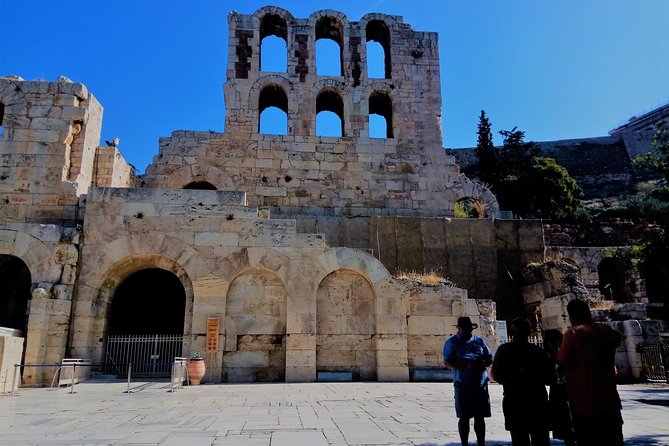
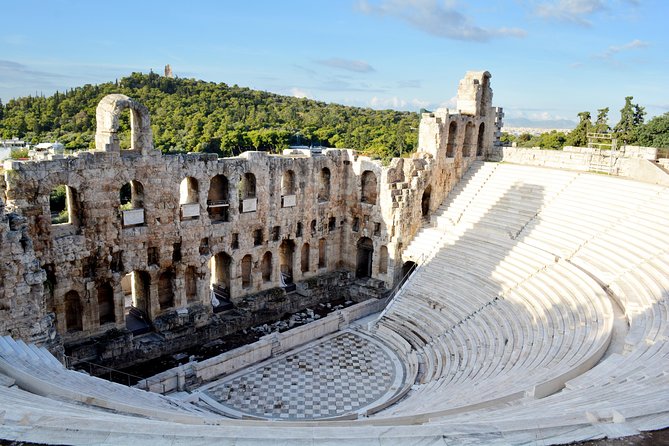
Next you’ll walk around the Odeon of Herodes Atticus. This is a different kind of space than the theater on the ground—more intimate, with a Roman-era feel, and perfect for understanding how performances and civic culture evolved.
You also visit the sanctuary of Asclepius, the healing god. This part surprises people—in a good way—because it reminds you that the Acropolis wasn’t only about temples and politics. It was also a place where people came for healing rituals, and that changes how you read the whole complex.
Practical note: the Acropolis is steep. Some paths can be slippery when wet, and there aren’t cafés up there. Bring water and plan for a hike that feels more like “good workout” than “easy stroll.”
Summit landmarks: Propylaea, Temple of Nike, Erechtheion, and the Parthenon

Once you’re higher on the hill, the landmarks come in a satisfying sequence: gateway first, then the iconic temples and the famous architecture details you’ve likely seen in photos but never really understood.
You’ll reach the Propylaea (the gateway). It’s the kind of entrance that makes the rest of the site feel more intentional—like the Acropolis was designed as a destination, not an accident of stone.
Then comes the Temple of Nike (the Temple of Athena Nike). It’s not the largest structure up there, but it’s visually sharp and it’s one of the key points for understanding what the Greeks built to communicate power and belief.
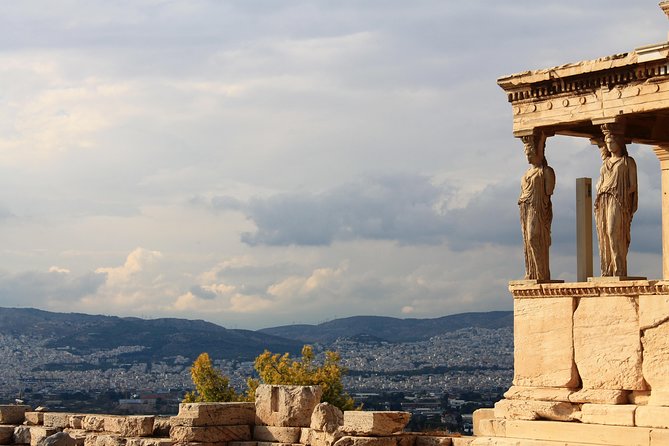
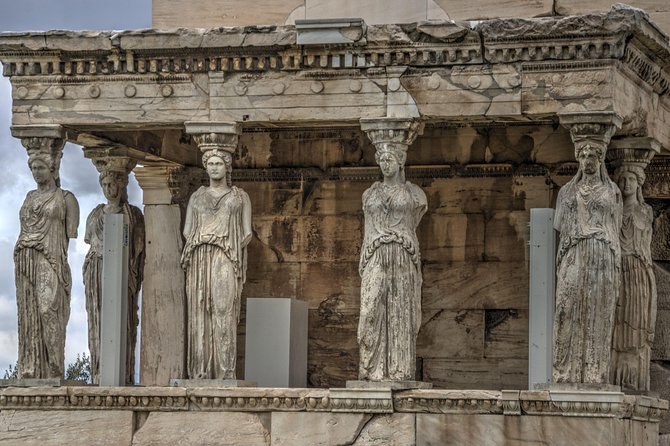
After that, you’ll see the Erechtheion, famous for its asymmetrical layout and for the sculpted female figures that act as supports. Those figures are often what people remember later, especially after you’ve also seen the museum’s related pieces below.
And then, of course, the Parthenon. You’ll have time to admire this 5th-century B.C. statement of Doric architecture, dedicated to Athena, patroness of Athens. The guide’s explanations are what help the Parthenon click: it isn’t only a pretty ruin. It’s tied to ideas about democracy and the Golden Age of Pericles, and once you hear that context, the building feels like a message set in stone.
The practical catch: this is the Acropolis. You’re going to walk, you’re going to look up, and you’re going to spend time on uneven ground. Comfy shoes are not optional.
The smart mid-tour break before the Museum
Right after the hill portion, you get a short break before heading to the Acropolis Museum. The main purpose here is simple: you can use the bathroom and catch your breath before the museum shift.
That matters because it keeps the second half from feeling like a sprint. The hill is active; the museum is more about reading details, standing still, and seeing objects up close. This break helps you switch gears without feeling rushed.
Acropolis Museum: where the stones become objects you can understand
The Acropolis Museum is where this tour earns its keep. If you’ve ever stood on a historic site and felt like you were staring at copies, the museum is the antidote.
The day’s museum segment is about 2 hours, and it starts with the kind of evidence that makes ancient life feel real. On the ground floor, artifacts show daily life facets: wedding customs, children’s favorite toys, healing techniques, and religious practices. Instead of only worship and politics, you get the human side—what people wore, what they did, what they believed would keep them safe.
Then you go to the first floor and you’re close to archaic statues from the 6th century B.C. This is where the guide’s explanations tend to land hardest. You’re standing near pieces that once adorned the Acropolis, and that physical proximity helps you understand why the site above was worth preserving.
You’ll also see the Caryatids and huge sections of the Acropolis entrance. These are the moments where museum viewing stops being passive. You start noticing craftsmanship and scale, and you connect it back to the structures you just saw on the hill.
On the last floor, you’re treated to the original Parthenon frieze, plus a breathtaking view back toward the Acropolis. It’s a strong ending because it ties together the two halves of your walk: monument in front of you, artifacts around you, and the hill behind you like a living reference.
You can also read our reviews of more museum experiences in Athens




Tickets and line-skip reality: what’s included and what isn’t

This tour is priced low on paper, but what you pay for depends on the ticket option you select. The base price you’ll see is around $41.12 per person, and it includes an English speaking licensed guide.
If you choose the option that includes tickets, the tour includes access to the Acropolis and the Acropolis Museum. It also includes skip-the-lines at the ticket offices and lets you enter through a separate entrance to the Museum (when that option is selected).
Important: you cannot skip the line for the Acropolis itself. The Acropolis line rules are strict, and this tour doesn’t magically break them. That’s why the ticket option matters mostly for the Museum experience and ticket office time.
If you book without tickets, you’ll need to purchase entry yourself. The guidance says you can buy online at least 24 hours before the tour, or you may be able to purchase from the tour check-in point for 30€ for the Acropolis and 20€ for the Museum per person (adult tickets only), if you notify them at least 24 hours in advance. Bring cash if you’re in the without-tickets mode.
The value angle is this: a guide is what makes the difference between seeing a site and understanding it. Tickets are the price of entry. Together, you’re paying for context plus access to the two big anchors of Athens.
A note on pace: how the 3 to 4 hours usually feels
This is a 3 to 4 hour tour overall, with the museum component taking about 2 hours. That time mix is ideal for most first-time visitors because you get enough hill time to see the summit highlights without trying to squeeze in a full independent museum session afterward.
Group size maxes at 24, which usually makes the pace feel manageable. A good guide keeps you moving but stops often enough for photos and questions. I like that the tour is built with comfort in mind, including small breaks rather than only long stretches of walking.
Still, it’s not a slow-moving “sit and listen” type of outing. It’s Athens, on a steep hill. If you’re expecting flat-ground strolling, you might end up frustrated.
What to pack (so the day doesn’t annoy you)

This site is outdoors for a good chunk of the morning. You’ll be happier if you show up ready.
Bring water, a hat, sunglasses, and an umbrella if rain is possible. There aren’t typical café options on the Acropolis hill—there’s only a water fountain. If you want a comfortable visit, bring a light layer too, especially in shoulder seasons and winter when it can cool off higher up.
If you’re sensitive to audio distractions, know that audio can sometimes be affected by other groups’ equipment. It’s rarely a deal-breaker, but it’s worth factoring in if you plan to rely heavily on audio.
Who this tour suits best (and who might want a different plan)
This guided combo is ideal if you want a first strong look at Athens with explanations that connect mythology, architecture, and civic life. It’s also a solid fit if you don’t want to do a bunch of homework before you arrive. The guide’s job is to provide that context in a way that actually helps you see details.
It’s also a good choice for travelers who like order. The museum after the hill is especially smart because you get to confirm what you just learned with real originals and friezes.
On the flip side, it’s not suitable for children under 6 years old, and it isn’t recommended for people with mobility impairments. The hill walking and uneven terrain are the main reasons.
And remember: group tours don’t allow elevator use on the Acropolis. If mobility is a concern, you should think carefully before booking.
Should you book this Acropolis + Museum guided tour?
Yes, if you want the Acropolis to make sense fast. The biggest strength here is the pairing: summit monuments up top, then the museum originals right after, so the story isn’t stuck in your imagination. You also get an experienced English speaking licensed guide, and the Museum option can include separate entry and skip-the-line ticket office time depending on what you select.
Hold off or choose a different style of visit if you’re hoping for minimal walking or you need elevator access on the hill. And if you’re the type who wants hours alone in the Museum with no guide pacing, you might prefer a self-guided plan.
If you’re doing Athens for the first time, this is one of the easiest ways to get more meaning out of less time. Start early, wear good shoes, buy tickets thoughtfully based on your option, and let the guide connect the Parthenon and frieze into one clear picture.
FAQ
How long is the Acropolis, Parthenon and Acropolis Museum guided tour?
The tour runs about 3 to 4 hours in total. The Acropolis Museum visit is about 2 hours, with time on the hill for multiple stops.
Where is the meeting point, and where does the tour end?
Meet at Mitseon 2, Athina 117 42, Greece. The tour ends at the Acropolis Museum on Dionysiou Areopagitou 15, Athina 117 42, Greece.
Are Acropolis and Acropolis Museum tickets included?
It depends on the ticket option you choose. If you selected the tickets option, your guide provides the tickets and access. If you booked without tickets, you’ll need to buy them yourself (online at least 24 hours before, or sometimes on-site with cash for adult tickets only).
Can I skip the lines at the Acropolis and Museum?
You can skip the line at the Museum ticket offices if you selected the option that includes skip-the-line benefits. However, the Acropolis line itself cannot be skipped, even with this tour.
What if I booked the option without entrance tickets?
Bring cash to purchase your admission at the check-in spot just before the tour. You can also reserve tickets for your time slot by letting them know in advance, or you can buy online at least 24 hours before from the official sites.
Is elevator access available on the Acropolis?
No. Elevator use to the Acropolis is not permitted on group tours.
Is this tour suitable for kids or for mobility needs?
It’s not suitable for children under 6 years old. It’s also not suitable for people with mobility impairments.




More Guided Tours in Athens

More Tours in Athens



More Tour Reviews in Athens
- All Day Cruise -3 Islands to Agistri,Moni, Aegina with lunch and drinks included
★ 5.0 · 4,958 reviews