REVIEW · ATHENS
Athens All Included: Acropolis and Museum Guided Tour with Ticket
Book on Viator →Operated by Walks In Europe · Bookable on Viator
The Acropolis is easier with a guide. This small-group tour meets near the Acropolis area, hands you timed, pre-reserved entry, and uses headsets so you can actually follow the story while you walk the hill. You also get a guided jump from the Acropolis into the Acropolis Museum, so the day flows instead of turning into a scramble.
I especially like the way the route hits both the famous moments and the in-between spots, from the Parthenon to the Theatre of Dionysus and the north-side temples most people miss. Guides such as Eva and Antigone are named in past tour comments for strong storytelling that makes the stone feel connected to real Athenian life.
One caution: if you want lots of solo wandering at the top, the guided pace can feel tight, and you’ll still be dealing with steps and uneven ground. Free time exists, but it’s not the whole day up there.
In This Review
- Key highlights worth knowing
- Timed tickets plus a small group: the real advantage
- Where you meet and how the timing works
- Stop-by-stop on the Acropolis hill: what you’ll actually see
- The opening walk: Acropolis highlights with headsets
- The Parthenon: beyond the postcard
- Propylaea and the ceremonial entrance feel
- Views and the south route (plus Theatre of Dionysus)
- North-side temples: the stuff many people miss
- The practical reality: stairs, uneven ground, and cold
- Acropolis Museum: glass floors and the Parthenon Gallery story
- What you’ll notice fast inside
- Parthenon Gallery and the Elgin Marbles
- Archaic Gallery for earlier context
- After the guided portion
- 3 hours sounds short. Here’s what it really means for your day
- Price and value: when this tour earns its $165.67
- Practical tips so the day feels smooth (not stressful)
- Who this tour fits best
- Should you book Athens All Included: Acropolis and Museum Guided Tour with Ticket?
Key highlights worth knowing

- Timed entry to both the Acropolis and the Acropolis Museum to keep your day moving
- Headsets so you can hear your licensed Greek guide even in open-air crowds
- A small group (max 20) that tends to make photo stops and questions actually work
- A planned route that includes the Propylaea, Temple of Athena Nike, Theatre of Dionysus, and north-side viewpoints
- Acropolis Museum focus, including the Parthenon Gallery and the Elgin Marbles story
- Optional extra time after the guided museum portion, at your own pace
Timed tickets plus a small group: the real advantage
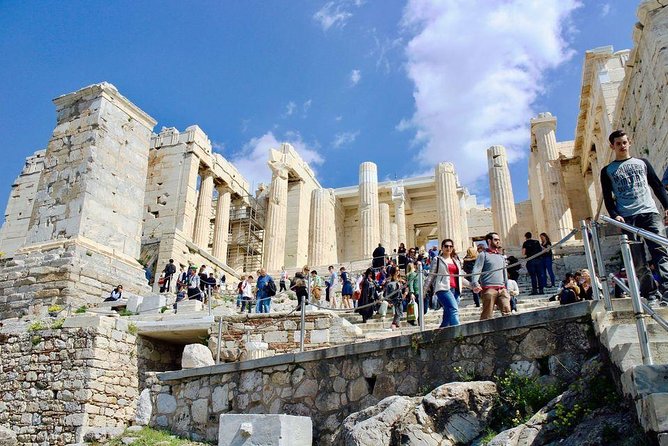
In Athens, the Acropolis can feel like a theme park line that moves slowly no matter how good your expectations are. This tour’s main value is simple: you get pre-reserved admission tickets timed to your entry windows, and you start your visit right away instead of playing queue roulette.
The group size matters too. With a maximum of 20 people, you’re not stuck in a big conga line where your guide can’t notice who needs a slower pace, a bathroom break, or a chance to catch up. Past guests specifically mentioned guides handling mixed walking ability well, and that’s a big deal on this hill.
You also won’t be relying on strained listening in outdoor noise. Headsets help the guide’s narration stay clear, which makes the whole thing feel less like you’re reading signs and more like you’re understanding what you’re standing in front of.
Possible downside to keep in mind: even with reserved tickets, high season can still mean a wait in a pre-reserved holder queue. The tour is built to reduce the worst of the delay, but Athens in peak months is still Athens.
You can also read our reviews of more tours and experiences in Athens


Where you meet and how the timing works
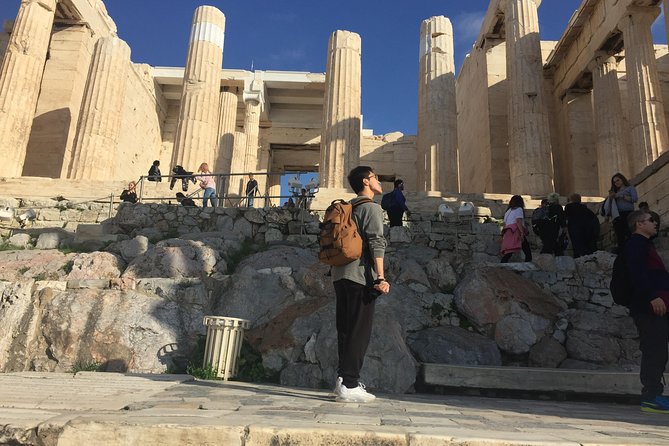
You meet at Makrigianni 7, Athina 117 42 and the tour ends at Acropolis Museum, Dionysiou Areopagitou 15. The itinerary notes that the guided portion begins at the Acropolis metro station area, so expect the start to be in that immediate neighborhood.
Plan to arrive about 10 minutes early. The tour departs sharply because entry times are reserved, and your tickets are timed and expire within 5 to 10 minutes. If you’re late, you can’t just join the start midstream. The good news: Athens has metro access nearby, which is the easiest way to get to the meeting point without wasting time in traffic.
This is one of those tours where being “almost on time” doesn’t help. If your morning plan is messy—crisscrossing neighborhoods, late coffee, the wrong tram—this tour punishes that. But if you keep your schedule clean, you’ll feel the payoff fast.
Stop-by-stop on the Acropolis hill: what you’ll actually see
The guided Acropolis section is paced for about two hours total walking and interpretation, including a focus on key structures and multiple perspectives. The route is designed so you see more than the first cluster of landmarks that everyone crowds around.
The opening walk: Acropolis highlights with headsets
You begin with your guide and small group, then start moving through the site with headsets so the story lands while you’re looking at each monument. This is where the tour earns its ticket price. The guide connects architecture and myth to real layout and purpose—why you’re seeing certain temples in a certain order, and what those spaces were meant to do.
The walk includes stops and explanation around: Parthenon, Propylaea, Erechtheion, Temple of Athena Nike, and the Theatre of Dionysus. The Theatre of Dionysus is especially important because it ties the Acropolis to Greek drama—so you’re not just looking at religion and politics, you’re seeing where theater got its big start.
Small group perk: photo pauses and questions are easier to manage. Several tour comments highlighted guides pausing for pictures and pointing out better viewpoints than you’d guess from the crowd.
The Parthenon: beyond the postcard
The Parthenon segment is included as a focused visit, with guided context. You’ll get explanations for how it was designed and built and what it meant to Athenians—less as a generic “great temple” and more as a symbol tied to the city’s golden age.
Here’s why that matters for you: at the Acropolis, it’s easy to stare at columns and feel impressed but disconnected. A good guide gives you the mental map—so you can look at the Parthenon and recognize why it’s such a big deal in Western art and civic symbolism.
Time is limited, though. One review note complained about not enough independent time on the Acropolis, with only about 10 minutes for self-exploration. If you’re the type who wants long, slow wandering and picture-by-picture editing, you may wish the guided portion ran shorter.
You can also read our reviews of more guided tours in Athens



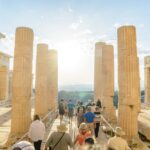
Propylaea and the ceremonial entrance feel
Next up is the Propylaea, the monumental gateway that once framed ceremonial entry to the sacred spaces above. The guide’s job here is to help you read the gateway as more than a pretty set of columns. You’ll learn how the design reflected Athenian power and how it shaped the experience of moving from regular city space into ritual territory.
It’s a stop that often gets rushed by people who think the Parthenon is the only show in town. On a guided route, Propylaea becomes a “how the day was supposed to feel” moment.
Views and the south route (plus Theatre of Dionysus)
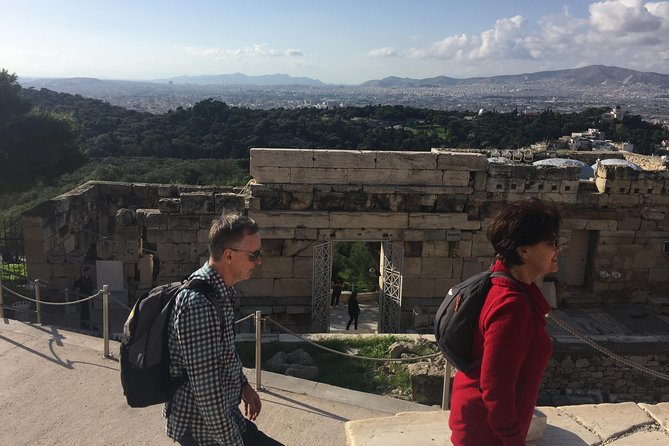
The tour also takes you a different way toward the south exit, so you don’t only see the same angles everybody gets while staying near the first paths. You’ll also get viewpoints over the city and toward the Aegean Sea.
Then you reach the Theatre of Dionysus, repeatedly emphasized as part of the drama story. Even if you know the basics of Greek theater, it lands better when you understand its location in relation to the rest of the Acropolis complex.
If you like taking photos, these viewpoint moments are some of the highest reward—because you’re standing where the architecture and the city align.
North-side temples: the stuff many people miss
A final highlight is the north side, where the tour includes temples associated with earlier cults and the Olympian gods. A guided visit helps here because many of these structures look “incomplete” or confusing at first glance if you don’t have context.
This is where the Acropolis stops being only about the famous icons and starts becoming a layered religious landscape. If you want something that feels more than a monument checklist, this section is where it happens.
The practical reality: stairs, uneven ground, and cold
The tour requires moderate physical fitness. Expect climbing stairs and walking on uneven ground. That’s true year-round, but it’s also why winter and shoulder seasons can catch people off guard: at higher elevations it can be cold, even if the city below feels mild.
Acropolis Museum: glass floors and the Parthenon Gallery story
After the hilltop portion, you take a short break, then head inside the Acropolis Museum with your pre-booked admission tickets. The museum guide portion is about 45 minutes, with plenty of opportunity to keep exploring after the tour ends.
The museum is designed to complement what you just saw outside. Instead of forcing you to mentally translate broken ruins into intact buildings, it helps you see original sculpture and architectural elements in context.
What you’ll notice fast inside
One of the most striking features is the glass floor, which lets you look down onto excavations beneath the building. That alone changes the experience. You’re not just in a room with artifacts—you’re inside a structure built over layers of the ancient city.
Parthenon Gallery and the Elgin Marbles
The guide spends time in the Parthenon Gallery, and you’ll learn the story of the Elgin Marbles and why they matter. Even if you’ve heard the basics, a guided explanation helps you understand the significance beyond the headline.
This part is valuable because the museum tells you what the carvings and sculptures were doing for the temples—how they fit into a larger visual and religious program. Without a guide, it’s still beautiful, but with one you can make sense of what you’re looking at.
Archaic Gallery for earlier context
The guided visit concludes in the Archaic Gallery, which holds statues that predate the Acropolis monuments. This is smart pacing: it widens the timeline, so the Acropolis doesn’t feel like it appeared fully formed in the 5th century BC.
After the guided portion
Once the guided portion finishes, you can remain and explore at your own pace or relax at the museum café. This is a nice built-in compromise: you get interpretation up front, then you control your time afterward.
A heads-up based on the tour’s structure: if you’re hoping to use the guided portion to “max out” everything and then instantly exit, you may find you’re tempted to stay longer anyway once you’re inside.
3 hours sounds short. Here’s what it really means for your day
A three-hour visit can be the sweet spot in Athens because you’re targeting two major anchors without turning the day into a full-day commitment.
But you need to understand how that time gets spent:
- Most of your time is walking and looking up at the Acropolis, with guided narration filling the gaps that guidebooks can’t.
- Your museum time is guided first, then optional self-guided exploring.
- Independent time on the Acropolis itself is limited, and your schedule is designed to keep you inside the timed ticket windows.
This setup is great for people who get overwhelmed by too many stops without structure. It’s also great if you want the key monuments explained in a way that makes your photos mean something later.
If you’re the type who loves wandering without listening, you may feel like you’re spending more time hearing stories than taking in the site at your own speed. That’s the trade.
My take: for most first-time visitors, it’s a smart trade, because the Acropolis is one place where context turns awe into understanding.
Price and value: when this tour earns its $165.67
At $165.67 per person, the price isn’t budget. So you should ask what you’re buying besides a walk around famous sites.
Here’s what you’re paying for, all at once:
- Skip-the-line style access through pre-reserved tickets for both the Acropolis and the museum
- A licensed local guide working with a small group size
- Headsets, which reduce the frustration factor when crowds and wind make listening hard
- A route that covers more than the obvious highlights, including lesser-seen temple areas and viewpoint angles
- A museum add-on that helps you interpret what you just saw outside
If you were doing this DIY, you’d likely spend extra time sorting entry times and navigating the site without context. You can cut costs on a trip like Athens—most people do. But this is one of the rare “spend a bit more” experiences that can feel efficient instead of overpriced, because it prevents wasted time and turns the monuments into a guided narrative.
Also, the reviews repeatedly emphasize the guide impact: the stories, the pace, the sense that someone makes sure you’re not lost. A tour like this is often worth it when you’re choosing between paying for meaning or paying for convenience.
Practical tips so the day feels smooth (not stressful)
A few real-world things will make this trip better:
- Wear proper walking shoes. Flip-flops and sandals are not a fun plan on uneven stone.
- Expect steps. Even if you can walk fine on flat ground, the Acropolis is a workout.
- Bring a small layer for higher altitude. In cooler months, the top can feel colder than you expect.
- Arrive early and keep your morning schedule clean. Timed tickets that expire quickly mean you want zero last-minute surprises.
- If you need bathroom breaks, ask your guide. Past comments mention guides being considerate with WC stops, which helps keep the tour humane.
If you like photos, pay attention when the guide points out picture spots. A few tour notes praised guides for stopping for photos and steering people toward better angles than a casual walk would find.
Who this tour fits best

This tour is a strong match if you:
- Want the Acropolis and museum in one efficient session
- Prefer a guide to turn monuments into context
- Like small groups (max 20) rather than big bus crowds
- Are comfortable with moderate walking and some stairs
It may be a poor fit if you:
- Want long stretches of total independence on the Acropolis hill
- Have mobility restrictions that make stairs and uneven ground difficult
- Need a stroller. Strollers of any kind aren’t allowed, and kids under 6 aren’t permitted.
Should you book Athens All Included: Acropolis and Museum Guided Tour with Ticket?
Yes, if you want a structured, ticketed way to see the Acropolis and then understand it inside the museum. The combination of timed entry for both places, headsets, and a small group makes this feel like good use of a short Athens window.
Skip it if your main goal is wandering slowly with zero listening. In that case, you might be happier paying for tickets only and building your own pacing.
If you’re a first-time Athens visitor, this tour is one of the easiest ways to leave the Acropolis feeling like you actually learned something, not just took photos.




More Tickets in Athens




More Tours in Athens



More Tour Reviews in Athens
- All Day Cruise -3 Islands to Agistri,Moni, Aegina with lunch and drinks included
★ 5.0 · 4,958 reviews