REVIEW · ATHENS
Athens Acropolis and Parthenon Walking Tour
Book on Viator →Operated by Athens Walking Tours · Bookable on Viator
If you only have a short Athens window, this walk helps. You’ll get a licensed guide, earsets so you don’t miss a word, and a clear route through the Acropolis highlights in about 2 hours. It’s a smart way to see the UNESCO World Heritage site without turning your trip into a guessing game.
What I really like is how much context you get for what you’re looking at. I especially appreciate the way the guide ties each monument to the classical Greek ideas behind it, so the stones feel like stories instead of random piles.
One thing to consider: it’s a steep, uneven uphill climb. If wind or the earset sound glitches, hearing can be harder, and there aren’t conveniences like toilets once you’re on the site.
In This Review
- Key things to know before you go
- Why This 2-Hour Acropolis and Parthenon Tour Fits Real Travel Days
- Meeting at the Yogurt Bar: Find Your Group Fast and Start Smart
- Ticket Options and Skip-the-Line Reality at the Acropolis
- What You’ll See: Propylaea, Dionysus, Asclepios, and the Odeon
- Acropolis core: first look at the hilltop (about 20 minutes)
- Theatre of Dionysus: the birthplace of drama (about 15 minutes)
- Temple of Asclepios: medicine with a spiritual side (about 10 minutes)
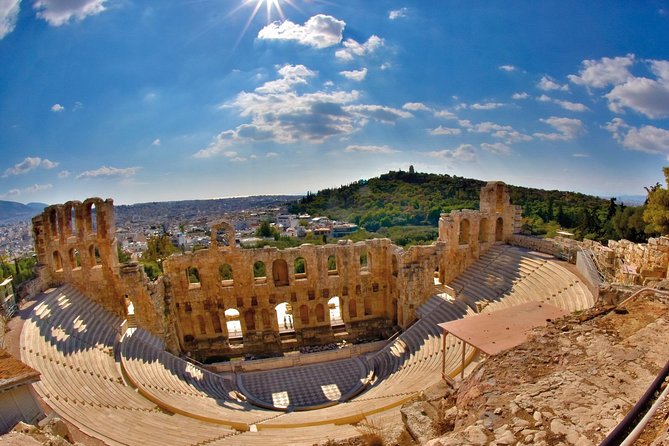
- Odeon of Herodes Atticus: an ancient theater that still matters (about 10 minutes)
- The View Breaks: Philopappos Hill and Temple of Athena Nike
- Philopappos Hill, also called Hill of the Muses (quick stop)
- Temple of Athena Nike (about 5 minutes)
- Propylaea and the Erechtheion Caryatids: Details You’ll Miss Solo
- Propylaea: the grand marble gateway (about 5 minutes)
- Erechtheion: Athena and Poseidon plus the famous porch (about 15 minutes)
- The Parthenon Stop: Make the Most of Your 25 Minutes
- Pace, Terrain, and Comfort Tips That Actually Matter
- Value Check: Is $41.12 a Good Use of Your Athens Time?
- Who This Tour Suits Best (And Who Should Think Twice)
- FAQ
- What’s the duration of the Acropolis and Parthenon walking tour?
- Do I need an entrance ticket for the Acropolis?
- Does the tour include earsets?
- Where do we meet the tour?
- Is the tour for people with limited mobility?
- Are baby strollers allowed on the Acropolis?
- Should You Book This Acropolis and Parthenon Tour?
Key things to know before you go
- Earsets for everyone help you hear commentary clearly while moving between stops.
- Skip-the-line at ticket offices is available when you choose the admission-ticket option.
- A short, focused route hits the Acropolis core and major nearby landmarks without dragging on.
- Photo-and-view moments include stops like Philopappos Hill and the Temple of Athena Nike.
- Group size stays small (max 24), so the tour doesn’t feel like a cattle chute.
Why This 2-Hour Acropolis and Parthenon Tour Fits Real Travel Days
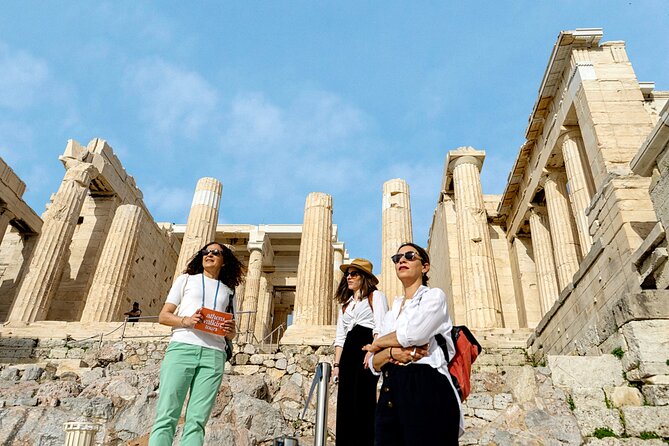
The Acropolis is one of those places where time disappears fast. You think you’ll just walk around, then you’re stuck in lines or wandering and realizing you missed the exact thing you came for. This tour is built for the opposite problem: it gives you a guided route that concentrates on the big moments up on the hill.
At $41.12 per person (about), it’s not trying to be a bargain-only deal. Instead, you’re paying for the guide who keeps you oriented, plus earsets that make group tours actually work in crowds. With a planned duration of about 2 hours, you’re done before your energy drops to zero.
You also get practical extras: an Athens map for the rest of your day and an Athens guide magazine with ideas for what to do next. That combination matters, because the Acropolis is just step one of a good Athens itinerary.
You can also read our reviews of more walking tours in Athens

Meeting at the Yogurt Bar: Find Your Group Fast and Start Smart
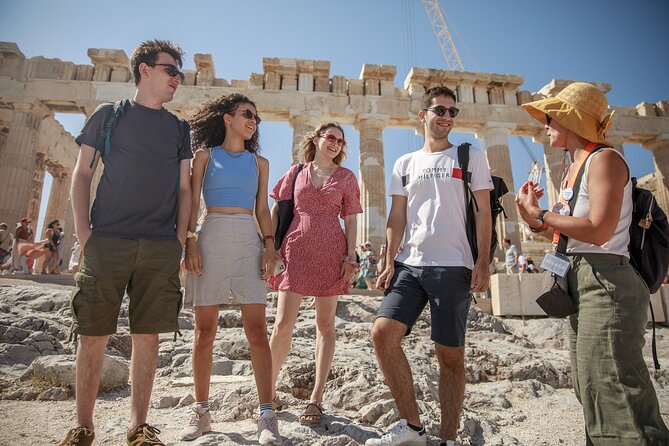
Meet your guide and group near the base of the Acropolis at the yogurt bar at LUKUMAΔΕΣ, Dionysiou Areopagitou 3 (the exact address is part of the listing). You’ll start at your chosen time, then follow the guide uphill.
This meeting style is a quiet win. You’re not hunting for a random tour booth in a plaza, and you’re not starting your day with stress. It’s also close to public transportation, which matters in Athens where the “last mile” can feel like a maze if you’re trying to do everything on your own.
If you picked the option without admission tickets, you’ll hand cash to the guide at the start so they can use prepaid access. That means you don’t need to handle ticket offices mid-stress—just show up on time and be ready to climb.
Ticket Options and Skip-the-Line Reality at the Acropolis
The tour price depends on which option you choose. If you go without the admission ticket, you’ll need to purchase the Acropolis entry separately (the standard listed entrance fee is €30.00 per person). If you choose the upgrade with admission tickets, you can use the included skip-the-line handling at the ticket offices.
Here’s the practical takeaway: don’t assume the cheapest option is always the best value. If you’re traveling during peak season or at a tight schedule, skipping friction at the ticket desks can buy you time—and in Athens, time is usually the real currency.
Also note the site runs on strict entry times. The guide can’t wait for latecomers, and there are no refunds if you miss that window. So plan to arrive early enough that you’re not rushing through security like it’s an escape room.
What You’ll See: Propylaea, Dionysus, Asclepios, and the Odeon

This walk is paced as a sequence of stories. You move from major landmarks to supporting sites that explain how the Acropolis functioned in the classical world. Even if you’ve seen photos of the Parthenon a hundred times, the tour helps you connect the dots between religion, theater, and civic pride.
Acropolis core: first look at the hilltop (about 20 minutes)
You start with the Acropolis itself, and the guide frames what you’re about to see. Expect key orientation right away: what this place meant, why the layout matters, and how the main structures connect to Greek culture.
This first segment is where guided tours earn their keep. Without context, the Acropolis can feel like a museum you’re walking through without a map. With a guide, it feels like a living “why” behind each building.
- All Day Cruise -3 Islands to Agistri,Moni, Aegina with lunch and drinks included
★ 5.0 · 4,958 reviews





Theatre of Dionysus: the birthplace of drama (about 15 minutes)
Next up is the Theatre of Dionysus. The guide’s focus is the idea that this was the original home of drama—then the tour brings in the famous playwrights: Aeschylus, Sophocles, and Euripides.
I like this stop because it changes your mindset. You’re not just looking at architecture; you’re standing in a place tied to performance and public debate—Greek culture in action.
Temple of Asclepios: medicine with a spiritual side (about 10 minutes)
Then you shift gears to the sanctuary dedicated to Asclepius, the god of medicine. The guide explains how ancient Athenians sought cures and gave thanks for restored health.
This stop offers breathing room, too. It’s a reminder that the Acropolis wasn’t only temples to gods for show; it included spaces for healing and ritual. If you tend to get “Parthenon fatigue,” this one can reset your attention.
Odeon of Herodes Atticus: an ancient theater that still matters (about 10 minutes)
You’ll also see the Odeon of Herodes Atticus, built in 161 AD. The guide connects its purpose then and now: it still hosts performances today.
This is another moment where you feel the continuity. Stone architecture isn’t stuck in the past here—it’s still used, which makes the whole hilltop feel less like ruins and more like a backdrop to human gatherings.
The View Breaks: Philopappos Hill and Temple of Athena Nike

One smart thing about this tour is that it includes pauses that aren’t just “look, then walk again.” They build in viewpoint stops where you can catch your breath, steady your camera, and see the city in context.
Philopappos Hill, also called Hill of the Muses (quick stop)
You’ll visit Philopappos Hill, where the monument of Philopappos sits. The payoff is the view down over Athens, plus a chance to reflect before you move deeper into the main Acropolis area.
This is also a good spot to notice how high you are, and how the hilltop structures dominate the surroundings. That change in perspective makes the later stops easier to understand.
Temple of Athena Nike (about 5 minutes)
Then you get the Temple of Athena Nike on a bastion at the southwestern edge of the Acropolis. It’s dedicated to Athena as goddess of victory and is also known for the panoramic views from the area.
If you like “small stop, big impact,” this is it. It’s short, but it gives you one of the most satisfying look-around moments on the walk.
Propylaea and the Erechtheion Caryatids: Details You’ll Miss Solo
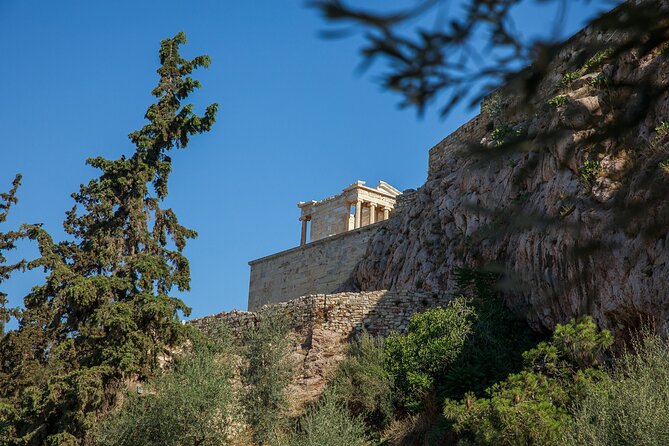
Now you’re approaching the classic skyline pieces. This is where a guide’s input can turn good sightseeing into real understanding.
Propylaea: the grand marble gateway (about 5 minutes)
You pass through the Propylaea, the monumental marble gateway designed by Mnesikles. The guide sets the tone of anticipation: you’re moving into the space as if you’re an honored guest entering the sacred center.
Even if you’ve read descriptions before, standing there is different. It helps you understand why the approach matters—why your path through the Acropolis is part of the experience, not just travel between objects.
Erechtheion: Athena and Poseidon plus the famous porch (about 15 minutes)
The Erechtheion comes next, dedicated to both Athena and Poseidon. The real showstopper is the Caryatid Porch, with six graceful female statues that support the structure.
I love this part because it’s easy to look at and say, Wow. A guide helps you see what you’re looking at: how the building works, why those figures are important, and how the temple’s identity ties into the larger mythology of Athens.
If you’ve ever felt overwhelmed at historical sites—too many stones, too little meaning—this is the kind of stop where things start to click.
The Parthenon Stop: Make the Most of Your 25 Minutes
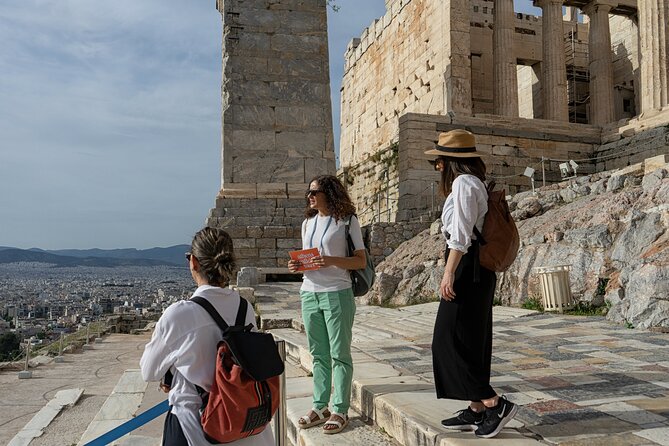
The Parthenon is the final big anchor, and you’ll spend about 25 minutes there. The guide frames it as the masterpiece of the Acropolis and a symbol of classical Greek civilization, dedicated to Athena Parthenos.
What makes this segment work is that you’ve already built context through the earlier stops. Theatre of Dionysus gives you civic life and performance. Asclepios gives you religion and ritual beyond art-for-art’s-sake. Propylaea and Erechtheion prepare you to notice design choices instead of just admiring the shape.
Also, the guide can help you pick viewpoints for photos and for seeing architectural details. If you’re in a large group, that direction matters a lot—people who don’t get guidance often end up taking the same angle everyone else takes.
Pace, Terrain, and Comfort Tips That Actually Matter
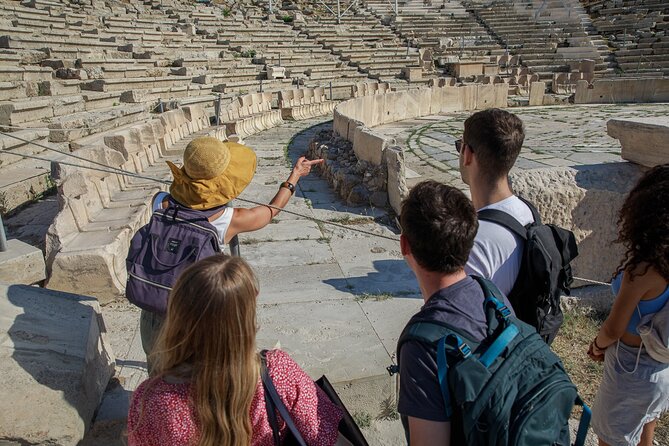
This isn’t a flat stroll. It involves uphill walking and uneven ground on an archaeological site. The tour calls for a moderate physical fitness level, and it’s not for people who want an easy walk.
A few practical realities:
- Wear comfortable shoes with good grip.
- Bring water and use sunscreen and a hat.
- There are airport-style security checks, and in peak season waits can run 30+ minutes.
- Once you’re on the site, plan on no toilet access there (so handle bathroom needs before entry).
Also, baby strollers aren’t allowed on the Acropolis archaeological site. If you’re traveling with a little one, a baby pouch is recommended because there’s no cloakroom at the side entrance used for entry.
Wind can also affect hearing. Some people reported earsets with intermittent sound or static, and another report said strong wind made it hard to hear the guide clearly at times. If weather looks rough, count on moving closer to your guide during key explanations and stay patient if the wind messes with audio.
Value Check: Is $41.12 a Good Use of Your Athens Time?
For many first-time visitors, the biggest question is whether a guided tour is worth it versus doing it on your own. Here’s how I’d judge the value based on what this tour actually includes.
You’re getting:
- A licensed guide.
- Earsets so you can hear commentary while moving.
- An Athens map plus a guide magazine.
- Skip-the-line handling at ticket offices when you select the admission-ticket option.
If you’re the type who likes to understand what you’re seeing (not just point and shoot), the guide earns the cost quickly. Athens history is layered; you’ll get more meaning in a short 2 hours than you will wandering without structure for twice as long.
Where value can dip is if you strongly prefer DIY pacing and you’re comfortable reading on your own while managing long lines and security. In that case, you may feel the guide is extra—especially if your schedule is truly flexible.
But if your time is short, if you want a set route, or if you’d rather focus on photos and views without worrying about what’s where, this priced guide format usually makes sense.
Who This Tour Suits Best (And Who Should Think Twice)
This is a strong match if:
- You only have a half-day and want the hilltop highlights.
- You want a structured walk with a guide who can answer questions.
- You value hearing explanations clearly through earsets.
- You like the idea of combining major monuments with smaller context stops.
It may not be the best fit if:
- You need a very gentle walk with minimal stairs.
- You rely on hearing perfectly all the time and are sensitive to audio issues in wind.
- You’re traveling with a stroller (since strollers aren’t allowed on the site).
Also, if you’re the kind of person who wants to linger for long periods at one monument, the tour’s plan is focused. It will show you a lot, but it won’t give you unlimited time at one spot.
FAQ
What’s the duration of the Acropolis and Parthenon walking tour?
It runs about 2 hours on average.
Do I need an entrance ticket for the Acropolis?
If you choose the option without an admission ticket, you must purchase an Acropolis entrance ticket to join the tour. The listed entrance fee is €30.00 per person.
Does the tour include earsets?
Yes. The tour provides earsets so you can hear the guide clearly while walking.
Where do we meet the tour?
You meet near the base of the Acropolis at LUKUMAΔΕΣ, Dionysiou Areopagitou 3, Athina 117 42.
Is the tour for people with limited mobility?
The tour requires a moderate physical fitness level and includes uphill walking and uneven ground. Comfortable shoes are recommended.
Are baby strollers allowed on the Acropolis?
No. Baby strollers are not allowed on the Acropolis archaeological site, and there’s no cloakroom at the side entrance used.
Should You Book This Acropolis and Parthenon Tour?
If you want a clean, guided route that turns the Acropolis into a story you can follow, I’d book it. You’re paying for orientation, clear audio, and a tight 2-hour hit list that covers the Parthenon and the surrounding monuments that make the whole hill make sense.
I’d skip it only if you’re prioritizing a slow personal pace over structure, or if audio issues in wind would stress you out. Otherwise, this is one of the best ways to get the most meaning per hour in Athens.




More Walking Tours in Athens



More Tours in Athens



More Tour Reviews in Athens
- All Day Cruise -3 Islands to Agistri,Moni, Aegina with lunch and drinks included
★ 5.0 · 4,958 reviews