REVIEW · ATHENS
Athens: Acropolis Guided Private Tour without Entry Ticket
Book on GetYourGuide →Operated by Secrets of Greece IKE · Bookable on GetYourGuide
One hill, one city of legends. This private Acropolis tour threads through the most important ruins above Athens with a licensed guide and a small group feel, focused on what you’re actually seeing. You also get mythology and history tied to the shapes of the stones, not just dates.
What I liked most is how the tour stays interactive. You’ll have time to ask questions while you move between the Propylaea gateway, the Caryatids, and major theater spaces like Dionysus and the Odeon of Herodes Atticus. If you’re the type who wonders what a temple was for or why a building looks the way it does, this format works.
One possible drawback: no Acropolis entry ticket is included. You must buy your timed ticket in advance (and line up with the correct time window by season), or plan to arrive early at the South entrance to purchase it.
In This Review
- Key things to know before you go
- A private Acropolis walk that keeps the story on the move
- Meeting at the Acropolis Metro entrance and matching your ticket time
- Propylaea gateway: walking into the citadel like it matters
- Parthenon area and the goddess protector of the city
- Dionysus Theater: the 17,000-seat festival machine
- Erechtheion and Caryatids: details you might otherwise miss
- Odeon of Herodes Atticus: a giant stone theater with gravity
- Temple of Asclepius: a different angle on the Acropolis
- Taking your time after the guided portion
- Price and value: $292 per group up to 3, plus your own entry ticket
- Who should book this Acropolis private tour
- Should you book this Acropolis guided private tour?
- FAQ
- Where do I meet the guide?
- How long is the tour?
- Is the Acropolis entry ticket included?
- What language is the live tour guide?
- Is this tour private?
- What time ticket should I select depending on the season?
- What if I can’t get an entry ticket because there is no availability?
- What if I don’t have my ticket yet on the day of the tour?
- What’s included in the price?
- What’s not allowed during the tour?
- FAQ
- Can I cancel for a refund?
- Is there free time after the tour ends?
- Where does the tour end?
- What’s the group size limit for the listed price?
- Are hotel pickup or drop-off included?
- What terrain should I expect?
- How do I know I’m choosing the correct meeting point?
- Is there a reserve now, pay later option?
Key things to know before you go
- Private, small-group style means you’re not stuck listening to a headset presentation while you stare at a wall
- Licensed guide in Spanish keeps the focus tight on the site and the stories behind it
- High-impact stops include Propylaea, Dionysus theater, the Erechtheion area, Caryatids, and Odeon of Herodes Atticus
- Walking uphill and uneven ground is part of the deal, so comfy shoes matter
- You’ll need your own entry ticket before the tour starts
A private Acropolis walk that keeps the story on the move
The Acropolis is the kind of place where it’s easy to get overwhelmed. You arrive, look up, and your brain fills in the blanks with whatever postcard image you’ve seen before. This tour is designed to prevent that. You walk the site with a guide who connects each stop to the myths and religious festivals that gave these buildings their meaning.
I like the pacing. It’s not a sprint. You get enough time at the major landmarks to understand what they are and why they matter. The private setup also helps. When you can ask a direct question, the ruins stop being background scenery and start becoming a readable map.
And yes, you’re visiting the core “greatest hits” area: the gateway into the citadel (Propylaea), the temple complex around Athena, and the grand performance spaces. But the real value is how the guide frames what you’re seeing—temples, carvings, and theaters as pieces of a single story rather than separate sightseeing errands.
You can also read our reviews of more tours and experiences in Athens


Meeting at the Acropolis Metro entrance and matching your ticket time
You meet your guide at the street-level entrance of the Metro station Acropolis. That’s a practical choice because you can orient yourself quickly and avoid a confusing start. The tour ends back at the meeting point, so you’re not left figuring out how to get back to your day.
Since the entry ticket isn’t included, timing is the one thing you must handle carefully. Tickets must be purchased prior to the start of the activity, and you’ll need to select a specific time window depending on the season:
- High season (01/04–31/10): select the 08:00–09:00 ticket window
- Low season (01/11–31/03): select the 09:00–10:00 ticket window
If you’re trying to coordinate this and the exact slot you need is sold out, the provider says they’ll help you. That’s useful, because nothing kills a plan faster than arriving ready to go and then hitting an entry-ticket wall.
One more smart move: if you do not already have your ticket, you’ll need to go to the ticket office area of the South entrance about 30 minutes before the tour time. Once you get the tickets, the meeting point is less than a 2-minute walk away. In other words, you’re not adding a long extra trek. You’re just building in time for the queue.
Propylaea gateway: walking into the citadel like it matters

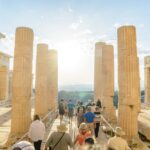
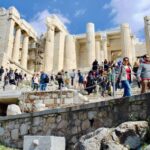
The tour starts its “big story” moment at the Propylaea, the monumental gateway into the citadel. Standing here, you immediately feel how the Acropolis works as a statement. This isn’t a random hilltop. It’s a carefully organized dramatic approach, and the gateway signals entry into a special world—religion, civic pride, and myth in one package.
As you pass through, the guide helps you connect architecture to symbolism. You’re not just looking at impressive stonework. You’re learning how people in ancient Athens experienced this space: moving from ordinary city life into a place where festivals, worship, and performances all came together.
A practical tip: expect some uphill segments and uneven ground. The Propylaea area can be busy even in quieter hours, so having a guide who keeps you oriented helps a lot.
Parthenon area and the goddess protector of the city
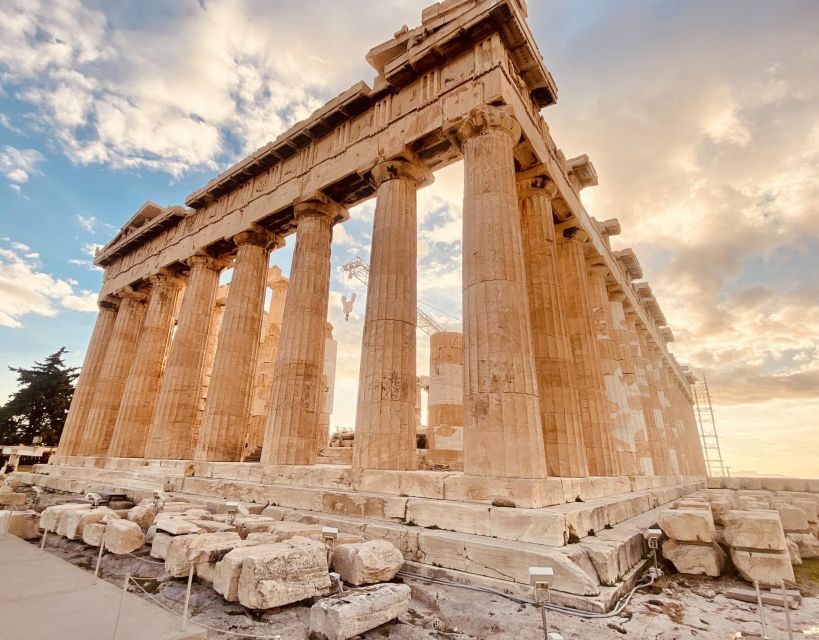
Once you’re inside the sacred space, the focus shifts to Athena—the goddess protector of Athens. You’ll see the temple of Parthenon and the area associated with the city’s religious heart.
Even if you’ve heard the name Parthenon before, a guided walk changes what you notice. You start looking at how the complex is laid out, what you can infer from what’s left, and how the myths link back to real civic life. The guide’s commentary connects the ancient stories to the archaeological remains you can actually see today.
I like that this part of the tour doesn’t treat mythology as fantasy. The myths here were tied to festivals and worship. So when you hear how these stories shaped public life, the ruins become more than iconic views. They become evidence of how people organized meaning in their world.
Dionysus Theater: the 17,000-seat festival machine
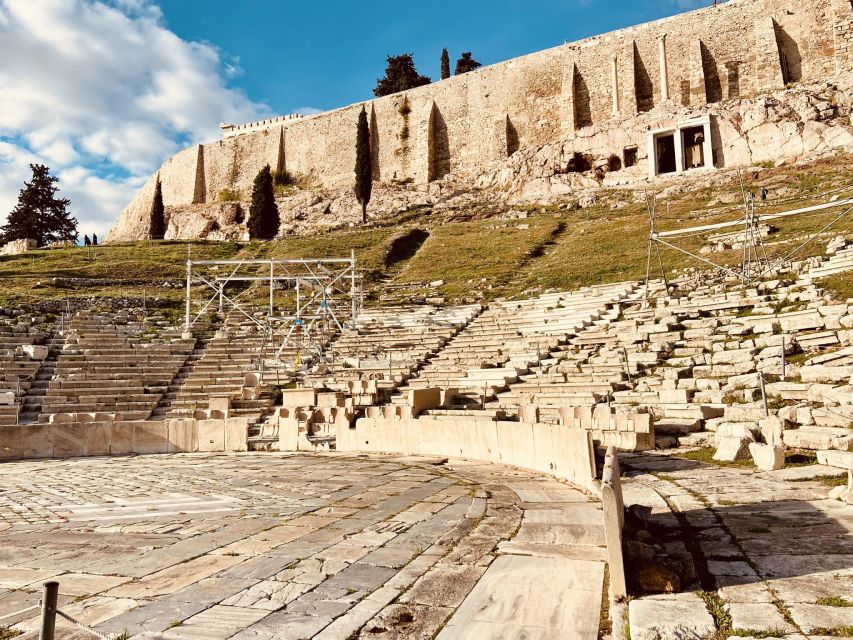
Next comes one of the most unforgettable stops: the theater of Dionysus. This venue held about 17,000 spectators and played a major role in festivals connected to the Greek god Dionysus.
If you’ve ever wondered how ancient Greece could produce stories that still move us, this stop helps. The theater wasn’t just entertainment. It was a civic event. It gathered people, staged myths, and turned shared culture into something you experienced together.
From the guide’s explanation, you learn how the performances and the religious calendar tied directly into the site. You’re looking at stone seating and structural remnants, but you’re also hearing why crowds gathered here and what they came to celebrate.
Drawback to consider: theaters can feel more crowded visually than you expect because there’s a lot of “line of sight” attention. If you’re sensitive to crowds, I’d keep your expectations realistic—but a guide who knows where to pause and how to frame the views can make it feel manageable.
You can also read our reviews of more guided tours in Athens



Erechtheion and Caryatids: details you might otherwise miss
The Erechtheion area is famous for the Caryatides—stone figures used as sculptural supports. On this tour, you’ll spend time looking at the Caryatid stone carvings and hear how they fit into the broader setting around Athena.
This is where a guide really earns their license. Up close, the carvings are more than decorative. They become a clue to how ancient Athenians blended art, myth, and architecture into functional structures.
You’ll also see the Temple of Athena Nike, described as the smallest temple. That detail matters because it changes your expectations. This isn’t the biggest building on the hill, but it’s part of the same symbolic system. The guide helps you understand why “small” doesn’t mean “unimportant.”
If you like photography, this section is strong. But don’t plan to just snap and run. The best moments happen when you stop and let the guide point out what your eyes might skip.
Odeon of Herodes Atticus: a giant stone theater with gravity
One of the highlights is the Odeon of Herodes Atticus, a giant stone theater. You’ll also get guided context so it’s not just a dramatic structure. You’ll hear the story framing how this kind of venue functioned in ancient Greek cultural life.
The Odeon complements the Dionysus Theater stop. Together, they show you two sides of the same idea: massive public spaces designed for performance and festival culture. After you’ve seen the scale described at Dionysus, it’s easier to appreciate what “giant” really means here—and why these theaters shaped how Athenians gathered and expressed shared identity.
This is also a strong section for questions. If you’re curious about how performance culture worked, or how religion and public life overlapped, ask. A private setup makes that possible without awkward interruptions.
Temple of Asclepius: a different angle on the Acropolis
The tour also includes the temple of Asclepius. Asclepius is tied to healing in Greek myth, which gives you a useful contrast to the more performance-heavy stops.
That variety matters. The Acropolis isn’t only about drama and grand ceremonies. It also reflects other human needs—health, ritual, and the idea that the sacred could provide comfort in everyday life. Even without going deep into medical history, the guide’s framing helps you see why a healing deity would have a place in this powerful civic-religious center.
Taking your time after the guided portion
After the main tour, you get free time to stay longer and explore the outstanding site at your own pace. I like this added flexibility. Sometimes the guide’s route takes you to the places you need in a logical order. Then you can choose what you want to linger over—maybe the carvings, maybe the viewpoints, maybe the theater spaces again with fresh context in your head.
Just remember: the site is uphill and uneven. Give yourself enough time to slow down, especially if you’re stopping for photos.
Price and value: $292 per group up to 3, plus your own entry ticket
The price is $292 per group up to 3 people for a 2-hour private guided walk. That can work out very well if you’re traveling as a small party, because you’re essentially paying for private guidance rather than sharing the experience with a crowd.
Here’s the practical math: if you max out the group of 3, the cost is about $97 per person for the guided portion. If you’re only 2 people, it’s about $146 per person. And if it’s just you, it’s the full $292.
Then add the fact that Acropolis entry tickets are not included. You’ll need to buy them separately and choose the right time window by season. If you already planned to visit the Acropolis anyway (you should), then the ticket cost is a normal part of the trip. The question becomes whether the guided piece is worth it. For me, the value is clear when you want context: myths tied directly to what you’re looking at, plus a guide you can ask questions to without waiting.
Also, the tour is explicitly Spanish. If you’re comfortable with Spanish, you’ll get the most out of the narrative. If not, this is the one area where you may feel friction—because the tour description doesn’t suggest other language options.
Who should book this Acropolis private tour
This is a great fit if:
- you want a focused, guided route through the biggest Acropolis landmarks
- you like understanding the stories behind what you see (mythology tied to ruins and festivals)
- you’re traveling as a small group and want the chance to ask questions
- you appreciate licensed guidance rather than a self-guided scramble
It may be less ideal if:
- you dislike uphill walking and uneven surfaces
- you want to skip ticket planning, because entry is required and time slots matter
- you need a guide in a language other than Spanish (the tour guide language is Spanish)
Should you book this Acropolis guided private tour?
If you’re visiting Athens and want the Acropolis to feel understandable, not just impressive, I’d book it. The combination of private pacing, a licensed guide, and stops that include Propylaea, Caryatids, Dionysus Theater, and the Odeon of Herodes Atticus is a strong mix. The mythology-focused commentary is what turns the site into more than photos.
The decision mostly comes down to one detail: you’re willing to handle the entry ticket timing yourself. If you can secure your timed ticket ahead of time, this tour becomes a clean, high-value way to see the Acropolis with clarity. If ticket timing is likely to be stressful for you, plan to arrive at the South entrance about 30 minutes early so you can grab tickets and make it to the meeting point.
FAQ
Where do I meet the guide?
Meet your guide at the entrance of the Metro station Acropolis, on the street level.
How long is the tour?
The duration is 2 hours. Starting times depend on availability.
Is the Acropolis entry ticket included?
No. Acropolis entry tickets must be purchased separately before the tour starts.
What language is the live tour guide?
The live tour guide is Spanish.
Is this tour private?
Yes. It’s described as a private group experience.
What time ticket should I select depending on the season?
For low season (01/11–31/03), select the 09:00–10:00 ticket. For high season (01/04–31/10), select the 08:00–09:00 ticket.
What if I can’t get an entry ticket because there is no availability?
If you can’t get the ticket due to availability, the provider says they will help you.
What if I don’t have my ticket yet on the day of the tour?
If you don’t have your ticket purchased, you need to go to the ticket office area of the South entrance 30 minutes before the tour time, then go to the meeting point (less than 2 minutes away on foot).
What’s included in the price?
Included: guided tour of the Acropolis and a licensed guide.
What’s not allowed during the tour?
Baby strollers, non-folding wheelchairs, and electric wheelchairs are not allowed.
FAQ
Can I cancel for a refund?
Yes. Free cancellation is available up to 24 hours in advance for a full refund.
Is there free time after the tour ends?
Yes. After the guided portion, you have free time to stay longer and explore the Acropolis site at your own pace.
Where does the tour end?
The tour ends back at the meeting point (the Metro station Acropolis entrance).
What’s the group size limit for the listed price?
The price is per group up to 3 people.
Are hotel pickup or drop-off included?
No. Hotel pickup and drop-off are not included.
What terrain should I expect?
The tour requires walking uphill and on uneven surfaces.
How do I know I’m choosing the correct meeting point?
You meet at the street-level entrance of the Metro station Acropolis, and the tour ends back there.
Is there a reserve now, pay later option?
Yes. You can reserve now and pay later.




More Tickets in Athens


More Tours in Athens



More Tour Reviews in Athens
- All Day Cruise -3 Islands to Agistri,Moni, Aegina with lunch and drinks included
★ 5.0 · 4,958 reviews