REVIEW · ATHENS
Athens: Peloponnese Highlights Day Trip and V.R. Audio Guide
Book on GetYourGuide →Operated by SIGHTS OF ATHENS-GRAY LINE · Bookable on GetYourGuide
Greek legends come with a headset. This day trip strings together Mycenae, Epidaurus, and Nafplion with a VR device and an audio guide, all while you ride in comfort from central Athens. It is history with modern help, so you spend more time noticing details than trying to piece the story together.
What I like most is how the VR audio guide makes the ancient sites feel connected, even when you are hopping from one stop to the next. The second big win for me is the Epidaurus Theater experience, where the acoustics are the star and not just a trivia fact.
The main drawback is simple: it is a full day with tight time blocks. You will see a lot, but you have to accept that you cannot linger forever.
In This Review
- Key highlights to know before you go
- A Full-Day Peloponnese Route From Athens (and how the timing works)
- Corinth Canal: A real-world shortcut between seas
- Mycenae Acropolis, Agamemnon’s Tomb, and Cyclopean Walls
- Epidaurus Theater: The acoustics are the main event
- Nafplion Old Town: Venetian streets, fortresses, and real breathing room
- The VR device and 10-language audio guide: how to use them without fuss
- Price and logistics: good value if you like a structured day
- Comfort, pace, and the “packed day” truth
- Who should book this Athens to Peloponnese day trip
- Should you book it? My practical recommendation
- FAQ
- What are the main places this tour includes?
- How long is the day trip from Athens?
- Is food and drinks included?
- Are entry fees included?
- What languages are covered?
- Where are the pickup locations in Athens?
- Is the tour suitable for people with mobility impairments?
Key highlights to know before you go

- Corinth Canal engineering stop for photos and a quick break on the drive
- Mycenae Acropolis and Cyclopean walls plus the tomb of Agamemnon area
- Epidaurus Theater acoustics test vibe at one of Greece’s best-preserved classical theaters
- Nafplion old-town wandering time with the three-fortress backdrop (Palamidi, Akronafplia, Bourtzi)
- VR device + 10-language audio guide to keep the story clear through multiple sites
- Tour leaders who keep things moving (guides such as George, Christopher, Angela, Irene, and Nancy)
A Full-Day Peloponnese Route From Athens (and how the timing works)
This is the kind of day trip that works best when you treat it like a guided sampler. You leave Athens early from central meeting points, ride about an hour toward the Peloponnese, then start stacking stops that each have their own mood.
The schedule is built around a coach rhythm: ride, short break, longer site visit, then a city stroll with free time. You should plan for lots of walking at the sites, plus stairs and uneven ground in historic areas. If you like to take deep breaths, this tour is still fun—but you will do your slow wandering in Nafplion, not everywhere else.
A quick note on the group: you have a live English-speaking tour leader, and the VR/audio elements support you on-site. Guides such as George, Christopher, Angela, Irene, and Nancy are specifically mentioned across experiences, and the common theme is that they try to keep timing tight while answering questions.
You can also read our reviews of more guided tours in Athens

Corinth Canal: A real-world shortcut between seas
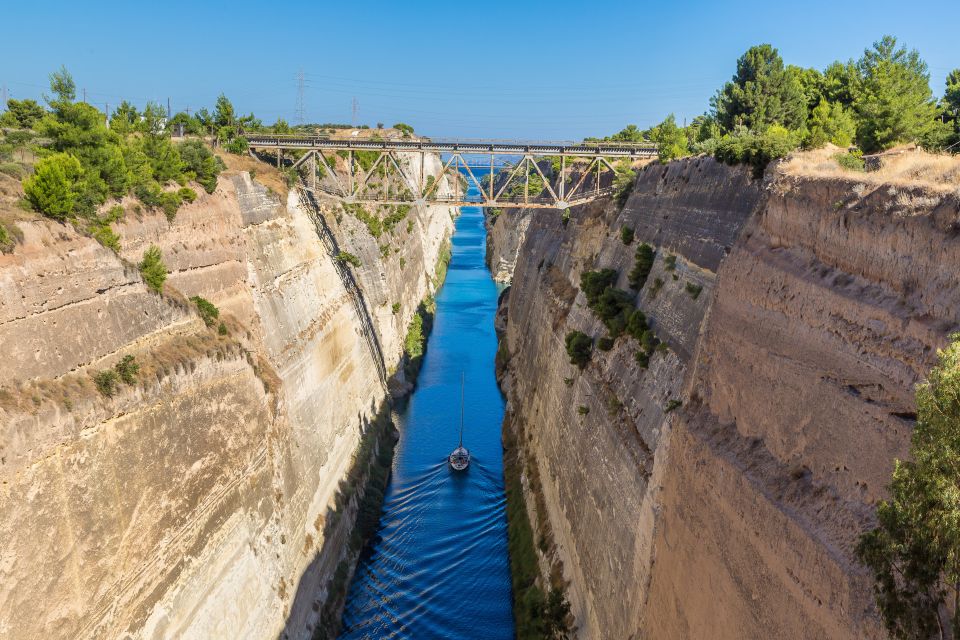
One of the smartest parts of the route is the Corinth Canal stop. It is not a long detour. You get a 20-minute break for photos and a quick look/visit before you head deeper into the Peloponnese.
Why it’s worth it: this canal is famous for connecting the Aegean and Ionian seas. Standing near it, you can actually grasp the engineering scale without needing a whole day of studying diagrams. It gives your brain a change of scenery before the ancient stuff starts again.
Practical tip: bring your camera ready. This is the kind of photo stop where the best angles disappear fast if you are still tying your shoes.
Mycenae Acropolis, Agamemnon’s Tomb, and Cyclopean Walls
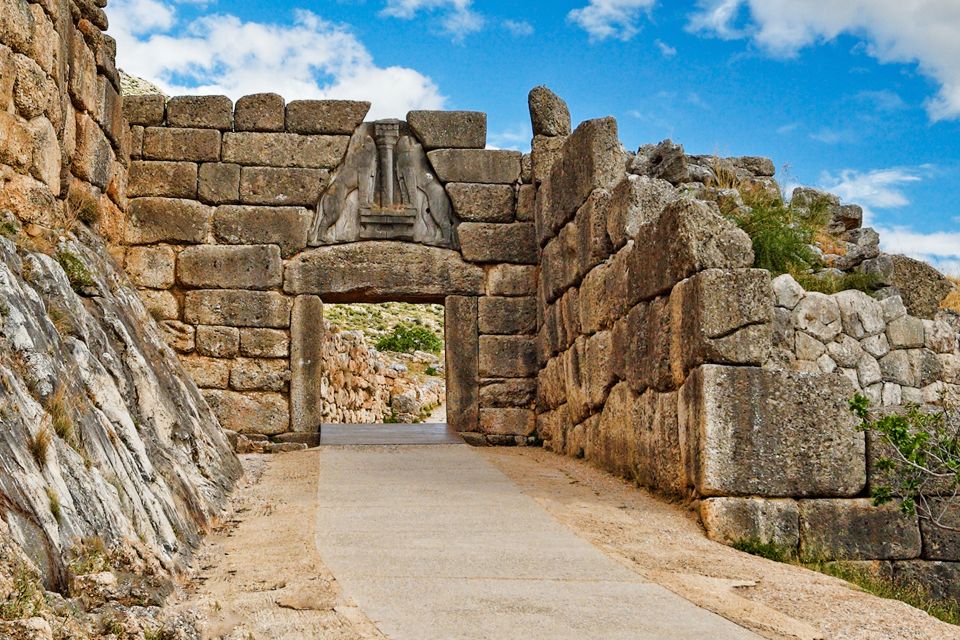
Mycenae is the heavy hitter on this day, and you get about 2.5 hours at the archaeological site. If you only have one major ancient stop on your trip, this is a strong choice.
What you will focus on here includes:
- The Mycenaean Acropolis
- The area around the tomb of Agamemnon
- The ruins of the Cyclopean walls—the massive fortification walls that make the settlement feel built for survival
This is not just a place to look at stones. It is a place that helps you understand why Mycenae mattered. When you see those walls and the acropolis layout, the scale reads instantly: this was a kingdom built to control territory.
You may also have the option to visit the Archaeological Museum of Mycenae (time depending on how the group moves). If you are the type who likes artifacts that explain what you just walked past, the museum can add depth. If you prefer maximizing outdoor time and views, you can focus on the site itself.
Small drawback to plan around: Mycenae can involve uneven paths and a decent amount of walking. Wear the shoes you would actually trust on an archaeological slope, not your newest sneakers.
Epidaurus Theater: The acoustics are the main event
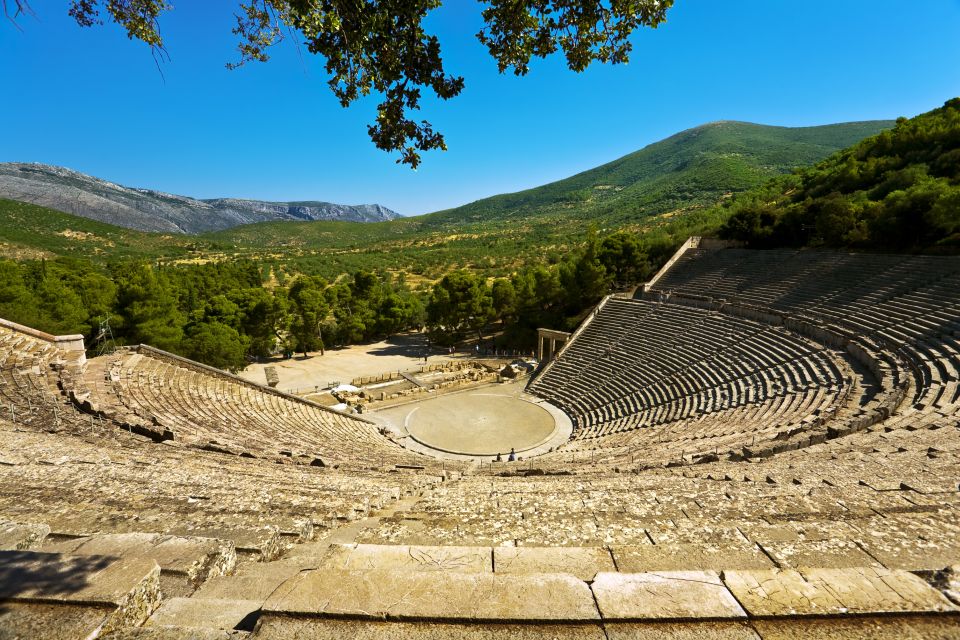
Then comes Epidaurus, with about 2 hours at the theater. This is one of those places where the legend is not just marketing.
The theater is described as a 4th-century structure and one of the best-preserved classical Greek theaters. It seats up to 14,000 people, and the layout includes restored Corinthian pilasters flanking the entrance. But the big pull is the acoustics: a coin dropped at the center can reportedly be heard from the highest seat.
The reason I love this stop is that it turns history into an experience. You stop thinking of the theater as a ruin and start thinking about the sound design and the audience shape—how thousands of people could share the same moment.
You will also hear that Epidaurus is still used for performances of ancient Greek drama during the annual Hellenic Festival. Even if you do not catch a performance on your day, knowing it is still active changes how you look at the stone.
Practical tip: bring a hat or something for sun protection. Theater seating is not exactly shade-friendly, and you will want to focus without getting distracted by weather.
Nafplion Old Town: Venetian streets, fortresses, and real breathing room
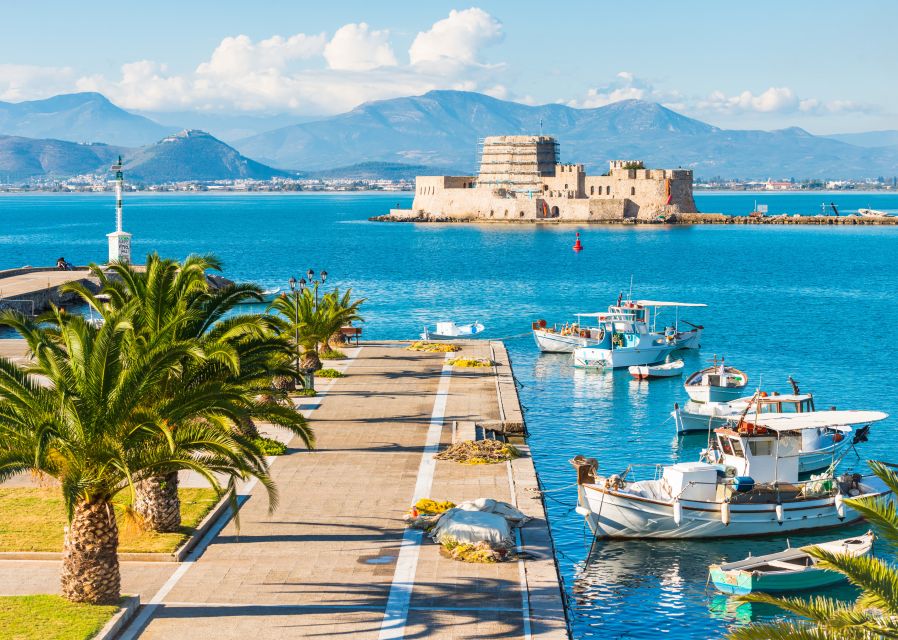
Nafplion is your payoff stop, with about 1.5 hours. You will get a break, a photo moment, and then time to wander the attractive narrow streets.
Nafplion is also one of the best cities on the Peloponnese for walking at a human pace. It has been a major port since the Bronze Age, and it became the first capital of Greece after independence. That mix of long-ago significance and later city development shows in the architecture.
You are also surrounded by three fortresses:
- Palamidi (the massive fortress)
- Akronafplia (the smaller fortress)
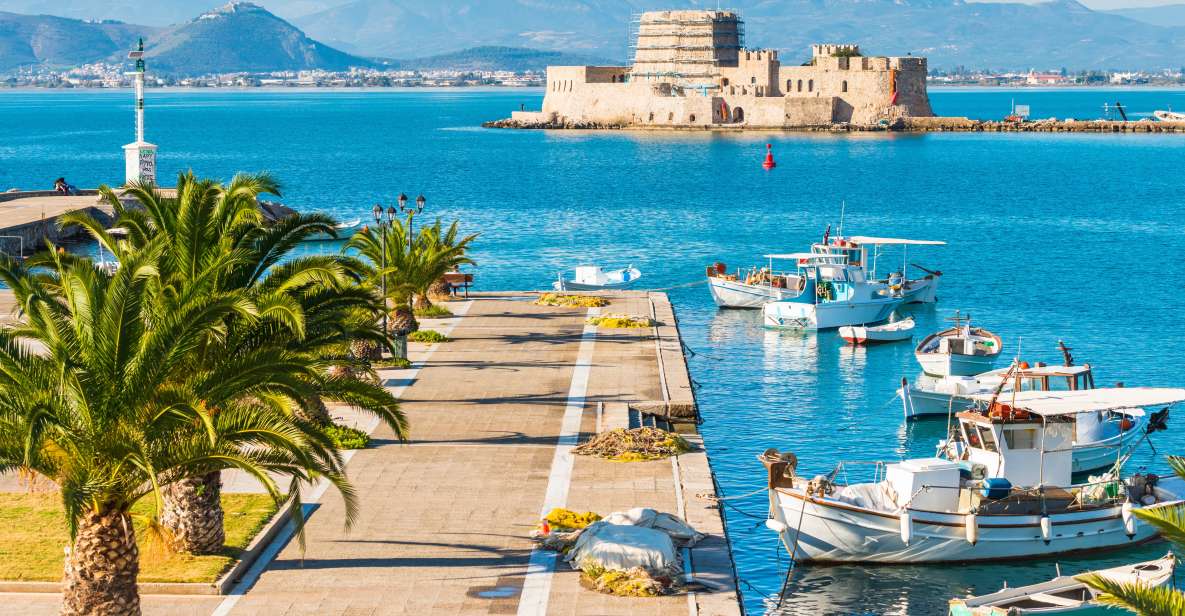
- Bourtzi (the water castle on an islet west of the old town)
During your time here, you can admire Venetian houses, neoclassical mansions, and quayside cafes. You might even decide to shop or sit down for a traditional meal or just a slow coffee. In summer, you can also aim for Arvanitia beach if your energy holds.
The main thing to know is time management. One common theme from experiences is that Nafplion time can feel tight if you want lunch plus a longer wander. If you want both, plan a shorter route: old town first, pick one view, then commit to a single long pause.
If you are traveling with a more relaxed pace, Nafplion is where you can slow down without breaking the tour.
You can also read our reviews of more tours and experiences in Athens






The VR device and 10-language audio guide: how to use them without fuss
This tour includes a VR device and an audio guide in 10 languages (English, French, German, Italian, Spanish, Russian, Portuguese, Polish, Chinese, Japanese). You also have a live English tour leader, so you are not stuck on tech alone.
Here is the approach that works best: use the audio guide to get your bearings fast, then let the site visuals do the rest. VR can help you picture what you are looking at—especially at Mycenae and Epidaurus where the context matters. But you still want to look up from the headset and check the real lines of walls, seating, and entrances.
There are also a couple of tech realities to keep expectations grounded. Some experiences note that the VR experience can be a bit imperfect, including GPS not always working perfectly. If you run into that, do not panic. Follow the leader, and use on-site signs and obvious landmarks to stay oriented.
Audio guide quality is also variable. Some experiences say it works, but could be improved. The upside: you are paired with a human guide who can fill gaps when you need extra explanation.
Price and logistics: good value if you like a structured day
The price listed is $33.31 per person, which is low for a full day that includes transportation, a tour leader, and both a VR device and multi-language audio guide. You are also looking at multiple high-demand stops, which are usually the kind of thing that costs more when you book sites separately.
What you should remember: food and drinks are not included. You will likely pay for coffee, snacks, or lunch on your own—especially in Nafplion. The good news is the tour allows time for coffee or lunch of your choice, and you can bring snacks if you want to keep things smooth between stops.
Also note that entry fees are only included if you select the option. So check what you are paying for when you book, especially if you care about getting everything covered in one price.
Logistics-wise, you start with morning pickup in central Athens. Pickup times are listed for several locations, including:
- 07:45 at the Plaza? (listed as Monument of the Unknown Soldier area)
- 07:50 at Greek Parliament
- 08:00 at Omonoia Square
- 08:05 at Karaiskaki Square
And you are instructed to wait at the blue SIGHTS OF ATHENS hop-on, hop-off buses sign.
What this means for you: arrive early enough to find your group and avoid last-minute stress. The day runs on schedule, and smooth mornings make the rest of the day feel easier.
Comfort, pace, and the “packed day” truth
This is an 11-hour tour, and it feels like one. You are in transit often enough that you will notice road time, and you will be walking at multiple sites. If you hate rushing, you will still enjoy it—but your best strategy is to let the guide handle the pacing and you focus on what matters most to you.
Comfort varies by bus age rather than by service level. Some experiences mention the bus being older, though still comfortable. If you are sensitive to battery-drain from lots of photos, you might want a portable charger since you will be shooting all day.
One more reality check: the route can be affected by traffic on the return. That is not unique to this tour, but it can make the ride back feel longer. Pack patience.
The silver lining is that you get free time in Nafplion and you are not forced into every stop. Some experiences also praise that you have enough time without constant pressure to shop, which keeps the day from turning into a sales circuit.
Who should book this Athens to Peloponnese day trip
I think this tour is ideal if you want:
- One day that hits Mycenae + Epidaurus + Nafplion without planning transfers
- A guided explanation so the sites make sense fast
- VR and multi-language audio support, especially if you like visual context
You might also like it if you have limited time in Athens and want to leave with more than one Peloponnese memory. Mycenae brings the kingdom-story power, Epidaurus brings the sound-and-space wonder, and Nafplion brings the human-scale city break.
This is less ideal if:
- You have mobility limitations (it is noted as not suitable for people with mobility impairments)
- You want long, slow museum-style exploring at each stop
- You hate tech you have to operate during a busy day
Should you book it? My practical recommendation
Book this tour if you want maximum ancient-to-city payoff in one structured day, and you value having a live guide plus a VR audio guide to keep everything connected. The best part of the day is how easily it moves you from engineering (Corinth Canal) to fortifications (Cyclopean walls) to performance acoustics (Epidaurus), then ends with the breathing room of Nafplion.
Skip it if you are the type who needs lots of unscheduled time at every stop. Nafplion gives you that, but the rest of the sites are time-boxed. Also, if you are expecting a smooth tech ride every second, keep expectations realistic since GPS on the VR can be imperfect.
If you want a day that is organized, history-forward, and genuinely good value for the price, this one earns a spot on your list.
FAQ
What are the main places this tour includes?
You visit the Corinth Canal, the archaeological site of Mycenae, the ancient Theater of Epidaurus, and the city of Nafplion.
How long is the day trip from Athens?
It runs for about 11 hours total.
Is food and drinks included?
No. Food and drinks are not included, but you do have free time in Nafplion for coffee or lunch.
Are entry fees included?
Entry fees are included only when the option is selected.
What languages are covered?
You get a live English tour leader and an audio guide in 10 languages.
Where are the pickup locations in Athens?
Pickup includes several central points such as Omonoia Square, Karaiskaki Square, Greek Parliament, and the Melina Mercouri Monument/Plaka area, plus other listed options.
Is the tour suitable for people with mobility impairments?
No. It is listed as not suitable for people with mobility impairments.

More Self-Guided Tours in Athens
More Guided Tours in Athens

More Tour Reviews in Athens
- All Day Cruise -3 Islands to Agistri,Moni, Aegina with lunch and drinks included
★ 5.0 · 4,958 reviews