REVIEW · ATHENS
Athens Myths and Legends Odyssey Walking Tour
Book on Viator →Operated by Grecian Lux · Bookable on Viator
Myths walk well in Athens. This 4-hour tour strings together gods, heroes, and emperors across some of the city’s most photogenic landmarks and a few quieter lanes. You get a story-first route that helps you understand what you’re seeing, not just where to stand for a picture.
I especially like the pacing for a half-day plan: you cover a lot of ground without feeling rushed. I also like the included break—Greek coffee and a local sweet—plus the guide’s practical recommendations for what to see, do, and eat next. One thing to consider: the tour ends at the Acropolis area, but the Acropolis interior isn’t included, so you’ll want to plan a separate visit if that’s your goal.
In This Review
- Key highlights to look for
- A four-hour Athens myth walk that fits your schedule
- Starting at Syntagma Square and reading the city’s power
- Neoclassical Athens at the Academy of Athens stop
- The Evzones and the Monument to the Unknown Soldier ceremony
- Hadrian’s Arch to the Panathenaic Stadium: Rome, Zeus, and the Olympics
- Plaka and Theseus: the oldest neighborhood with myth-linked pathways
- What the included coffee and sweets really do for your day
- Your guide matters: English storytelling and names to look out for
- Who should book this Athens walking tour (and who might skip it)
- Should you book? My decision rule
- FAQ
- How long is the Athens Myths and Legends Odyssey Walking Tour?
- Where does the tour start?
- Is pickup available?
- What language is the tour offered in?
- What’s included in the price?
- Is the Acropolis included inside?
- How many people are on the tour?
- Is there a ticket or admission fee for the stops?
- What’s the cancellation policy?
- How important is the hourly guard ceremony?
Key highlights to look for
- Half-day route that still hits the big names like Panathenaic Stadium and Hadrian’s Arch.
- A real break built in for tired feet, with Greek coffee and a sweet included.
- Evzones ceremony timing at the Monument to the Unknown Soldier every hour.
- Roman-meets-Greek storytelling as you move from Hadrian’s Arch toward the stadium.
- Plaka + Theseus angle: you walk through the oldest neighborhood while learning the myth-linked “why.”
- Small-group feel (max 12) and English-speaking guidance with personalized food and drink tips.
A four-hour Athens myth walk that fits your schedule
If you’re in Athens for a short stay, this kind of tour is a smart move. In about 4 hours, you cover the center of the city: royal-era squares, neoclassical buildings, Roman landmarks, the stadium tied to the Olympics, then onward toward the Acropolis zone. Many tours either focus too narrowly or drop you at the same few icons. Here, you keep moving, but the stops are designed so you can actually look, ask questions, and catch your breath.
I like the “myths and legends” angle because it changes how you read the streets. A monument stops being just a monument. A square becomes a turning point in Greek nation-building. A stadium becomes part of a long Olympic story. And once you start making those connections, Athens feels less like a checklist and more like a place with memory.
You also get a useful kind of help that goes beyond facts. The tour includes personalized suggestions for what to see, do, and eat after the walk. That matters in Athens, where you can easily burn an afternoon wandering and still end up unsure what’s worth the effort. A good guide helps you aim your time.
One practical consideration: you’ll be doing a walking tour, and the route ends at the Acropolis area. That means you’re likely to want more time after this for views and photos. Plan for it, especially if you know you want to visit inside the main Acropolis sites separately.
You can also read our reviews of more walking tours in Athens

Starting at Syntagma Square and reading the city’s power
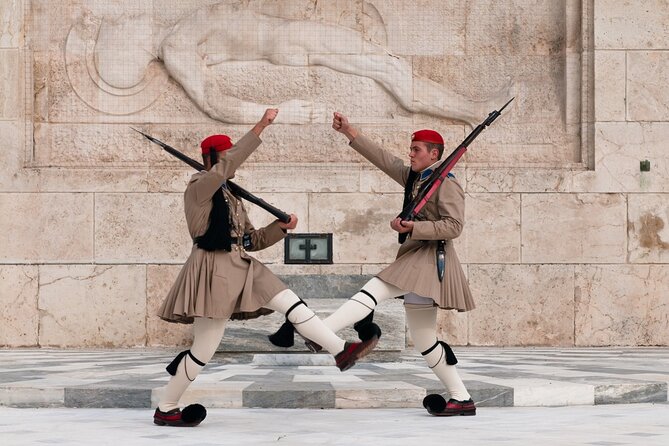
You begin at Syntagma Square, Pl. Sintagmatos, Athina 105 63. It’s Athens at maximum importance and maximum foot traffic: the Parliament buildings and grand neoclassical architecture make it feel like the city is speaking in official tones. But the most interesting part is the story your guide sets up right away—why King Otto moved the capital from Nafplio to Athens, and why he chose this square for his palace.
That background changes what you notice next. Instead of seeing only busy sidewalks and government facades, you start to see the square as part of the Greek Kingdom’s early shaping. You also get a fast lesson in how Athens became the center of gravity, politically and symbolically.
This first stop is also a good “reset” moment. It anchors your day. It gives your brain something organized to hold onto as you move through the city. If you’ve ever arrived in a new place and felt overwhelmed, you know the value of starting with context before the pace picks up.
Potential drawback: Syntagma is crowded. The tour begins here, so if you don’t love busy squares, keep your patience ready for the first moments. The upside is that you’re starting in a place that’s easy to find and easy to orient from.
Neoclassical Athens at the Academy of Athens stop

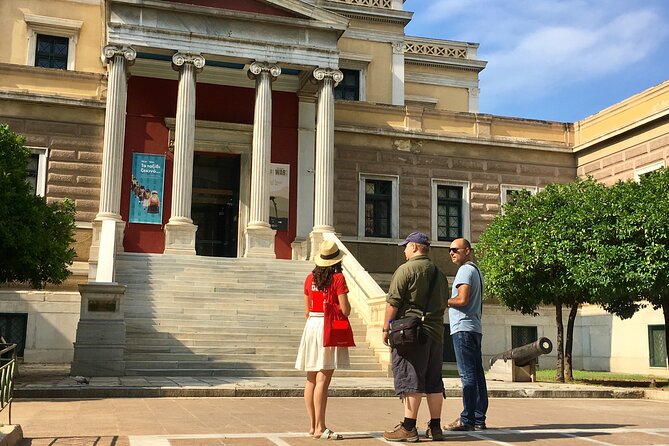
From Syntagma, you head toward the Academy of Athens and the cluster of landmark neoclassical buildings around it. This is where the tour shifts from “why this square matters” to “what Athens looked like when it wanted to look timeless.”
You’ll see iconic institutions along the way, including the National Library and the University, plus the old Parliament and other impressive neoclassical architecture. These aren’t random pretty facades. They’re the visual language of a modern state borrowing prestige and permanence from older traditions.
I like this stop because it helps you spot Athens patterns quickly. Once you know what to look for—materials, style, monumental scale—you can start recognizing the city’s layers even between major monuments. That makes the rest of your walk easier to process.
Keep expectations realistic: this segment is about seeing and learning what you’re looking at. It’s not a long museum-style stop. Instead, it’s a guided “read the architecture” moment that makes later mythology and Roman history feel more grounded.
The Evzones and the Monument to the Unknown Soldier ceremony

Next comes one of the most memorable practical experiences in the itinerary: the Monument to the Unknown Soldier and the Evzones guards. You’ll move into the Parliament area, then see the tomb and learn about the tradition behind the changing of the guard. The uniform is striking—white skirt, red hat, and an old rifle—so even if you know nothing about the history, your eyes will do the learning for you.
The key detail here is timing. The ceremony happens every hour. That’s the kind of “book it in your day” information that can make or break a tour. If you’re the type who hates missing the moment, this stop is designed for that. It’s also one of those Athens experiences that feels instantly local rather than just touristy.
Small note to consider: ceremonies depend on schedules and crowds. You can’t control the flow of people around you, especially near government buildings. But that’s part of the real-world Athens feel.
If you’re traveling with kids or you just want something visually dramatic, this is a strong anchor stop. The costumes, the formality, and the hourly rhythm give your day a clear highlight.
Hadrian’s Arch to the Panathenaic Stadium: Rome, Zeus, and the Olympics
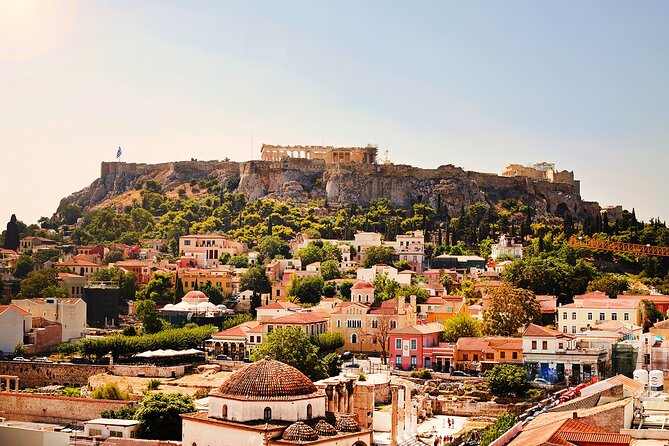
From Parliament area streets, you move into a stretch that connects Athens’s older layers with the later Roman era. You pass Hadrian’s Arch, built in honor of one of the most glorified Roman emperors. You also get along Athen’s oldest streets, with landmark points like Diogenes Square mentioned in the route.
This is where myth-and-legend turns into city history with real geography. Athens isn’t only ancient Greece; it’s also centuries of different rulers leaving traces. Hadrian’s Arch is a clean example of how a city absorbs power and keeps moving forward.
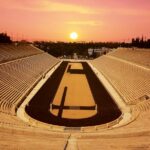
Then you reach the big crowd-pleaser: Panathenaic Stadium. The tour brings you past the ruins of the Temple of Zeus, the National Gardens, and the Zappeion. Finally, you see the white marble Panathinaiko Stadium—famous for hosting the first Olympic Games, and later for the 2004 Olympic marathon ending.
Even if you’re not a sports person, you’ll likely enjoy this. The stadium is one of those places where you can feel the long arc of “international competition” back to its ancient roots. And because it’s a distinct visual setting—marble, curves, and stadium geometry—it gives your photo lineup a different look than temples and squares.
There’s a practical bonus too. An hour at this stop-long section gives your legs a break compared with nonstop walking. It also helps you recharge before the neighborhood walking toward Plaka and the Acropolis area.
- All Day Cruise -3 Islands to Agistri,Moni, Aegina with lunch and drinks included
★ 5.0 · 4,958 reviews




Plaka and Theseus: the oldest neighborhood with myth-linked pathways
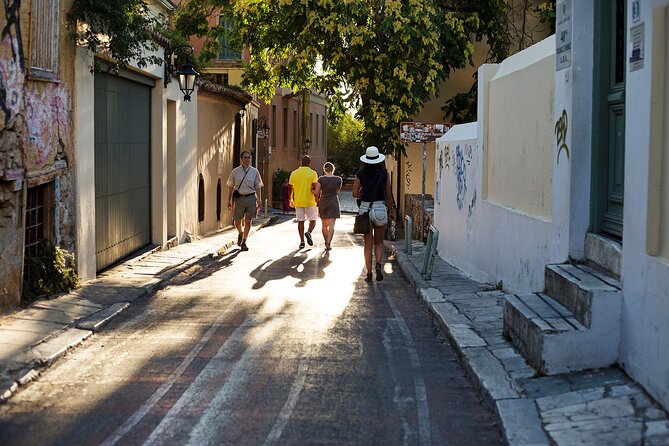
After the stadium, you head into Plaka, described as Athens’s oldest continuously inhabited neighborhood. This is where the tour slows down in a good way. Plaka feels like a place you could drift through for hours, with old pathways, stone lanes, and storefront life that feels both historic and everyday.
Your guide ties this part to Theseus, the legendary hero from Greek mythology. You’ll follow Theseus-style trails around the city’s famous landmarks, and you’ll pass by key ancient references like the Acropolis and the Ancient Agora from the surrounding area. You’re not going inside the Acropolis during this tour, but you’re close enough that the “next step” becomes obvious.
The best part of a stop like Plaka is how it helps you understand the city’s “in-between” spaces. Big monuments often steal the spotlight. Plaka reminds you Athens also lives in its side streets and quieter corners.
Possible drawback: because Plaka is lively and photogenic, it can be tempting to wander on your own. That’s great, but the tour structure matters here. Stay with the route through the key myth storytelling points so the day stays coherent, then break off for your own exploration afterward.
What the included coffee and sweets really do for your day

The tour includes a cup of Greek coffee and a local sweet. That sounds small on paper, but it has a big impact on how the experience feels. A walking tour in Athens can be deceptively tiring, especially when you’re moving between different types of stops—broad squares, ceremonial areas, and then neighborhood streets.
Having a built-in pause keeps the experience human. Your guide can also keep working the story while you’re resting. In the small details, you’ll also notice that the tour isn’t just about dumping information. It’s about pacing your attention so the myths land instead of bouncing off your brain.
I’ve found that tours with an actual break tend to create better memories. The coffee stop is a moment of normal Athens life, not just a time to catch water. Plus, it’s included—no hunting down a café mid-walk with your group splitting up.
Your guide matters: English storytelling and names to look out for
The experience is led by an English-speaking local guide, and that language piece matters in Athens. With the right guide, you don’t just hear facts; you learn how to connect them.
In past experiences with this kind of tour format, I’ve seen guides like Babis, Theo, and George praised for turning history into something you can follow. That lines up with what you want: clear explanations, real enthusiasm, and a sense of humor that doesn’t feel forced. When guides point out little “why this, not that” details, you start noticing the city as a system, not a series of random stops.
The tour also promises personalized tips for where to go next—bars, eateries, and what to prioritize. That’s the kind of help that saves you time. It’s also helpful when you don’t want to rely on guesswork after you’ve walked your legs into a new neighborhood.
Who should book this Athens walking tour (and who might skip it)
This tour fits best if you want:
- A half-day structure that covers major central sights without eating your whole day.
- A guide-led approach where myths and legends become a wayfinding tool.
- Included refreshments plus practical recommendations for food and fun after the walk.
- A small-group size (max 12 travelers) that keeps questions realistic.
You might skip it (or at least consider pairing it) if:
- Your top priority is going inside the Acropolis buildings. This experience ends at the Acropolis area, but Acropolis interior visits aren’t included, so you’ll need a separate plan.
- You don’t want any crowd-heavy moments. Syntagma Square and the ceremony area can get busy.
If you’re visiting first-timers or you want to build a strong foundation before deeper site visits, this is a solid choice.
Should you book? My decision rule
Book it if you like the idea of seeing Athens with a story thread—gods, heroes, Roman emperors—and you want that thread to connect to real streets. The value is strongest when you’ll use the guide’s recommendations afterward, because that’s when the tour turns into more than a walk.
I’d be extra confident booking if you care about the hourly guard ceremony and you want a plan that ends near the Acropolis so you can keep exploring. Just remember the one trade-off: you’ll still want separate time (and tickets) if you plan to go inside the Acropolis sites.
FAQ
How long is the Athens Myths and Legends Odyssey Walking Tour?
It runs for about 4 hours.
Where does the tour start?
The tour starts at Syntagma Square, Pl. Sintagmatos, Athina 105 63, Greece. The start time is 9:30 am.
Is pickup available?
Pickup is offered for the private group option. You can meet your guide at your Athens hotel lobby, Airbnb, or Piraeus port. Pickup time is adjustable upon request, and your guide will be holding a sign with your name.
What language is the tour offered in?
The tour is offered in English.
What’s included in the price?
It includes a cup of Greek coffee and a local sweet, an English-speaking local guide, and personalized tips for bars and eateries. For the private option, pickup and drop-off are included.
Is the Acropolis included inside?
No. The tour ends at the Acropolis of Athens, but entrance or time inside the Acropolis is not included.
How many people are on the tour?
This tour has a maximum of 12 travelers.
Is there a ticket or admission fee for the stops?
The stops listed are shown as free admission in the schedule, including Syntagma Square and the other major points on the route.
What’s the cancellation policy?
Free cancellation is available up to 24 hours in advance for a full refund. If it’s canceled due to poor weather, you’ll be offered a different date or a full refund.
How important is the hourly guard ceremony?
It’s a major moment of the tour. The itinerary includes the Monument to the Unknown Soldier area and the changing of the Evzones guards, which happens every hour.


More Walking Tours in Athens

More Tours in Athens


More Tour Reviews in Athens
- All Day Cruise -3 Islands to Agistri,Moni, Aegina with lunch and drinks included
★ 5.0 · 4,958 reviews