REVIEW · ATHENS
Ancient Corinth and canal Day trip from Athens: Private Tour
Book on Viator →Operated by Andrew's Unique Tours · Bookable on Viator
Corinth is where ancient faith and engineering both show up. This private half-day tour from Athens strings together Corinth Canal views, Ancient Corinth landmarks tied to St. Paul, and the climb-and-lookouts of Acrocorinth. You get door-to-door pickup, plus flexible time at each stop so you can move at your pace.
I especially like the way this plan uses the coast route to make the Peloponnese feel real without wasting your whole day. And you’ll also appreciate the practical touches: bottled water, tolls handled, and a private vehicle (SUV or Mercedes E-Class) that keeps you comfortable for the ride.
One thing to keep in mind: site tickets are not included, and some stops have short time windows. If you want to linger, you may need to prioritize—especially around the main ruins and museum.
In This Review
- Key highlights worth your attention
- Why Corinth Works So Well as a Day Trip From Athens
- Private Transport and Pickup: Comfort, Timing, and Who This Fits
- Stop at the Corinth Canal: Where Two Seas Meet the Story
- Diolkos: The Short Stop With a Big Transport Idea
- Ancient Corinth Ruins: Apollo, Civic Spaces, and the St. Paul Connection
- Acrocorinth: Upper Corinth’s Fortress Views (and Why the Short Stop Can Work)
- Temple of Apollo Details: One Stop, Several Layers of Meaning
- Archaeological Museum of Corinth: When You Want Context Beyond the Stones
- Tickets, Guides, and the One Part You Should Plan for
- Price and Value: $570.15 for Up to 3 People
- Pacing and Weather: How to Avoid a Tight, Stressy Day
- Who Should Book This Corinth Canal and Ancient Corinth Private Tour
- Should You Book? My Practical Recommendation
- FAQ
- How long is the Ancient Corinth and canal day trip?
- How many people are included in a group?
- Is pickup included?
- Are admission tickets included for the sites?
- What vehicle will be used?
- Do I get a licensed tour guide?
- Do I need good weather?
- What is the cancellation window?
Key highlights worth your attention
- Door-to-door pickup in Athens and Piraeus for a smooth half-day schedule
- Corinth Canal photos plus the Diolkos boat-drag concept (short stop, big idea)
- Ancient Corinth sights tied to St. Paul, including the Vima area
- Acrocorinth viewpoints from Upper Corinth’s fortress height
- Private group size up to 3, giving you control over pacing
- Driver brings history context, but site narration is not provided by a licensed guide
Why Corinth Works So Well as a Day Trip From Athens
Corinth isn’t just another set of ruins. It’s a meeting point—between the sea and land routes, between Greek mythology and early Christian history, and between big names and everyday details. In one 6-hour window, you can see why this place mattered.
I like that the route is built for momentum. You’re not stuck for hours on a bus with a rigid schedule. Instead, you start with the modern marvel of the Corinth Canal, then move back in time to ancient transport engineering (the Diolkos), and finally land in the archaeological zone where temples, theaters, and civic spaces still have shape.
You’ll also like the fact that this is private. Your group isn’t fighting for space or listening to someone else’s pace. That matters on ruins days, where small time limits can otherwise feel stressful.
You can also read our reviews of more private tours in Athens

Private Transport and Pickup: Comfort, Timing, and Who This Fits
This is a true private tour for your group of up to 3 people. The vehicle is an SUV (Kodiaq) or a Mercedes E-Class style taxi—your operator will use whichever fits best. Either way, the point is simple: you’re not doing this with crowded public transit.
Pickup is offered from your accommodation in Athens, and also from the Piraeus cruise ship terminal. That’s a big deal if you’re on a cruise and you need a schedule that doesn’t depend on you figuring out local connections.
Duration is about 6 hours (approx.), with multiple short stops. That makes it a strong choice for people who want a meaningful taste of the Peloponnese without committing to a full day drive. It’s also a good fit if you don’t want to manage parking, timing, and routing yourself.
The operator provides bottled water and handles tolls, which keeps your head clear once you’re out of Athens. You still have to plan for your own meals and site tickets, but the logistics are otherwise low-stress.
Stop at the Corinth Canal: Where Two Seas Meet the Story
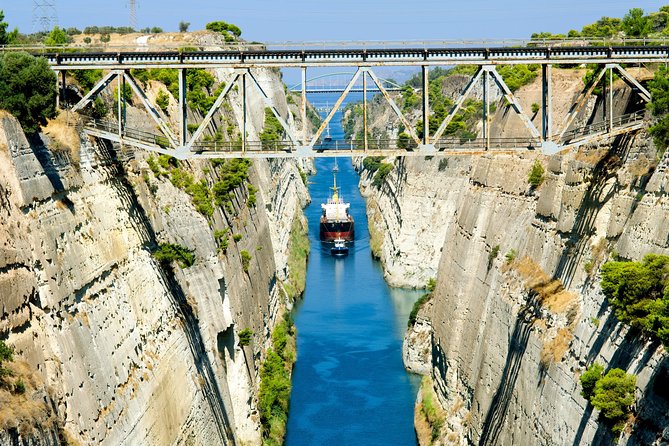
The Corinth Canal is the first “wow” moment on this route. It slices through the Isthmus of Corinth, connecting the Ionian Sea and the Aegean Sea. Even if you know the geography already, seeing the canal in person gives it weight.
This stop is only around 30 minutes, and that’s actually helpful. You’re not losing the day staring at a single viewpoint. You get enough time to walk, take photos, and understand what the canal changes—how it cuts routes that used to require a much longer, dangerous circumnavigation.
A practical tip: treat this as your reset stop. Use it to grab water, get your photos early, and set expectations for the next phase. When you’re moving from modern engineering into archaeological sites, getting your bearings fast helps.
Diolkos: The Short Stop With a Big Transport Idea
Right after the canal, you’ll stop by the Diolkos, a paved trackway from ancient Greece. The concept is clever: boats could be moved over land across the Isthmus of Corinth instead of traveling the long way around the Peloponnese peninsula.
This is one of those stops where a 15-minute view can still pay off, as long as you pay attention to the “why.” It ties into the whole theme of Corinth as a strategic connector. And it makes the later ancient sites feel more grounded, because you’re seeing how people solved real movement problems.
If you like engineering, logistics, or “how did they do it” history, this short stop is worth your full attention. If you’re in pure monument mode, just make sure you don’t speed past it too quickly—you might miss the point that connects the canal era to the ancient one.
Ancient Corinth Ruins: Apollo, Civic Spaces, and the St. Paul Connection
Ancient Corinth is where the day starts to feel dense—in a good way. You get roughly 2 hours at the main site, so you can actually do more than a quick walk-through.
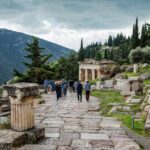
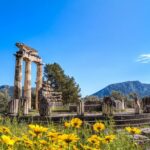
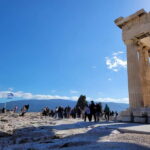
You’ll see the Temple of Apollo (associated with the Sun and oracles in the cultural storytelling around him), the theater, the Roman Odeon, and the Glauke Fountain area. These aren’t random background pieces. They suggest a city that hosted performances, civic gatherings, and religious life.
One of the most meaningful parts is the Vima (step) from where St. Paul preached to the Corinthians in 52 A.D. That connection adds a layer beyond “ancient tourism.” Even if you’re not traveling for religion, it helps you understand why this site sits at a crossroads of belief and community life.
The Lechaion Street is also part of your route through the site area. Streets matter here because they help you visualize movement—where people went, how the city functioned, and how the architecture relates to daily use.
You’ll also have access to the museum on-site area (more on timing below), though museum time depends on how you pace the ruins. If you enjoy reading stones and inscriptions, you may want to spend more time on whatever interior displays catch your eye, then accept that you’ll skim less elsewhere.
Consideration: two hours can feel fast once you’re inside the archaeological zone. If you plan to do the museum thoroughly, choose whether you’ll prioritize the standout ruins first, then catch the rest before your time runs tight.
You can also read our reviews of more tours and experiences in Athens



Acrocorinth: Upper Corinth’s Fortress Views (and Why the Short Stop Can Work)
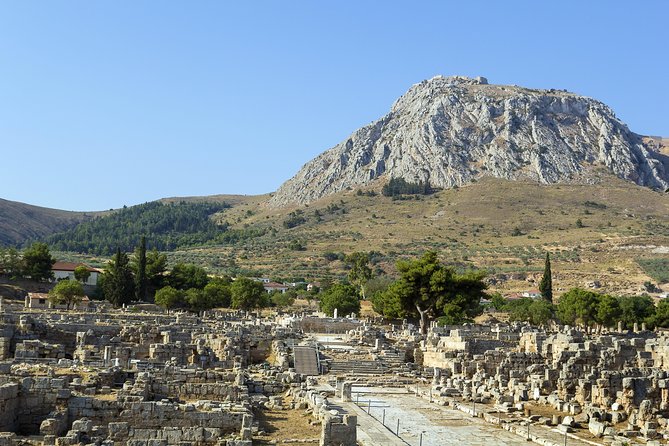
After Ancient Corinth, you head up to Acrocorinth, the “Upper Corinth” fortress area. Think of it as the city’s high-walled vantage point—what you’d want when you’re looking for defense, control, and long-distance sightlines.
This stop is about 15 minutes. That sounds short, but for Acrocorinth, short can be enough if your goal is perspective rather than deep exploration. You’ll get the payoff views over the area without losing your momentum for the rest of the day.
What I like about this structure is that it changes the pacing. After walking through temples, steps, and theater seats, you shift to sky and distance. It helps the day make sense: you see the geography that made Corinth valuable in the first place.
Tip: wear comfortable shoes even if you don’t plan a long walk. Fortress areas often have uneven ground and simple paths where you still want sure footing for quick photographing.
Temple of Apollo Details: One Stop, Several Layers of Meaning
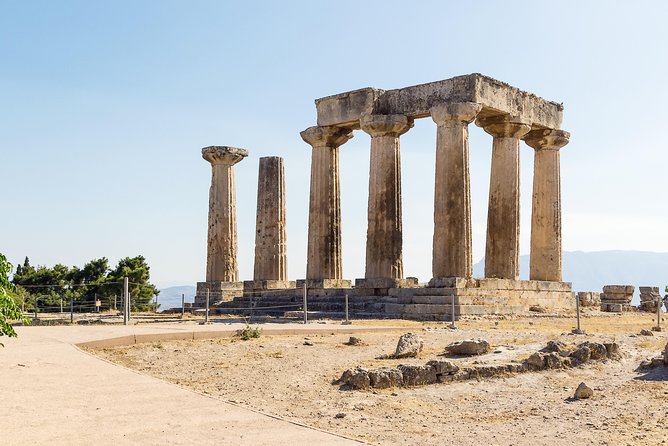
There’s also a focused stop at the Temple of Apollo, described as one of the earliest Doric temples in the Peloponnese and the Greek mainland, built around 560 B.C.E. That’s why this monument matters: it’s both early in architectural style and central to the religious story of the area.
This segment is about 10 minutes. Again, that short time window can be a strength. You’ll see the essentials without the “drag” time that happens when you try to do everything.
If you want to make the most of it, look at the setting and proportions rather than only hunting for the most photogenic angle. The point is understanding scale and placement in relation to the broader ancient site.
This is the kind of stop where you’ll benefit from having at least a light mental framework for what you’re seeing—Doric style, early dating, and how Apollo fits the myth-and-religion world of Corinth.
Archaeological Museum of Corinth: When You Want Context Beyond the Stones
The Archaeological Museum of Ancient Corinth is a separate layer of the experience. It’s located within the archaeological site area, and it was constructed between 1931 and 1932 to display finds from excavations.
Your time here is about 30 minutes. That’s not a long museum visit, so be strategic. Use the museum to answer what the ruins can’t easily do: What fragments were found? What does the local material culture look like? How do the excavations connect the dots?
If you’re the type who likes to understand how archaeology works—why objects were moved, how museums interpret the site—this is a good add-on. If museums aren’t your thing, you can treat the museum as a quick “orientation” stop to make the ruins afterward feel more legible.
Either way, remember that museum time is part of the broader site time. Don’t plan your day around squeezing in everything. Plan for picking the places you want to remember.
Tickets, Guides, and the One Part You Should Plan for
Here’s the practical reality: tickets to the archaeological sites are not included. That means you should budget separately for entry fees for the places you stop in.
Also, there is no licensed tour guide included. Instead, you’ll have professional drivers with knowledge of history who can talk along the way, but they’re not licensed to accompany you inside every site.
So what does that mean for your experience? It means you’ll get helpful context during the ride and at the stops, but once you’re on the ground in the ruins, you may rely on your own pace and on any on-site signage or materials.
I think that’s fine for many people, especially if you enjoy self-guided exploration. But if you strongly prefer a fully narrated, licensed guide during every stop, you should consider whether this format matches your expectations.
To avoid disappointment, set your mindset: this is a private transport + smart history context plan, not a live museum-style guided commentary at every exhibit.
Price and Value: $570.15 for Up to 3 People
The price is $570.15 per group (up to 3) for about 6 hours, with pickup included from Athens accommodations and Piraeus. That may sound steep if you compare it to a public bus day.
But compare it to what you’re buying: private vehicle, door-to-door pickup, and a flexible schedule that lets you spend as much time as you want on stops. If you’re traveling as a couple plus one, or with a friend, the per-person cost drops fast compared to solo private pricing.
It also helps that you’re not managing navigation or parking. Corinth and Acrocorinth are not “just hop out wherever” kind of places. Having a driver who knows the timing and can get you through efficiently is part of the value.
Where you’ll still spend extra money: site admission tickets, plus any coffee, lunch, or snacks you want during the day. If you come prepared with a simple plan for food and ticket costs, the overall experience feels more balanced.
Pacing and Weather: How to Avoid a Tight, Stressy Day
This tour requires good weather. That’s not a minor detail. If conditions are bad enough, the tour can be canceled and you’ll be offered another date or a full refund.
The schedule is also built around short, manageable blocks. Canal stop (around 30 minutes), Diolkos (about 15 minutes), main ruins (about 2 hours), Acrocorinth (about 15 minutes), plus Apollo and museum segments.
That structure works if you’re flexible and you accept that you’re choosing highlights rather than doing an all-day archaeology deep run. If you want slow wandering, you’ll need to be selective. You can often spend more time where you want most, but the day still has finite hours.
One more practical angle: start thinking about your comfort. You’ll be walking around the archaeological areas, standing for viewpoints, and moving between locations. Comfortable shoes make the biggest difference.
Who Should Book This Corinth Canal and Ancient Corinth Private Tour
This works best for you if:
- you want a meaningful half-day outside Athens without complicated logistics
- you care about Corinth’s connection to both Greek culture and early Christian history
- you like private pacing and hate feeling rushed by group logistics
- you’re traveling with up to 3 people and can split the group price
It may be a weaker fit if:
- you want a licensed guide inside every site (this includes history knowledge from the driver, but not a licensed escort throughout)
- you prefer full-day museum time
- you dislike paying separate admission fees for ruins and museum areas
- you’re traveling when weather is uncertain
Should You Book? My Practical Recommendation
If your goal is a high-impact Corinth day trip from Athens, I’d book it—especially if you’re traveling in a small group and you value private convenience. The mix of the Corinth Canal, the Diolkos transport story, and the St. Paul-associated Vima area gives you more than a single theme. Then Acrocorinth adds a viewpoint payoff that makes the whole day feel coherent.
Just go in with two expectations set clearly: plan for site tickets and choose your priorities inside Ancient Corinth and the museum. If you do that, you’ll come away feeling you understood why Corinth mattered—geographically, politically, and culturally—without burning your whole day on the road.
FAQ
How long is the Ancient Corinth and canal day trip?
It runs for about 6 hours (approx.).
How many people are included in a group?
It’s a private tour/activity for your group, up to 3 people.
Is pickup included?
Yes. Pickup and drop-off are offered from your accommodation in Athens, and also from the Piraeus cruise ship terminal.
Are admission tickets included for the sites?
No. Tickets to the archaeological sites are not included.
What vehicle will be used?
An SUV such as a Kodiaq, or a Mercedes E-Class taxi/cab style vehicle.
Do I get a licensed tour guide?
No. The included history comes from the professional drivers with knowledge of history, but a licensed tour guide is not included.
Do I need good weather?
Yes. The experience requires good weather, and if it’s canceled due to poor weather you’ll be offered a different date or a full refund.
What is the cancellation window?
You can cancel for free up to 24 hours in advance for a full refund. If you cancel less than 24 hours before the start time, you don’t get a refund.



More Private Tours in Athens


More Tours in Athens




More Tour Reviews in Athens
- All Day Cruise -3 Islands to Agistri,Moni, Aegina with lunch and drinks included
★ 5.0 · 4,958 reviews