REVIEW · ATHENS
Walk through the history of Athens
Book on Viator →Operated by Greca Travel · Bookable on Viator
Athens looks different when you walk it with a plan. This 2.5-hour history-and-architecture stroll strings together big-name spots—starting with the neoclassical sweep of Panepistimiou Avenue and finishing with Acropolis views from the metro area. You get a clear line from Athens of today to Athens of empires, athletes, and architects.
I especially like the way the route hits “important but easy to miss” details fast. Two highlights for me: you’ll get the changing of the guard moment at Syntagma Square, and you’ll see the Olympic-era landmarks tied to the modern Games.
The main drawback is practical, not dramatic: some stops involve outside viewing and key site tickets aren’t included, so you’ll need to plan your Acropolis visit separately if you want to go inside. Also, the timing is tight, with short stops that work best if you enjoy moving and spotting, not lingering.
In This Review
- Key Things I’d Remember Before You Go
- Why This Athens History Walk Works (Even on a Tight Day)
- Starting on Panepistimiou Avenue: The Neoclassical Trilogy in Real Life
- Syntagma Square: Parliament Power and the Guard Change
- Kallimármaro Stadium: White Marble and Olympic Origins
- Zappeion: How the Modern Olympics Shaped Athens’ Buildings
- Temple of Olympian Zeus: Hadrian, Zeus, and a 13-Meter Story
- Ending by Acropolis Metro: A View-First Finish That Sets Up Your Afternoon
- How the Pace Feels: 2.5 Hours, Short Stops, Smart Flow
- What the Guides Can Add (And Why You’ll Notice the Difference)
- Price and Value: $31.13 for a Lot of Built-In Context
- Practical Advice Before You Book
- Who This Tour Suits Best
- Should You Book This Athens History Walk?
- FAQ
- FAQ
- How long is the Athens history walk?
- Where does the tour start and end?
- What languages are the guides offered in?
- How many people are in the group?
- Are tickets included for the Acropolis archaeological site?
- Are tickets included for the Numismatic Museum and Temple of Olympian Zeus?
- Is the tour wheelchair or mobility-friendly?
- What happens if the weather is poor?
- Is cancellation free?
Key Things I’d Remember Before You Go

- Panepistimiou Avenue neoclassical trio vibe: quick looks at landmark buildings right along the grand avenue sweep
- Syntagma Square guard change: a simple way to watch a very Greek ritual without extra effort
- Kallimármaro stadium facts that matter: white marble + first Modern Olympics site
- Zappeion’s Olympic purpose: built for the early modern Games and still used for official events
- Temple of Olympian Zeus context: Hadrian and Zeus legends you can connect to the stones
- Finish near Acropolis Metro: set up to continue on foot toward the Acropolis with less stress
Why This Athens History Walk Works (Even on a Tight Day)

This tour is built for travelers who want a lot of Athens in a short window, without turning the day into a rush-and-wait mess. The route links layers of the city: the formal neoclassical age of modern Athens, the ceremonial heart of the state, and then the Olympic chapter that helped shape global attention.
It also ends in a smart place. Rather than dropping you miles away, you finish near Acropolis Metro Station by the pedestrian area of Dionysiou Areopagitou. That’s helpful because you can decide on the spot whether to continue toward the Acropolis, stop for lunch in Plaka, or just enjoy the view and keep your afternoon flexible.
You can also read our reviews of more walking tours in Athens

Starting on Panepistimiou Avenue: The Neoclassical Trilogy in Real Life
The walk begins at Titania Hotel Athens, on Panepistimiou 52. From there, you’re straight into the formal, architectural character of Athens—wide sidewalks, grand façades, and that signature neoclassical style you see in old photos, but can also appreciate up close.
This section is mainly about what the buildings signal. You’ll pass by the Numismatic Museum and other landmark structures on the avenue, including the Archaeological Company Building, the Catholic Church of St. Dionysius, the Athens Ophthalmological Hospital, and the Central Bank of Greece building. Even with short viewing time, it’s a useful orientation to how modern Athens chose to present itself: structured, official, and designed to feel like a continuation of classical ideals.
What I like here is that this part isn’t only about Greece-as-a-museum. It’s Greece as a working city—institutions, services, daily life—set inside impressive stone and symmetry. One practical thing: since the tour doesn’t include entry ticket time for the Numismatic Museum, don’t plan on rushing into it during the stop. Treat it as a visual introduction, then decide later if you want to go deeper on your own.
Syntagma Square: Parliament Power and the Guard Change

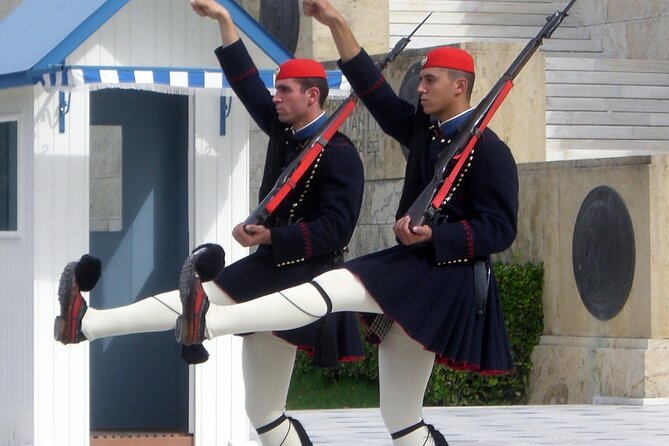
Next comes Syntagma Square, the seat of the Hellenic Parliament. If you’ve never watched the changing of the guard, this is one of the easiest ways to get it without hunting for timing yourself.
You’ll have about ten minutes here, which sounds short until you remember what Syntagma does best: it turns into a live scene. Traditional soldiers, a ceremonial pace, and a central backdrop of government buildings. It’s also a good moment to reset after street walking—stand still for a bit, look around, then continue.
A tip for making this stop feel worth your time: pick a spot where you can see both the soldiers and the architecture around them. In such a central place, it’s easy to end up looking only at your feet or only at phones. Give yourself a few seconds to angle your view, and you’ll get a more satisfying “I’m in the center of modern Athens” photo.
Kallimármaro Stadium: White Marble and Olympic Origins
The tour then shifts to one of the city’s most memorable sports landmarks: Kallimármaro, the stadium often nicknamed the good marble. You’ll get a panoramic view, and the facts you’ll associate with it are specific and fun in a trivia-spotting way.
This is the stadium that hosted the first edition of the Modern Olympic Games, and it’s also famously the only stadium in the world built entirely in white marble. Standing near it (even from a viewpoint) helps the Olympic story feel less abstract. It’s not just “sports history”—it’s architecture, materials, and spectacle all in one.
Because your time here is short, think of this as a “connect the dots” stop. You’re learning how Athens uses the past to frame modern identity. That’s exactly what Olympic symbolism was meant to do when the modern Games returned to Greece.
Zappeion: How the Modern Olympics Shaped Athens’ Buildings
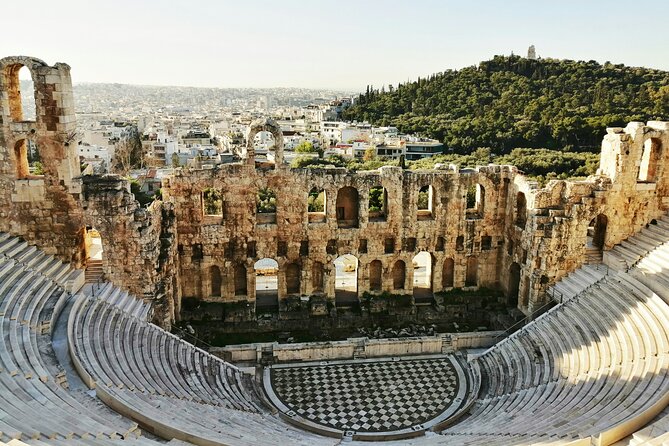
From there you’ll pass by the Zappeion. This building is described as the first structure built specifically for the modern Olympic Games, and it still has a practical role today—used for official and private ceremonies and meetings.
That mix is what makes Zappeion a satisfying stop. It’s not a ruined monument or a fenced-off relic. It’s part of the city’s ongoing use, which means the architecture isn’t only there to be looked at—it helps host real events.
If you’re the type who likes connecting “then and now,” Zappeion is a good bridge stop between the stadium and the heavier historical layers coming next.
You can also read our reviews of more historical tours in Athens
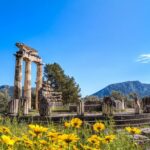





Temple of Olympian Zeus: Hadrian, Zeus, and a 13-Meter Story

As you approach the end, you’ll pass by the Temple of Olympian Zeus. This is where the tour starts leaning into empire-era storytelling.
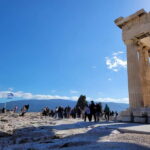
The big connection here is Hadrian and the statue of himself placed near a monumental Zeus statue. The Zeus statue is described as 13 meters high and decorated with gold and ivory, based on an image associated with Phidias. Even if you don’t go inside (tickets here aren’t included), the sightline and the explanation help you understand why people remember this place so intensely.
Two things to keep in mind:
1) The experience at this stop is about context and orientation more than deep access.
2) If you want to visit the archaeological site fully, you’ll need to plan tickets separately, since those aren’t included.
This is a tour-friendly way to approach Temple of Olympian Zeus. You get the narrative so the stones don’t feel random.
Ending by Acropolis Metro: A View-First Finish That Sets Up Your Afternoon
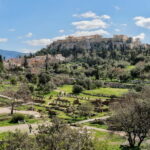
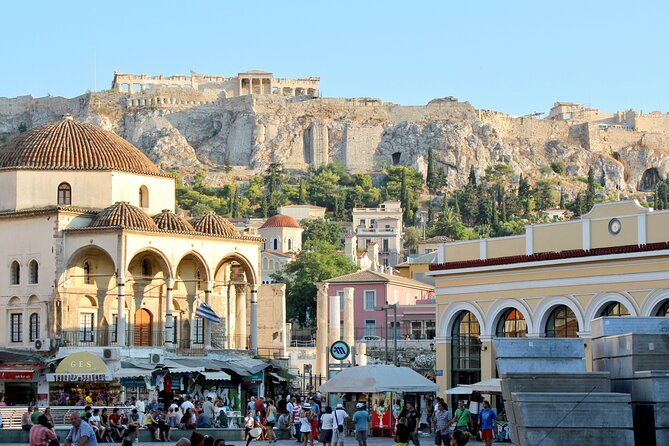
You finish at the Acropolis Metro Station, close to the pedestrian street of Dionysiou Areopagitou. This matters because it gives you the chance to take in the view—especially with the Acropolis crowned by the Partenón—without feeling like you must immediately commit to a full site visit.
Your tour ends after a final walk-and-look, but it explicitly leaves you options. You can keep exploring the Acropolis and its museum if you already planned for tickets. Or you can head into Plaka on your own for lunch at one of the many tavernas or for small souvenir shopping.
If you want the best of both worlds, this is how I’d think about the finish:
- Use the ending moment to get oriented and decide.
- If you’re going to pay for the Acropolis archaeological site, do it with energy left.
- If you’re not going in, treat the view as the win and spend your time in neighborhoods that feel lived-in.
How the Pace Feels: 2.5 Hours, Short Stops, Smart Flow

The total duration is listed at about 2 hours 30 minutes, and most stops are roughly ten minutes. That creates a brisk but effective pace.
With a max group size of 14 travelers, it’s usually easier to hear questions and keep track of where to stand. This isn’t a slow “linger and read every plaque” tour. It’s more like a well-guided city walk where you absorb the bigger story by moving between key places.
I also appreciate the guide-to-group size ratio implied here. Smaller groups tend to keep the experience from feeling like a factory line, and it makes it easier for the guide to answer real questions instead of only delivering a monologue.
What the Guides Can Add (And Why You’ll Notice the Difference)
The quality of your Athens experience often comes down to the guide’s storytelling. In the feedback for Greca Travel, I’ve seen a strong theme: guides who explain history clearly and answer questions without turning it into a lecture.
For example, one guide named Magdalene was praised for being spectacular at explaining history and giving a broader look into Plaka. Another guide named Jenni stood out for explaining lots of city curiosities and adapting well when traveling with a child (including a 16-month-old). That kind of flexibility matters because Athens is full of uneven sidewalks and sudden crowds.
There’s also a small caution worth hearing: at the Acropolis, rules can feel intense. One guide discussion included an exaggerated moment about not touching the marble. Even if you’re careful, it’s good to know you’ll likely encounter strict instructions once you’re near the most famous stone surfaces.
Price and Value: $31.13 for a Lot of Built-In Context
At $31.13 per person (with group discounts and a mobile ticket), this tour is priced like a budget-friendly orientation walk—but it doesn’t feel like a barebones deal. The value comes from the way it strings together multiple major landmarks in one logical path.
You’re paying for:
- Guided context so you’re not just seeing random famous places
- Efficient routing that prevents backtracking
- A manageable group size that makes the walk feel human-sized
You should factor in the extra cost potential: tickets for the Acropolis archaeological site aren’t included, and the Temple of Olympian Zeus and the Numismatic Museum have ticket notes as not included too. In other words, the tour helps you understand where to go next, but it doesn’t try to buy every ticket for you.
If you already plan to visit the Acropolis, this tour can act like a warm-up. You’ll arrive at the site with a story in your head, which makes the crowds feel less chaotic.
Practical Advice Before You Book
A few things will help you get the most out of the day:
- Plan for tickets separately if you want full Acropolis time. This tour ends near the metro, so you’ll still need to handle admissions on your schedule.
- Bring comfortable shoes and be ready for lots of walking between viewpoints.
- Time your day so you don’t feel rushed afterward. The tour sets you up for either the Acropolis or a Plaka lunch, so keep the rest of the afternoon flexible.
- Weather matters. The experience is noted as requiring good weather. If Athens is being dramatic with rain, plan for an alternate date or a refund approach.
- Arrive early at the start point. On at least one occasion, a no-show problem has been reported for this provider. That doesn’t mean it will happen to you, but arriving a bit early is cheap insurance.
Who This Tour Suits Best
This Athens walk is a great fit if you:
- Want a short, guided overview with real architectural and historical framing
- Like Olympic and political landmarks, not just temples
- Prefer a small-group feel (max 14)
- Want a finish that lets you choose Acropolis entry vs. neighborhood time in Plaka
It may be less ideal if you:
- Expect long time at each major site
- Want everything included with no extra ticket planning
- Prefer slow pacing and lots of museum time during the guide walk
Should You Book This Athens History Walk?
I think you should book it if your goal is to get oriented fast—neoclassical Athens to Olympic Athens to Acropolis views—without overplanning. The short, guided route is a good way to learn what you’re looking at, and the finish near the metro gives you real freedom for what comes next.
Just don’t treat it as a full Acropolis tour. The Acropolis site ticket isn’t included, so if you want the deeper experience at the archaeological area, plan that step separately. If you do, this walk becomes a high-value warm-up and makes the rest of your day feel more connected.
FAQ
FAQ
How long is the Athens history walk?
It lasts about 2 hours 30 minutes.
Where does the tour start and end?
It starts at Titania Hotel Athens (Panepistimiou 52, Athens) and ends at Acropolis Metro Station (near Dionysiou Areopagitou, Athens 117 42).
What languages are the guides offered in?
You’ll get an assistant in Spanish or English, depending on the selection you make.
How many people are in the group?
The tour has a maximum of 14 travelers.
Are tickets included for the Acropolis archaeological site?
No. Acropolis tickets are not included.
Are tickets included for the Numismatic Museum and Temple of Olympian Zeus?
No. Tickets are not included for the Numismatic Museum stop and the Temple of Olympian Zeus stop.
Is the tour wheelchair or mobility-friendly?
The information says most travelers can participate, but it does not specify detailed accessibility features.
What happens if the weather is poor?
The experience requires good weather. If it’s canceled due to poor weather, you’ll be offered a different date or a full refund.
Is cancellation free?
Yes. You can cancel up to 24 hours in advance for a full refund.

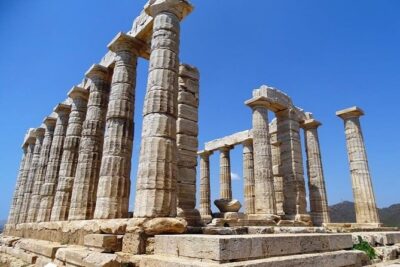

More Historical Tours in Athens
More Walking Tours in Athens


More Tour Reviews in Athens
- All Day Cruise -3 Islands to Agistri,Moni, Aegina with lunch and drinks included
★ 5.0 · 4,958 reviews