REVIEW · ATHENS
Mycenae, Epidaurus, Nafplio Full Day Private Tour from Athens
Book on Viator →Operated by My Athens Transfers · Bookable on Viator
Ancient ruins, packed into one efficient day. This private Athens tour strings together Corinth Canal views, the fortress of Mycenae, Epidaurus’ theatre, and the pretty seaside town of Nafplio—so you get more than just a museum stop. Door-to-door pickup and a car with Wi‑Fi keep the long drive from feeling like a waste.
I love how the pacing gives you real time to walk: you’re not just herded through. I also love that lunch is built in, and Nafplio gives you enough breathing room to eat, wander, and even choose how much castle climbing you want.
One thing to factor in: major site tickets for Mycenae and Epidaurus are not included, so you’ll want to budget for on-site entrance fees. Also, this is a full day, so you’re trading some sleep-in time for a lot of driving and a lot of walking.
In This Review
- Quick highlights that matter
- Price and value: what $229.14 buys you
- Door-to-door logistics, Wi‑Fi, and the comfort factor
- Entrance fees at Mycenae and Epidaurus: plan for about €40
- Corinth Canal: a quick stop with big “how did they do that?” energy
- Mycenae citadel and Lion Gate: where Agamemnon’s world becomes real
- Museum time at Mycenae: what the ticketed entrance covers
- Treasury of Atreus: the beehive tomb and the scale shock
- Epidaurus Archaeological Museum and the theatre payoff
- Sanctuary of Asklepios: short stop, meaningful context
- Nafplio: the best payoff for your feet and your appetite
- Bourtzi, Acronauplia, and Palamidi: choose how many steps you want
- What the best drivers actually do (and why it matters)
- Who should book this private Mycenae Epidaurus Nafplio tour
- Should you book this tour?
- FAQ
- What is included in the tour price?
- Do I need to pay entrance fees?
- Will there be a licensed tour guide with me inside the sites?
- How long is the tour?
- Is pickup available from my hotel or address in Athens?
- Is Wi‑Fi available during the drive?
- Is this a group tour or private?
Quick highlights that matter
- Door-to-door pickup in Athens: Your driver meets you at the Athens address you choose and returns you to the same place (or another preferred drop-off point).
- A driver who can tailor the day: Names like Spiros, George, Notis, Michael, and Petros come up often for friendly, story-filled commentary and flexible pacing.
- Two ancient showstoppers in one day: Mycenae’s Lion Gate and the Ancient Theatre of Epidaurus are the kind of stops you remember long after the photos.
- Lunch is included: You’ll have a Greek traditional food option, with Nafplio time built around the meal.
- Wi‑Fi and air-conditioning onboard: Useful on a long day with multiple transfers and stops.
- Comfortable footwear is smart: The sites involve stone paths and steps, and slick conditions can happen.
Price and value: what $229.14 buys you
At about $229.14 per person for an 8 to 9 hour private tour, you’re paying for a few things that matter in practice: private transport, door-to-door pickup, and a driver who stays with you through the day. That’s the value here. Instead of renting a car and doing all the logistics yourself, you show up, step into an air-conditioned vehicle, and spend your energy on ruins and views.
This isn’t a “driver drops you off and disappears” setup. The vehicle includes Wi‑Fi and bottled water, and the driver provides history and context on the road. You’ll still need to pay some entrance fees on-site (more on that next), but you’re already getting the biggest time-saver—transportation—handled for you.
Also, since this tour averages booking about 72 days in advance, it’s a good idea to reserve early if you’re traveling in high season or around specific dates you care about.
You can also read our reviews of more private tours in Athens

Door-to-door logistics, Wi‑Fi, and the comfort factor
The cleanest part of this experience is the simplicity: private transportation with pickup from your Athens hotel or apartment address (or airport/port pickup if that fits your trip). Your driver waits in the lobby or at the building entrance, and you can request an adjustable pickup time.
Onboard comforts are more than a luxury when you’re doing three major ancient sites plus Nafplio. The car is air-conditioned, includes Wi‑Fi, and you’ll have bottled water. In plain terms: you arrive at the first ruins with less stress, and you’re not tired in the worst way when you need to walk.
One more practical point: this is a private group, so you don’t share your schedule with strangers. That flexibility shows up later, when you need a little extra time at a viewpoint or prefer to move through a section at your own pace.
Entrance fees at Mycenae and Epidaurus: plan for about €40
Here’s how the money part works, in a straightforward way. Some stops have free entry, while key museum/site areas are not included in the tour price.
Not included (pay on-site):
- Mycenae & the Archaeological Museum of Ancient Mycenae & the Treasury of Atreus cluster: €20.00 per person
- Epidaurus & the Epidaurus Archaeological Museum cluster: €20.00 per person
Free (included as part of your time, no extra ticket stated):
- Corinth Canal viewpoint stop
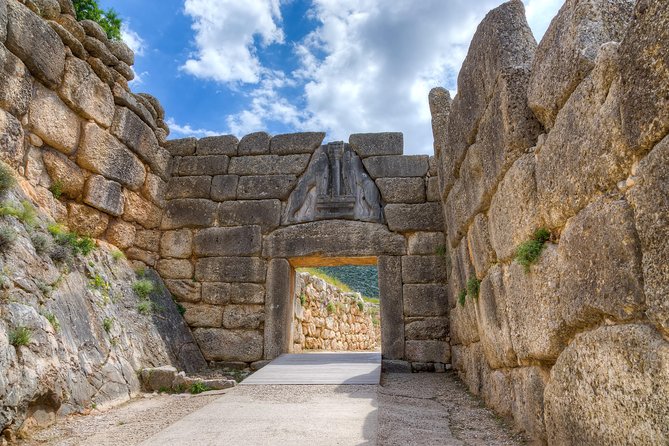
- Lion Gate
- Citadel area viewpoints listed as free stops
- Sanctuary of Asklepios (not listed as needing a ticket)
- Epidaurus Ancient Theatre time window (not listed as ticketed here, but pay attention to how the venue sells admissions on the day)
- Nafplio sightseeing points like Bourtzi and areas around Acronauplia and the fortifications
So your budget is basically two ticket payments on the day. If you’re doing a lot of paid entries anyway in Greece, this won’t feel out of place. If you’re trying to keep costs tight, it’s the one catch you should plan for.
Corinth Canal: a quick stop with big “how did they do that?” energy
You’ll stop at the Corinth Canal for about 15 minutes. It’s not an hours-long visit, but it’s a smart pause. The canal cuts through the Isthmus of Corinth, connecting the Gulf of Corinth (Ionian Sea side) with the Saronic Gulf (Aegean Sea side). It’s short—about 6.4 km—and it has no locks.
The real payoff is the viewpoint. From above, you can see the narrow limestone walls and get a sense of how ships thread through a cut that makes the Peloponnese feel like an island. It’s a nice reset before you switch from modern engineering to Bronze Age power.
If you’re sensitive to time pressure, this is a good stop to use for a bathroom break and a quick photo burst, then get back on the road.
Mycenae citadel and Lion Gate: where Agamemnon’s world becomes real
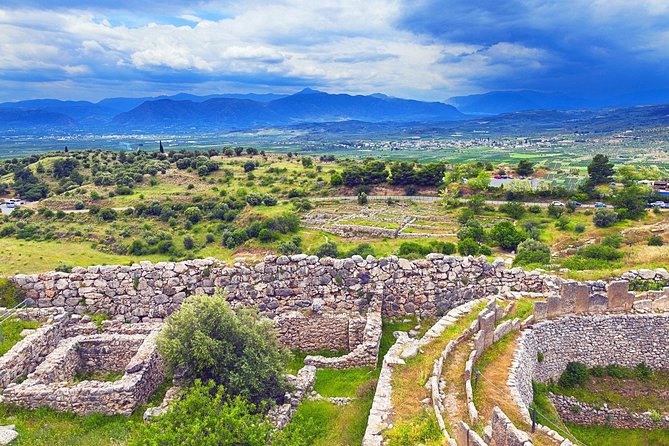
Mycenae is the anchor stop of the day, and the tour gives you a logical flow through it: you see the citadel, then move through the most famous entrances and monuments.
You’ll spend time at:
- The archaeological site of Mycenae (about 40 minutes)
- The Lion Gate area (about 15 minutes)
- The museum and other monuments around the entrance area
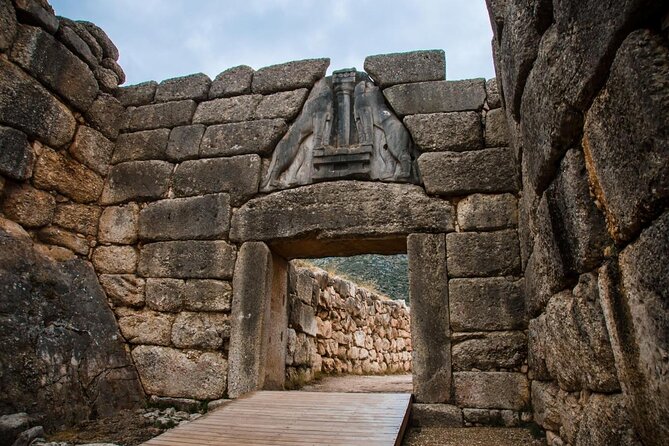
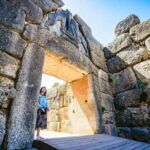
Lion Gate matters because it’s the iconic entrance to the Bronze Age citadel. It’s built in the 13th century BC (around 1250 BC) and decorated with two lionesses or lions in a heraldic pose above the passage. It’s also described as the sole surviving monumental piece of Mycenaean sculpture and the only prehistoric Aegean relief motif that survived without being buried underground.
What I like about this stop is that you can connect big myths to physical scale. Standing near the gate, you get a better sense of why a fortified power center like Mycenae dominated southern Greece and beyond. You’re not just learning names—you’re seeing how the place was designed to impress and defend.
Practical note: you’ll be walking on stone. If your shoes aren’t grippy, consider bringing something with solid traction.
You can also read our reviews of more tours and experiences in Athens
- All Day Cruise -3 Islands to Agistri,Moni, Aegina with lunch and drinks included
★ 5.0 · 4,958 reviews


Museum time at Mycenae: what the ticketed entrance covers
Between major outdoor stops, there’s a museum slot around the entrance area, about 30 minutes for the Archaeological Museum of Ancient Mycenae (ticket not included). Even if you’re not a “museum person,” I’d treat this as part of the puzzle—because the artifacts help explain what you just saw on the walls and gates.
This is where the day becomes less vague. Instead of only thinking in terms of ruins and photos, you can read the material culture that connects to the citadel’s peak period (1350 to 1200 BC is commonly referenced for its great floruit).
If you’re short on attention span, focus on the museum sections that directly connect to what’s outside: the power center, the monumental gate sculpture, and the story of the city’s height. You can skim fast and still get the value.
Treasury of Atreus: the beehive tomb and the scale shock
The Citadel and Treasury of Atreus (often called the Tomb of Agamemnon) is a tholos or beehive tomb on Panagitsa Hill, built around 1250 BC. The tour allots about 15 minutes here.
The most striking detail is the doorway lintel: it weighs roughly 120 tons. That’s the kind of number that makes you stop thinking in “ancient” terms and start thinking in heavy engineering terms. Even with limited time, it’s worth standing there and letting your brain catch up to the scale.
This stop is also a good reminder that myths often latch onto real monuments. Whether you treat the story as legend or cultural memory, the tomb is undeniably impressive as a monument built to last.
Epidaurus Archaeological Museum and the theatre payoff
After Mycenae, the day shifts to Epidaurus, and the contrast is immediate. You go from fortress energy to a sanctuary devoted to Asklepios, plus a theatre famous for acoustics.
You’ll visit:
- Epidaurus Archaeological Museum (about 30 minutes, ticket not included)
- The Ancient Theatre of Epidaurus (about 30 minutes, ticket not included)
- Sanctuary of Asklepios (about 15 minutes, listed as free)
The museum is known for reconstructions—especially temples, columns, and inscriptions. That matters because Epidaurus isn’t just “pretty ruins.” The sanctuary is a system of meanings: worship, healing culture, and architecture designed to stage experience.
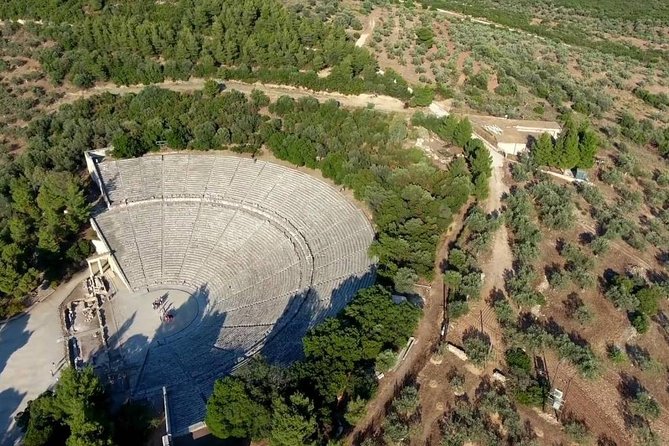
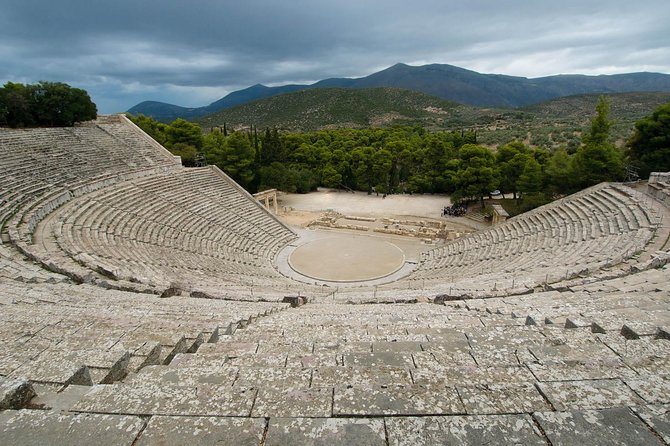
Then comes the theatre. The Ancient Theatre of Epidaurus is widely considered the most perfect ancient Greek theatre for acoustics and aesthetics. It keeps the tripartite structure: theatron, orchestra, and skene. During Roman times, it didn’t suffer many modifications—so what you see is close to what performers and audiences experienced.
Even if you’ve heard claims about its sound before, I’d still go through the motions here. Stand, look across the seating, and imagine how space guided voices. You don’t need a performance to feel why this theatre became a standard reference point for generations.
Sanctuary of Asklepios: short stop, meaningful context
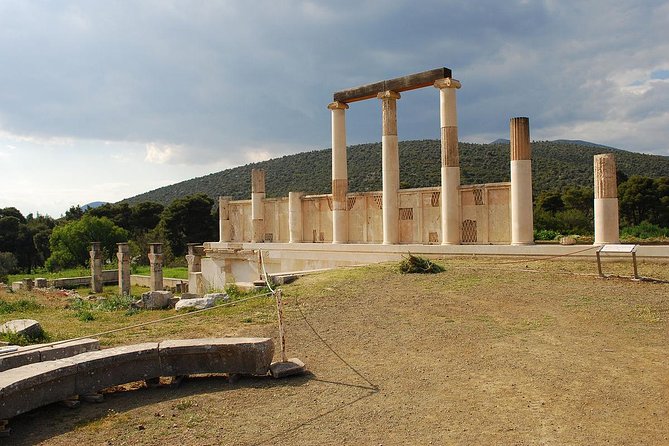
The Sanctuary of Asklepios is the spiritual core of the Epidaurus area. The Temple of Asclepius was built in the early 4th century BC, and Epidaurus was a major cult site—considered a rival to other famous sanctuaries like Olympia and Delphi.
This stop is about 15 minutes, so I treat it like a “finish the story” moment. By now you’ve seen the theatre and the museum explanations. Here, you connect it all back to purpose: this place wasn’t built for leisure first. It was built for healing rites and a sanctuary lifestyle centered on Asclepius.
If you want to get more from the day, ask your driver for a quick explanation of why Asclepius mattered in the ancient world and how sanctuaries worked as social places, not only religious ones. You’ll likely get better answers than you expected—many drivers on this route are eager to talk.
Nafplio: the best payoff for your feet and your appetite
Nafplio is where the day turns pleasant. You’ll get about 1 hour 30 minutes of free time for lunch, coffee, or shopping—then more short stops around the harbor and viewpoints.
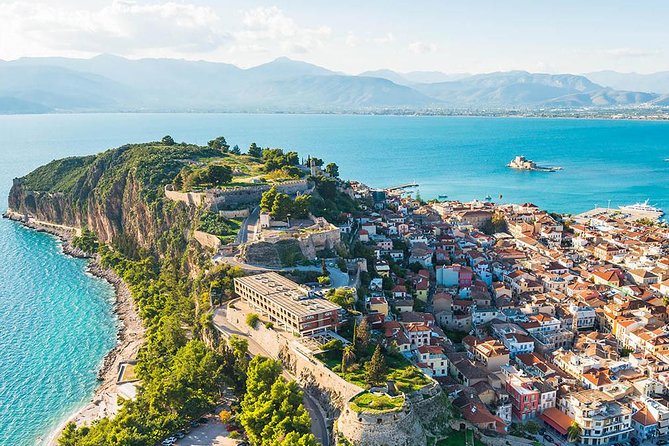
Nafplio is often described as the Naples of the East, and the details match: cobbled squares, Venetian architecture, and castles with commanding views over the Argolic Gulf. Historically, it shifted hands through multiple eras—Medieval lordships, the Venetians, then the Ottomans—and it served as capital in modern Greek political history after the Revolution (1821 to 1834).
I love using Nafplio as a palate cleanser after ruins. You go from stone monuments to livable streets. You can wander without feeling like you’re “behind” the schedule, and you can choose your pace.
Lunch is included on this tour, with a Greek traditional food option. The practical win is that lunch doesn’t require research or decision-making while you’re already tired. After eating, you still have time to browse.
Bourtzi, Acronauplia, and Palamidi: choose how many steps you want
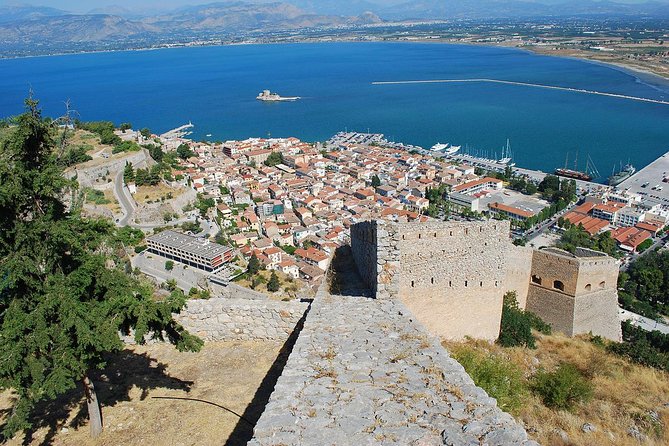
The harbor viewpoint stop at Bourtzi (about 10 minutes) gives you the classic photo: a Venetian castle, the water castle, sitting in the middle of Nafplio’s harbor.
From there, the tour adds time around the older fortifications. The Acronauplia area is the oldest part of Nafplio, and it was transformed into part of the city fortifications after Venetian and Frankish influence. The site was also used as a prison for a period, and later, tourism infrastructure appeared at the viewpoint level.
Then there’s Palamidi Castle, the big climb option. It’s a fortress built by the Venetians during their second occupation of the area (1686–1715) on a hill about 216 meters high. You’ll see mention of 913 steps from town, plus the common joke that it’s actually 999 steps. The tour allots about 30 minutes for it, and the ticket isn’t included.
Here’s my practical advice: Palamidi is the stop to take if you want the view more than you want comfort. If your legs are already tired from Mycenae and Epidaurus, you can still enjoy Nafplio without going full “step marathon” mode. The tour gives you the choice of where your energy goes.
What the best drivers actually do (and why it matters)
The standout element in this kind of private day trip is not only what you see. It’s how the day flows between stops.
On this route, drivers often add extra value by:
- Timing the day so you’re not stuck waiting around
- Explaining myths and history in a way that connects to what you’re standing in front of
- Answering questions in the moment, without feeling like you’re interrupting a formal lecture
- Suggesting practical things like where to eat in Nafplio
It’s no surprise that names like Spiros, George, Notis, Michael, Petros, Kostas, and Fotis show up frequently in the kind of feedback this tour earns. The most praised pattern is simple: friendly, flexible, and ready with stories.
So before you set off, do this: at pickup, ask your driver what the single most memorable stop is today—and then ask for one myth-to-monument connection you can look for while you walk. That small prompt turns you from a passive passenger into an active observer.
Who should book this private Mycenae Epidaurus Nafplio tour
This tour fits best if you want:
- A single-day hit list of three major ancient sites plus a real town experience
- Private door-to-door logistics from Athens
- A driver who can keep the story going during the long transfers
- Included lunch so you don’t spend your time hunting for food
It’s also a good fit for families who want control without doing the planning work. It’s not ideal if you hate long drives or if you want a deep, slow excavation-level experience at just one site. This day is designed for breadth. You’ll see a lot, then you’ll move on.
One more note: if you travel in quieter months, you may find more breathing space at major ruins. Winter and shoulder season can change the vibe of outdoor sites dramatically.
Should you book this tour?
If you’re doing Athens and you want Mycenae and Epidaurus without turning the trip into a self-drive stress test, I think this is an easy yes. The value comes from private transport, the pacing that gives you time to walk, and a lunch that keeps the Nafplio section from feeling like a rushed rest stop.
Just go in with two expectations: you’ll budget for entrance fees at Mycenae and Epidaurus, and your day will be full—so pack grippy shoes and plan for some walking and steps at Palamidi if you choose it.
If those match your style, you’ll finish the day with one big win: the feeling that ancient Greece isn’t stuck in textbooks. It’s on the ground, under your feet, and you’ve seen it all in a way that stays practical.
FAQ
What is included in the tour price?
The tour includes hotel/airport/port pickup and drop-off, private transportation in an air-conditioned vehicle, Wi‑Fi on board, bottled water, and lunch (with a Greek traditional food option). Drivers provide history commentary but are not licensed tour guides who enter sites with you.
Do I need to pay entrance fees?
Some major site admissions are not included and must be purchased on-site. The Mycenae site and related museum/tomb areas are €20.00 per person, and Epidaurus plus the Epidaurus Archaeological Museum are also €20.00 per person. Other listed stops are free.
Will there be a licensed tour guide with me inside the sites?
A licensed tour guide is not included, though it can be requested depending on availability. Your driver is not an official guide inside the archaeological sites, but they can explain places and answer questions in fluent English.
How long is the tour?
The full day tour runs about 8 to 9 hours.
Is pickup available from my hotel or address in Athens?
Yes. Pickup is offered from the Athens address of your choice. The driver will wait for you in the hotel lobby, at your apartment entrance, or at the airport/port pickup point with a sign.
Is Wi‑Fi available during the drive?
Yes. Wi‑Fi is available in the vehicle.
Is this a group tour or private?
This is a private tour/activity. Only your group participates.


More Private Tours in Athens

More Tours in Athens



More Tour Reviews in Athens
- All Day Cruise -3 Islands to Agistri,Moni, Aegina with lunch and drinks included
★ 5.0 · 4,958 reviews