REVIEW · ATHENS
Philosophy and Democracy tour of Athens
Book on Viator →Operated by Athens Classic Tour · Bookable on Viator
Philosophy and democracy are street-level here. This small-group Athens tour turns ancient ideas into something you can see, from Kerameikos to the Pnyx hill where citizens decided their future. I love how the guide compares ancient and modern democracies in plain language, and I like the practical tips for where to eat, drink, and explore next. One thing to plan for: several major stops require separate admission tickets, and it is a walking route.
With Panos leading, the tone stays lively and accessible, even when the topics get serious. The pace is intentionally comfortable, with short time blocks at each site so you spend more of the 3 hours 30 minutes learning than shuffling.
Because the tour needs good weather, I suggest wearing solid shoes and bringing water. If you’re trying to understand Athens beyond the Acropolis postcard, this is an efficient way to do it.
In This Review
- Key things you’ll notice on this Philosophy and Democracy tour
- Why this Athens walk is about ideas you can actually see
- Timing, meeting point, and what 3.5 hours feels like
- Kerameikos: ceramics, cemeteries, and Pericles’ democracy moment
- The Flea Market stroll: Athens today between the big ideas
- Hadrian’s Library and the Roman Agora: when Athens changes rulers
- Tower of the Winds: Athens as a science-and-sound city
- Plaka: the calm streets that make the story stick
- Ancient Agora: where philosophy and civic life share the same streets
- Prison of Socrates: a short tribute with real emotional weight
- Pnyx Hill: the cradle of democracy plus the best views
- Near the Acropolis: time with Athens’ biggest monument area
- Pacing, questions, and the small-group advantage
- Price and value: $50.81 makes sense, if you budget for tickets
- Who should book this tour (and who might want a different one)
- Quick FAQ
- FAQ
- How long is the Philosophy and Democracy tour in Athens?
- How big is the group?
- What language is the tour offered in?
- Is a mobile ticket provided?
- Are site admission tickets included?
- Where does the tour start and end?
- What happens if the weather is bad?
- Should you book this Philosophy and Democracy tour?
Key things you’ll notice on this Philosophy and Democracy tour
- Kerameikos sets the stage: ceramic workshops and Athens’ cemetery, tied to Pericles’ Epitaph speech.
- A smart mix of Greek and Roman Athens: Hadrian’s Library and the Roman Agora add contrast to the democracy story.
- Tower of the Winds shows Athens as science-minded: wind, timekeeping, and even an hourly sound mechanism.
- You’ll walk where debates happened: the Ancient Agora, with philosophers and statesmen tied to the same streets.
- Pnyx is the payoff: the so-called cradle of democracy plus big Acropolis views.
- Small group size (max 15): more time for questions and clearer explanations.
Why this Athens walk is about ideas you can actually see
Most Athens tours focus on monuments. This one focuses on the thinking behind them: philosophy and democracy, explained through the actual streets and landmarks where those debates took place.
What makes it click is the way the guide keeps connecting dots. You’re not just hearing dates and names. You’re learning why Athens mattered, what democracy looked like on the ground, and how philosophy shaped how people argued about power.
You can also read our reviews of more tours and experiences in Athens.


Timing, meeting point, and what 3.5 hours feels like
The tour runs about 3 hours 30 minutes. It’s structured with multiple short stops, so you get variety without a long slog at one site.
You meet at the Statue of Theseus in Athens (Athens 105 55) and finish near Theorias 21 (Athina 105 58). Since you’re walking through different neighborhoods and archaeological areas, you’ll want to arrive ready to move, not just take pictures.
It’s also booked fairly ahead of time (on average 36 days in advance). If your travel dates are fixed, I’d grab a spot early rather than waiting.
Kerameikos: ceramics, cemeteries, and Pericles’ democracy moment
Your first major stop is Kerameikos Archaeological Site, one of Athens’ most important places that still feels under-visited. The name Kerameikos comes from ceramic—because the area was packed with ceramic workshops.
Then the site shifts in tone. Over many centuries, Kerameikos functioned as the cemetery of Athens, and prominent Athenians were buried here. That sets you up for the big political anchor: this is where Pericles delivered his famous Epitaph speech for the early casualties of the Peloponnesian War, praising the virtues of democracy and the values of the Athenians.
This is one of those stops where the site location matters. It’s easier to understand civic pride and civic risk when you’re standing in the place tied to remembrance and public speech. Admission isn’t included here, so budget separately if you want to go inside.
Practical note: the stop is about 15 minutes. That’s enough time to get the story and pick out the key areas, but not long enough to read every stone detail. If you like to linger, plan on a longer return visit later.
The Flea Market stroll: Athens today between the big ideas
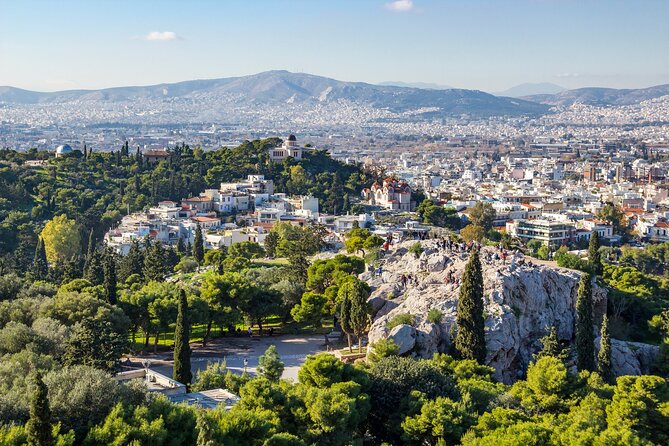
Next you get an easy walk through a Flea Market area. This stop is about 15 minutes and admission is free.
Why include this? Because it helps you reset your brain. After ceramics, cemeteries, and political speeches, the market gives you a sense of everyday Athens—people moving, bargaining, and keeping the city alive beyond the ancient map.
This is a good segment for quick snacks or just watching how commerce works here now. If you’re sensitive to crowds, keep your expectations realistic: you’re in an active part of town.
Hadrian’s Library and the Roman Agora: when Athens changes rulers

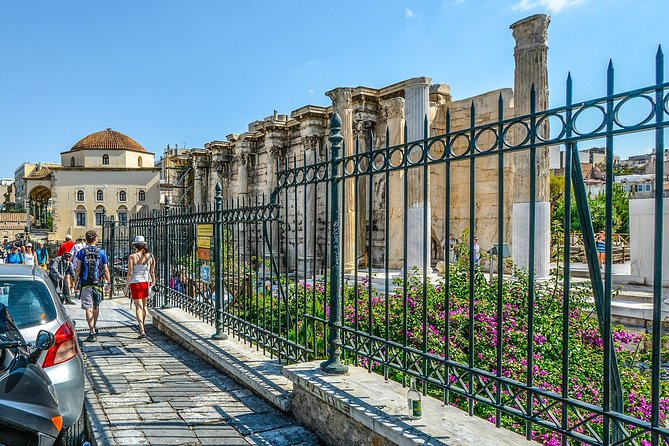
Then you move into the Roman layer of the city with Hadrian’s Library. It was created by Roman Emperor Hadrian in AD 132, on the north side of the Acropolis.
The vibe here is different from classic Greek spaces. You’re seeing how later power embedded itself into Athens, turning local prestige into a wider imperial statement. It’s a reminder that Athens’ story didn’t stop with Greek democracy at its peak.
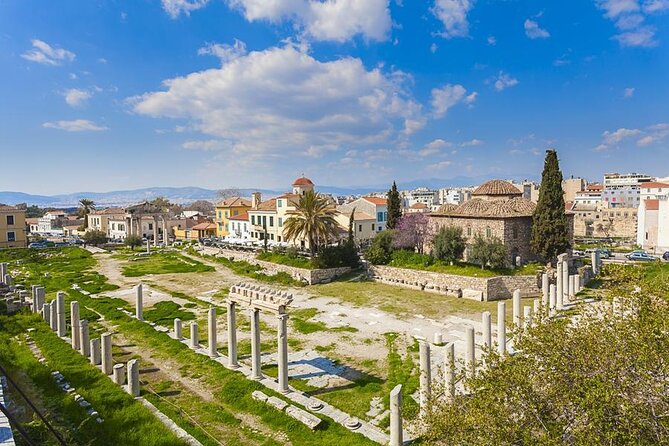
Not far from that, you visit the Roman Agora, located north of the Acropolis and east of the Ancient Agora. Again, think contrast: this is Roman-era civic space shaping how people used the city after Greek institutions evolved.
These stops are short (about 15 minutes each), and admission isn’t included for them. Still, the explanations help you connect why Roman Athens didn’t erase Greek Athens—it re-framed it.
- All Day Cruise -3 Islands to Agistri,Moni, Aegina with lunch and drinks included
★ 5.0 · 4,958 reviews




Tower of the Winds: Athens as a science-and-sound city
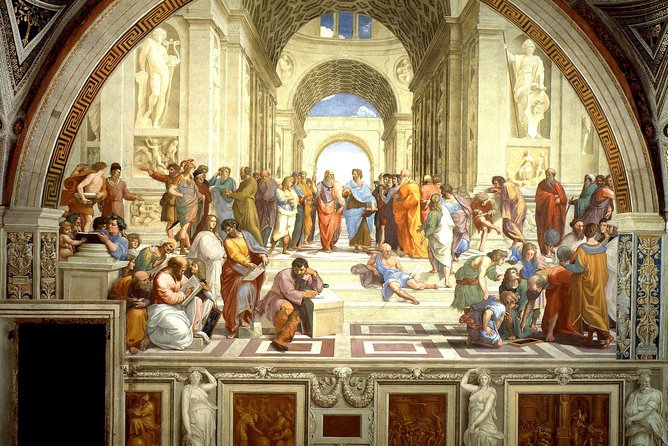
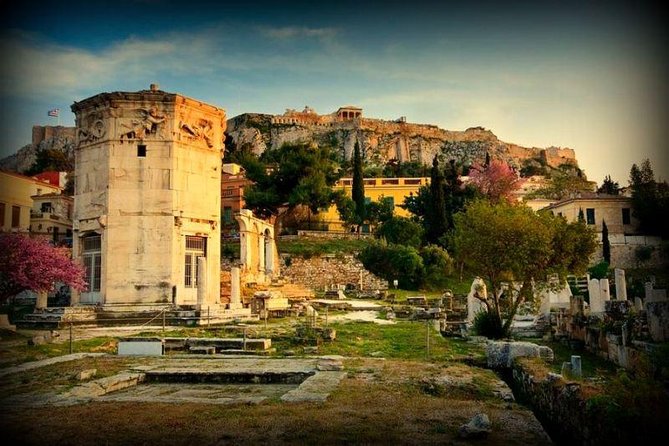
One of my favorite stops is the Tower of the Winds, an octagonal building built by the astronomer Andronicus of Kyrristos in the 1st century BC. It served as a wind indicator and also as a clock.
Here’s the extra-mind-blower detail: it was designed for multiple weather conditions. The clock was solar, but in cloudy days there was also a hydraulic mechanism that produced a sound every hour. In other words, the city’s timekeeping wasn’t only about light—it was about making time audible.
It’s a five-minute stop, so you don’t get time to study it like a textbook. But you do get the context to notice how advanced practical science was embedded in public life.
Admission isn’t included, so it’s a quick win even if you’re watching your budget.
Plaka: the calm streets that make the story stick
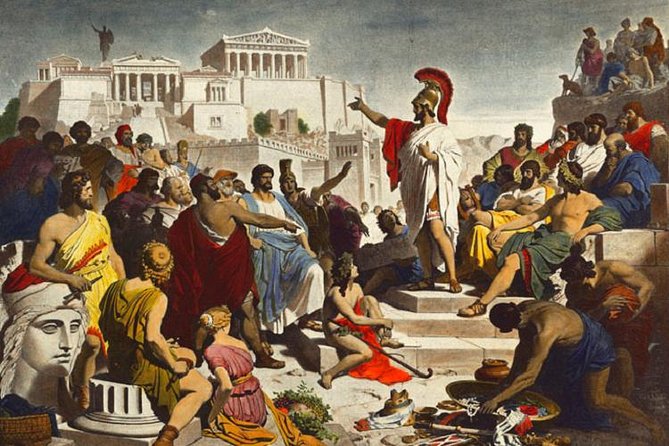
You also pass through Plaka, known for scenic small houses and narrow streets. This isn’t just downtime. It helps you feel the city’s layout and scale after walking through archaeology zones.
Plaka is where the “I get it now” moment often happens. The ancient story stays in your head, and then the modern streets give it a real sense of location and continuity.
If you’re thinking about where to eat later, this is a strong area to orient yourself. Your guide also shares where to grab food and drinks, which is especially useful if you don’t want to wander blindly.
Ancient Agora: where philosophy and civic life share the same streets
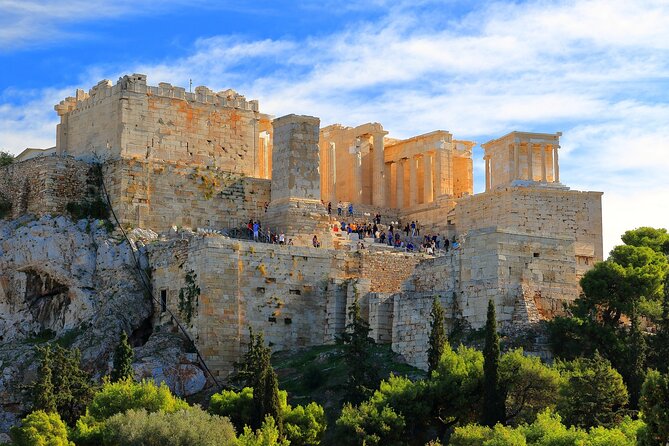
The heart of the ideological story arrives at the Ancient Agora of Athens. This place was the center of city life, and you can feel that when you’re moving through the spaces where ideas were argued out in public.
The guide connects the Agora to the people who shaped Western thought and politics. You’ll hear about philosophers such as Socrates and Plato, and politicians like Solon, Themistocles, and Pericles. The mix also includes figures tied to public life and debate, like Thucydides, Sofoklis, and Aristofanis.
The point isn’t to name-drop. It’s to show how discussions and debates were part of civic work. In Athens, public space wasn’t only for commerce or crowds; it was where people argued about law, ethics, war, and the future.
Admission isn’t included here either, and the stop is about 20 minutes. That’s enough to understand the role of the Agora and the big personalities, but if you want deep reading, you’ll still need a longer independent visit.
Prison of Socrates: a short tribute with real emotional weight
Right nearby is the Prison of Socrates. This stop is about 10 minutes and admission is free.
Why it matters: it turns philosophy from theory into lived consequence. Even without going into courtroom or classroom details, it reinforces that Athens’ famous thinkers weren’t floating above politics. They were tangled in civic decisions.
This is the kind of stop where you usually slow down a little, even on a structured tour. It pairs well with what you’ve learned at the Agora, so the democracy/philosophy theme feels complete.
Pnyx Hill: the cradle of democracy plus the best views
Then comes the payoff at Pnyx (Pnyx Hill), one of the most meaningful places on the route. It’s often called the cradle of democracy because it was the first place in the world where people took decisions for their future.
You also get the practical reward: views over Athens and the Acropolis. Standing here makes the concept of participation feel less abstract and more like geography—the city’s power centered around this kind of gathering and voting space.
This stop is about 30 minutes and admission is free. It’s long enough to absorb the setting and take pictures without racing.
If you care about how democracy looked physically—how a public space shapes public action—this is your anchor stop.
Near the Acropolis: time with Athens’ biggest monument area
The tour also gives you time to visit and admire Greece’s greatest monument area. You’re not just hearing about it in passing; you’re meant to see it as a finishing moment for the whole philosophy/democracy arc.
The big lesson: monuments are outcomes. They’re what Athens built when civic life, debate, and power shaped the city’s priorities.
Even if you’ve already seen parts of the Acropolis, the way this tour frames it can change how you notice the setting and why it was built where it was built.
Pacing, questions, and the small-group advantage
With a maximum of 15 travelers, the guide can keep attention focused. That matters because the tour is basically a walking lesson in political theory and ancient philosophy, not just a photo safari.
The pace is consistently easy, with shorter timed stops and enough in-between movement to keep energy up. Many people also appreciate that the guide explains complex ideas in a way you can follow without needing a history degree.
You’ll also get room to ask questions. That’s a big deal on a tour like this, because democracy and philosophy aren’t one-note facts. They raise arguments, and you’ll often want clarification.
One practical reminder from real-world touring: bring water. Athens walking is real, and even when stops are short, sun and pavement add up.
Price and value: $50.81 makes sense, if you budget for tickets
The price is $50.81 per person for about 3 hours 30 minutes, with a mobile ticket and English language offering. That’s strong value for a guided route through multiple major sites, especially with the small-group size.
The catch is admission. Several stops list admission as not included, including major archaeological areas like Kerameikos, Hadrian’s Library, the Roman Agora, Ancient Agora, and others. Some stops are free, like the Flea Market, Prison of Socrates, and Pnyx.
So the math becomes: the tour price buys the guide, the connections, and the order of sights. You still need to budget separate entry where required. If you’re the type who hates ticket math, plan your entry decisions before you start.
Also, this tour is highly rated, with an average 5 stars from 285 reviews. That doesn’t guarantee fit, but it does suggest the format works.
Who should book this tour (and who might want a different one)
This is best for you if you enjoy ideas, not just stones. If you like hearing why Athens mattered—how philosophy and democracy shaped public life—this tour gives you a clean path through the city’s key locations.
It’s also a good choice if you’ve already visited the main Acropolis area. Instead of repeating the same skyline views, you’ll learn the surrounding districts where civic life and debate happened.
You might consider a different tour if you want long stays at only one or two sites. Here, time is shared across many stops, and some admissions require extra planning.
Quick FAQ
FAQ
How long is the Philosophy and Democracy tour in Athens?
It runs about 3 hours 30 minutes (approx.).
How big is the group?
The tour has a maximum of 15 travelers, which keeps the experience more conversational.
What language is the tour offered in?
It is offered in English.
Is a mobile ticket provided?
Yes, the tour uses a mobile ticket.
Are site admission tickets included?
Admission is not included for several stops (like Kerameikos, Hadrian’s Library, Roman Agora, and Ancient Agora). Some stops are free (like the Flea Market, Prison of Socrates, and Pnyx).
Where does the tour start and end?
It starts at the Statue of Theseus (Athens 105 55) and ends at Theorias 21 (Athina 105 58).
What happens if the weather is bad?
The tour requires good weather. If it’s canceled due to poor weather, you’ll be offered a different date or a full refund.
Should you book this Philosophy and Democracy tour?
Yes, if you want Athens to make sense as a place where people argued about justice, government, and how to live. The route is structured so each stop builds on the last, from Kerameikos’ link to civic remembrance, to the Agora’s debate culture, to Pnyx as the literal stage of democracy.
Book it with eyes open on two things: you’ll do some walking, and you may need separate admissions for certain sites. If that fits your style, this is an excellent value way to see Athens with a sharper lens than the usual monument-only approach.



More Tours in Athens

More Tour Reviews in Athens
- All Day Cruise -3 Islands to Agistri,Moni, Aegina with lunch and drinks included
★ 5.0 · 4,958 reviews