REVIEW · ATHENS
Ancient Corinth, Temple of Hera, Blue Lake full day private tour from Athens
Book on Viator →Operated by My Athens Transfers · Bookable on Viator
Corinth in one long, satisfying day. You’ll link together ancient ruins and water views on a private Peloponnese circuit, starting with the Corinth Canal and ending at the Heraion sanctuary by Perachora and Limni Vouliagmeni. The ride is air-conditioned, with English narration from your driver so the places connect as you move between them.
I like how this tour stays low-stress: hotel or airport pickup, no waiting around with strangers, and a driver who keeps the day moving. I also love the mix of stops that feel different—big-time ruins at Ancient Corinth, then calmer breaks at the cove of Perachora and the small-channel lagoon locals call the Blue Lake. George, Notis, and Tom (drivers in prior trips) all show up in the feedback as the kind of people who turn driving time into useful context, not dead time.
One consideration: you’ll pay for Ancient Corinth and the Archaeological Museum on your own (about €15 per person), and the time at each site is fixed, so it’s not the kind of tour where you can linger for hours without moving along.
In This Review
- Key things to know before you go
- The real value of a private Corinth, Heraion and Blue Lake day
- Stop 1: Corinth Canal viewpoints that make sense of the isthmus
- Ancient Corinth: where the stories of the city get crowded (in a good way)
- Archaeological Museum of Corinth: the smart pairing after the ruins
- Quick hits: Temple of Apollo and the climb to Acrocorinth
- Limni Vouliagmeni and the Heraion at Perachora: sea air, sacred sites, and Blue Lake breaks
- Limni Vouliagmeni (your Blue Lake stop)
- Heraion of Perachora: the sanctuary behind the stones
- Timing: how an 8–9 hour route keeps your day from dragging
- Price and fees: is €220.73 per person worth it?
- Who should book this private day trip
- Should you book this Corinth, Heraion and Blue Lake private tour?
- FAQ
- How long is the Ancient Corinth, Heraion and Blue Lake private tour?
- Is this tour private or shared?
- What language is the narration?
- Do I get pickup and drop-off from my hotel or other location?
- Is WiFi included in the vehicle?
- Are bottled water and other refreshments provided?
- Are entrance tickets included in the price?
- Is a licensed tour guide included?
- Is a mobile ticket used for this experience?
- What if my plans change? Can I cancel for a refund?
Key things to know before you go
- Private door-to-door pickup (hotel, airport, port, or apartment) keeps the day smooth from the start.
- English narration while you ride helps you understand what you’re seeing before you step out.
- The day covers Corinth Canal, Ancient Corinth, Acrocorinth, the Heraion at Perachora, and Limni Vouliagmeni.
- Some sites are free, including the Corinth Canal viewpoint stops and several major ruins/temples.
- Plan on buying entrance tickets for Ancient Corinth + the Museum (not included in the package price).
- The route is built for a full day, so comfortable shoes and a flexible pace matter.
The real value of a private Corinth, Heraion and Blue Lake day
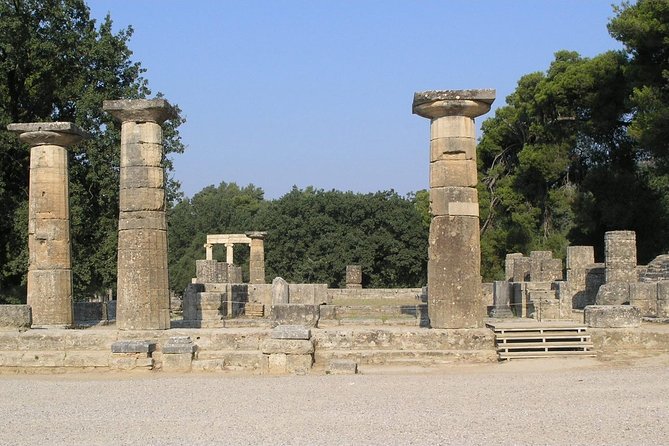
This tour is basically a fast, well-structured way to get out of Athens and see why the north Peloponnese mattered. You’re not just collecting photos. You’re tracing one geographic idea: Corinth as the control point between the Greek mainland and the Peloponnese—plus the religious life wrapped around the sea at Perachora.
For the money, the big win is transportation plus interpretation. At €220.73 per person, you’re paying for an 8 to 9 hour private vehicle, bottled water, and narration from a driver who can explain what you’ll see. Entrance fees are separate, but several of the stops are free, and you’re not wasting half a day figuring out buses and schedules.
The other practical win: since it’s private, you can set the pickup time (within reason) and your driver brings you back to the same place or to a point you prefer. That matters in Greece, where good plans are often about timing, not just sightseeing.
You can also read our reviews of more private tours in Athens

Stop 1: Corinth Canal viewpoints that make sense of the isthmus
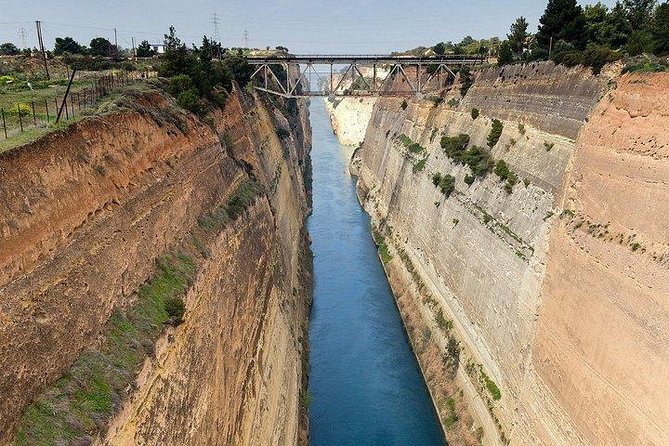
The Corinth Canal is short, but it’s a big deal. It cuts through the narrow Isthmus of Corinth, separating the Peloponnese from the mainland like a man-made “almost-island.” The canal is 6.4 kilometers long, 21.4 meters wide at the base, and built at sea level with no locks—so it’s not a maze. It’s a straight squeeze through limestone walls.
You get about 30 minutes and, importantly, you don’t need to be a ship spotter to enjoy it. From the higher viewpoints, you can look down at the channel walls and see vessels making their way through. It’s the kind of stop that helps you understand the rest of the day: Corinth wasn’t just a city. It was the chokepoint.
A tip from the way this tour is structured: use this first stop to reset mentally. You’re about to get into archaeology, and the canal gives your eyes a break—plus it helps the ruins you’ll see later feel connected instead of random.
Ancient Corinth: where the stories of the city get crowded (in a good way)
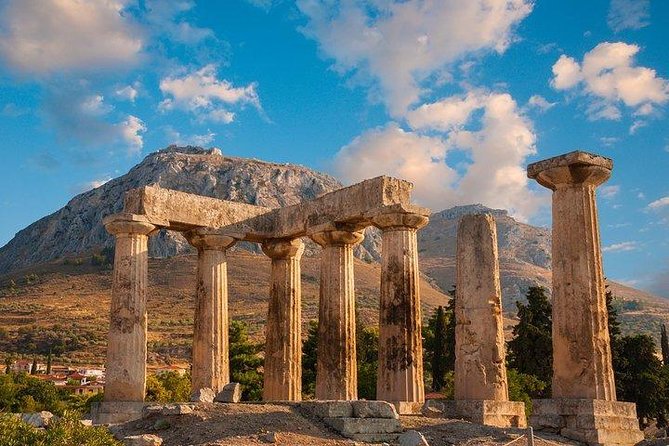
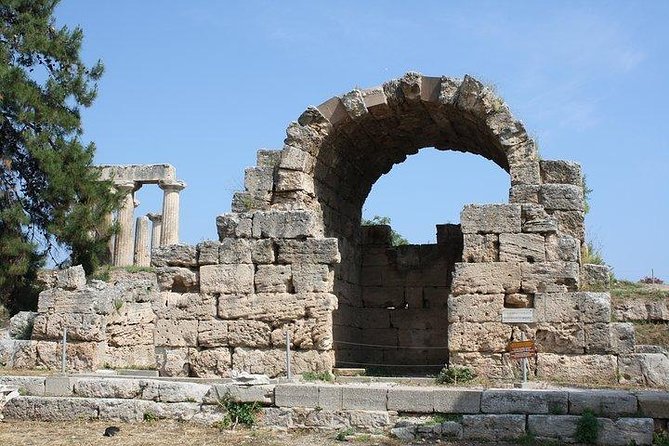
Ancient Corinth (Archaia Korinthos) is one of those sites where multiple layers of time overlap—Greek, Roman, and later references. It was a major city-state on the isthmus, roughly halfway between Athens and Sparta. Later, it became well known in Christianity through Saint Paul’s letters (First and Second Corinthians) and the city’s mention in the Acts of the Apostles.
What I like about visiting it with a driver giving narration: the site stops being a list of ruins and starts turning into a living explanation. You can understand why Corinth mattered strategically and economically, not just spiritually or culturally.
You’ll have around 1 hour 30 minutes here. That’s enough time to see the essentials at a good pace, but not enough time to master every detail. If you’re the type who reads every plaque, you may need to prioritize. If you’re the type who wants the “big picture” first, this time slot often feels just right.
Archaeological Museum of Corinth: the smart pairing after the ruins

The Archaeological Museum of Ancient Corinth sits inside the wider archaeological area, and it was built in the early 1930s to show findings from excavations. One practical advantage of doing the museum right after you walk among the ruins: your brain is still in the right mode. You can connect objects and features to what you just saw outside.
Your stop is about 1 hour, and the museum setting is tied to major elements of the broader site—things like the Fountain of Peirene and areas such as the Lechaion Road, Agora, Stoa, theatre, and cistern spaces. Even if you don’t plan to read every caption, just seeing how the layout and discoveries fit together helps you interpret the archaeology.
Since museum admission is not included, budget for that alongside the Ancient Corinth ticket cost. It’s one of the reasons I suggest planning your tickets calmly rather than rushing at the start of your visit.
Quick hits: Temple of Apollo and the climb to Acrocorinth

After Ancient Corinth, the day shifts into “power moves”—short stops with high payoff.
Temple of Apollo is a brief visit (about 15 minutes) and it’s free. It was constructed around 550 BC, which gives you an instant sense of how early the sacred landscape developed in this area. This isn’t the kind of stop where you need a long explanation. It’s more like a punctuation mark: another sign that Corinth’s religious importance wasn’t an add-on. It was built into the city’s identity.
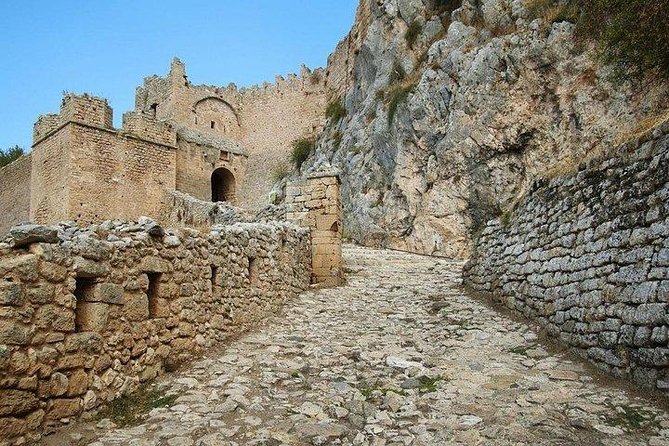
Then comes Akrokorinthos (Acrocorinth), the upper fortress on a monolithic rock overlooking the city. This spot is free and you’ll have about 1 hour. Acrocorinth’s big story is control and defense. It was used repeatedly as a last line of defense and it commanded the Isthmus of Corinth.
Here’s the practical consideration: you’re on a fortress landscape, meaning you’ll likely be walking on uneven terrain and taking in viewpoints that reward time but don’t feel flat and easy. If you know you get tired fast, pace yourself. Use the narration to decide what matters most, then spend your energy on the views that help you understand the geography.
You can also read our reviews of more tours and experiences in Athens
- All Day Cruise -3 Islands to Agistri,Moni, Aegina with lunch and drinks included
★ 5.0 · 4,958 reviews


Limni Vouliagmeni and the Heraion at Perachora: sea air, sacred sites, and Blue Lake breaks
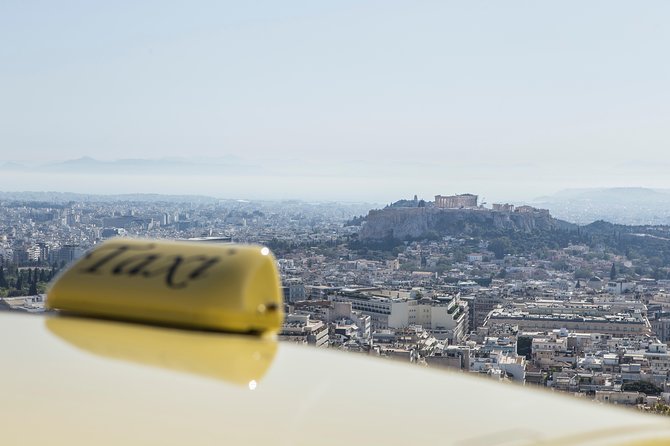
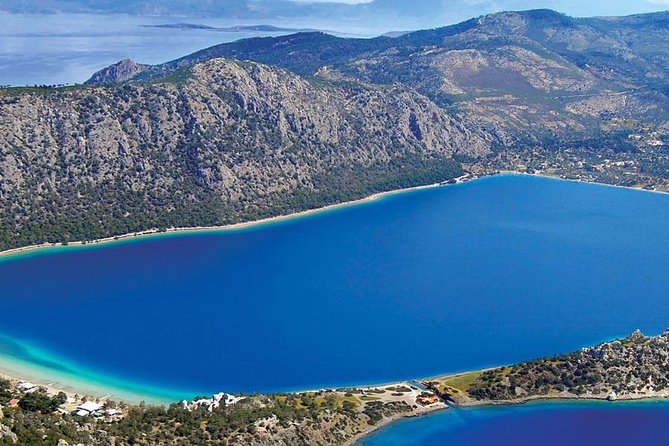
This is where the tour changes tone. Up to now, the day has been about corridors of power—canal, city, fortress. Then you reach the coastal world around Perachora and the lagoon called Limni Vouliagmeni, often described as the Blue Lake.
Limni Vouliagmeni (your Blue Lake stop)
Limni Vouliagmeni is a lagoon near Loutraki and close to the area of the Heraion and Perachora. It’s about 16 kilometers northwest of Loutraki and has a maximum length near 2 kilometers and width around 1 kilometer. Depth doesn’t exceed 40 meters, and it connects to the Corinthian Gulf through a narrow canal.
You get about 30 minutes and it’s free. The standout here is atmosphere. The sandy beach contrast with the Loutraki area, plus the idea that people lived nearby since at least the 3rd millennium BC, makes this more than just a scenic break. You’re in a landscape with a long human timeline.
If you want photos, this is your moment. Move quickly to get your angles, then slow down for the water and the stillness. This isn’t a museum stop, so treat it like a breath between archaeology.
Heraion of Perachora: the sanctuary behind the stones
The Heraion (Sanctuary of Hera) in Perachora is a major highlight. It sits in a small cove at the end of the Perachora peninsula, giving you a sense of a religious place built with sea in mind. You’ll have about 1 hour, and admission is free.
The site includes a temple of Hera (with unusual construction and antiquity), plus remains of other structures like an L-shaped stoa, a large cistern, and dining rooms. There’s also discussion about whether influence came from Argos, Megara, or Corinth, but the sanctuary likely fell under Corinth’s control because it faced Corinth’s harbors across the gulf.
This stop works well for two types of travelers. If you like Greek temple architecture and rural cults, you’ll appreciate the way it’s framed as evidence for origins and practices. If you prefer stories, you’ll enjoy that cult activity may date back as early as the 9th century BCE and continued until Corinth was sacked in 146 BCE—then Roman-era domestic buildings took over.
And again, the driver narration helps. Sacred sites can feel like stone puzzles if you don’t have context. With narration while you ride, you’ll walk in knowing why this place was set up here, not just that it existed.
Timing: how an 8–9 hour route keeps your day from dragging
This is an 8 to 9 hour outing, so time management matters. You’re getting multiple stops with short-to-medium durations:
- Corinth Canal: 30 minutes
- Ancient Corinth: 1 hour 30 minutes
- Museum of Corinth: 1 hour
- Temple of Apollo: 15 minutes
- Acrocorinth: 1 hour
- Limni Vouliagmeni: 30 minutes
- Heraion at Perachora: 1 hour
That schedule is designed to prevent the classic full-day problem: spending too long in one place and then rushing the rest. It’s still a full day, but the structure is balanced.
If you want to maximize the experience, I’d do this: treat the first sites as orientation (canal + Ancient Corinth), then switch into “choose your focus” (fortress views at Acrocorinth, then scenery and sacred architecture at Perachora). That way you don’t feel you missed out when you can’t read every wall.
Price and fees: is €220.73 per person worth it?
Let’s talk value plainly. The tour price is $220.73 per person, and what you get for that is a lot of friction removal:
- Private air-conditioned vehicle
- WiFi onboard
- bottled water
- hotel/airport/port/apartment pickup and drop-off
- driver-led English narration
- all the transportation time between north Peloponnese stops
What’s not included is the entrance fee for Ancient Corinth and the Archaeological Museum of Corinth, listed at €15 per person. Several other stops are free, including the Corinth Canal stop, Temple of Apollo, Acrocorinth, Limni Vouliagmeni, and the Heraion.
So the math is simple: you’re mainly paying for access and organization plus the driver’s expertise in how the sites connect. If you’ve ever tried to do this region independently on a tight schedule, you already know why private transport is often worth it—especially when you want a full-day route without the stress.
Who should book this private day trip
This tour fits best if:
- you want one organized day outside Athens that hits the big anchors—Corinth Canal, Ancient Corinth, Acrocorinth, Perachora Heraion, and Blue Lake
- you value driver narration and don’t necessarily need a licensed guide inside every site
- you prefer a private pace over joining a larger group
You might choose a different option if:
- you want very long stays and deep self-guided wandering at each ruin
- you’re traveling strictly on a budget and don’t want to add entrance fees on top
From the feedback about Corinth-focused days, the driver element is often the difference-maker. People specifically highlighted George and Tom for making the history click, and Notis for turning the day into learning without making it feel like homework.
Should you book this Corinth, Heraion and Blue Lake private tour?
If this is your first serious trip to the Corinth area from Athens, I’d book it. The route is efficient, the mix of sea-air stops with major archaeology feels logical, and the private transport saves you a lot of planning stress.
I’d also book it if you like seeing how geography creates history. This day is built around the isthmus idea—Corinth as the hinge between land and sea, and then Perachora as the religious coastline tied to Corinth’s world.
If you’re the kind of visitor who needs hours inside every museum room, know that the schedule is compact. But if you want the highlights, with context and a comfortable ride, this is a strong use of a full day.
FAQ
How long is the Ancient Corinth, Heraion and Blue Lake private tour?
It runs about 8 to 9 hours.
Is this tour private or shared?
It is private. Only your group participates.
What language is the narration?
Narration is offered in English.
Do I get pickup and drop-off from my hotel or other location?
Yes. Pickup and drop-off are offered from hotels, airports, ports, or apartment entrances. The pickup time is adjustable upon request.
Is WiFi included in the vehicle?
Yes, WiFi is included on board.
Are bottled water and other refreshments provided?
Yes. Bottled water is included.
Are entrance tickets included in the price?
Ancient Corinth and the Archaeological Museum of Corinth are not included. Entrance can be purchased on-site for €15 per person. Other listed stops have free admission.
Is a licensed tour guide included?
A licensed tour guide is not automatically included, but it may be available upon request depending on availability. The driver provides narration and answers questions but is not a licensed tour guide inside the sites.
Is a mobile ticket used for this experience?
Yes. A mobile ticket is offered.
What if my plans change? Can I cancel for a refund?
Free cancellation is allowed up to 24 hours in advance for a full refund. If you cancel less than 24 hours before the start time, the payment is not refunded.
More Private Tours in Athens

More Tours in Athens




More Tour Reviews in Athens
- All Day Cruise -3 Islands to Agistri,Moni, Aegina with lunch and drinks included
★ 5.0 · 4,958 reviews