One day, three ancient stops, zero car stress. This private route stitches together Corinth Canal engineering, Acrocorinth’s fortress views, and Mycenae’s Bronze Age power center, all starting with a hotel pickup. I also love the private driver setup for getting from place to place smoothly, and the simple win of onboard Wi-Fi to stay connected while you roll.
My other favorite part is the pacing: you’re not forced into a rigid script, so you can slow down for photos and a proper look at ruins. The main drawback to keep in mind is that site and museum entrance fees are not included, so your final spend will depend on which indoor stops you prioritize.
In This Review
- Key things to know before you go
- Private Athens Pickup to Peloponnese Loop: The Big-Picture Plan
- Getting Around: Private Vehicle, Wi-Fi, and a Driver Who Sets the Rhythm
- Corinth Canal and Ancient Diolkos: Engineering in a Single Stop
- Acrocorinth (Akrokorinthos): The Acropolis That Owns the Sky
- Quick Stops at Upper Peirene and Geraneia Viewpoints
- Ancient Corinth Archaeological Museum and Temple of Apollo
- Agora, Bema, Roman Corners, and St. Paul’s Church Mosaic
- From Corinth Town to Mycenae: A Late-Bronze Age Turn
- Mycenae Site Highlights: Cyclopean Walls, Lion Gate, Treasury of Atreus
- Mycenae Museum and the Gold Factor
- Price, Tickets, and Whether It Feels Worth It
- Should you book this private Corinth and Mycenae tour?
- FAQ
- Is this a fully private tour or shared with other people?
- What’s included in the $299.78 per person price?
- Are entrance fees to the sites included?
- Do you get Wi-Fi and refreshments during the day?
- How does pickup work if I’m staying in an Airbnb?
- Can I cancel for a full refund?
Key things to know before you go
- Hotel pickup and drop-off means you start the day without navigating Athens first
- Onboard Wi-Fi + bottled water + refreshing wipes help a lot during long drives
- Corinth Canal + Ancient Diolkos gives you a real sense of how boats crossed the isthmus
- Acrocorinth layers include ancient, Frankish, and later religious remains on one huge rock
- Time flexibility with your driver helps you avoid the rushed, checklist feeling
Private Athens Pickup to Peloponnese Loop: The Big-Picture Plan
This is an easy-to-follow private day that’s built for people who want a lot of ancient ground covered without the hassle of car hire. From Athens, you’ll head west through the Peloponnese, hitting Corinth Canal and the surrounding Corinth sites before moving on to Mycenae.
The day runs about 8 hours, but how it feels depends on your pace at the major stops. Some segments are naturally quick (viewpoints and gates), while the archaeological areas and museum time are where you’ll spend your energy and decide how long you want to linger.
If you’re the type who likes connecting dots—engineering to trade, fortresses to politics, myths to the actual walls—this format makes sense. Just keep expectations realistic: you’re covering a lot, so it helps to pick what matters most to you and use your time wisely.
You can also read our reviews of more private tours in Athens

Getting Around: Private Vehicle, Wi-Fi, and a Driver Who Sets the Rhythm
The private vehicle is a big part of the value here. You’re not sharing space with strangers, and you’re not spending time figuring out parking, transfers, or the right route out of Athens.
The tour includes hotel/port pickup and drop-off, and your driver meets you at your hotel lobby (or contacts you for an Airbnb to meet at the building entrance). You also get onboard Wi-Fi, bottled water, and refreshing wipes—small items that matter when you’re doing multiple outdoor stops in a single day.
One practical detail: skip-the-line ticket service is available on request. That can save time on busier days, but you’ll want to ask ahead so it’s arranged how you expect. If you know you’ll want museums and indoor sites, build that into your planning from the start.
Corinth Canal and Ancient Diolkos: Engineering in a Single Stop
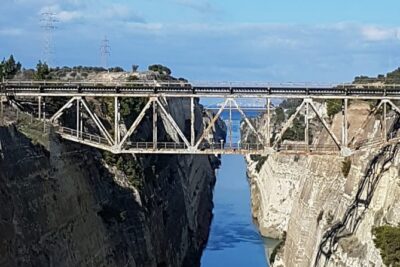
Your day starts building context fast at the Corinth Canal area. You’ll visit the Isthmus Canal, described as one of the most important projects of the 19th century—an engineering job that played a catalytic role for Mediterranean trade.
Then comes the Ancient Diolkos idea: a paved trackway that enabled boats to be moved overland across the isthmus in ancient times. That pairing is smart because it shows evolution instead of just pointing at one monument. You’re seeing how people solved the same geographic problem with different tools across centuries.
Expect this stop to be more about understanding than walking for hours. It’s a great moment to take wide photos, then switch gears toward the dramatic rock of Acrocorinth.
Acrocorinth (Akrokorinthos): The Acropolis That Owns the Sky
Acrocorinth is one of those places where you instantly get why it mattered. It’s the acropolis of ancient Corinth, set on a monolithic rock that dominates the surrounding area.
What’s especially interesting is the fortification story you can read from what remains: a system of circuit walls (including multiple layers) reinforced by towers. From there, you’ll also see traces of the Temple of Aphrodite on the highest of the two peaks, plus the Frankish Tower at the southwest edge of the rock.
Even better, the site preserves later layers too—remains of churches, mosques, houses, fountains, and cisterns. That mix makes Acrocorinth feel less like a single era snapshot and more like a living hill people kept using long after the Bronze Age.
You get around an hour here, and that’s usually the right length to see the key viewpoints without burning the whole day before Mycenae.
Quick Stops at Upper Peirene and Geraneia Viewpoints
Between the big archaeological moments, you get two short stops that work well for a breather. At Upper Peirene, the highlight is the Peirene Spring story tied to Asopus and Sisyphus, located within the encircling walls.
Then you’ll head to Geraneia for views over the Corinthian Gulf and the southwest coast of the Peloponnese. These are the kinds of stops that help you reset your brain. You’re still moving through history, but you’re also getting perspective on geography—why Corinth and its neighbors were positioned for trade and power.
With about 15 minutes at each, you won’t go deep here. But you’ll likely appreciate them because they break up the heavier walking and museum time ahead.
- All Day Cruise -3 Islands to Agistri,Moni, Aegina with lunch and drinks included
★ 5.0 · 4,958 reviews




Ancient Corinth Archaeological Museum and Temple of Apollo
Ancient Corinth is where the day turns from snapshots to substance. You’ll spend time at the archaeological museum first, then work through the site itself, with key areas that include the Temple of Apollo, the Agora, and other major ruins.
The museum matters because it frames what you’re seeing outside. From the artifacts on display—items tied to local life and nearby sites—you’ll get a sense of the scale and variety of what has survived. The Temple of Apollo itself is described as one of the earliest Doric temples in the Peloponnese and on the Greek mainland, with monolithic columns that are rare in the ancient world.
You’ll also encounter the Hadgimoustafa spring, noted as an Ottoman-era fountain built within this landscape. That’s a reminder that ruins don’t live in a sealed bubble; later periods reused and reinterpreted the same spaces.
A practical note: this is a long-ish stop (about 3 hours including time for lunch on a terrace option). If you’re curious about details, this is where you should slow down. If you’re trying to protect time for Mycenae, decide early that Apollo and the Agora are your must-do priorities.
Agora, Bema, Roman Corners, and St. Paul’s Church Mosaic
If you want the religious and cultural connections to feel real, the Agora and the Bema area are important. The Agora described here is a large rectangular space with shops, small temples, and the Bema—the podium associated with Apostle Paul addressing the Corinthians in 52 AD.
You’ll also see Roman buildings and the theatre/Odeon/Asklepieion areas. Even without getting lost in every label, the layout helps you understand how civic life shifted over time.
One stop that tends to land emotionally (and visually) is St. Paul’s church, where a mosaic mural depicts Saul’s vision from Christ as he traveled to Damascus to persecute Christians. It’s not just archaeology—it’s a later layer of meaning sitting right on top of older civic space.
This is a good moment to ask your driver questions as you move. A driver with strong Greek history background can connect the dots quickly, and you’ll get more out of the walk.
From Corinth Town to Mycenae: A Late-Bronze Age Turn
After Ancient Corinth, you get a chance to break into the modern day with a one-hour stop in Corinth town. This is a practical stretch for village-style shopping and handmade souvenirs.
Then the route turns toward Mycenae with a drive time of about 40 minutes. This transition matters. The setting changes from Corinth’s mix of civic and religious remains into Mycenae’s heavy fortress feeling—walls, gates, royal tombs, and the world of late Bronze Age power.
This part is also where pacing matters most. If you’ve spent extra time earlier at Ancient Corinth, Mycenae can feel tighter. My advice: pick a clear cutoff for the site portions you want most and treat the museum time like your final anchor.
Mycenae Site Highlights: Cyclopean Walls, Lion Gate, Treasury of Atreus
Mycenae is described as the richest late Bronze Age center connected with King Agamemnon’s mythical kingdom. Even the entrances are dramatic, starting with the Grave Circles A and B, plus the famous Cyclopean Walls made from huge limestone boulders.
The Royal Palace areas include domestic apartments, the Throne Room suite, the Grand Staircase, rooms for palace officials, and the Forecourt. It’s a compact way to understand how authority was built—literally into architecture.
Then you hit the Lion Gate, the main entrance to the Bronze Age citadel, and you move into the tomb world with the Treasury of Atreus, a tholos (beehive) tomb built around 1250 BC. Nearby is the Tomb of Clytemnestra, also a tholos type tomb dated to around the same period.
This is where good footwear and a calm pace pay off. The walls and gates are unforgettable, but the real value is in looking slowly enough to register scale—huge stones, tight design, and deliberate placement.
If Mycenae is your top priority, I’d plan to spend less time on the optional extras earlier in the day and keep your energy for the most iconic ruins.
Mycenae Museum and the Gold Factor
The Mycenae Archaeological Museum is where you see the payoff for all those tombs and royal spaces. The highlights listed include gold grave goods, burial masks, jewellery, weapons, worship idols, and frescoes.
The museum is typically the place where you’ll leave with the strongest sense of what life and status looked like in this era. It’s also indoor time, which can be a relief if the day is hot and you’ve been outside since morning.
You’ll have about 30 minutes here, so it helps to focus on your own interests. If you love metalwork and decorative pieces, prioritize the gold goods. If fresco themes are your thing, spend your time where those are displayed.
Price, Tickets, and Whether It Feels Worth It
At about $299.78 per person for an 8-hour private tour from Athens, the value is mostly in what you avoid: car rental logistics, wasted transit time, and the stress of coordinating multiple stops on your own.
You also get real comfort extras built in: private first-class vehicle, Wi-Fi, bottled water, and refreshing wipes. And because it’s private, your driver can support timing so you’re not stuck at a site for too little—or too long—depending on what you care about most.
The tradeoff is straightforward: entrance fees to the sites aren’t included, and lunch isn’t included either. So you should budget for admissions at the major archaeological areas and museum time you choose to prioritize. If you want the kind of interpretive detail you’d normally get from a licensed guide, there’s an option for a licensed tour guide to accompany you into the site and museum for an additional cost on request—handy if that’s how you like to learn.
Should you book this private Corinth and Mycenae tour?
I’d book this if you want a one-day hit of Corinth Canal engineering, Acrocorinth’s fortress views, and Mycenae’s Cyclopean walls and royal tombs, all with a dedicated private driver and the convenience of Athens pickup.
I might skip or modify the plan if you hate tight time windows or you’re looking for a museum-heavy day with lots of guided interpretation inside every stop, since tickets aren’t included and indoor time is limited. In that case, decide whether Ancient Corinth or Mycenae is your true priority, and let that choice drive your pace.
If you’re flexible and okay with a full day, this is one of the more efficient ways to see these sites without turning the trip into a logistics project.
FAQ
Is this a fully private tour or shared with other people?
This is a private tour/activity. Only your group participates.
What’s included in the $299.78 per person price?
Included items are fully private service, professional drivers, hotel/port pickup and drop-off, private first-class transportation, onboard Wi-Fi, bottled water and refreshing wipes, and skip-the-line ticket service on request.
Are entrance fees to the sites included?
No. Entrance fees to the sites are not included, and food and drinks are also not included.
Do you get Wi-Fi and refreshments during the day?
Yes. The vehicle includes Wi-Fi, plus bottled water and refreshing wipes during your tour.
How does pickup work if I’m staying in an Airbnb?
Your driver will contact you upon arrival so you can meet at the entrance of the building.
Can I cancel for a full refund?
Yes, you can cancel for free up to 24 hours in advance for a full refund.
If you want, tell me your travel dates and whether you care more about Ancient Corinth or Mycenae—I can suggest how to protect the time you’ll want most.



More Private Tours in Athens


More Tours in Athens


More Tour Reviews in Athens
- All Day Cruise -3 Islands to Agistri,Moni, Aegina with lunch and drinks included
★ 5.0 · 4,958 reviews