REVIEW · ATHENS
Ancient Corinth, Mycenae, Epidaurus, Nafplio full day private tour from Athens
Book on Viator →Operated by My Athens Transfers · Bookable on Viator
Two thousand years of Greece, in one long day. This private route strings together Corinth Canal views, the big hitters of Mycenae and Epidaurus, and a real lunch break in Nafplio.
I like that the driving is done in a private, air-conditioned vehicle with Wi-Fi and bottled water, so the day doesn’t feel like a slog between sites. I also like the optional upgrade to a traditional Greek lunch at a local restaurant. One thing to consider: it’s a full, packed day with steep walking and lots of uneven ground, so you’ll want comfy shoes and a realistic pace.
In This Review
- Quick hits before you go
- The value of a private Peloponnese day from Athens
- Corinth Canal: a short stop with the right kind of wow
- Ancient Corinth and its museum stop: history with context, not overload
- Mycenae: Lion Gate, the walls, and the story of Agamemnon’s world
- The Archaeological Museum of Mycenae and the Treasury of Atreus
- Epidaurus: sanctuary buildings and a theatre where sound is part of the design
- Nafplio lunch time: break the ruins cycle with real town wandering
- Hilltop views around Acronauplia and Palamidi’s steep climb
- Private driver commentary: what you get when the driver doesn’t enter the sites
- Price and entrance fees: budgeting for a full day of major sites
- What to bring for steep stones and a long day
- Should you book this private Corinth–Mycenae–Epidaurus tour?
- FAQ
- Is this a private tour?
- How long is the tour?
- Does the tour include pickup from Athens hotels?
- Is lunch included?
- Are entrance fees included in the tour price?
- Does the driver guide you inside the archaeological sites?
- What is the cancellation policy for a full refund?
Quick hits before you go
- Private hotel pickup and drop-off means you start and end where you actually are in Athens.
- Corinth Canal gets a top-down photo moment and context fast, with the canal’s narrow 21.4 m width in your back pocket.
- Mycenae is the heavy hitter: Lion Gate, Cyclopean walls, and the Treasury of Atreus are built for big “how did they do this?” moments.
- Epidaurus Theatre is the site where acoustics matter, not just architecture.
- Nafplio breaks up the day with time for lunch, coffee, harbor photos, and optional views from the hilltop fortress area.
- Drivers like Notis, Spiros, Panos, and George show up often in the feedback, and they’re praised for safety and lively storytelling on the road.
The value of a private Peloponnese day from Athens
This tour works because it treats the drive like part of the experience. You’re not just being transported between ruins. You get local commentary from your driver in fluent English, plus the comfort of an air-conditioned ride with Wi-Fi and bottled water when the day runs long.
It’s also built for people who want a “best of” outline without feeling trapped in a group bus schedule. With private pickup and drop-off at your hotel (or the exact entrance for an apartment), the logistics are simple, even if your Athens location is a little tricky.
The itinerary is naturally full—Corinth, Mycenae, Epidaurus, then Nafplio—so it’s the kind of day where your enjoyment depends on your willingness to walk and climb. If you’re hoping for a light, sit-down-and-snack route, this may be more effort than you want.
You can also read our reviews of more private tours in Athens

Corinth Canal: a short stop with the right kind of wow
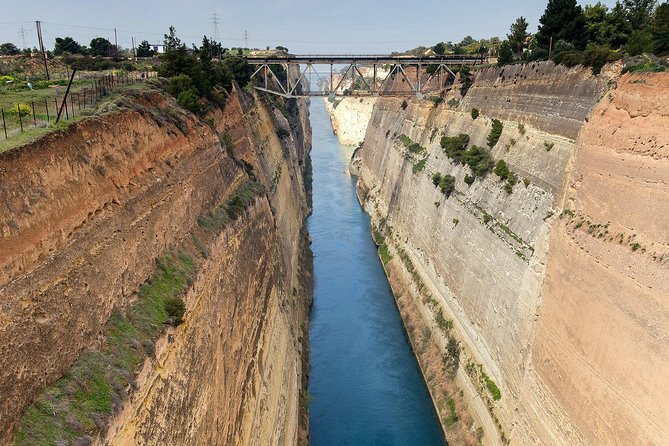
You’ll first hit the Corinth Canal, the narrow cut linking the Ionian Sea and the Aegean Sea. It’s only 6.4 km long, 21.4 m wide at its base, and it has no locks, which matters because it limits what can pass through.
The stop is brief, but it’s aimed at the good part: being high enough to see the steep limestone walls and the vessels threading through below. That top-down angle is what makes this more than a roadside photo. You also get the bigger geographic idea: the canal makes the Peloponnese feel like an island.
Tip for your time here: keep your camera ready for the first viewpoint, then take a second look once you’ve clocked the canal’s scale.
Ancient Corinth and its museum stop: history with context, not overload
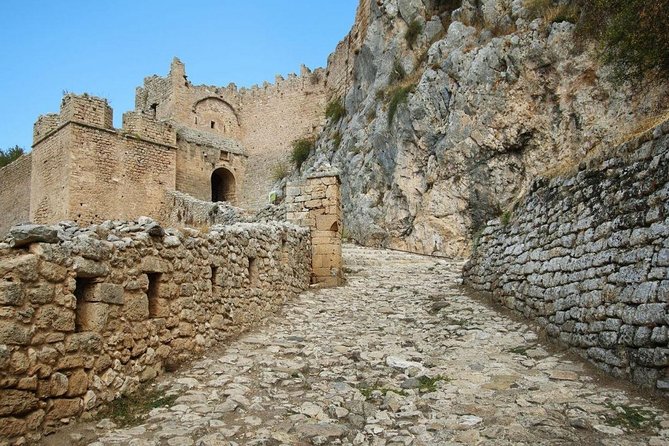
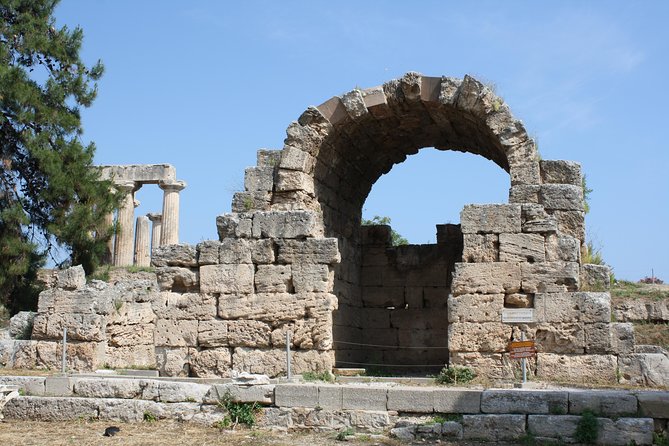
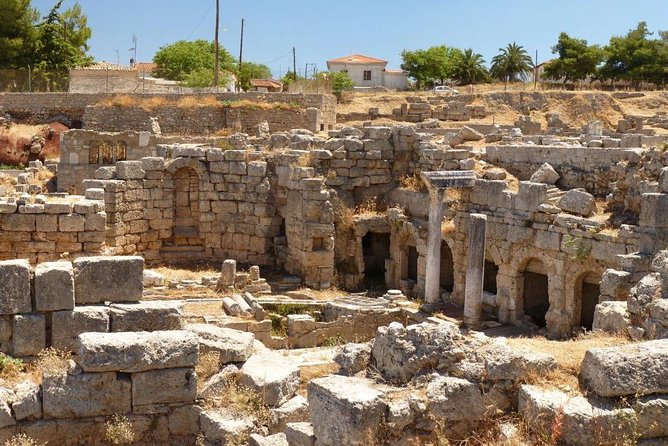
Ancient Corinth, or Archaia Korinthos, sits at the center of multiple stories. It’s tied to the letters of Saint Paul, and it also shows up in Pausanias’ Description of Greece. But more than religion-and-textbook facts, the site helps you understand why Corinth mattered: it was a major city-state on the Isthmus, positioned between major Greek power centers.
You’ll get about an hour at Ancient Corinth, plus a museum visit on-site. The museum is small enough to feel manageable, but it’s designed to showcase the excavations from the area. That’s a smart combo: ruins for scale, museum for “what am I looking at?”
There’s also a quick stop at the Temple of Apollo (constructed around 550 BC). Even with a short time window, it helps you connect the site to the religious life of the ancient city, rather than treating Corinth like only a set of walls.
A practical note: museum timing is usually where you’ll either feel refreshed or restless. Here, the museum is short enough that it tends to work well if you keep moving.
Mycenae: Lion Gate, the walls, and the story of Agamemnon’s world
If you care about the Bronze Age, Mycenae is the place. The citadel is described as the seat of mythical King Agamemnon, and it’s also tied to the Mycenaean civilization—the period of Greek history often labeled from roughly 1600 BC to 1100 BC.
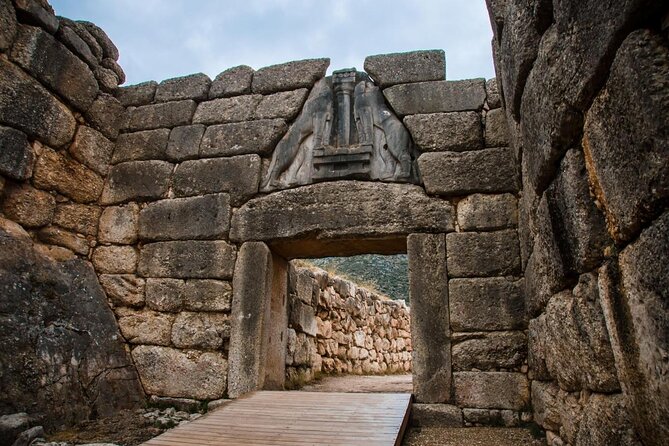
You’ll spend time in the fortified area, focusing on standout monuments like the Lion Gate and the Cyclopean walls. Those walls are called Cyclopean for a reason: the scale makes it feel almost impossible without machines we didn’t have back then. The access through Lion Gate also gives you a clean visual idea of how the rulers controlled entry.
Lion Gate is a star even for archaeology nerds, because the relief sculpture is one of the rare surviving monumental pieces of Mycenaean sculpture. It’s also noted as the only surviving relief motif described in classical antiquity literature—so you’re looking at something with a trail of attention stretching into the classical era.
The Archaeological Museum of Mycenae and the Treasury of Atreus
Right by the Lion Gate area, you’ll visit the Archaeological Museum of Ancient Mycenae. It’s timed around a half hour, so it’s not a slow museum day. Think of it as a “tight focus” stop to anchor what you saw outside.
Then comes one of the most dramatic monuments on the route: the Treasury of Atreus (also known as the Tomb of Agamemnon). This is a large tholos, built around 1250 BC, with the “beehive” stone-tomb style.
The numbers here are almost unfair. The lintel above the doorway is described as weighing 120 tons, with massive dimensions. Even if you don’t memorize those figures, seeing the entrance makes you appreciate the engineering punch.
If you like historical detective work, it’s also tied to later rediscovery. Pausanias mentions it centuries after it was built, and it was still visible in 1879 when Schliemann discovered shaft graves under the Acropolis area.
You can also read our reviews of more tours and experiences in Athens
- All Day Cruise -3 Islands to Agistri,Moni, Aegina with lunch and drinks included
★ 5.0 · 4,958 reviews


Epidaurus: sanctuary buildings and a theatre where sound is part of the design
The route shifts from city life to something closer to healing and ritual with Epidaurus. You’ll first stop at the Archaeological Museum of Epidaurus, established in the early 1900s to display artifacts from the site. The museum is described with reconstructions and displays that help you picture what these temples and structures looked like in use.
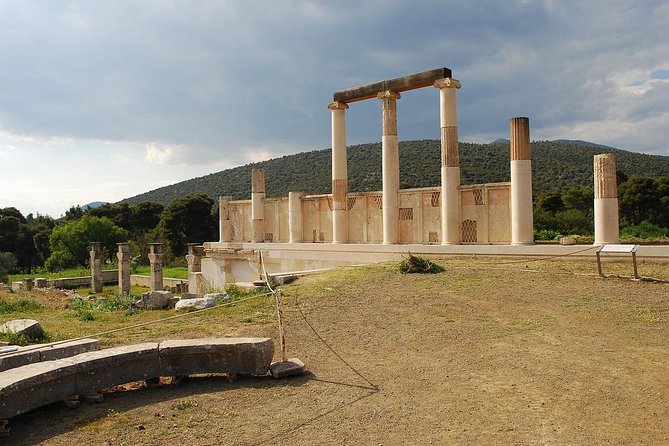
Then you’ll head into the sanctuary area devoted to Asclepius, the god associated with medicine. The temple of Asclepius is dated to the early 4th century BC, and the sanctuary is described as a major rival to other big sites in Greece.
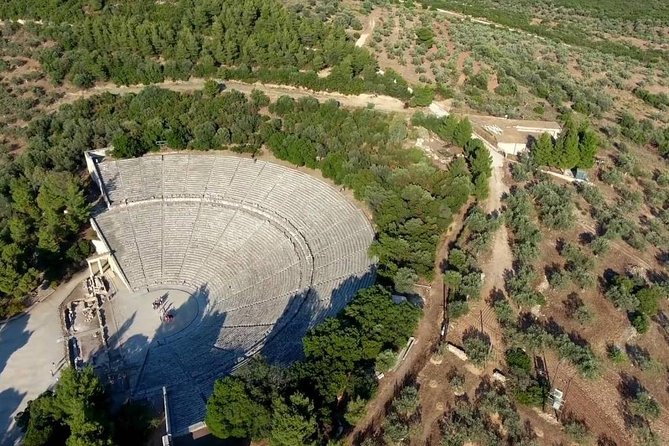
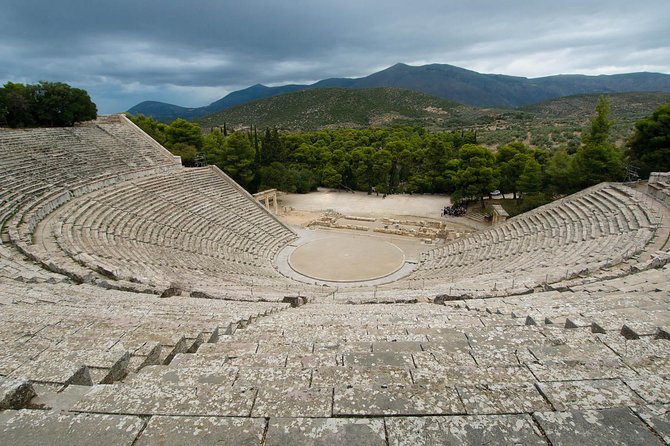
After that, the highlight is the Ancient Theatre of Epidaurus. It’s widely considered one of the best-preserved ancient Greek theatres for acoustics and aesthetics. What makes it special is that it retains a clear theatre layout: theatron, orchestra, and skene.
This is where you’ll feel the difference between “ruins” and “designed space.” Even in a short visit, it’s the kind of theatre where your brain starts mapping sightlines and hearing routes.
Nafplio lunch time: break the ruins cycle with real town wandering
Nafplio is a major reason this tour doesn’t feel purely archaeological. You get free time for lunch, coffee, or shopping, plus extra room to wander. The stop is about 1 hour 30 minutes, which is enough to eat without turning it into a sprint.
The town is described as Venetian-flavored, with cobbled squares, waterfront views, and towering castles overlooking the Argolic Gulf. It also earns its nickname as the Naples of the East, thanks to the mix of old-world architecture and seaside energy.
After lunch time, you’ll have the chance to enjoy the harbor and nearby fortifications. You can view Bourtzi, the Venetian water castle sitting in the harbor. It’s short and photo-friendly, and it gives you that classic “castle-from-the-water” perspective.
Hilltop views around Acronauplia and Palamidi’s steep climb
If you want one more dose of dramatic views, the route includes time at Acronauplia, the oldest part of Nafplion that became part of the town’s fortifications under later rulers. It’s also where the hilltop story turns into a modern tourism scene, since a hotel complex was built there after the government decided the views would be useful for tourism.
Then there’s Palamidi Castle, the Venetian fortress above Nafplio. It’s positioned on a hill about 216 meters high and was built during the Venetian occupation from 1686–1715. Expect a lot of steps: the route notes 913 steps from town, and locals say it’s more like 999.
This stop is great if you enjoy climbing and want the panoramic payoff. It can feel like a workout if you’ve already done steep ground at Mycenae and Epidaurus. Pace it. Pause often. You’re not trying to win a stair race.
Private driver commentary: what you get when the driver doesn’t enter the sites
One difference to understand up front: your driver is not described as a licensed guide who walks inside each archaeological site with you. Instead, you’ll get deep commentary on the drive and at viewpoints, and your driver can answer questions about what you’re seeing.
In practice, this tends to work well because you can focus during the on-site time without a group constantly herding you. It’s also a good fit if you like reading at your own pace—your driver can still give you the story that makes the stones mean something.
In the feedback, drivers such as Notis, Spiros, Panos, George, Michael, Costa, Alex, and Nicholas show up often, and they’re praised for safety, punctuality, and handling questions. Some are specifically noted for recommending a great restaurant in Nafplio, which can matter when you’ve got limited lunch time.
Price and entrance fees: budgeting for a full day of major sites
The price is $265.70 per person for a 9 to 10 hour private tour. What you’re paying for is time and comfort: pickup and drop-off in Athens, a private air-conditioned vehicle, plus Wi-Fi and bottled water. You’re also paying for the fact that your day is structured around several major destinations without you needing to coordinate separate transport.
Entrance fees are listed as not included for specific sites:
- Ancient Corinth and the Archaeological Museum of Corinth: €15 per person
- Mycenae, the Archaeological Museum of Mycenae, and the Treasury of Atreus: €20 per person
- Epidaurus and the Epidaurus Archaeological Museum: €20 per person
That’s roughly €55 total if you plan to pay for every ticketed component listed. Some stops are free (like the Temple of Apollo and the Sanctuary of Asklepios), so your final total can depend on what you choose to enter versus just view.
You also have an upgrade option for traditional Greek lunch. If you want more than a quick sandwich stop, this is the part that most affects the day’s comfort and enjoyment.
What to bring for steep stones and a long day
This tour is manageable for most people, but it’s not flat. You’ll be doing several walking breaks across rocky and uneven ground, and there’s real climbing involved at points like Mycenae and especially Palamidi.
Here’s what I’d plan around:
- Comfortable shoes with good grip. Some ground is described as rocky and uneven, and rain would make slick surfaces more of a concern.
- Sun protection and water awareness, even though bottled water is included in the car.
- A mental switch for the museum-and-ruins rhythm. Short museum time works best when you treat it as a primer, not a deep study.
Also: the tour is private, but it’s still a packed route. If you’re prone to getting tired in the afternoon, plan to slow down during Nafplio’s free time. That break is built for that.
Should you book this private Corinth–Mycenae–Epidaurus tour?
Book it if you want a single-day hit list of Greece’s Bronze Age power and a top-tier theatre experience, all with Athens pickup and an air-conditioned ride. It’s a strong choice for first-time visitors who feel like the Peloponnese is hard to string together on your own, especially if you value driver storytelling and not just museum labels.
Skip it or consider another option if you need a low-walking itinerary. This day includes multiple sites where the ground is not smooth and where some stops come with steep stairs or uphill sections. Also, if entrance fees would stretch your budget, you’ll want to factor in those ticket amounts ahead of time.
If you’re okay with a full day and you like seeing big sites in one sweep, this tour is good value for what it includes: transport + time structure + comfort + optional lunch.
FAQ
Is this a private tour?
Yes. It’s a private tour, so only your group participates. Your driver picks you up and returns you to the same place or to a point you prefer.
How long is the tour?
It runs about 9 to 10 hours.
Does the tour include pickup from Athens hotels?
Yes. Hotel pickup and drop-off are included, and the driver waits in the hotel lobby. For apartments, the driver waits at the building entrance.
Is lunch included?
Lunch is included, with an option to upgrade to traditional Greek food at a local restaurant.
Are entrance fees included in the tour price?
No. Entrance fees for Ancient Corinth and its museum (listed as €15), Mycenae sites and museum (listed as €20), and Epidaurus and its museum (listed as €20) are not included. Some other stops are listed as free.
Does the driver guide you inside the archaeological sites?
Your driver can provide commentary in fluent English, but they are not described as licensed tour guides who enter the sites with you. They can still answer questions about what you’re visiting.
What is the cancellation policy for a full refund?
You can cancel up to 24 hours in advance for a full refund. If you cancel less than 24 hours before the start time, the amount paid is not refunded.




More Private Tours in Athens

More Tours in Athens



More Tour Reviews in Athens
- All Day Cruise -3 Islands to Agistri,Moni, Aegina with lunch and drinks included
★ 5.0 · 4,958 reviews