REVIEW · ATHENS
Fast Private Athens Tour
Book on Viator →Operated by Jump Transfers · Bookable on Viator
Minutes matter in Athens, this tour saves yours. This fast private loop is built for real-life timing, with a driver handling traffic while you hop between top sights. I like that it’s private (just your group, up to four) and that it works well as an Athens shore excursion when you do not have time to plan every bus and ticket. The only real drawback: it’s short, with many stops that feel more like focused look-and-photo moments than slow, in-depth exploring.
You get a mobile ticket, English service, and child-friendly options like infant seats on request, which makes the pace less stressful for families. Expect about 45 minutes to 1 hour 10 minutes of sightseeing, plus the practical benefit of getting picked up from your hotel or apartment.
In This Review
- Key highlights worth your attention
- Why a fast private Athens loop is ideal for limited time
- Price and value: $118.35 per group (up to 4) and what that buys you
- Pickup, timing, and how to use the hour well
- Acropolis Museum and Pnyx: the democracy story in fast, smart hits
- Hadrian’s Gate and the Temple of Olympian Zeus: Roman Athens at full size
- Panathinaiko Stadium: why Athens still celebrates games in marble
- Hellenic Parliament, Evzones, and Syntagma: watching Greece’s democracy in motion
- Academy, University, and National Library: Athens as a learning city
- Omonia, Klafthmonos, and the Old Parliament: squares that help you read the city
- Comfort, weather, and who will enjoy this pace
- Should you book the Fast Private Athens Tour?
- FAQ
- How long is the Fast Private Athens Tour?
- Is this a private tour?
- Do you offer pickup?
- What language is the tour offered in?
- Can you accommodate infants?
- How many people are in a group?
- What days and hours does it operate?
- Is admission included at the stops?
- What happens if the weather is bad or I need to cancel?
Key highlights worth your attention
- Hotel pickup included, so you start without wasting daylight on transit
- Private tour for up to four, ideal for couples, friends, and small families
- Traffic handled for you, which matters in Athens where streets can get messy
- A lineup of big landmarks in one ride, from ancient democracy sites to modern government
- Child-friendly setup, with infant seats available on request
- Admission is listed as free for the stops included on this route
Why a fast private Athens loop is ideal for limited time
Athens can eat up time fast. Not because the sights are hard to find, but because getting between them takes effort—traffic, crosswalks, and finding a parking plan that does not ruin your schedule.
This tour is designed to solve that. You get a quick, private route through major Athens anchors: museum, democracy-era sites, Roman monuments, and modern political Athens around Syntagma. In practice, it means you can see a lot without turning your day into a logistics project.
It’s also a smart choice for shore excursions. When a cruise stops for only a short window, you want the biggest “I’m really in Athens” moments, not a start-and-stop day where you spend half the time figuring out how to get from one place to the next.
The vibe is also more relaxed than a group bus tour. You can keep the pace conversational and practical, and you’re not forced to match someone else’s speed.
You can also read our reviews of more private tours in Athens

Price and value: $118.35 per group (up to 4) and what that buys you
The price is $118.35 per group, up to four people. That pricing structure is important. If you’re traveling as a small group, your per-person cost can land low compared with booking multiple tickets and separate services.
More importantly, this is value for time and convenience. You’re paying for:
- a driver to handle navigation through Athens streets
- a private format with your group only
- a tight route that strings together major landmarks
If you’re used to DIY sightseeing, you might be thinking, Why pay for this when the sights are famous? The answer is that Athens is famous and complicated. This tour trades “freedom to wander” for “freedom to not stress,” which can be a great swap if you’re on a deadline.
And yes, you’re getting a short visit style: more orientation and big-picture exposure than deep study. But for many people, that’s exactly what they want in a first day in Athens.
Pickup, timing, and how to use the hour well
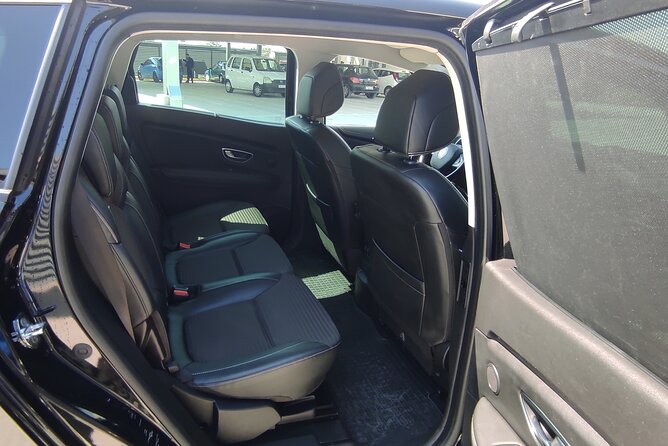
You’re picked up from your hotel or apartment, which is the kind of detail that quietly changes your whole day. Instead of hauling yourself across the city for a meeting point, you start where you’re already sleeping.
The tour runs on a schedule that’s listed as Monday through Thursday, 8:00 AM to 6:00 PM. So if you’re visiting Athens on a Friday, Saturday, or Sunday, double-check availability when you book.
Duration is about 45 minutes to 1 hour 10 minutes. That usually means the route is paced in a “photo stop + quick context” way. Plan your expectations like this: you will see a lot, but you’ll need to come back later (or pair this with another activity) if you want long museum time or slow walking.
A practical tip: if you can, do this early in your Athens trip. Use it to get oriented. After that, you can decide what deserves a second visit with more time.
Acropolis Museum and Pnyx: the democracy story in fast, smart hits
The day starts with the Acropolis Museum, a major archaeology museum that houses artifacts from the Acropolis site and surrounding slopes. It’s built to display findings from Greek Bronze Age through Roman and Byzantine Greece, and it even sits over ruins tied to parts of Roman and early Byzantine Athens.
The scale is the kind of detail that helps you understand why this museum matters: it exhibits over 4,250 objects across about 14,000 square meters. The museum itself opened to the public on June 20, 2009, and it was founded earlier in 2003, with organizational development in the years that followed.
Then you move to Pnyx, the hill where Athenians gathered for popular assemblies starting as early as 507 BC. It’s located less than a kilometer west of the Acropolis and about 1.6 kilometers southwest of Syntagma Square, which makes it a strong “connect-the-dots” stop. You’ll get a sense of how democracy wasn’t a vague idea—it was a physical place where people gathered.
If you only have a short time in Athens, this pairing works well because it hits both sides of the story:
- what’s been preserved (the museum)
- where the decisions were made (Pnyx)
The drawback, again, is time. In a short stop, you’re not reading every panel or walking every gallery wall. But you do come away with sharper context for what you’ll see later around the Acropolis area.
Hadrian’s Gate and the Temple of Olympian Zeus: Roman Athens at full size
Next up is Hadrian’s Gate (also known as the Arch of Hadrian). It’s a monumental gateway that resembles a Roman triumphal arch and spanned an ancient road connecting central Athens to the eastern complex that included the Temple of Olympian Zeus.
The arch is tied to the Roman emperor Hadrian. It’s commonly associated with a celebration linked to his arrival and the dedication of the nearby temple complex in the early 2nd century AD. There’s also a detail worth knowing: inscriptions have been interpreted by scholars as honoring him more as an Athenian citizen than strictly as a Roman ruler.
Then you get to the Temple of Olympian Zeus, the Olympieion—famous for its scale and for the long construction timeline. Construction began in the 6th century BC, but it wasn’t completed until the reign of Emperor Hadrian in the 2nd century AD, about 638 years later.
When you stand near these remains (or view them from your quick stops), it helps to know the original plan: 104 colossal columns were part of the Roman-era temple vision. During that period, it was considered the largest temple in Greece and housed one of the largest cult statues in the ancient world.
This portion of the tour is great if you want the Athens story to include more than classical Greece. Athens didn’t freeze in time. The city kept evolving, and Roman Athens left a huge physical mark.
In short: this pair gives you the “power and ambition” side of history, in the most literal way possible—through massive stone architecture and the symbolism of gateways and temples.
- All Day Cruise -3 Islands to Agistri,Moni, Aegina with lunch and drinks included
★ 5.0 · 4,958 reviews




Panathinaiko Stadium: why Athens still celebrates games in marble
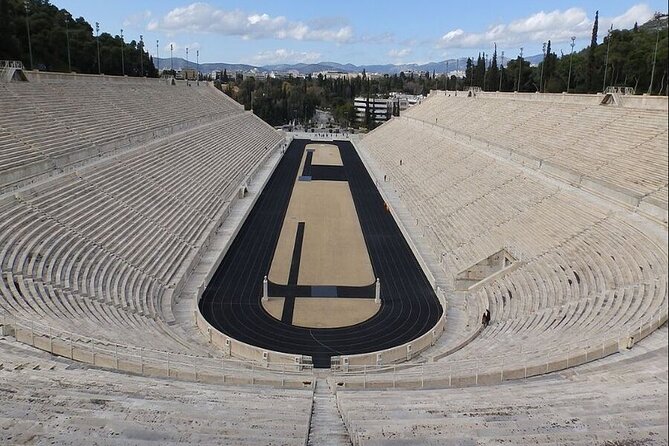
The route continues to Panathinaiko Stadium (often called Kallimarmaro). This is one of Athens’ most recognizable historic venues, and it has a simple reason for the attention: it’s the only stadium built entirely of marble.
A stadium existed on the site long before the current form. Records tied to Lykourgos point to a racecourse-style stadium around 330 BC, built for the Panathenaic Games. The stadium was rebuilt in marble later by Herodes Atticus in 144 AD, and it reached a reported capacity of 50,000 seats.
After Christianity spread in the 4th century, the venue fell into neglect. It was later excavated in 1869, then hosted the Zappas Olympics in 1870 and 1875. The modern turning point is big: it hosted key events for the first modern Olympics in 1896, and the stadium also staged major events again in 2004.
If you like your travel with a bit of continuity, this stop is satisfying. The site is not just ruins—it’s still part of athletic life in Athens. It’s even the finishing point of the annual Athens Classic Marathon, which means this marble arena still gets used.
In a fast stop, you’re not touring like an indoor museum visit. But you do get a strong sense of why this stadium keeps returning to the city’s identity.
Hellenic Parliament, Evzones, and Syntagma: watching Greece’s democracy in motion
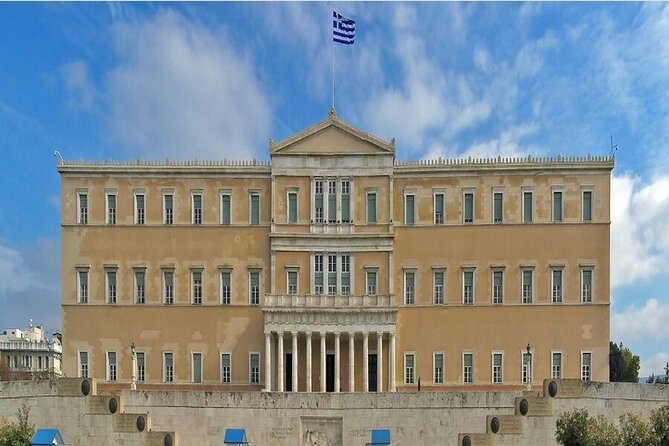
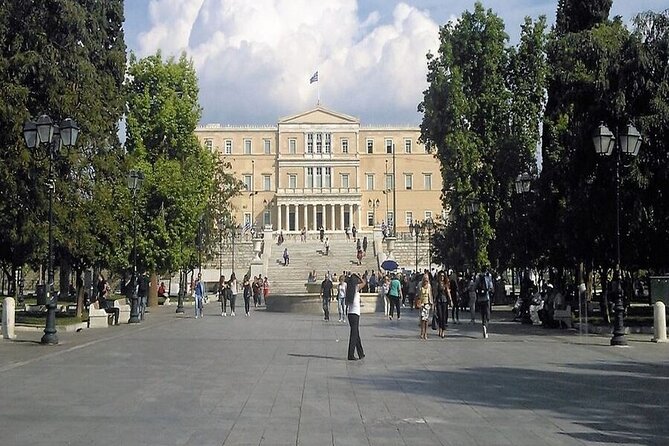
Now the tour shifts into modern Athens with Syntagma Square and the buildings that frame it. The Hellenic Parliament sits in the Old Royal Palace, overlooking Syntagma Square. It’s described as Greece’s unicameral legislature and the supreme democratic institution that represents citizens through elected Members of Parliament.
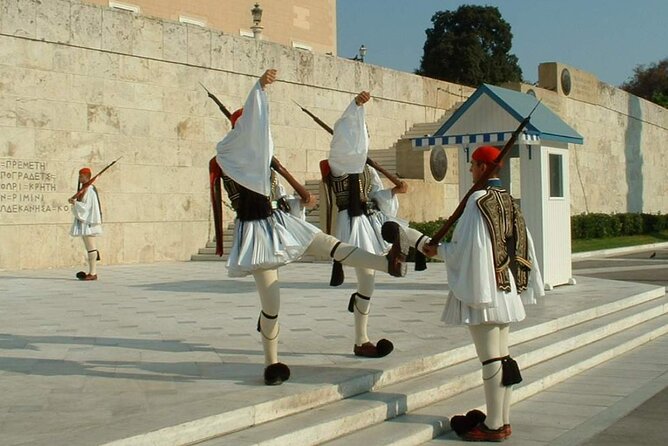
Right nearby, you’ll also have a close look at the Evzones—the Presidential Guard unit. The tour information calls out that these are today’s ceremonial guards for the Tomb of the Unknown Soldier and the Presidential Mansion. Their distinctive uniform evolved from clothing tied to the klephts who resisted Ottoman occupation.
The most visible piece is the fustanella, a kilt-like garment. This uniform is why you see so many people stopping in the street: it’s instantly recognizable and very theatrical, even when you’re just doing quick sightseeing.
Then you land back at Syntagma Square itself. It’s the central square of modern Athens, named after the constitution Athens was forced to get in 1843 following an uprising on 3 September 1843. It’s located in front of the 19th-century Old Royal Palace, and the Parliament has been housed there since 1934.
Syntagma is also a transit powerhouse: the metro station under the square connects lines 2 and 3, plus there’s a tram terminal and numerous bus stops. That makes it useful for more than sightseeing. After the tour, it’s an easy place to navigate the city from.
In a short time, this section gives you a sense of the present-day Athens “center of gravity.” Ancient sites tell you what Athens used to be. Syntagma tells you what Athens is still trying to be.
Academy, University, and National Library: Athens as a learning city
One stretch of the route is dedicated to Athens as a place of study and research.
First is the Academy of Athens, described as Greece’s national academy and its highest research establishment. It was established in 1926, with founding principles traced back to Plato’s historical Academy. It operates under the supervision of the Ministry of Education.
Then you pass the National and Kapodistrian University of Athens (EKPA). It was established by Regency Law on December 31, 1836 (old calendar) by royal decree of Otto on April 14, 1837. It has been continuously operating since May 3, 1837. The university is the largest in Greece after the Aristotle University of Thessaloniki, with more than 40,000 undergraduate students and more than 2,000 teaching and research staff.
You also stop at the National Library of Greece. The tour data says it was founded by Ioannis Kapodistrias in 1832. Its mission is centered on preserving evidence of Greek culture and intellectual production, including locating, collecting, organizing, describing, and preserving those materials over time.
These stops might not feel like the “wow” monuments of the Acropolis area, but they add something important: Athens has always been a city that builds institutions, not only temples.
Also, if you’re traveling with students, teachers, or people who love systems and education, this part gives you a side of Athens that many first-time visitors miss.
The practical note: in a fast route, you’ll likely view exteriors more than you’ll tour inside. Still, the names alone tell you you’re looking at big national institutions, not random buildings.
Omonia, Klafthmonos, and the Old Parliament: squares that help you read the city

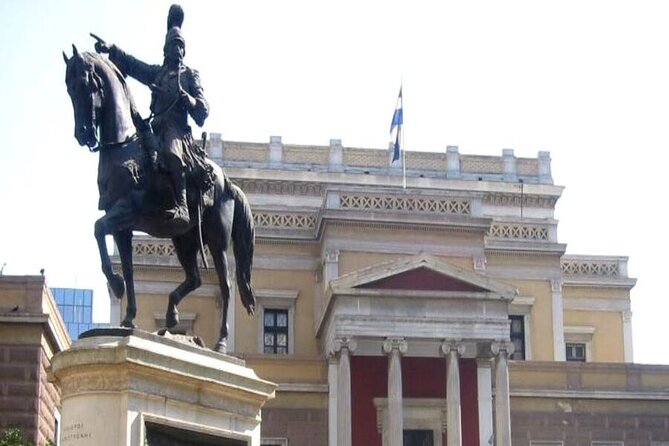
No one “lives” in a museum. Most people experience Athens in streets and squares. This route includes three that act like city signposts: Omonia, Klafthmonos, and the Old Parliament building now home to the National Historical Museum.
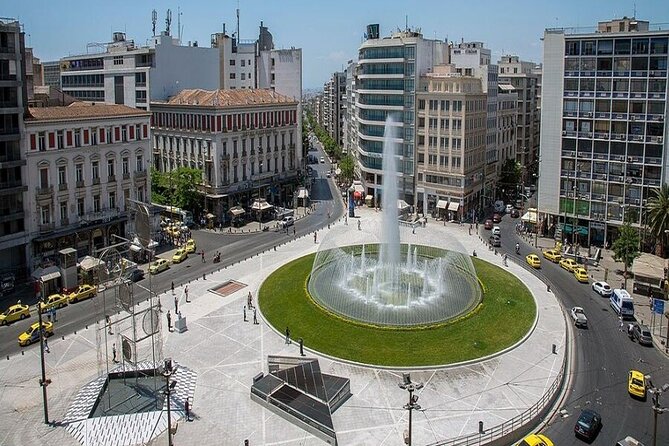
Omonia Square (Concord Square) is a central traffic hub served by Omonia metro station. It’s an older square and an important shopping area, placed at the intersection of six main streets (including Panepistimiou and Stadiou among others).
Then there’s Klafthmonos Square, nicknamed the Crying Square. The meaning comes from a vignette in the magazine Hestia. The story tied the name to dismissed civil servants who protested for their dismissal in front of the Ministry of Finance, which has since been demolished.
Finally, you see the National History Museum (Old Parliament). This site held the Greek Parliament between 1875 and 1935. It originally started as the house of politician Alexandros Kontostavlos. When Athens became the capital in 1833, King Otto selected it as a temporary residence while the Royal Palace was being built. After the 1843 Revolution, the national assembly convened here. A major fire in 1854 destroyed the earlier building, and construction of a new building began in 1858 with French architect Francois Boulanger involved, with the foundation laid by Queen Amalia.
This cluster is useful because it helps you understand Athens as layers, not a single era. By the time you reach Syntagma, you already have a better grasp of how the city’s civic power shifted between buildings and squares.
Even in short stops, these details make your photos more than decoration. You can glance at a square later and remember what kind of civic life it represented.
Comfort, weather, and who will enjoy this pace
This tour is short by design, and that affects comfort. If you like a slow, deep plan with lots of walking, you might feel held back. If you like quick, efficient orientation with plenty of flexibility for the rest of the day, you’ll likely be happy.
It’s also child-friendly. The tour info notes infant seats are available on request, which is a big deal if you’re traveling with a baby and do not want to gamble on comfort and safety.
One more practical point: the experience requires good weather. That matters in Athens, where conditions can change quickly. If it’s canceled for poor weather, you’ll be offered a different date or a full refund.
If you’re someone who gets annoyed by public transit transfers and group-meeting chaos, this private format is a solid fit. You sit back, let your driver deal with city movement, and you get a focused sampler of Athens in about an hour.
Should you book the Fast Private Athens Tour?
Book it if:
- You have a tight schedule and want major Athens landmarks without a DIY transit puzzle
- You’re traveling in a small group of up to four and value private, door-to-door simplicity
- You want a first-day overview so you can decide what deserves more time later
- You’re bringing kids and want infant seats on request plus a calm pace
Skip it (or pair it with something else) if:
- You want long museum time and deep reading inside each site
- You hate short stops where you might not feel fully satisfied without a second visit
If your goal is to get your bearings fast and see how Athens moves from ancient democracy to Roman monuments to modern government, this one is a practical, time-smart choice.
FAQ
How long is the Fast Private Athens Tour?
It runs for approximately 45 minutes to 1 hour 10 minutes.
Is this a private tour?
Yes. It’s private, and only your group participates.
Do you offer pickup?
Yes. Pickup is available from your hotel or apartment.
What language is the tour offered in?
The tour is offered in English.
Can you accommodate infants?
Infant seats are available on request.
How many people are in a group?
The price is per group for up to 4 people.
What days and hours does it operate?
The listed opening hours are Monday through Thursday, 8:00 AM to 6:00 PM.
Is admission included at the stops?
The tour details list admission tickets as free for the stops included.
What happens if the weather is bad or I need to cancel?
The experience requires good weather. If it’s canceled due to poor weather, you’ll be offered a different date or a full refund. You can also cancel for a full refund up to 24 hours in advance.


More Private Tours in Athens


More Tours in Athens


More Tour Reviews in Athens
- All Day Cruise -3 Islands to Agistri,Moni, Aegina with lunch and drinks included
★ 5.0 · 4,958 reviews