REVIEW · ATHENS
Biblical Ancient Corinth Canal Epidaurus Nafplio Private Tour
Book on Viator →Operated by Yomadic.Tours & Transfers · Bookable on Viator
Corinth and Epidaurus in one day sounds ambitious. I like how this feels truly private while still covering major ancient sites, and I also love the air-conditioned comfort (plus WiFi and water) on the long drives. One thing to consider: it’s a full day, and several key sites have entrance fees you’ll pay separately, so you’ll want to budget and pace yourself.
If you enjoy switching gears—from the engineering drama of the Corinth Canal to the theatre-and-acoustics fame of Epidaurus, then to Nafplio’s hilltop castles—you’ll probably have a great time. I also appreciate the hands-on flexibility. People have mentioned guides like Giannis, Themos, and Chris working with changes and not rushing, which is exactly what you want when you’re trying to match the day to your energy level.
At $240.93 per person, you’re paying for the convenience: pickup/drop-off from your exact place in Athens (hotel, Airbnb, port), a modern vehicle, and a driver who shares history along the way. The “hidden cost” is mostly the museum and site tickets, so it’s worth comparing total spend versus doing multiple separate day trips.
In This Review
- Key points worth knowing before you go
- Why this Athens-to-Peloponnese day plan works
- Corinth Canal: a 2,000-year wish made practical
- Ancient Corinth and the museum: where Paul’s world becomes real
- Temple of Apollo and Acrocorinth: Doric lines and the big fortress view
- Epidaurus: acoustics, the Asklepios sanctuary, and a calmer pace
- Nafplio lunch-and-views time: a pleasant ending after ancient stones
- Palamidi Castle, Akronaufplia, and Bourtzi: the hilltop payoff
- Palamidi Castle
- Akronaufplia
- Bourtzi
- Price and what you’re actually getting at $240.93
- Logistics tips so you don’t feel rushed
- Who should book this private day trip (and who might prefer something else)
- Should you book this private Corinth–Epidaurus–Nafplio tour?
- FAQ
- How long is the private tour?
- Is pickup included, and where can the driver meet me?
- Is this tour private or shared?
- Are entrance fees included in the price?
- What’s included for comfort during the day?
- What if weather is bad?
Key points worth knowing before you go
- Private door-to-door pickup from Athens, with a driver who returns you to the same place or a spot you prefer
- Comfort for a hot day: A/C, WiFi, bottled water, and car seats available if you book in advance
- Big ancient highlights with short stops: Corinth Canal, Ancient Corinth, Apollo, Acrocorinth, Epidaurus, then Nafplio
- Epidaurus is the star for many people: the theatre’s famous acoustics and the Asklepios sanctuary area
- Flexibility is built in so you can slow down for photos, shade breaks, or extra interests
- Entrance fees are separate for multiple sites (including Ancient Corinth, Palamidi, and the Archaeological Site of Epidaurus)
Why this Athens-to-Peloponnese day plan works
This is a classic “see it all” day, but it’s planned in a way that makes sense. You start at Corinth and its immediate area, then you move into Epidaurus, and finally you end in Nafplio—one of the most pleasant places to close a long sightseeing day.
The practical win is the order: you get the engineering and ancient Corinth pieces first, then the theatre-and-medicine complex at Epidaurus, then the views and food vibe in Nafplio. You’re not hopping randomly across the map, and you don’t burn time with extra backtracking.
Also, since it’s private, you don’t have to wait on a large group. That matters with short visits like a quick stop at the Temple of Apollo or a focused look up at Acrocorinth. You can ask for a slower pace, and people have reported that the driver will go longer than the listed schedule when things run smoothly.
You can also read our reviews of more private tours in Athens

Corinth Canal: a 2,000-year wish made practical
The Corinth Canal stop is brief, but it’s the right kind of stop. You’re looking at a narrow waterway that cuts across the isthmus of Corinth, separating mainland Greece from the Peloponnese—turning the peninsula into something closer to an island.
What makes this stop more than a quick photo is the story behind it. The canal was built in the late 19th century, but the idea goes back about 2,000 years. Before it existed, ships that wanted to cross between the Aegean and the Adriatic region had to sail around the Peloponnese, adding about 185 nautical miles.
You’ll also hear the connection to Periander, the tyrant of Corinth (around 602 BC), and his diolkos—essentially a stone road where ships were moved on wheeled platforms. It’s a fascinating reminder that Greeks weren’t just building temples; they were also thinking hard about transportation long before modern engineering.
Tip for you: since this is about impressions and views, don’t over-plan your walking. Wear sun protection and grab a water bottle break; this stop is best as a quick “wow” moment before the deeper ruins later.
Ancient Corinth and the museum: where Paul’s world becomes real
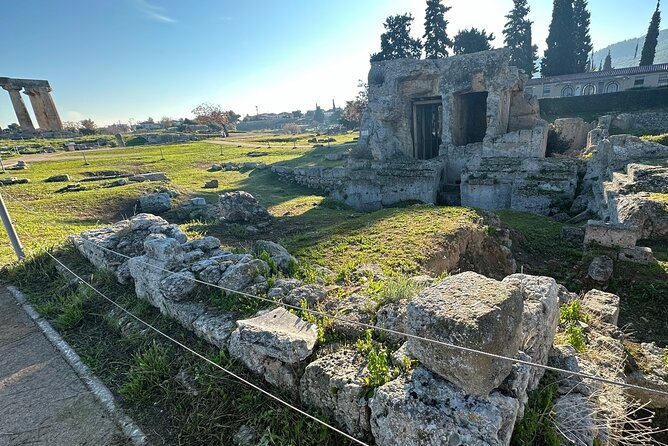
Ancient Corinth is one of those stops where you feel two layers at once: the ancient city’s political and commercial importance, and the later religious meaning it picked up through Saint Paul’s letters.
Corinth was an important city-state on the Isthmus of Corinth—roughly between Athens and Sparta. In 400 BC, its population is given as about 90,000, and later Romans demolished Corinth in 146 BC, built a new city around 44 BC, and made it a provincial capital.
For Christians, the name hits instantly. You’re tied to First and Second Corinthians in the New Testament and to Paul’s missionary travels described in Acts. Even if that part isn’t your focus, the scale of Corinth explains why it was such a magnet for people, beliefs, and power.
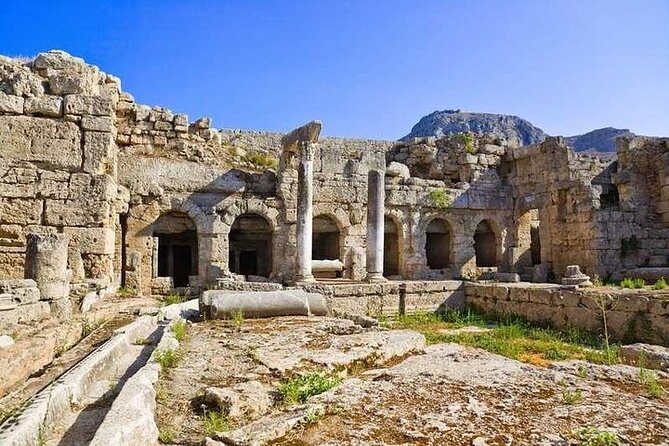
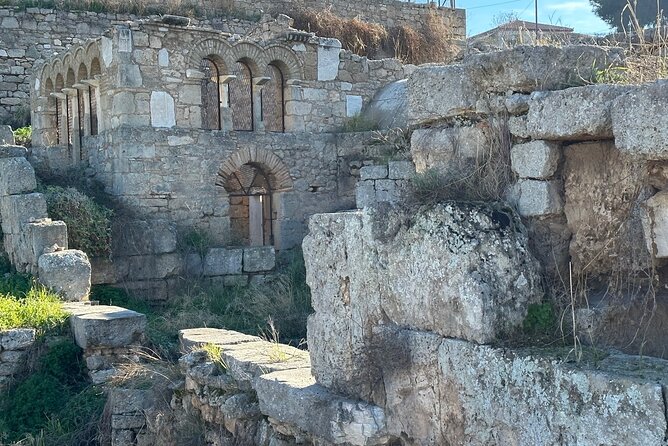
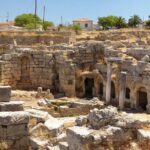
Then there’s the Archaeological Museum of Ancient Corinth, located within the broader ancient site area. It was built between 1931 and 1932 to showcase archaeological finds, and you’ll be in the same zone where key features are labeled and explained—like Lechaion Road, the Basilica, the Fountain of Peirene, the Stoa, the Agora, and the theatre.
A practical note: the museum time is relatively short. So use it to “get your bearings fast.” If you want to read every plaque, this may feel like a race. But if you want context without drowning in details, it’s a good fit.
Consideration: entrance to Ancient Corinth is not included, so you’ll want to budget for that day ticket and be ready to pay it on arrival.
Temple of Apollo and Acrocorinth: Doric lines and the big fortress view

After Corinth proper, the day moves upward—first to the Temple of Apollo and then to Acrocorinth (the acropolis, often called Upper Corinth).
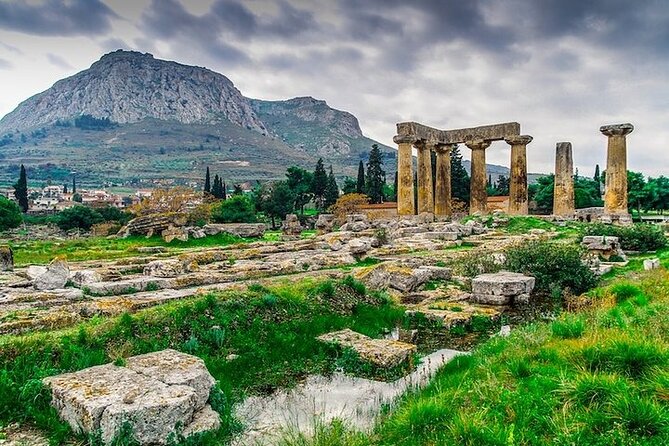
The Temple of Apollo at Corinth was constructed around 550 BC. It’s described as one of the earliest Doric temples on the Peloponnese and Greek Mainland, with monolithic columns that were rare in the ancient world. Even if you can’t spot every detail instantly, the point is clear: this is early, serious Greek architecture, sitting in a landscape that controlled a strategic corridor.
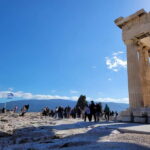
Then comes Acrocorinth, the massive rock fortress that oversees the ancient city. The main value here is not just ruins—it’s the commanding position. Acrocorinth guarded access into the Peloponnese peninsula and was repeatedly used as a last line of defense.
Because you’re on a high point, you’ll likely get long sightlines over the region. That turns history into geography, which is exactly what makes this stop memorable.
Tip for you: plan for heat and stairs. Even when the visit is timed for a shorter stop, acropolis areas can be slow if you pause often to look around.
Epidaurus: acoustics, the Asklepios sanctuary, and a calmer pace
If Corinth is about corridors and empires, Epidaurus is about craft and human experience—especially sound.
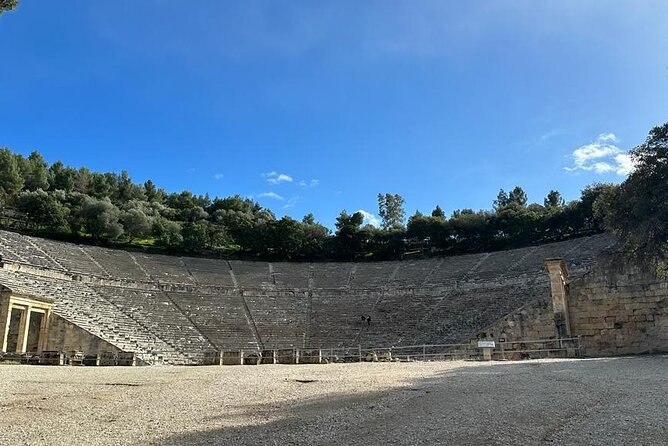
The headline is the Ancient Theatre of Epidaurus, famous for classic Greek construction and astonishing acoustics. The idea is simple and mind-bending: a drop of a coin (or similar gesture) on the stage can be heard even from the last seats. That’s the kind of claim you hear in guidebooks, but it’s worth seeing because the design makes it feel believable rather than mystical.
You’ll also spend time in the Epidaurus Archaeological Museum, which is noted for reconstructions of temples and for columns with inscriptions. That museum is where you can connect what you see in the theatre and sanctuary area to the larger religious site layout.
Then comes the spiritual/medical side: the Sanctuary of Asklepios, dedicated to Asclepius, the ancient Greek demi-god of medicine. Epidaurus is described as a rival to other major cult centers like Olympia and Delphi. The theatre and sanctuary together create a fuller picture: this wasn’t just entertainment, it was a complex place for healing, rituals, and community belief.
Practical pacing: Epidaurus time is split across several parts (theatre, museum, sanctuary). That means you won’t hit every corner in depth. But it’s an efficient way to understand why Epidaurus earned its reputation.
Entrance fees: the Archaeological Site of Epidaurus is listed as €20 per person and isn’t included, so you’ll want to plan for it.
- All Day Cruise -3 Islands to Agistri,Moni, Aegina with lunch and drinks included
★ 5.0 · 4,958 reviews





Nafplio lunch-and-views time: a pleasant ending after ancient stones
By the time you reach Nafplio, the day shifts from ruins to livable city vibes. Nafplio is a seaport town expanded along the hills near the Argolic Gulf. It has medieval layers tied to Argos and Nauplia, and it later served as a capital after the Greek Revolution era.
You get a block of free time for lunch, coffee, and shopping. That’s not filler. It’s your chance to refuel without turning the whole day into a guided march. Many people appreciate having an unstructured window after long archaeological walking.
One of the main photo stops is the Lion of the Bavarians. It’s huge, carved into rock above Michael Iatrou Street, with a small park at its base. The story connected to it is vivid: it was commissioned by King Louis (father of Otto) in memory of Bavarian soldiers who died in Nafplio in 1833 of a typhoid epidemic. Locals also have an alternate nickname-based story that links the suffering to bitter food—so you’ll get both the official account and local folklore flavor while standing right there.
Tip for you: treat this as a viewpoint + story stop, not a “museum.” It works best if you slow down long enough to take it in.
Palamidi Castle, Akronaufplia, and Bourtzi: the hilltop payoff
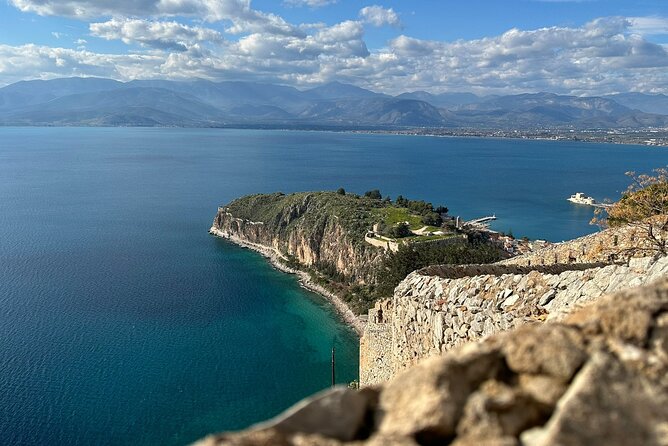
Nafplio is built for views, and this tour leans into that.
Palamidi Castle
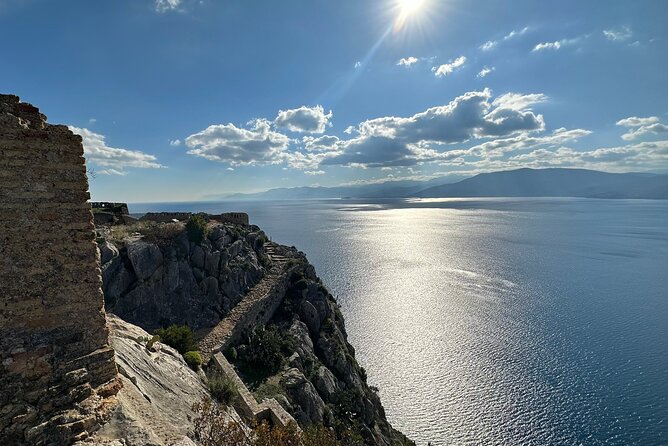
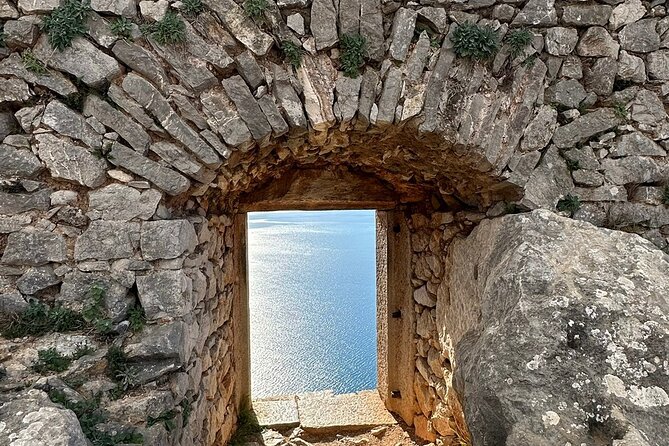
Palamidi Castle is described as one of the best-preserved castles in Greece, built by Venetians during their second occupation (1686–1715). It sits on a hill crest about 216 meters high, so the payoff is the views over the city, the gulf, and the surrounding area.
The visit is short, but it’s also intense. You’ll hear about the steps—locals say 999 steps to the top, while the total inside routes are even more. Even if you don’t count every stair, your legs will remember.
Akronaufplia
The tour also includes time around Akronaufplia, the oldest part of Nafplio. Up until the 13th century it was its own town. Later the Venetians and Franks transformed it into part of the fortifications. At one point it was used as a prison, and then the Greek government kept the area open for tourism because of the views.
This stop is valuable because it fills in how Nafplio became what it is: a fortress city, not just a pretty waterfront.
Bourtzi
Finally, you’ll get the Bourtzi view: a Venetian castle located in the middle of Nafplio’s harbor. The best part is that it’s meant for photos. It’s quick, but it’s a strong visual closer.
Consideration: if your mobility is limited, the Nafplio side includes hills and fortress terrain. You can still enjoy the views, but you might want to ask your driver to adjust the walking level to match your pace.
Price and what you’re actually getting at $240.93
The sticker price—$240.93 per person—can look steep until you break down what’s included.
You’re getting:
- Fully private transportation for your group (not a shared bus)
- Pickup and drop-off from Athens Hotel, Airbnb, or the port, and the driver returns you to the same place or a preferred point
- A modern vehicle with A/C, WiFi, and bottled water
- Fuel and tolls included
- A driver with expert English and extensive historical knowledge
- The option for car seats if needed
- Ability to customize the day if you want changes
What you’re not getting is the “site guide license” inside museums and archaeological zones. Entrance fees are also not included for key places, including:
- Ancient Corinth: €15 per person
- Palamidi Castle: €20 per person
- Archaeological Site of Epidaurus: €20 per person
So the value math for you is mostly about convenience + private time. If you tried to do the same day with trains or multiple taxis, you’d likely lose hours. And if you’re traveling with family, teenagers, or mixed mobility, the private transport becomes even more worth it.
Also, people have praised the drivers for adding flexibility and going longer rather than rushing. That’s hard to measure ahead of time, but it matters when you’re paying for a single full day.
Logistics tips so you don’t feel rushed
This is a day where planning small things makes a big difference.
- Bring sun protection. You’ll be outside for canal views, acropolis areas, and Epidaurus surroundings.
- Pack water. Bottled water is provided on the vehicle, but you’ll still want your own in your day bag too.
- If you care about details at ruins, consider arranging extra guidance at sites. The tour driver shares plenty, but you don’t get a licensed guide accompanying you inside archaeological areas and museums.
- Wear shoes you trust. Acrocorinth and Palamidi aren’t hard in a “climb Everest” way, but they can be tiring if you’re not used to uneven stone.
- Plan your lunch with your pace in mind. Nafplio’s free time is your built-in buffer.
If the day feels long, that’s not your imagination. The best way to make it work is to set your expectations: think in half-hour chunks with breaks, not in checkboxes.
Who should book this private day trip (and who might prefer something else)
You’ll likely love this tour if you:
- Want one day to cover Corinth, Epidaurus, and Nafplio without multiple transfers
- Prefer a private setup where you can slow down, ask questions, or change plans
- Enjoy both classic archaeology and “human scale” city time in Nafplio
- Travel with mixed ages or energy levels and want shade and A/C during the drives
You might choose a different format if you:
- Want deep museum time in every stop (this is more of a highlight-and-context day)
- Struggle with hills, stairs, and uneven ground at acropolises and fortress sites
- Have a very tight schedule and can’t afford a long day away from Athens
Should you book this private Corinth–Epidaurus–Nafplio tour?
I’d book it if you want a smooth, private way to hit multiple headline sites without burning your day on logistics. The combo of A/C door-to-door pickup, flexible drivers (people have highlighted Giannis, Themos, and Chris-style adaptability), and the mix of ancient and modern Nafplio time is a strong match for many first-time visitors to the Peloponnese.
But book it with the right mindset: you’re seeing a lot of stops, not living inside one museum. If you’re okay with “good context, then move on,” you’ll be happy. If you want a slow, fully guided deep-dive everywhere, you may want separate tours instead.
If you do book, I’d also do one simple thing: set your priorities now. Choose what matters most—Epidaurus theatre sound, Acrocorinth views, or Nafplio photos—then use the driver’s flexibility to protect that time.
FAQ
How long is the private tour?
The tour lasts about 8 hours 30 minutes.
Is pickup included, and where can the driver meet me?
Yes. Pickup is offered from your Athens hotel, Airbnb residence, or the port. The driver will wait in the hotel lobby or at the building entrance for apartments, and at the airport arrival hall or port gate for those transfers.
Is this tour private or shared?
This is fully private. Only your group participates.
Are entrance fees included in the price?
No. Entrance fees for archaeological sites and museums are not included. Ancient Corinth is listed as €15 per person, Palamidi Castle €20 per person, and the Archaeological Site of Epidaurus €20 per person.
What’s included for comfort during the day?
You’ll travel in a modern private vehicle with WiFi, A/C, and bottled water. Fuel and tolls are also included.
What if weather is bad?
This experience requires good weather. If it’s canceled due to poor weather, you’ll be offered a different date or a full refund.



More Private Tours in Athens


More Tours in Athens


More Tour Reviews in Athens
- All Day Cruise -3 Islands to Agistri,Moni, Aegina with lunch and drinks included
★ 5.0 · 4,958 reviews