REVIEW · ATHENS
Athens: Philosophy and Democracy Walking Tour
Book on GetYourGuide →Operated by Athens Classic Tours · Bookable on GetYourGuide
Democracy has a walking route in Athens. This Athens classic walk strings together the Ancient Agora and Pnyx Hill so philosophy and politics feel real, not textbook-only.
I especially like the way guides bring each stop to life with story-first explanation, often with English guiding by Panos-style storytelling that makes big ideas easy to follow. The trade-off: it runs rain or shine and it is still a city walk, so wear good shoes and note it is not suitable for people over 70.
In This Review
- Key things you’ll notice on this Athens philosophy and democracy tour
- Why this Athens route makes democracy feel concrete
- Starting at the Statue of Theseus: your “map” for the whole walk
- Kerameikos to Monastiraki: the civic city is also a trading city
- The Ancient Agora: where politics, commerce, and daily life overlapped
- Hadrian’s Library and the Roman Agora: learning and governance in the same frame
- Tower of the Winds: the weather and time machine in plain sight
- Pnyx Hill and Philopappos Hill: the viewpoint that explains democracy
- Pace and comfort: 3.5 hours that still feel like a real walk
- Price and value: $49 for context, not just sightseeing
- Who should book this Athens philosophy and democracy walk
- Should you book it?
- FAQ
- How long is the Athens Philosophy and Democracy walking tour?
- Where do I meet the guide?
- How big is the group?
- Is there a live guide, and is it in English?
- Are kids allowed, and is there a child discount?
- Are site admissions included in the price?
- Does the tour run rain or shine?
- What should I bring?
- Is the tour suitable for older adults?
Key things you’ll notice on this Athens philosophy and democracy tour
- Storytelling that turns ideas into street-level scenes
- Ancient Agora and Pnyx Hill, the heart of civic life
- Kerameikos area connections, including Pericles and famous speeches
- Tower of the Winds, a wind-indicator and clock in marble
- Hadrian’s Library and the Roman Agora without the museum maze feel
- Philopappos Hill views that cap the walk with perspective
Why this Athens route makes democracy feel concrete
Athens is easy to visit as a list of famous ruins. This tour is different. It’s built to explain how philosophy and democracy grew in the same neighborhoods where citizens gathered, argued, traded, and learned.
You’ll connect ideas like rational thought and civic life to the spaces that shaped them. That shift matters because the locations stop being background and start acting like evidence. By the time you reach Pnyx Hill, the story is no longer abstract.
You can also read our reviews of more walking tours in Athens
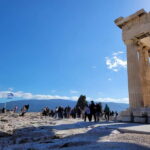

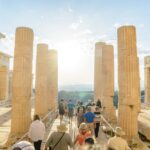
Starting at the Statue of Theseus: your “map” for the whole walk
You meet in front of the Statue of Theseus, opposite the train station across the road. It’s a handy starting point because it gives you a clear reference for the rest of the morning.
From there, the guide sets you up for what you’re about to see. You start with Kerameikos Archaeological Site area context—especially the part about how prominent Athenians were buried there for centuries and the famous speech connection tied to Pericles. Even if you’ve seen photos of ruins before, this beginning helps you understand why people cared about these places.
Two practical notes that help:
- Plan to move at walking-tour speed for a few hours.
- Expect the guide to keep the story moving as you go, not to park you in one spot for long.
Kerameikos to Monastiraki: the civic city is also a trading city
After the opening at the Kerameikos-related area, you shift toward Monastiraki. This is not just a break for shopping. It’s there to ground Athens as a working city, not a theme park.
Monastiraki Flea Market is where the modern atmosphere mixes with the ancient one. You’ll pass antique stores with old-world finds, and the guide’s framing helps you see the continuity: people still gather, browse, negotiate, and learn social rules in public spaces.
This stop also helps you mentally reset between heavier ruins. It’s a good moment to look around, notice side streets, and get a feel for Plaka-style backstreets as you pass through. Athens is famous for its views, but it’s also famous for these everyday corridors that turn walking into sightseeing with texture.
The Ancient Agora: where politics, commerce, and daily life overlapped
The Ancient Agora of Athens is the big civic ingredient. This is described as the best-known example of an ancient Greek agora, and the point is exactly that overlap: political, commercial, administrative, and social activity all mixed in one area.
What makes this stop valuable on a guided walk is the interpretation. You’re not just looking at stones—you’re hearing what kind of life unfolded there and how democracy didn’t come from nowhere. The guide connects the physical setting to the social process: decisions, debate, and public presence.
If you like history that explains how ordinary routines create big systems, this is a highlight. It also sets up the rest of the route so Pnyx Hill later feels like the natural next chapter instead of a random hill with views.
Hadrian’s Library and the Roman Agora: learning and governance in the same frame
Next up, you visit Hadrian’s Library and then the nearby Roman Agora. Hadrian’s Library is the kind of site that tells you Athens wasn’t only about philosophy talks and political speeches—it was also about institutions for learning.
Then you’re in the Roman Agora sphere, which helps you see how later layers of rulers and city design interact with older Greek public life. The tour treats the area as part of a longer story, not as disconnected “Roman bits” added later.
You do have to plan for practical ticketing here: admissions to places like Hadrian’s Library and the Roman Agora are listed as not included. If you’re counting on tickets to be bundled, double-check before you go. Still, the time value is strong because the guide connects each stop into one narrative line.
- All Day Cruise -3 Islands to Agistri,Moni, Aegina with lunch and drinks included
★ 5.0 · 4,958 reviews
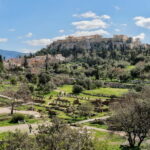




Tower of the Winds: the weather and time machine in plain sight
Tower of the Winds is one of those Athens stops that feels smaller than the idea behind it. It’s an octagonal marble tower in the Roman Agora that functioned as both a wind indicator and a clock.
Here’s the cool detail that makes the stop click: it’s tied to the first meteorological station concept, and the guide explains how it was used to forecast weather. That’s not just trivia. It shows how science, daily planning, and technology lived close together in the ancient city.
Even if you are not a “weather person,” you’ll probably enjoy this stop because it adds a concrete, physical example of how ancient Athenians organized knowledge. It also gives you a short, focused stop within the broader political-philosophy arc.
Pnyx Hill and Philopappos Hill: the viewpoint that explains democracy
Pnyx Hill is the democracy anchor. This is where the tour places the discussion of civic life, and it makes a lot of sense because this is a historic location associated with democracy.
From there, you also reach Philopappos Monument area on the way toward the hilltop views. You get a strong sense of scale when you’re up high. Athens looks like a set of layers from this angle, not one single era.
This is where the tour’s final stretches pay off. When the guide connects political ideas to the physical setting—who could gather, how space shapes speaking, how citizens experienced the city—you get a clearer mental picture. And the views help lock it in.
The route then passes by the Acropolis area. You don’t need to treat this as a full Acropolis mission during this tour, because the focus here is the civic and philosophical road leading up to the big backdrop.
Pace and comfort: 3.5 hours that still feel like a real walk
This is a 3.5-hour guided walking tour. The size stays small, with groups maxing at 15 people, which is great if you want questions answered and not just a lecture that runs over your day.
It’s described as an easy tour, with a few steps at the end. That matters if you are planning your Athens schedule around it. It’s not a “sit on a bus” experience, but it also isn’t framed as a hardcore hike.
Two practical considerations:
- You should plan for rain or shine.
- The tour is not suitable for people over 70.
If you are coming with kids, it’s noted that children up to 14 years old join for free. Reviews also suggest families can handle the content, though younger kids might find some philosophy-heavy moments harder than the scenery parts.
Price and value: $49 for context, not just sightseeing
At $49 per person for about 3.5 hours, this is priced like a focused guided experience rather than an all-day ticket grab. The value comes from the storytelling-to-stones ratio.
You get:
- A live English guide
- A small group size (max 15)
- A route that links key civic and learning sites into one argument: how philosophy and democracy developed together
What’s not included is where you should plan your budget. Admissions are listed as not included for sites including the Athens site entry, Hadrian’s Library, Roman Agora, Tower of the Winds, and Ancient Agora of Athens. If you already wanted to visit these anyway, the tour becomes a smarter way to spend your limited time because the guide adds interpretation to the time you would have spent standing there on your own.
So the real way to judge value is simple: will you appreciate guided context enough to justify separate site fees? If yes, $49 feels fair. If no—if you mainly want to roam solo—then a self-guided approach could be cheaper.
Who should book this Athens philosophy and democracy walk
Book it if you want Athens as an ideas-and-citizens story, not only a photo checklist. It’s a strong fit for:
- First-time Athens visitors who want a framework fast
- History lovers who like politics and public debate
- Students or lifelong learners who enjoy philosophy explained in everyday language
- Families with older kids (especially teens and pre-teens who can stay engaged)
It may not be your best choice if:
- You want minimal walking
- You need a fully accessible route
- You are over 70, since it’s listed as not suitable
Should you book it?
Yes, if you want Athens to make sense as a system—how civic life and thinking shaped the city. This tour’s biggest strength is that it connects places like the Ancient Agora and Pnyx Hill to democracy, and it adds a science-and-philosophy angle through stops like the Tower of the Winds.
I’d book it early in your trip if you can. You’ll return to other landmarks later with better context, and the city will feel less random.
FAQ
How long is the Athens Philosophy and Democracy walking tour?
It lasts 3.5 hours.
Where do I meet the guide?
Meet in front of the Statue of Theseus, opposite the train station across the road.
How big is the group?
The group is capped at a maximum of 15 people.
Is there a live guide, and is it in English?
Yes. You get a live tour guide in English.
Are kids allowed, and is there a child discount?
Children up to 14 years old join for free.
Are site admissions included in the price?
No. Admissions are not included for the Ancient Agora of Athens, Roman Agora, Tower of the Winds, Hadrian’s Library, and other listed entries.
Does the tour run rain or shine?
Yes, it takes place rain or shine.
What should I bring?
Wear comfortable shoes.
Is the tour suitable for older adults?
No. It is listed as not suitable for people over 70.



More Walking Tours in Athens


More Tours in Athens


More Tour Reviews in Athens
- All Day Cruise -3 Islands to Agistri,Moni, Aegina with lunch and drinks included
★ 5.0 · 4,958 reviews