REVIEW · ATHENS
Ancient Corinth, Epidaurus, Nafplio full day private tour from Athens
Book on Viator →Operated by My Athens Transfers · Bookable on Viator
One day. Three ancient worlds, plus a pretty port town. This full-day private route connects Corinth Canal views, Epidaurus at its best, and Nafplio’s castles and harbor. I love that you get the convenience of door-to-door pickup with your own driver, then enough time at each stop to actually look, not just pose. The main catch is the day runs long, and entrance fees for the key sites are extra.
Two big wins for me: first, the chance to follow St. Paul’s footsteps through Corinth with real context, not just dates. Second, Epidaurus Theatre is one of those places where the design still makes sense, even if you’re not a classic-scholar. The one consideration: this is not a licensed guide-follow-you-into-the-sites setup, so if you want commentary inside every building, you may want the optional licensed tour guide.
In This Review
- Key things I’d prioritize before you go
- Why This Corinth–Epidaurus–Nafplio Day Works (Even If It’s a Long Drive)
- Corinth Canal: Fast Views, Strong Geography, No Big Admission Hassle
- Ancient Corinth: Going Past the Ruins and Into Paul’s Context
- Corinth Archaeological Museum: A Helpful Reset Between Big Stops
- Temple of Apollo and Acrocorinth: Short Stops, Big Payoff Views
- Epidaurus Museum: When You Want the Theatre to Make Even More Sense
- Ancient Theatre of Epidaurus: The Acoustics Reputation Lives Here
- Sanctuary of Asclepios: Medicine, Ritual, and a Site Built for Belief
- Nafplio Lunch + Harbour Time: The Best Way to End a Big Antiquity Day
- Bourtzi and Acronauplia: Photo Stops That Also Tell a Story
- Palamidi Castle: Big Views Come With Real Steps
- Drivers, Commentary, and Why Private Changes Everything
- Price and Value: What $229 Buys You on a Day Like This
- What to Pack and How to Survive the Long Day Comfortably
- Who This Private Tour Suits Best
- Should You Book This Corinth, Epidaurus, and Nafplio Private Tour from Athens?
- FAQ
- Is this a private tour or a group tour?
- How long is the tour?
- Do I get hotel pickup in Athens?
- What’s included in the price?
- Are entrance fees included for the ancient sites?
- Is lunch included, and can it be upgraded?
- Will the driver go inside the archaeological sites with me?
- Do you offer a licensed tour guide?
- What language is the tour provided in?
- Is there anything I should know about walking or stairs?
Key things I’d prioritize before you go
- Door-to-door pickup from your Athens address, with Wi-Fi and bottled water for the long drive
- Corinth Canal views that explain why this narrow cut matters in Greek geography
- Ancient Corinth + museum time focused on Paul-era connections and the city’s major layouts
- Epidaurus Theatre—known for acoustics and visual harmony, with time to experience it
- Nafplio’s layered fortresses (Acronauplia and Palamidi) where the views are the point
- Lunch upgrade option if you want a classic Greek restaurant meal, not just a quick stop
Why This Corinth–Epidaurus–Nafplio Day Works (Even If It’s a Long Drive)
From Athens, you’re trading a slow day inside the city for a full day south into the Peloponnese. That trade is usually worth it. You’re stacking three major “why Greece matters” stops: Corinth’s strategic religious crossroads, Epidaurus’ famous sanctuary and theatre, and Nafplio’s elegant harbor-city atmosphere.
I like how the pacing feels built for real viewing. Even though it’s a lot of ground, the stops are time-managed, with short moments for the big scenic hits and longer windows where you’ll want to linger.
The drawback is obvious once you see the scope: you’ll be in the car for most of the day. If you’re sensitive to long driving days, this tour might feel like work. If you’re okay with a travel day that’s action-packed, it’s excellent value for a private format.
You can also read our reviews of more private tours in Athens

Corinth Canal: Fast Views, Strong Geography, No Big Admission Hassle
The day starts with Corinth Canal, the narrow passage that slices through the Isthmus of Corinth. It connects the Gulf of Corinth on one side with the Saronic Gulf on the other—meaning it visually shows how the Peloponnese feels like a separate “island” from the mainland.
What makes this stop special is the viewpoint. You don’t just drive past; you climb or position yourself high enough to see the canal’s steep limestone walls and watch ships thread their way through. The canal is short (about 6.4 km) but extremely tight at the base (about 21.4 m wide). There are no locks, and the canal sits at sea level, so it’s all about direct passage rather than controlled transit.
Practical tip: bring a layer. Even in warm months, open-air views over water can feel cooler, especially when you stop briefly.
Also good news for your budget: the visit time here is short and the admission is listed as free.
Ancient Corinth: Going Past the Ruins and Into Paul’s Context
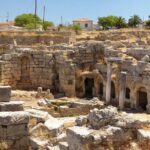
Then you get to Ancient Corinth (Archaia Korinthos), the city-state on the isthmus that mattered strategically and economically. This is not a “tiny ruins” stop. It’s large enough that you’ll feel how big this place once was.
The most meaningful connection here is St. Paul. Corinth shows up in his letters (1st and 2nd Corinthians), and it also appears in the Acts of the Apostles during Paul’s missionary travels. If you like religious history, this is one of the more direct ways to connect text with place.
You’ll also get the broader arc: Romans destroyed Corinth in 146 BC, built a new city later in 44 BC, and eventually made it the provincial capital. That means the site isn’t frozen in one era. You’re walking through layered importance—politics, trade, and belief.
What to expect on the ground: you’ll likely spend about an hour here. That’s long enough to see major areas without rushing, but not long enough to master every detail. If you’re the type who loves reading every sign, you may want more time or an optional licensed guide.
Cost note: entrance for Ancient Corinth is not included and is listed at €15 per person, usually purchased on-site.
Corinth Archaeological Museum: A Helpful Reset Between Big Stops
Right on the site area, the Archaeological Museum of Corinth is the kind of stop that makes the ruins feel less “scattered.” It was built in the early 1930s (1931–1932) to display finds from excavations, so it’s meant to help you connect what you saw with what archaeologists recovered.
The museum sits within the archaeological area, and the tour includes about 30 minutes. That’s enough time to focus on the core objects and reconstructions without turning this into a second full day.
This stop also helps you understand why the Corinth complex feels structured. The museum-side context ties into major features you may notice nearby, like Lechaion Road and key spaces around the sanctuary and city life areas. If you’re aiming to remember more than the “big picture,” the museum is where that memory gets better.
Cost note: the museum entrance fee is also listed as not included (part of the €15 Ancient Corinth package).
Temple of Apollo and Acrocorinth: Short Stops, Big Payoff Views
After the museum, you hit a quick sequence that works well because it mixes “deep time” with scenic reward.
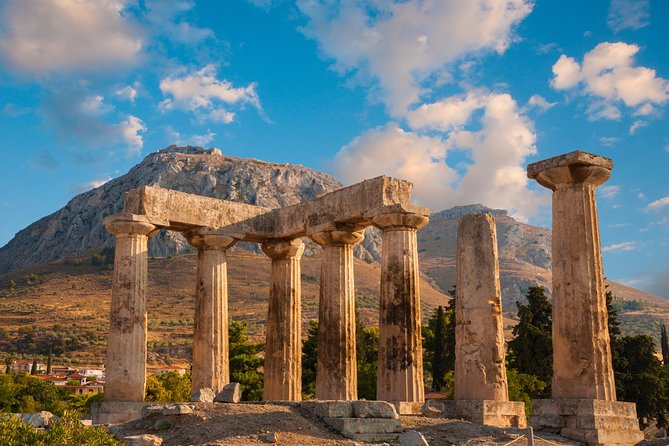
Temple of Apollo at Corinth is a compact stop (about 15 minutes), with construction dated to around 550 BC. The value here is scale and symbolism: you’re looking at a site tied to one of the most important Greek gods, in a city that helped shape regional culture long before Roman times reshaped it.
Then comes Akrokorinthos, also known as Acrocorinth, the Upper Corinth acropolis on a monolithic rock above the city. This one is mostly about views and defense logic. Acrocorinth’s fortress history makes sense when you’re above it: it had a secure water supply and served as a last-line defense because it controlled the Isthmus of Corinth. In other words, it wasn’t just a lookout—it was a gatekeeper.
The tour lists about 30 minutes here, plus the “free admission” note. Practical reality: the walking and terrain can be uneven, and this is a hilltop. Wear proper shoes, and don’t assume it’s a flat stroll.
If you’re comfortable with a bit of effort for a view, Akrokorinthos is one of the most satisfying stops in the day.
You can also read our reviews of more tours and experiences in Athens
- All Day Cruise -3 Islands to Agistri,Moni, Aegina with lunch and drinks included
★ 5.0 · 4,958 reviews


Epidaurus Museum: When You Want the Theatre to Make Even More Sense
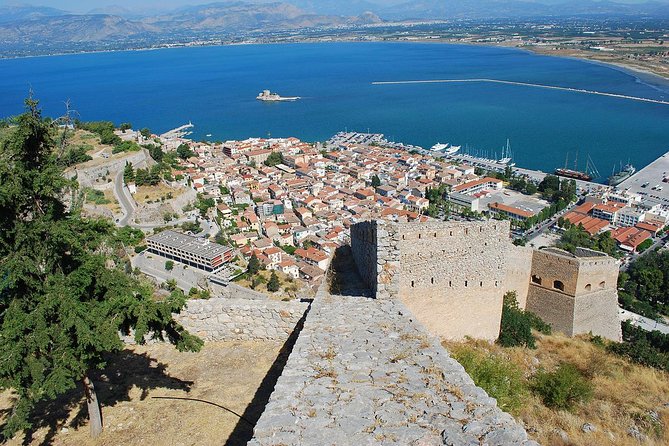
Next you move toward Epidaurus, starting at the Archaeological Museum of Epidaurus. This museum opened in the early 1900s and is known for reconstructions—especially columns and temple layouts—plus inscriptions tied to the sanctuary’s life.
The time window is short (about 30 minutes), so you’ll want to use it like a briefing. Focus on the reconstructions and the way the museum frames what the sanctuary was. If you’re going to the theatre right after, this helps you feel how the site worked as a full complex rather than just a famous performance hall.
Cost note: the museum entrance is not included and is part of the €20 Epidaurus package.
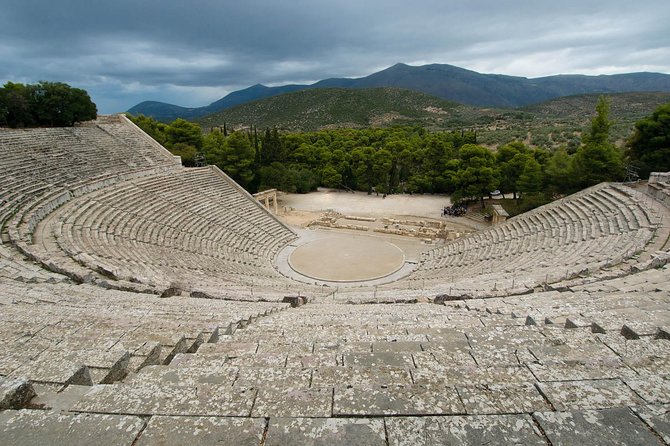
Ancient Theatre of Epidaurus: The Acoustics Reputation Lives Here
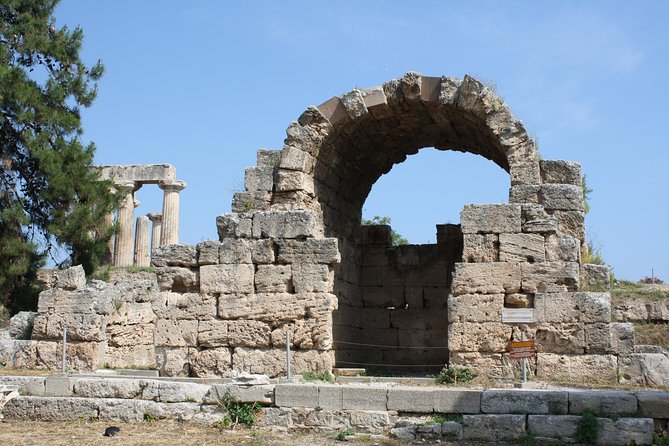
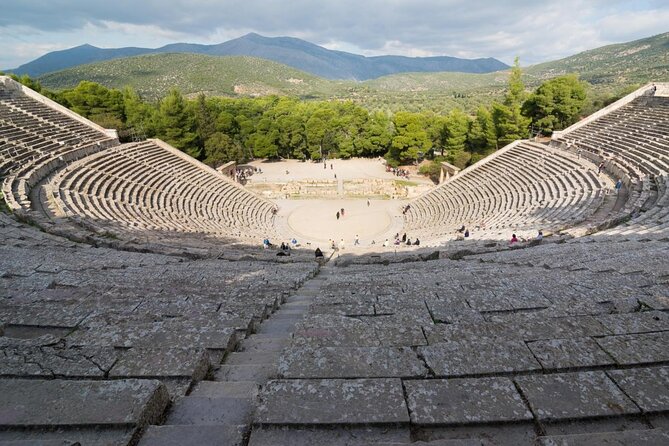
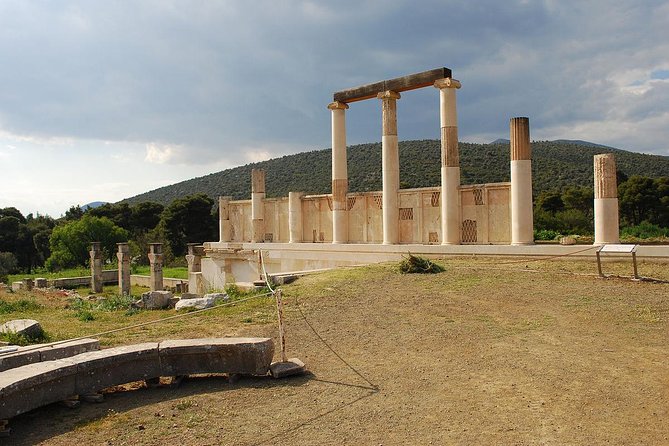
This is the star attraction for many people. The Ancient Theatre of Epidaurus sits at the sanctuary dedicated to Asclepius (the god of medicine). It’s built on the west side of Cynortion Mountain near modern Lygourio.
What you’re looking at is considered the most perfect ancient Greek theatre for acoustics and aesthetics. It retains the Hellenistic layout with three core parts: the theatron, orchestra, and skene. And unlike many theatres, during Roman times it did not suffer major modifications.
In plain terms: the design still works. Even if you only stand there and take it in quietly, you can understand why it became famous. If you’re the type who enjoys architecture, this is a must.
Time on the ground here is about 30 minutes. If you’re photographing, you’ll also want to pause from time to time and just look across the seating. It’s one of those places where the angles teach you something.
Cost note: theatre entrance is not included and is covered by the €20 Epidaurus package.
Sanctuary of Asclepios: Medicine, Ritual, and a Site Built for Belief
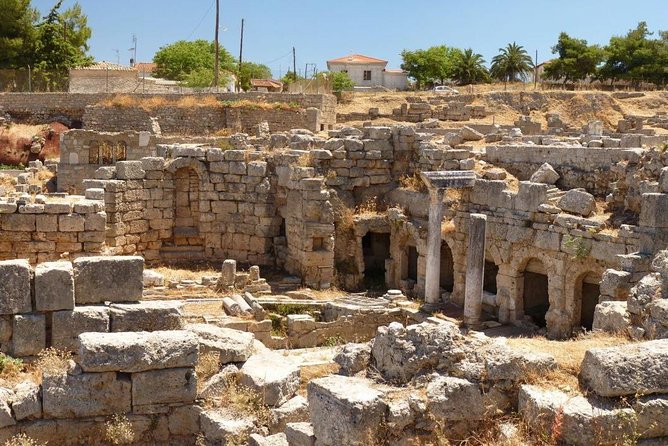
After the theatre, you’ll see the Sanctuary of Asklepios. The temple dedicated to Asclepius was the main holy site in the sanctuary complex. It’s often compared to other top cult sites like Olympia and Delphi, meaning this wasn’t some local spiritual corner.
The tour frames the timeline: the temple was built in the early 4th century BC. There’s also historical context about later closure pressures in the late Roman period when Christian rulers issued edicts limiting non-Christian worship.
This is the stop that turns “cool ancient theatre” into “understanding what this place was really for.” It’s also usually calmer than the theatre area, which helps.
The visit is shorter (about 15 minutes) and the admission is listed as free.
Nafplio Lunch + Harbour Time: The Best Way to End a Big Antiquity Day
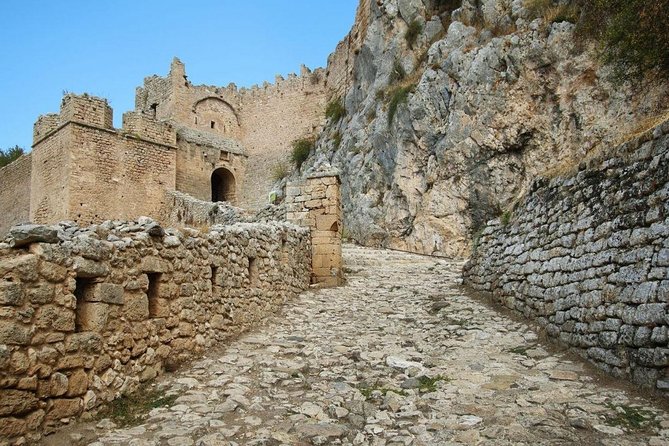
Then you shift gears to Nafplion, often called the Naples of the East, for its Venetian architecture, cobbled squares, and castles that dominate the view over the Argolic Gulf.
You get free time for lunch, coffee, or shopping (about 1 hour 30 minutes). This is where I think the tour earns its keep: you’re not stuck in one scheduled meal. If you want to linger with seafood or keep it light, you can.
You also have an option to upgrade your lunch to an authentic Greek restaurant meal. For many people, that’s the difference between a day that feels rushed and a day that feels like you actually lived somewhere for a while.
Nafplio also has political weight. It served as capital of the First Hellenic Republic and the Kingdom of Greece from the start of the Greek Revolution in 1821 until 1834. So even if your feet are tired, the town isn’t just pretty—it’s meaningful.
Bourtzi and Acronauplia: Photo Stops That Also Tell a Story
After lunch time, you get small but worthwhile viewpoints.
Bourtzi is a Venetian water castle sitting in the middle of Nafplio’s harbor. Even though you’re not spending a huge chunk of time there, it’s a perfect “quick wow” moment, especially for photos from the harbor side.
Admission is listed as free, and the stop is about 10 minutes.
Then you reach Acronauplia, the oldest part of Nafplion. Until the 13th century it was its own town, and later the Venetians and Franks turned it into part of the fortifications. A part of it was used as a prison before being redeveloped for tourism view benefits, with a hotel complex still standing there.
This is one of those stops where you’ll appreciate it more if you like fortifications and layers of occupation.
Palamidi Castle: Big Views Come With Real Steps
If you still have energy, Palamidi is a fantastic finale. Palamidi sits east of Acronauplia on a hill about 216 meters high. It was built by the Venetians during their second occupation (1686–1715).
The payoff is the view over the Argolic Gulf and Nafplio itself. But let’s be honest: you’re dealing with steps. The tour notes 913 steps from town to fortress, while locals say it’s over 1000 (sometimes described as 999). Either way, it’s a climb.
You’ll get about 30 minutes up there. That’s enough time to take in the panorama, walk a bit, and catch your breath again before heading back down.
Practical advice: wear supportive shoes and plan for sun. You’ll feel it more on the return walk.
Drivers, Commentary, and Why Private Changes Everything
This is a private tour with your own vehicle and driver. You get professional drivers with deep background and fluent English commentary, but the drivers are not licensed tour guides who enter archaeological sites with you.
That detail matters. If you want to ask questions while standing inside specific buildings or reading every sign with a guide present, you’ll need the optional licensed tour guide (offered on request, depending on availability).
Still, the driver commentary can make a big difference in how you connect the dots. Based on past guests, drivers like George, Alex, Takis, Anthony, Fotis, and Panos have been called out for being organized, flexible, and full of context. Many of them also adjust stop timing when your interests shift.
If you like personal pacing—more minutes here, less there—private format is the reason this tour gets booked so often.
Price and Value: What $229 Buys You on a Day Like This
At about $229.14 per person, you’re paying for more than transport. You’re paying for a full-day circuit that’s hard to reproduce without a car: Corinth Canal, Ancient Corinth (plus museum), Akrokorinthos, Epidaurus (the museum plus theatre), and Nafplio with castles.
Value breaks into two parts:
- Convenience and stress reduction. Door-to-door pickup in an air-conditioned vehicle, plus Wi-Fi and bottled water, means you spend the day looking at history instead of solving logistics.
- Time efficiency. The route is structured so you see multiple major sites without cutting your day short.
The tradeoff is the separate entrance fees. Budget for €15 per person for Ancient Corinth and its museum, and €20 per person for Epidaurus and its museum. Lunch is included, with an option for a more traditional restaurant meal upgrade.
For families, couples, and groups who want a private pace, this often pencils out well compared with piecing together transport plus tickets plus driver time.
What to Pack and How to Survive the Long Day Comfortably
This day includes hilltop views and stair-heavy fortress areas. You’ll want:
- Comfortable walking shoes for uneven ground and climbs at Acrocorinth and Palamidi
- Sun protection for the Nafplio fortifications and open theatre areas
- A light layer for canal viewpoints and breezy harbour time
- Cash or card for entrances (since Corinth and Epidaurus site fees are not included)
Also, plan your expectations. This is not “see every artifact.” It’s “see the big things, understand why they mattered, and end with a real town experience.”
Who This Private Tour Suits Best
This is a great match if you:
- want a private day trip without renting a car
- like mixing major ancient sites with a classic Greek port town
- prefer guided context from your driver, with an optional licensed tour guide if you want more
- would rather have flexibility than a strict group bus schedule
It may be less ideal if you:
- hate long drive days
- want someone walking beside you inside every site with a license
- have limited mobility concerns (there are climbs and steps at fortress areas)
Should You Book This Corinth, Epidaurus, and Nafplio Private Tour from Athens?
I’d book it if you want one smart day that connects geography, religion, theatre design, and a real town to wander after. The combination of Corinth Canal views, Ancient Corinth’s Paul-era connections, Epidaurus Theatre’s “this still works” feel, and Nafplio’s harbour-and-fortress atmosphere is a strong use of time from Athens.
Before you book, do two quick checks:
- Confirm you’re comfortable with extra site entrances (Corinth package €15, Epidaurus package €20).
- Decide whether you want the optional licensed tour guide for more in-site explanation, since the driver won’t enter the archaeological areas with you.
If those fit your style, this is a high-value private way to get out of Athens and experience the Peloponnese at its most memorable.
FAQ
Is this a private tour or a group tour?
It’s a private tour, meaning only your group participates. You’ll use a private vehicle with pickup and drop-off to the place you choose in Athens.
How long is the tour?
The duration is listed as about 8 to 9 hours.
Do I get hotel pickup in Athens?
Yes. The tour offers hotel/airport/port pickup and drop-off, with a driver waiting in the lobby or at the specified pickup point.
What’s included in the price?
Private transportation, an air-conditioned vehicle, Wi-Fi on board, bottled water, lunch, and the pickup/drop-off are included.
Are entrance fees included for the ancient sites?
No. Entrance fees are listed as not included for Ancient Corinth and its Archaeological Museum (€15 per person), and for Epidaurus and its Archaeological Museum (€20 per person). These can be purchased on-site.
Is lunch included, and can it be upgraded?
Lunch is included. There’s also an option to upgrade to an authentic lunch in a typical Greek restaurant.
Will the driver go inside the archaeological sites with me?
No. The drivers are knowledgeable and can provide commentary in English, but they are not licensed tour guides and they will not enter the archaeological sites with you.
Do you offer a licensed tour guide?
A licensed tour guide is offered on request and depending on availability, for an additional cost.
What language is the tour provided in?
English is offered.
Is there anything I should know about walking or stairs?
Some stops involve hills and steps, especially at fortress areas in Nafplio. Comfortable shoes are important, since this is a long day with walking.




More Private Tours in Athens

More Tours in Athens




More Tour Reviews in Athens
- All Day Cruise -3 Islands to Agistri,Moni, Aegina with lunch and drinks included
★ 5.0 · 4,958 reviews