REVIEW · ATHENS
Biblical Corinth Taste Faith & History with wine & Oil Tasting
Book on Viator →Operated by Yomadic.Tours & Transfers · Bookable on Viator
Faith meets ruins in a tight Athens day.
This is a small-group trip built around Corinth and the Apostle Paul—plus the canal and ship-saving Diolkos story—so you’re not just hopping between ruins. You get a private vehicle day with comfortable timing, real context for the Bible references, and optional wine and oil tasting moments when you want a more sensory finish.
I love the door-to-door style pickup from Athens (hotel, Airbnb, or port) in a modern mini van, not a big bus shuffle. I also love that the day doesn’t treat Corinth as one stop only—you’ll get major ancient areas, museums, and the commanding viewpoint at Acrocorinth.
One caution: the biggest archaeological site can close unexpectedly (including filming periods), and access can shift. Also, what feels like one price can grow once you factor in entrance fees and the tasting add-ons.
In This Review
- Key highlights you’ll feel on the day
- From Athens to Corinth in comfort: private van, WiFi, and smart timing
- Corinth Canal and the Diolkos: how ships got around the peninsula
- Isthmia and the Apostle Paul: faith meeting athletic games
- Isthmia Archaeological Museum: glass from Kechreon, amphorae, and votives
- Ancient Corinth (Archaia Korinthos): the city-state that kept reinventing itself
- Archaeological Museum of Corinth and the story behind the stones
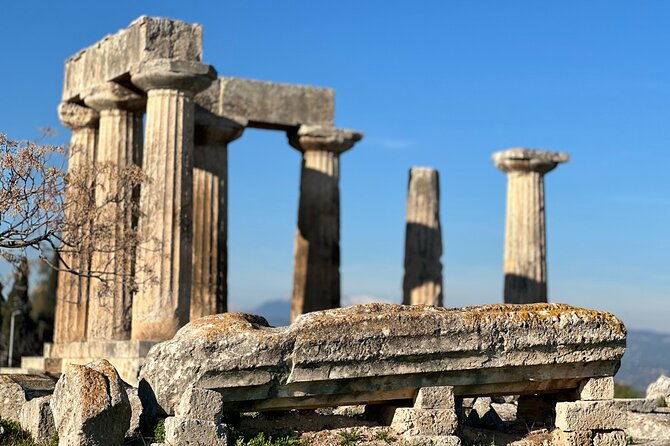
- Temple of Apollo at Corinth: a Doric presence from centuries ago
- Lunch break and Acrocorinth: turning history into a view
- Wine and oil tasting add-ons: how to budget the senses
- When the main site closes: filming periods and last-minute access
- Value check: is $190.46 for 5 hours a good deal?
- Should you book this Biblical Corinth taste tour?
- FAQ
- How long is the Biblical Corinth Taste, Faith & History tour?
- What’s the price per person for this tour?
- Do they pick you up in Athens?
- Is this tour a small group or a bus tour?
- Are wine and oil tastings included in the base price?
- Are entrance fees included?
- Do you get a licensed tour guide?
- What if weather is poor?
Key highlights you’ll feel on the day
- Private mini-van pacing: only your group, up to 7 people, with WiFi, A/C, and bottled water in the car.
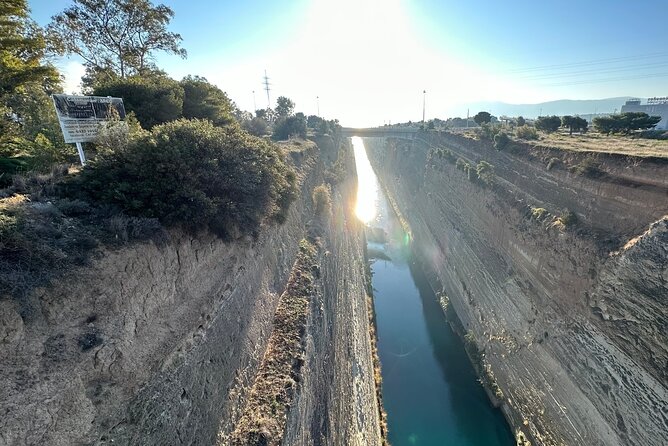
- Corinth Canal + the Diolkos: learn how an isthmus problem got solved with a stone ship-roller trackway.
- Isthmia and Paul’s connection: why the Isthmian Games mattered in early Christian storylines.
- Museum stops with specific artifacts: glass panels from Kechreon, amphorae, votives, and statue types.
- Acrocorinth viewpoints: the fortress on the rock that controlled movement into the Peloponnese.
From Athens to Corinth in comfort: private van, WiFi, and smart timing
The best part of this kind of day trip is not the history itself. It’s the way you get there and back without wasting it. You’ll ride in a modern, first-class private vehicle with WiFi, A/C, and bottled water, which matters because this is a full 5-hour block in a region where summer heat and tight timing can turn “easy” into “stressed.”
Your pickup can be at an Athens hotel or Airbnb, or at the port. If you’re arriving by flight, there’s an optional airport pickup available. Either way, the setup is simple: you get picked up and dropped back to where you started, so you’re not hunting taxis after your last viewpoint.
The tour is offered in English with an English-speaking driver who is well-versed in Greek history. And the group size is genuinely small. This is not a bus experience where you’re stuck on someone else’s schedule; it’s your group in a luxury mini van (capacity up to 7), so questions are easier and the day can feel more like a guided drive with stops than a rigid checklist.
If your priority is maximum time at sites (not in traffic), this is the right kind of format. You also get a mobile ticket, which helps day-of smoothness.
You can also read our reviews of more food & drink experiences in Athens



Corinth Canal and the Diolkos: how ships got around the peninsula
The day starts by making the geography make sense. Corinth sits on a narrow isthmus, and that bottleneck shaped everything: trade, war, and travel routes.
At the Corinth Canal, you’re looking at a waterway that connects the Gulf of Corinth to the Saronic Gulf, effectively separating the mainland from the Peloponnese like an island. The canal is a late-19th-century project, but the big idea is much older: for about 2,000 years, it was a dream to cut across rather than sail the long way around the peninsula.
Here’s the kind of detail that makes the canal stop more than a photo stop. You learn that a tyrant named Periander (early era, around 602 BC) is linked to the first concept of bypassing the long route. Since the technology wasn’t there to dig a canal, the solution was the diolkos—a stone road that let ships be transferred overland.
That brings you to the Diolkos stop. This is one of those stories that makes you slow down. You’re not just hearing that ancient people were clever; you’re seeing how the shortcut worked in concept: a paved trackway where boats and goods could move across the isthmus without the dangerous circumnavigation. The trackway is described as roughly 6 km to 8.5 km long and used from about 600 BC until the middle of the 1st century AD.
Aristophanes even gets credited with a speed saying: as fast as a Corinthian. It’s the sort of phrase that turns ancient infrastructure into something lived-in by ordinary people.
Value tip: If you like practical history—how problems get solved—Corinth starts clicking early. You’ll understand later ruins differently once you’ve wrapped your head around the isthmus role.
Isthmia and the Apostle Paul: faith meeting athletic games
After canal-and-trackway history, the tour shifts from trade routes to people routes. Isthmia is right by the Corinth Canal area, and it’s connected to the ancient world’s second most important sports festivals after Olympia: the Isthmian Games.
The Bible connection is the real hook here. Paul’s presence in the Isthmian region is treated as important, because the reference to him shows his involvement in a cultural event where people gathered from across the Greek world. The story goes that Paul worked as a tent maker for athletes and visitors. In practical terms, that means you’re placing religious identity inside the rhythm of mass public life—not inside some quiet study.
If you’re traveling with someone who loves the New Testament but doesn’t want only church stops, this part works well. You’re standing in a setting that matches how Paul’s world actually moved—crowds, events, travel, trade, and talk. You’ll also get a sense that the games weren’t just sports. They were a platform for community attention.
A quick museum stop follows, so don’t expect a long worship-style narrative here. You’ll get the faith context and then move back into artifacts.
Isthmia Archaeological Museum: glass from Kechreon, amphorae, and votives
The Archaeological Museum of Isthmia is short and focused, which is good on a day trip. You get to see key objects without losing half your time under fluorescent lights.
Some of the most interesting details include:
- Archaic marble pediment (dated to the end of the 7th century BC) placed at the entrance of an early Temple of Poseidon.
- Glazing from Kechreon, glass pieces that arrived from Alexandria packed in twos and were found submerged on the floor of the Temple of Isis. The description matters: these colored segments are compared to stained glass, and they include harbor views, landscapes, animals and plants, and figures like philosophers (Homer and Plato mentioned), along with ships and geometric decoration.
- An Imperial statue type of Zeus (mid-2nd century BC).
- An Epinician stele featuring a portrait of the Corinthian musician Lefkios Cornelius (around 150 AD).
- Animal figurines, including a golden bull described as a vow to the sanctuary (around the 6th century BC).
- Commercial amphorae connected to the region and cult/weapon offerings, plus items from Mycenaean and Roman cemeteries tied to nearby areas.
Even if you only spend a brief time here, it gives you something useful for the rest of the day: the sense that Corinth wasn’t only architecture. It was trade, belief, art, and ritual practice showing up in small objects.
Practical note: This museum stop has an extra admission fee. If you’re trying to control costs, check what’s essential to you—this is the kind of stop where you’ll feel the “value” if you like material culture.
Ancient Corinth (Archaia Korinthos): the city-state that kept reinventing itself
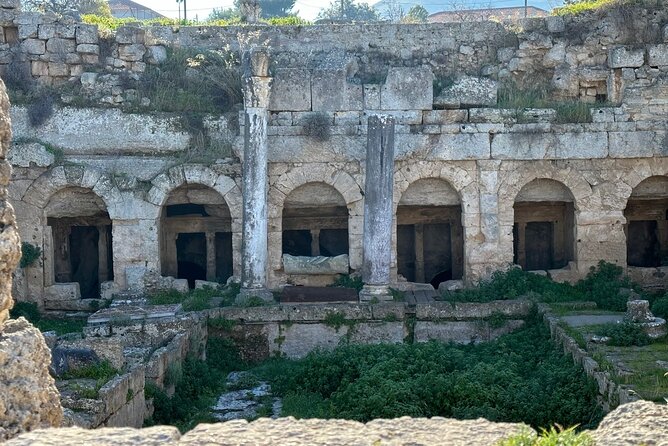
Then the tour lands where the day’s name actually comes from: Ancient Corinth. Corinth was a city-state on the isthmus, roughly halfway between Athens and Sparta, and it grew into one of Greece’s biggest commercial centers. The details matter because they explain why Corinth keeps showing up in historical and biblical references.
The big timeline you’ll hear:
- In 400 BC, Corinth is described with a population around 90,000.
- The Romans demolished Corinth in 146 BC.
- They rebuilt a new city starting around 44 BC.
- Later it became the provincial capital of Greece.
That rebuilding detail changes how you walk through ruins. You’re not only seeing one era. You’re seeing layers of what came after loss.
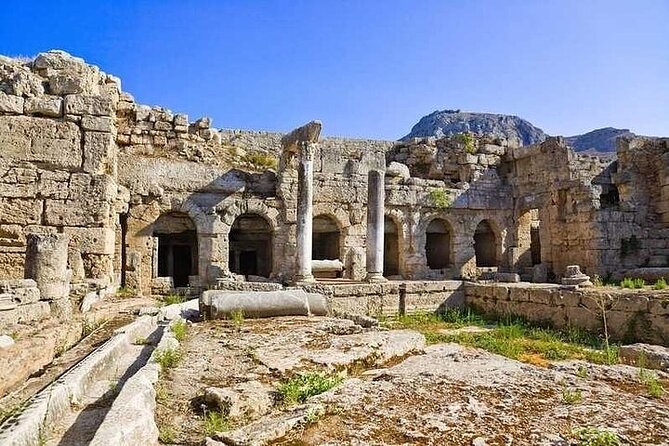
This is also where the faith context becomes more concrete. Corinth is known for Paul’s letters—First and Second Corinthians. It also appears in Acts during Paul’s missionary travel. If you’re the type who reads passages and then wishes you could picture the street-level reality, this is the stop where the city starts to feel like a place instead of a name.
In practice, you’ll get time to explore the ruins area with no museum-bombing. It’s long enough to grasp the scope but short enough that you’re not exhausted before Acrocorinth.
Heads-up: Site access can shift because of closures. If your heart is set on this particular stop being open, it’s worth booking with a flexible mindset.
You can also read our reviews of more historical tours in Athens


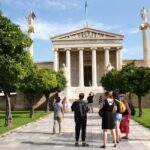
Archaeological Museum of Corinth and the story behind the stones
The Archaeological Museum of Corinth is an add-on stop that sits near the broader archaeological setting. It was built in the early 1930s to show excavations, and that makes it feel purpose-built rather than random.
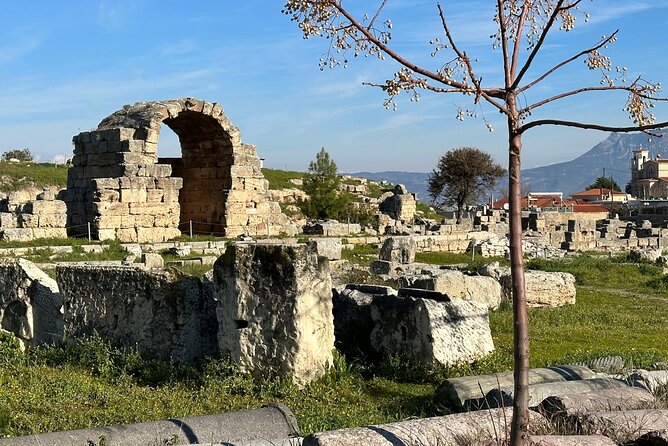
Key context you’ll get as you move around includes the layout and major points in the ancient complex, like:
- the Hadgimoustafa spring
- the Lechaion Road
- areas such as a basilica, the Fountain of Peirene, a stoa, an agora, an odeion
If you like understanding how ancient cities worked day-to-day, museums like this do something underrated. They give you orientation so the ruins stop looking like scattered rock. Instead, you start recognizing where social life happened (agora), where public movement went (roadways), and where water/comfort was planned (springs and fountains).
This is also the segment where the tour balances education and not-too-heavy pacing. You’ll move from museum context into a temple stop.
Temple of Apollo at Corinth: a Doric presence from centuries ago
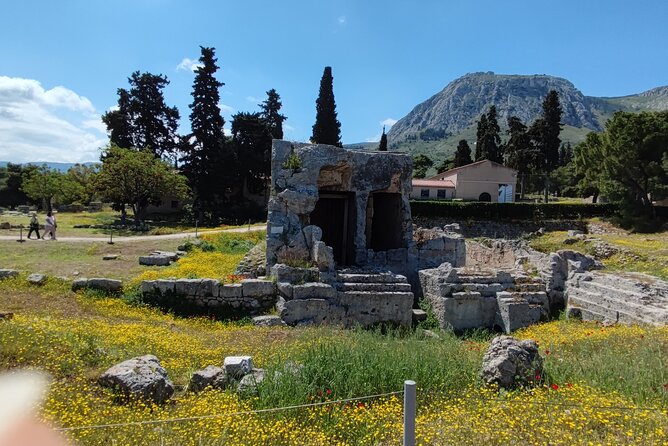
The Temple of Apollo is one of those stops you remember because it’s early, and the architecture is simple but striking.
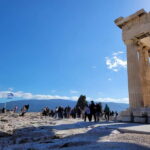
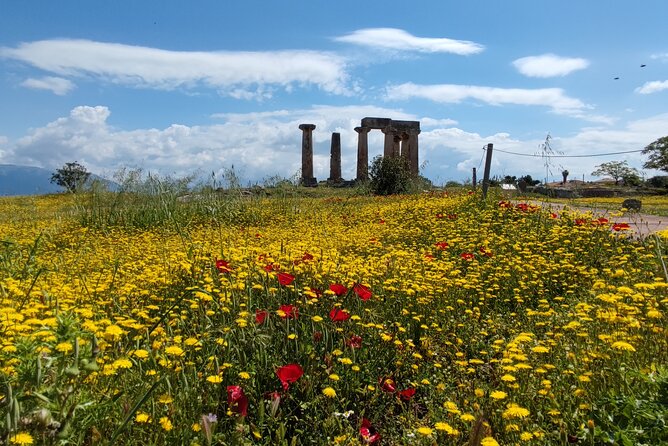
The temple is described as constructed around 560 BC, with dating to about 550 BC also mentioned. It’s said to be one of the earliest Doric temples in the Peloponnese and on the Greek mainland, and the description highlights monolithic columns, which are noted as rare.
Even if you’re not a classical architecture nerd, you’ll likely appreciate the way this anchors the rest of the day. A festival city needs religious space, and Corinth’s identity shows up in those sacred structures.
This is a short stop, so don’t expect a long lesson here. But it’s a good palate cleanser between heavier ruin sections.
Lunch break and Acrocorinth: turning history into a view
At some point you’ll get a chunk of free time for lunch and shopping. That’s smart in a day trip, because it helps you match the day to your preferences. If you want a quick bite, you can keep it casual. If you want to shop for olive oil or local food items, there’s time.
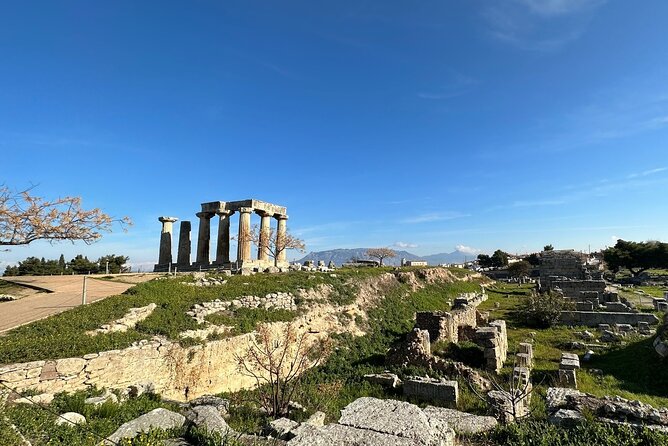
Then comes Acrocorinth, the upper fortress on a rock above Corinth. This is one of the day’s true payoff stops because it explains power.
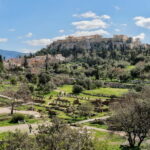
Acrocorinth is described as a monolithic rock overlooking the ancient city. It had a secure water supply, and because it controlled the Isthmus of Corinth, it functioned as a last defense for southern Greece by repelling enemies trying to enter the Peloponnese overland.
Practical reality: you’ll want comfortable shoes, and you should expect some uphill terrain. Even with modest walking, the viewpoint feels worth it. From above, Corinth’s “between Athens and Sparta” positioning stops being a map fact and becomes a lived geography fact.
In the accounts I’ve seen connected to this tour, drivers like Panos or Periklis are often praised for making this segment work, not just as a view, but as an explanation of why the fortress mattered to control movement and survival.
Wine and oil tasting add-ons: how to budget the senses
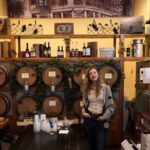
Here’s where the title can be a little misleading if you don’t read the fine print. Oil tasting and wine tasting are listed as paid add-ons, not automatically included in the base price.
What you can add:
- Oil tasting with finger food: €80 per person
- Wine tasting: €15 per person
So think of the pricing in two layers:
1) You pay for the guided day and transportation.
2) You choose how much of the taste experience you want.
If you want the “taste” part without going all-in, the wine add-on is the more budget-friendly way to keep the day moving. If you’re a serious foodie who wants the full sensory angle, the oil tasting is the big spend—and it may be worth it if you care about learning how olive oil connects to regional food culture.
Either way, plan on entrance fees too. The tour lists entrance fees as extra, including an estimated €15 per person for archaeological site admission.
My practical take: pick one tasting level. Don’t assume both are included. A calm budget makes the day feel enjoyable instead of awkward at payment time.
When the main site closes: filming periods and last-minute access
There’s one scenario you should plan for: a major stop can close unexpectedly. In this particular experience, closure risk has happened when a site is used for filming (the information given includes a reference to filming for director Nolan’s project The Odyssey), and the tour can’t always know the day and time in advance due to safety.
What does that mean for you?
- Be flexible about which ruins and museum segments you’ll get.
- Consider adding enough buffer to your schedule so you’re not forced to make the day work no matter what.
- Keep your expectations realistic: Acrocorinth often delivers even when other parts shift, because it’s tied to the fortress viewpoint and the broader area, but the main archaeological route can still be affected.
This is the kind of situation where having a strong driver matters. Good drivers adjust on the fly and make sure you still leave with clear understanding of what you did see.
Value check: is $190.46 for 5 hours a good deal?
At $190.46 per person for about 5 hours, you’re paying primarily for:
- private small-group transportation (up to 7 max)
- English-speaking guidance from the driver
- door-to-door pickup in Athens
- the ability to hit major Corinth landmarks efficiently without a complicated route
Whether it’s a great value depends on your style:
- Best value for you if you want a guided day with minimal hassle and you’re okay adding entrance fees and tasting add-ons.
- Less value if you already have your own transport and only want one or two stops. You could build a cheaper DIY day, but it won’t be as smooth, and it won’t come with the narrative thread connecting Corinth, Paul, the canal, and the fortress.
Also watch the add-ons:
- entrance fees are extra (listed as €15 per person)
- museum admissions can be extra
- a licensed tour guide is optional (listed as an additional €140 per person)
- oil and wine tastings add cost
So the smarter way to think about price is total cost, not starting cost. If you choose the wine tasting only, you’ll likely feel good about the overall spend. If you add oil tasting too, budget accordingly.
Given the consistently high satisfaction rating (4.9) and the recurring praise for drivers, the base day itself seems to land well for people who want a guided, no-drama day.
Should you book this Biblical Corinth taste tour?
Book it if you want a guided Corinth day that connects Paul, the isthmus geography, and the ancient city layers, all with private-vehicle comfort and time for viewpoints. It’s a great fit for first-time Corinth visitors and for anyone traveling with Bible interests but not wanting to turn the day into only scripture talk.
Skip or rethink if you’re trying to keep the day ultra-budget. Entrance fees and optional tastings can add up fast, and a filming-related closure is a real risk for specific days. If your schedule is tight and non-negotiable, consider having a Plan B elsewhere.
If you do book, my advice is simple: choose your tasting add-on level ahead of time, wear good shoes for Acrocorinth, and ask your driver to frame the day around what you care about most—Paul’s story, ship routes, or the fortress power. That’s usually when this day turns from sightseeing into understanding.
FAQ
How long is the Biblical Corinth Taste, Faith & History tour?
It runs about 5 hours.
What’s the price per person for this tour?
The price is listed as $190.46 per person.
Do they pick you up in Athens?
Yes. Pickup is offered from an Athens hotel, Airbnb residence, or the port. You can also request airport pickup for an extra €60 per person.
Is this tour a small group or a bus tour?
It’s a small group experience. It’s private for your group and uses a luxury mini van up to 7 passengers.
Are wine and oil tastings included in the base price?
Wine tasting and oil tasting are listed as extra costs. Wine tasting is €15 per person, and oil tasting with finger food is €80 per person.
Are entrance fees included?
No. Entrance fees for attractions are listed as €15.00 per person, and some museum/site admissions are also not included.
Do you get a licensed tour guide?
An English-speaking driver is included. A licensed tour guide is optional upon request, depending on availability, for an additional €140.00 per person.
What if weather is poor?
The experience requires good weather. If it’s canceled due to poor weather, you’ll be offered a different date or a full refund.


More Historical Tours in Athens
More Food & Drink Experiences in Athens



More Tour Reviews in Athens
- All Day Cruise -3 Islands to Agistri,Moni, Aegina with lunch and drinks included
★ 5.0 · 4,958 reviews