REVIEW · ATHENS
Beat the Heat Acropolis Tour – Small group
Book on Viator →Operated by Alternative Athens · Bookable on Viator
Athens’ Acropolis hits different in the afternoon. This small-group tour trades some midday sweat and crowd stress for a guided route that makes the stones make sense. You’ll walk the main stops on the hill, with an English-speaking licensed guide and a wireless headset so you’re not shouting over other visitors.
Two things I like a lot: the small-group size (max 15) keeps the pace calm and the questions coming, and the stop-by-stop focus helps you actually connect the sites to the myths and history you’re seeing. One possible drawback: the Acropolis entry ticket isn’t included, so if you don’t pre-buy it, you can lose precious time to lines at the gate.
If you hate slow ticket chaos, plan ahead. If you want to understand the Acropolis beyond photos, this tour is a very practical way to do it without feeling like you’re in a human conveyor belt.
In This Review
- Key things to know before you go
- Why this Beat the Heat timing actually helps
- Meeting point and getting oriented fast at Hadrian’s Arch
- Your 2-hour route: from Dionysus’ stage to Athena’s temple
- Stop 1: Theatre of Dionysus Eleuthereus
- Stop 2: Temple of Athena Nike
- Stop 3: Erechtheion
- Stop 4: Propylaea
- Stop 5: Parthenon (the main event)
- Wireless headset and small-group pacing: what you’ll feel
- The ticket issue: plan for the €30 Acropolis entry fee
- Footwear and footing: steep, slippery, and worth respecting
- Price and value: what $54.44 really buys
- Who this tour is best for (and who should rethink it)
- A practical game plan for a better Acropolis day
- Should you book this Beat the Heat Acropolis tour?
- FAQ
- Is the Acropolis entry ticket included in the tour price?
- How long is the Beat the Heat Acropolis Tour?
- What stops does the tour include?
- What language is the guide?
- Where do I meet the guide?
- Are there any restrictions on bags or strollers?
- Is the group size small?
- Do I need ID if I’m under 25?
- Can I get a refund if plans change?
Key things to know before you go

- Wireless headset helps you hear the guide even in noisy crowd pockets.
- Small group (max 15) makes it easier to keep up and ask questions.
- Main Acropolis landmarks only: Theatre of Dionysus, Athena Nike, Erechtheion, Propylaea, and the Parthenon.
- Entry ticket is separate (pre-purchase option available), so avoid last-minute surprises.
- No strollers or big bags allowed at the Acropolis, so pack light.
Why this Beat the Heat timing actually helps

The Acropolis is one of those places where the biggest challenge isn’t “seeing it.” It’s managing the crowds and the heat without getting cranky. This tour is designed for the afternoon approach—when the light can be kinder, the crowds can feel more manageable, and you’re not baking through your whole visit.
You’ll be walking uphill between key ruins, and that alone can be tiring in summer. The afternoon timing helps you keep your energy for the moments that matter most: the view lines, the architectural details, and the stories your guide connects to what you’re standing in front of.
And that’s the real payoff here. The tour isn’t only about getting to the top. It’s about getting there with context, so the Parthenon isn’t just a famous building—it’s a turning point in how Greeks built, worshipped, and projected power.
You can also read our reviews of more tours and experiences in Athens.



Meeting point and getting oriented fast at Hadrian’s Arch
You start at the Arch of Hadrian, on Leof. Vasilisis Amalias 50. It’s a solid landmark meeting spot because it’s easy to find and it gives you a good “first frame” of where you are in Athens.
You’re also getting a heads-up before you climb: you’ll pick up a simple practical tool—a fun map of ancient Athens—that helps you link the big monuments you’ll see on the hill to the bigger story of the city below. That kind of orientation matters, especially if it’s your first time in Athens and you’re trying to build a mental map quickly.
Also note the small-but-important constraints: you’ll be moving at a steady pace, and the Acropolis has rules about bags. Strollers, backpacks, and big bags aren’t allowed at the Acropolis, so plan for hands-free travel and keep what you bring to a minimum.
Your 2-hour route: from Dionysus’ stage to Athena’s temple

This tour runs about 2 hours and stays focused. The structure is simple: a series of stops with short explanation blocks, then a longer visit centered on the Parthenon.
Here’s what that route feels like in real life: short “checkpoint lectures” as you walk, then time at the top’s headline sites. That’s a good rhythm. You don’t get stuck listening so long that you tune out, and you don’t just rush past while your brain is still trying to catch up.
Stop 1: Theatre of Dionysus Eleuthereus
You begin at the Theatre of Dionysus Eleuthereus, tied directly to Greek theater’s origins. Dionysus was the god of wine and grape harvest, and the theatre is described as the oldest founded theater in Athens.
The guide’s angle here is key. You’re not only looking at a ruin that once held an audience—you’re hearing how major playwrights (Aeschylus, Sophocles, Euripides, Aristophanes) were connected to first performances there. It’s a nice way to start because it reminds you the Acropolis wasn’t only a religious monument. It was also cultural life—stories performed in front of citizens.
Admission for this stop isn’t included, so you’re relying on the guided experience rather than a full site-entry at each point. The bigger “ticket moment” is the overall Acropolis access you’ll manage separately.
Stop 2: Temple of Athena Nike
Next up is the Temple of Athena Nike, dedicated to Athena and Nike. Nike is the goddess of victory, and the guide connects this idea to how Athena could be worshipped in a victorious form.
There’s a detail worth holding onto: it’s said the cult statue of Athena Nike had no wings so she would never leave Athens. That’s the kind of story that changes how you look at a temple. Instead of seeing a “small structure,” you start seeing a message: Athens wanted victory that stayed put.
Time here is brief, but the idea sticks—especially if you’re the type who likes symbolism, propaganda, and myth all mixed together.
- All Day Cruise -3 Islands to Agistri,Moni, Aegina with lunch and drinks included
★ 5.0 · 4,958 reviews




Stop 3: Erechtheion
You then reach the Erechtheion, known here for housing an ancient wooden cult statue of Athena. The tour frames the temple as a way to glorify Athens at the height of its influence and to protect a sacred object tied to the city’s identity.
This is one of those stops where the physical layout matters less than the meaning. You’re learning why this spot was important enough to build around, not just around it. The guide’s job is to help you picture what sacred worship likely looked like in a place that now feels like stone archaeology.
Stop 4: Propylaea
After that, you pass through the Propylaea, the monumental gateway. Think of it as the site’s “arrival mechanism.” You’re walking toward the core religious and civic centerpiece, and the guide’s commentary is what helps you understand why this gateway wasn’t casual.
At this stage, your legs are probably starting to feel it. That’s why the short stop length works well: you get a clear explanation without turning the walk into a long sit-down lecture.
Stop 5: Parthenon (the main event)
Then you get your longest chunk of time at the Parthenon—about 1 hour. This is where the tour’s value really shows. The Parthenon is described as built in the mid-5th century BCE and dedicated to Athena Parthenos (Athena the Virgin).
The guide also connects it to design evolution—called the culmination of Doric order development. In plain terms: you’ll learn what to look for when you’re staring at columns and edges, and why this temple became such a reference point for Greek architecture.
And because this tour is timed for an afternoon slot, you can often benefit from softer light and an easier breathing pace up there than a midday sprint. One helpful reality check from past guests: the top can still be crowded, and the ground can be slick on certain marble surfaces, so footwear matters.
Wireless headset and small-group pacing: what you’ll feel

This isn’t a huge busload tour. It’s capped at 15 travelers, which is a big deal on the Acropolis. It’s easier to keep the group together on steep sections and narrow paths, and it’s easier for the guide to manage questions without losing the flow.
The other practical tool is the wireless headset. On busy days, your biggest enemy is usually sound. People around you talk, shuffle, and take photos. A headset makes it much less likely you’ll miss key explanations when the crowd swells.
Still, be honest with yourself: you’re on an outdoor archaeological site. Even with audio, you might want to stand a bit closer to the guide during the most important explanations, especially near the Parthenon where sound carries differently.
The ticket issue: plan for the €30 Acropolis entry fee

Here’s the one logistical thing you must handle correctly: Acropolis entry tickets aren’t included. The extra fee listed is €30.00 per person.
You may be offered help to pre-purchase tickets if you let the operator know in advance. That matters because the Acropolis ticket lines can be slow, and the site has limited time windows each day. If you show up without your ticket sorted, you risk turning a guided highlight into a scramble.
One more practical tip: bring any discount eligibility info. If you’re under 25, you need an ID card or passport for possible discounts.
If you want a smooth experience, do this:
- Buy or pre-arrange the Acropolis entry ticket before tour day.
- Arrive at the meeting point with enough buffer that you’re not doing last-minute math on your phone.
Footwear and footing: steep, slippery, and worth respecting
The Acropolis is steep. That’s not a metaphor. It’s a climb with real stairs and uneven stone.
More than one guest note points out that some terrace areas include marble that can be slippery, and the Parthenon area can feel slick and crowded. So wear shoes with good grip. If your idea of Athens footwear is fashion-first sandals, I’d reconsider.
Also remember: you won’t have “free time” in the sense of wandering aimlessly for long stretches. The tour is built around guided stops, so you’ll be standing, listening, and moving. If you want more independent time, you’ll likely need to arrange it around the tour window.
Price and value: what $54.44 really buys
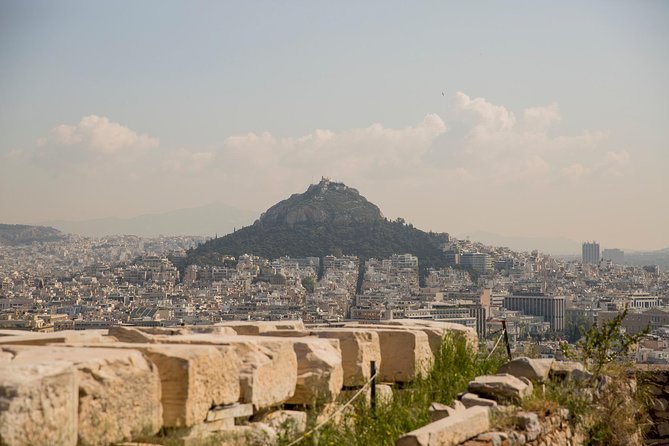
At $54.44 per person, you’re mainly paying for the guided experience: an English-speaking licensed guide, the small-group management, and the wireless headset. You’re also getting a fun map and a structured route that hits the big five stops in about 2 hours.
But you still need to budget the €30 Acropolis entry ticket. So the realistic “all-in” cost is guided tour plus site access.
Is it worth it? For me, yes—if you care about understanding what you’re seeing. The Acropolis is famous, but it can also feel like a pile of famous stones unless you get the story behind them. A good guide helps you look smarter and faster, especially at the Parthenon where details matter but are easy to miss when you’re just trying to snap photos.
If you’re the type who prefers to wander with no structure, you might decide to skip a tour and go independently. If you want context and a calmer route during heat and crowds, this one is priced in a sensible range for what you receive.
Who this tour is best for (and who should rethink it)
This works especially well for you if:
- You want a guided walk rather than a self-guided checklist.
- You’re visiting in hot weather and want an afternoon rhythm.
- You like myth and architecture tied together with explanations you can actually hear.
- You want a group small enough to feel human, not crowded.
You might rethink it if:
- You hate climbing and want minimal walking. There’s a hike involved to reach and move among the main areas.
- You need lots of unstructured downtime for your own pacing. This tour is structured around stops.
- You don’t want to manage the separate Acropolis ticket fee and lines. Pre-buying helps a lot.
Also, the tour is described as suitable for most travelers, and service animals are allowed.
A practical game plan for a better Acropolis day
If you want your afternoon to feel smooth, do three things:
- Pre-purchase the Acropolis ticket (or arrange it in advance) so you’re not stuck in a long queue.
- Wear grippy shoes for steep and potentially slippery marble areas.
- Pack light. No strollers or big bags at the Acropolis.
Then show up at the Arch of Hadrian meeting point ready to walk. Once you’re on the hill, the tour format makes it easy: listen, look, move, repeat.
You’ll leave with more than just photos. You’ll have a map in your head of what Dionysus’ theater meant, why Athena Nike symbolized staying victorious, and why the Parthenon still dominates every view line from the Acropolis.
Should you book this Beat the Heat Acropolis tour?
I’d book it if you want the Acropolis explained in an efficient, small-group way and you’re visiting during summer heat when crowds can feel intense. The headset and the capped group size are not flashy perks; they directly affect whether you enjoy the experience or spend it straining to hear over noise.
Just don’t treat this as a ticket-included skip-the-line deal. You must plan for the separate €30 Acropolis entry fee, and pre-buying is the smart move. If you do that, you’ll likely find this is one of the most practical ways to see the main sites without turning your Athens day into a heat-stressed endurance test.
FAQ
Is the Acropolis entry ticket included in the tour price?
No. The Acropolis entry ticket fee is listed separately at €30.00 per person. You can also arrange for pre-purchase if you let them know.
How long is the Beat the Heat Acropolis Tour?
It runs for about 2 hours.
What stops does the tour include?
You’ll visit the Theatre of Dionysus Eleuthereus, Temple of Athena Nike, Erechtheion, Propylaea, and the Parthenon.
What language is the guide?
The tour is offered in English.
Where do I meet the guide?
The start point is at the Arch of Hadrian, Leof. Vasilisis Amalias 50, Athina 105 58, Greece. The tour ends at the Acropolis of Athens.
Are there any restrictions on bags or strollers?
Yes. Strollers, backpacks, and big bags are not allowed at the Acropolis and should not be taken on the tour.
Is the group size small?
Yes. The tour has a maximum of 15 travelers.
Do I need ID if I’m under 25?
You’ll need an ID card or passport for people under 25 for possible discounts.
Can I get a refund if plans change?
You can cancel for a full refund up to 24 hours in advance. If you cancel within 24 hours of the start time, the amount paid is not refunded.




More Tours in Athens


More Tour Reviews in Athens
- All Day Cruise -3 Islands to Agistri,Moni, Aegina with lunch and drinks included
★ 5.0 · 4,958 reviews