REVIEW · ATHENS
Argolis Private Full Day tour
Book on Viator →Operated by H.P.Tours - Hellenic Private Tours · Bookable on Viator
That drive through Greece hits different.
This private Argolis full-day tour is all about your pace, with pickup included and time to tailor the day around what you actually care about. I like the comfort details too: air-conditioned transport, onboard WiFi, and a stress-reducing end-to-end plan that keeps you off the bus-hopping grind.
One possible drawback to plan around: the English-speaking driver can explain the monuments, but they’re not allowed to accompany you inside the sites—so if you want full guide access throughout, you’ll likely want to add a licensed guide.
In This Review
- Key takeaways before you book
- A private Argolis day trip that feels like you control the tempo
- Corinth Canal: the “isthmus cut” you notice right away
- Ancient Corinth and the Temple of Apollo in a focused 45-minute visit
- Mycenae’s hilltop citadel: where power looks defensive
- Nafplio and Tolon: a sea-view reset between ancient sites
- Epidaurus Theater: the acoustics are the reason this stop has gravity
- Time on the road vs. time in the sites: what the 9 to 10 hours really means
- Price and value for a small group up to 3
- Driver explanations vs. licensed guide access inside sites
- Who this Argolis private tour is best for
- Should you book the Argolis Private Full Day tour?
- FAQ
- What’s the group size for this private Argolis day tour?
- Where does pickup happen?
- What’s included in the price?
- Are entrance fees included?
- Do I need a tour guide inside the archaeological sites?
- How long is the tour?
- Is lunch included?
- Can I cancel for a full refund?
Key takeaways before you book
- Truly private group size (up to 3): perfect if you want quieter conversations and no one else steering the day.
- Pickup included from Athens hotels or Piraeus: fewer moving parts once your day starts.
- Real ancient stops, not “drive-by” photos: you’ll get dedicated time at major sites like Ancient Corinth, Mycenae, and Epidaurus.
- Comfort matters on long days: WiFi, bottled water, and a/c make the road time easier.
- Lunch isn’t included: you’ll have a set lunch opportunity by the sea, but you still pay for the meal.
A private Argolis day trip that feels like you control the tempo
If you’re tired of feeling rushed, this format helps a lot. You’re not sharing the day with strangers or waiting for a big busload to regroup. Instead, you can keep things moving when you want to, and slow down when the views or ruins call for it.
I also like that the day is structured around big highlights, yet still leaves room for adjustment. A driver with English explanations sets the stage, and you’re in comfortable transportation for the full route. That matters because Argolis isn’t next door to Athens—this is a proper day out.
The one thing to watch is depth inside the archaeological sites. The driver can talk and orient you, but they can’t legally guide you through the sites themselves. If you want someone licensed to walk you through everything, you’ll need an optional licensed English guide add-on (payable in cash), subject to availability.
You can also read our reviews of more private tours in Athens

Corinth Canal: the “isthmus cut” you notice right away
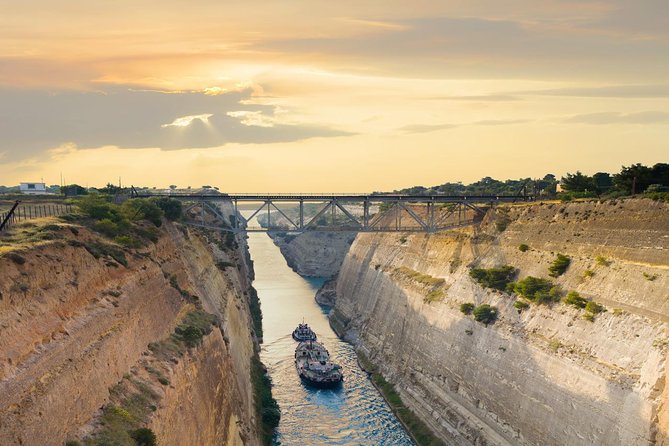
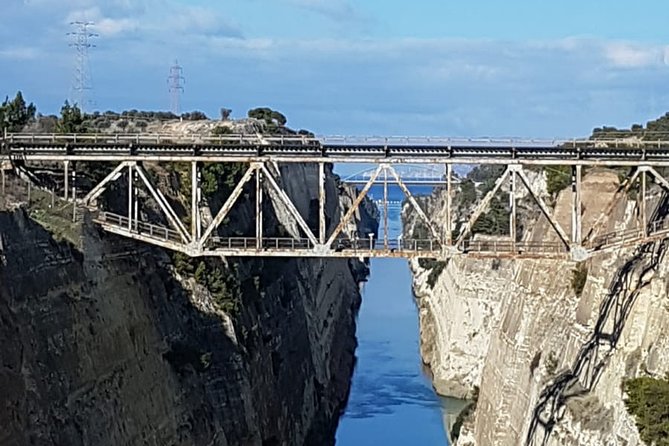
Your day starts at the Corinth Canal, a narrow strip that connects the Gulf of Corinth with the Saronic Gulf. The big wow isn’t just the fact that it exists—it’s the scale and engineering logic. It’s 6.4 kilometers long and only 21.4 meters wide at the base, and it has no locks, which is why most modern ships can’t pass through.
The canal’s story is also unusually dramatic. A canal was proposed in classical times, there was a failed attempt in the 1st century AD, and construction finally began in 1881. Even then, geological and financial problems bankrupted the original builders, and it wasn’t completed until 1893. It also faces periodic closures to deal with landslides from its steep walls.
In practical terms, you’re there for about 20 minutes. That’s short, but it’s the right amount of time if your goal is to understand what it is and get a few solid moments of photos and orientation before you move on.
Ancient Corinth and the Temple of Apollo in a focused 45-minute visit
Ancient Corinth (Archaia Korinthos) is one of those places where a small amount of time still lands you on the essentials. You’re looking at a site tied to major myths and major power—Corinth was wealthy, strategically placed, and connected to trade across the isthmus.
In the city’s mythic frame, Corinth’s rulers are linked to Sisyphus, the man doomed to repeat a task forever. That’s a fun doorway into how the Greeks used stories to make sense of place and leadership—then you get to walk among ruins that show real urban scale.
What I’d aim to notice fast:
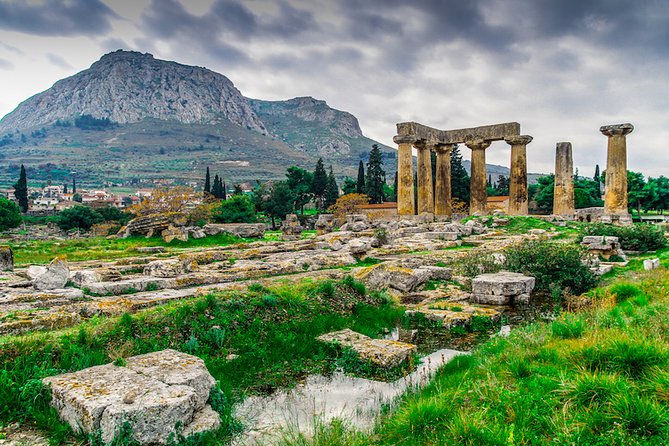
- The Temple of Apollo, built in the middle of the 6th century BCE, is the headline. Seven monolithic columns remain standing, which is a detail you don’t get in many other Greek temples.
- Walk the thought process of a Roman-era city. Even with only part of the ruins excavated, the surviving shapes plus archaeological reconstructions help you understand how important Corinth was in the Eastern Mediterranean.
- In the agora area, pay attention to the rostrum (bèma). It was a platform for important juridical and political announcements.
You’ll also hear about the city’s cultural identity and religion—Corinth was a major cult center for Aphrodite, and it hosted games related to the Isthmian Games tradition. There’s also a reminder that Corinthians and Athenians weren’t always friendly neighbors. Their conflicts helped trigger larger events that led toward the Peloponnesian War era.
One practical note: this stop includes about 45 minutes on-site. That’s enough for orientation and key ruins, but not enough to “read everything.” If you’re the kind of person who wants to linger over inscriptions and reconstruct each era carefully, consider adding a licensed guide.
Mycenae’s hilltop citadel: where power looks defensive
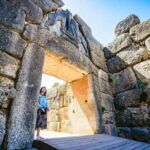
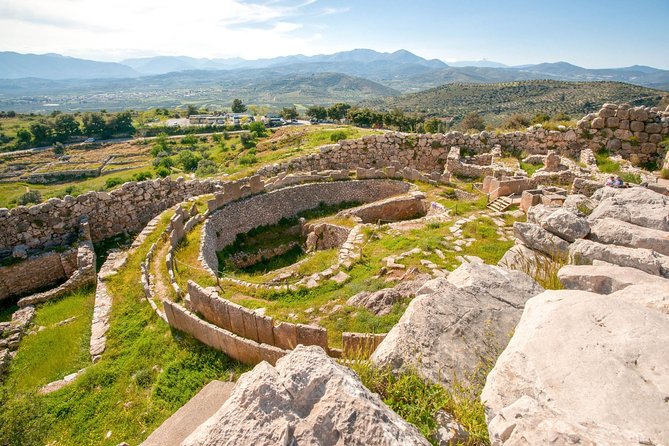
Then the day shifts inland to Mycenae, an archaeological site near Mykines in Argolis. It sits up on a hill about 900 feet above sea level, around 120 kilometers from Athens, and roughly 11 kilometers north of Argos.
This is where you feel the Mycenaean world as something militarized and organized. Mycenae was a major center of Greek civilization in the second millennium BC. At its peak around 1350 BC, the citadel and lower town reportedly supported about 30,000 people across an area of 32 hectares. That’s big enough to understand why the site matters, even if your visit is only about an hour.
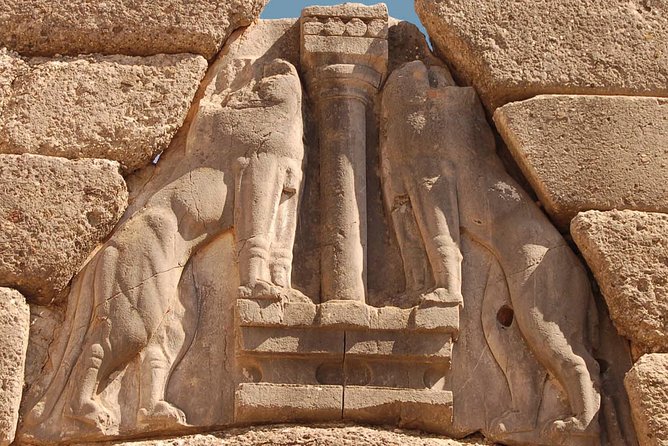
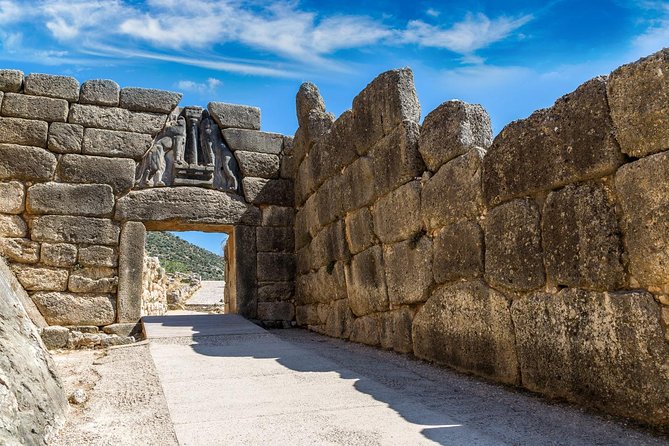
Here’s a detail I like because it’s both nerdy and practical: the first correct identification of Mycenae in modern literature came from a survey commissioned by the Provveditore Generale of the Kingdom of the Morea in 1700, and it used Pausanias’s description of the Lion Gate. So when you’re at Mycenae, you’re standing on a place that has been argued over, verified, and re-anchored by scholarship—long before the current visitor paths existed.
An hour is enough to appreciate the setting and the major structures, especially if you focus on the citadel logic: high ground, defensive design, and the sense of a command center overlooking routes.
Nafplio and Tolon: a sea-view reset between ancient sites
After Mycenae, the tour drops you into the human scale of Nafplio and Tolon. This is the part of the day that feels like a reward, not just a location change.
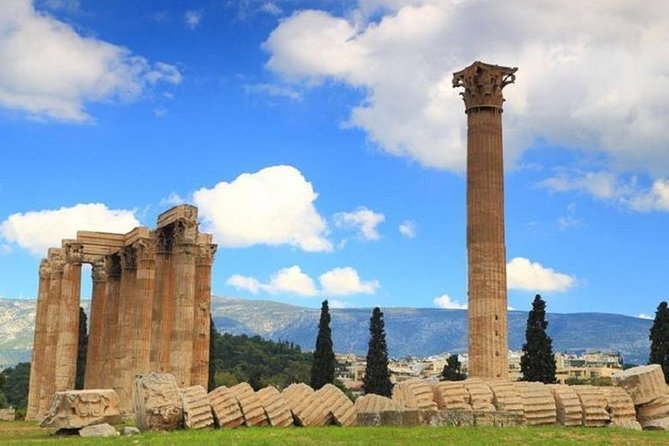
Nafplio is a seaport town on the Peloponnese that grew up along hills near the north end of the Argolic Gulf. It has layers of rule and importance across eras, including de la Roche after the Fourth Crusade, Venice, and the Ottoman Empire. It was also the capital of the First Hellenic Republic and later the Kingdom of Greece from the Greek Revolution in 1821 until 1834.
Why this matters to you on a day trip: Nafplio gives you a break where you can walk, look, and take your time with a coffee or view. The stop here is about 40 minutes, so you’ll want to keep it simple—pick a direction, enjoy the bay angle, and don’t turn it into a marathon.
Then you head to Tolon, just 7 kilometers east of Nafplio. You’ll get around 45 minutes, and lunch happens at a traditional family-owned restaurant with a view of the Saronic Gulf. Lunch isn’t included in the tour price, but the setup is still useful: it removes the guessing game of where to eat quickly and reliably after a long drive.
A practical tip: if you want the best experience, plan to eat without rushing. This is your decompression segment, and the sea-view setting is a big part of why people like this day format.
You can also read our reviews of more tours and experiences in Athens
- All Day Cruise -3 Islands to Agistri,Moni, Aegina with lunch and drinks included
★ 5.0 · 4,958 reviews


Epidaurus Theater: the acoustics are the reason this stop has gravity
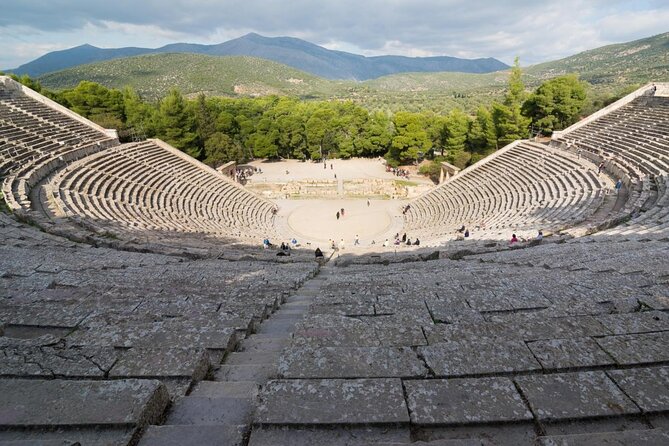
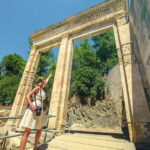
The final ancient highlight is the Ancient Theatre of Epidaurus. Epidaurus is known as both a spiritual place and a major healing center in ancient times, tied to the Sanctuary of Aesculapius. In other words, this wasn’t only entertainment—it was culture with a purpose.
The Theatre of Epidaurus is famous for its unique acoustics and for the fact that it retains its circular orchestra in a way that many other theaters don’t. Even better, it’s still used today, so you’re not just looking at a ruin with no future connection. You’re visiting a place that still functions in a modern context.
Your time here is about 45 minutes. That’s enough for a satisfying visit if you do it with a plan. I’d prioritize two things: getting oriented to the orchestra and seating shape, then slowing down for one good listening moment. Even if you don’t know the technical explanation of acoustics, you can still sense the design logic.
Also consider the combined meaning of the sanctuary setting. Epidaurus isn’t only “pretty theater.” It’s a site where healing, belief, and performance overlapped.
Time on the road vs. time in the sites: what the 9 to 10 hours really means
This is a 9 to 10 hour day. That duration is what makes the itinerary possible: you can’t cover Corinth, Ancient Corinth, Mycenae, Nafplio, Tolon, and Epidaurus with short waits unless transportation is tight.
That’s why the comfort inclusions aren’t small details. You’ll travel in an air-conditioned vehicle with WiFi onboard and bottled water. The driver keeps things moving, and you’ll spend your on-the-ground time in set chunks—20 minutes at Corinth Canal, 45 minutes at Ancient Corinth, 1 hour at Mycenae, about 40 minutes at Nafplio, 45 minutes at Tolon, and 45 minutes at Epidaurus.
This can be a great fit if you like structure. If you prefer a slow travel day with lots of wandering and frequent stops to snack, you might feel the schedule. But if you like big highlights with minimal stress, this timing is the point.
Price and value for a small group up to 3
The tour price is $533.95 per group (up to 3 people). For many people, the honest value question isn’t just cost—it’s what you’re paying for: private transportation, pickup/drop-off, and a well-defined route that hits major sites.
Here’s how I’d think about it:
- If you’re traveling as a couple or small family of up to three, the per-person cost can be reasonable for a full-day private itinerary that runs beyond standard bus routes.
- You’re also paying to protect your time. The day includes Athens hotel/Piraeus port pickup and drop-off, plus onboard comfort. That saves you the mental energy of planning transit, transfers, and timing yourself.
Two things that can add cost:
- Entrance fees are not included. You’ll pay €55 per adult for Ancient Corinth, Mycenae, and Epidaurus.
- Lunch isn’t included, though you’ll have a lunch stop in Tolon at a family restaurant by the sea.
The optional licensed guide is another add-on. If you want that extra depth inside sites, budget accordingly (it’s listed as 400 Euros payable in cash, subject to availability). If you’re okay with driver explanations outside and quick site focus inside, you might not feel the need.
Driver explanations vs. licensed guide access inside sites
This is one of the most important practical details in the whole experience. Your English-speaking driver will explain about the monuments and the history of Greece, plus interesting facts about historical and modern life. But they are not allowed by law to accompany you into the sites.
So you’re choosing between:
- A smooth, efficient day with explanation and orientation, then self-walk time inside.
- Or paying for an optional licensed English guide to walk you through the sites.
In the kind of feedback this tour gets, a guide named Jimmy comes up with praise for personalization. That’s a clue that if you can arrange a licensed guide for your day, it can raise the experience from informative to really memorable—especially in complex places like Ancient Corinth and Mycenae where context helps you read the ruins faster.
If you do add a licensed guide, you’ll likely enjoy the sites more with less guesswork about what you’re looking at and why it mattered.
Who this Argolis private tour is best for
I see this tour as a strong match for people who:
- Want a private day with a small group and no schedule chaos.
- Prefer major highlights over long detours.
- Like having a plan, then making light adjustments based on interest.
- Are okay with shorter site windows in exchange for seeing multiple top locations in one day.
It’s also a good pick if you’re starting from Athens and want to cover Argolis without figuring out trains, buses, and connections.
If you’re the type who wants to study every inscription or spend half a day in just one archaeological site, you might feel the pace. For that style, you’d probably want a more site-by-site focused itinerary.
Should you book the Argolis Private Full Day tour?
I’d book it if your goal is a high-value day: Corinth Canal, Ancient Corinth, Mycenae, Nafplio, Tolon, and Epidaurus—wrapped into a private format with pickup and comfortable transport. The structure is what makes it work, and the balance of driving plus guided orientation plus site time is genuinely practical for a first Argolis day.
Skip or reconsider if you strongly want a licensed guide inside every site and you don’t want to manage that add-on. Also reconsider if you hate time-boxed stops and want slow wandering only.
If you’re traveling with up to three people and you want a full, meaningful sweep of the region without the usual logistics headache, this is one of the more sensible ways to do it from Athens.
FAQ
What’s the group size for this private Argolis day tour?
It’s priced per group and supports up to 3 people per group.
Where does pickup happen?
Pickup is included from an Athens hotel or from the Piraeus Port cruise ship terminal. Airport pickup is also offered, but it’s on request and an additional fee varies by vehicle type.
What’s included in the price?
Private transportation with pickup and drop-off (Athens hotel/Piraeus port), an air-conditioned vehicle, WiFi on board, professional drivers, and bottled water are included.
Are entrance fees included?
No. Entrance fees to Ancient Corinth, Mycenae, and Epidaurus are listed as €55 per adult and are not included.
Do I need a tour guide inside the archaeological sites?
Your English-speaking driver will explain about the monuments, but they are not allowed to accompany you into the sites. An optional English-speaking licensed tour guide can be arranged at extra cost (400 Euros payable in cash), subject to availability.
How long is the tour?
The duration is about 9 to 10 hours.
Is lunch included?
Lunch is not included. There is a lunch stop at a traditional family-owned restaurant in Tolon with a view of the Saronic Gulf.
Can I cancel for a full refund?
Yes, free cancellation is available if you cancel at least 24 hours in advance for a full refund.


More Private Tours in Athens

More Tours in Athens



More Tour Reviews in Athens
- All Day Cruise -3 Islands to Agistri,Moni, Aegina with lunch and drinks included
★ 5.0 · 4,958 reviews