REVIEW · ATHENS
Ancient Corinth and Canal half day private tour from Athens
Book on Viator →Operated by My Athens Transfers · Bookable on Viator
Corinth hits fast, even in half a day. This private Athens tour strings together the Corinth Canal, Ancient Corinth, and Acrocorinth, with hotel pickup and Wi‑Fi onboard so the ride feels less like dead time and more like pre-show context.
I love the pacing here: you get a focused look at each place without feeling trapped on one long walking loop. I also love that your driver can shape the commentary to your interests, which is a big deal if you’re connecting the sites to St. Paul’s world. One watch-out: there is no licensed site guide included, and you’ll pay entrance fees for Ancient Corinth and the Archaeological Museum (listed as €15 per person).
In This Review
- Key Highlights You’ll Feel Right Away
- A Half-Day That Gives You Three Corinth Experiences
- Price and Value: What $160.60 Buys You (And What It Doesn’t)
- Private Pickup That Removes the Athens Headache
- In the Van: Wi‑Fi, Water, and Driver Commentary That Stays Useful
- Corinth Canal: The Engineering Cut That Makes You Lean Closer
- Ancient Corinth at Human Speed: Ruins, Paul, and the Big Timeline
- Archaeological Museum of Corinth: Worth It, Especially If You Like Objects
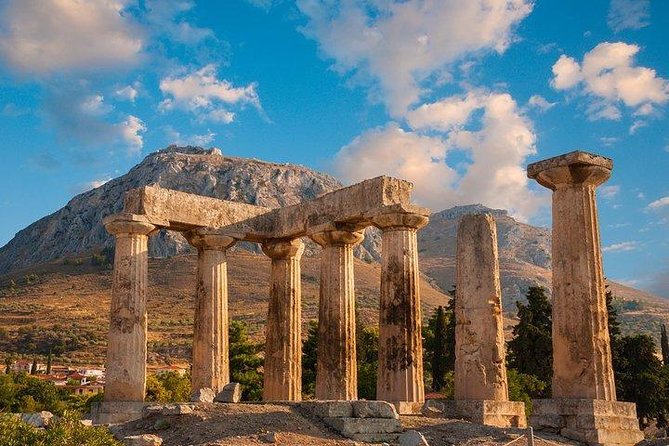
- Temple of Apollo: A Short Stop With Big-Name Weight
- Acrocorinth: The Fortress That Turns the View Into a Story
- Lunch With Greek Traditional Food: A Simple Reset Mid-Day
- Who Should Book This Private Corinth Tour?
- Should You Book It? My Straight Answer
- FAQ
- How long is the Ancient Corinth and Canal half-day private tour from Athens?
- What’s included in the price besides transportation?
- Do I need to pay any entrance fees?
- Is pickup available from hotels and the port?
- Is this tour with a licensed guide inside the sites?
- Can I add a licensed tour guide?
- Is the lunch included vegetarian or special diet options?
- Does the tour run in English?
- What’s the cancellation policy?
- Is the tour private or shared with other people?
Key Highlights You’ll Feel Right Away
- Door-to-door pickup and drop-off in Athens (hotel, Airbnb, airport, or Piraeus port)
- Corinth Canal in full engineering scale, with views over the cutting through the Isthmus
- Ancient Corinth ties to Christianity, including Paul’s letters and Acts
- Acrocorinth fortress views over both ancient and modern Corinth
- Wi‑Fi onboard plus bottled water, which makes the trip smoother
- Entrance fees are limited to the Ancient Corinth + museum portion (€15 pp), while other stops are free
A Half-Day That Gives You Three Corinth Experiences
Corinth is one of those places where you can’t really “see it all” in a single visit. But this tour avoids the common mistake: trying to do everything at once and ending up everywhere and nowhere.
Instead, you get three distinct flavors of Corinth:
First, you get the modern marvel: the Corinth Canal, a thin, deep cut that makes the Peloponnese feel like an island. Second, you get the ancient city: Ancient Corinth, linked to the Roman era and to early Christian history. Third, you get the high point: Acrocorinth, the acropolis fortress that controlled the approach to the peninsula.
That mix is why this tour works so well in a tight schedule. It also helps you build a mental map quickly—land, sea, city, then fortress—so your photos and memories feel connected instead of random.
You can also read our reviews of more private tours in Athens

Price and Value: What $160.60 Buys You (And What It Doesn’t)
At $160.60 per person for about 5 hours, the price lands in the “private day trip” category. What makes it feel more worth it than a bare-bones transfer is that you’re paying for:
- Private transportation with an air-conditioned vehicle
- Hotel/port pickup and drop-off
- Wi‑Fi onboard (handy if you want to message home or check things during the ride)
- Bottled water
- Lunch included, with a Greek traditional food option
Then there’s the part you should budget for separately: entrance fees for Ancient Corinth and the Archaeological Museum of Corinth. The listing indicates €15.00 per person for those sites. Many other stops in the loop are marked as free in the tour description, which is good because it keeps add-ons under control.
So the value equation is simple: you’re paying for convenience and time-efficiency, and the only real “extra” cost is the museum/archaeology entrance portion.
If you’re traveling as a couple or a small group, private pickup alone can feel like you’re buying back energy you’d otherwise spend on buses, taxis, and timing stress.
Private Pickup That Removes the Athens Headache

Athens is great, but the logistics can be the annoying part—especially if you’re staying in an apartment or if your timing is tied to cruise schedules.
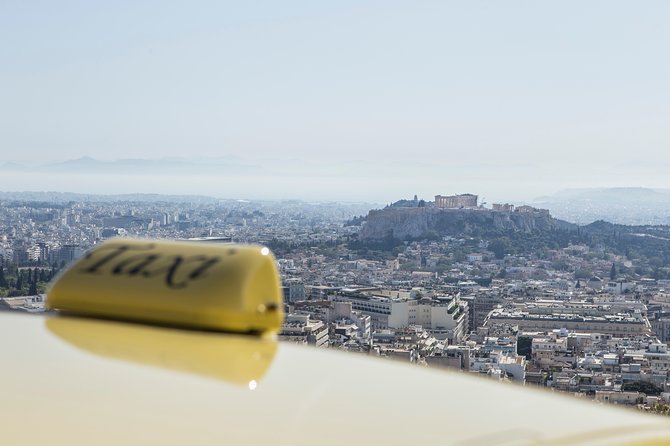
This tour handles that with pickup from your hotel, apartment, Airbnb, Athens airport, or Piraeus port. Your driver waits where you’ll actually find them: hotel lobby, building entrance, or the port gate holding a sign with your name.
You also get flexibility. Pickup time is adjustable upon request, and the departure times are described as widely available, which matters if you want to avoid midday heat or line up with your other plans.
The practical win is that you start Corinth already oriented. You’re not standing around in traffic guessing what time you’ll arrive, and you’re not burning your energy on getting from A to B. You’re spending it on the places themselves.
In the Van: Wi‑Fi, Water, and Driver Commentary That Stays Useful
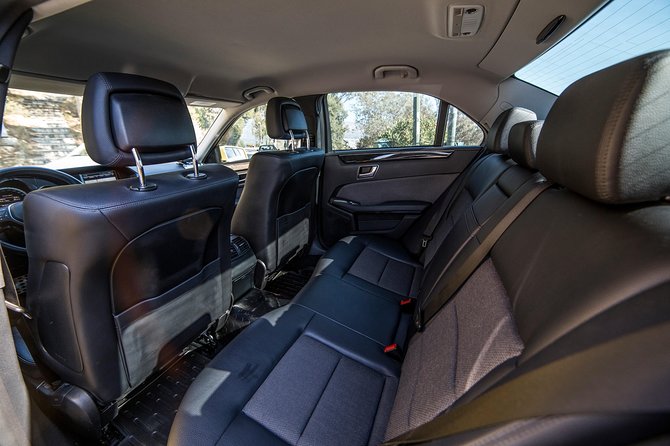
This is a private car, but it’s not just a car rental with sightseeing stops.
You have Wi‑Fi onboard and bottled water. That’s not glamorous, but it helps you stay functional—especially if you’re checking maps, translating signs ahead of time, or just keeping your phone alive for the day.
Your driver is described as a professional driver with history knowledge, and they can provide commentary in fluent English. The key point to understand is that they are not there as a licensed guide inside the archaeological sites. They won’t escort you through rooms and ruins like an official guide might.
Still, the commentary is where the tour often gets its punch. If you’re into the New Testament angle, Corinth becomes more than “old rocks.” You can understand why Paul was writing there, what the city was like, and how the Romans shaped what you see later.
That said, if you want a licensed guide who walks with you through every site and answers detailed questions on the spot, you should request that option ahead of time (availability depends on the operator).
Corinth Canal: The Engineering Cut That Makes You Lean Closer

The Corinth Canal is the early-morning adrenaline hit on this route.
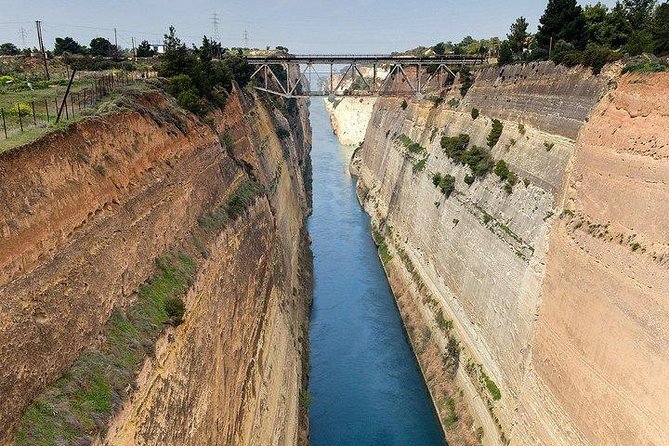
The canal connects the Gulf of Corinth in the Ionian Sea with the Saronic Gulf in the Aegean Sea. The important practical detail is that it cuts through the Isthmus of Corinth at sea level and has no locks. It’s about 6.4 kilometers long and only 21.4 meters wide at its base, which is why many modern ships can’t pass.
From higher viewpoints, you’re meant to admire two things at once: the steep limestone walls and the ships navigating through the channel. It’s a rare moment where you see how people solved a geography problem that’s been sitting there for centuries.
If you’re the kind of person who likes photos with scale, this is your stop. The canal looks small from far away, then you realize it’s a narrow, working cut through massive rock.
You’ll also appreciate it more if you think of it as a shortcut through a narrow neck of land. The tour description frames it as separating the Peloponnese from the mainland—almost like a peninsula becoming an island. That mental shift makes the drive later feel more connected to what you’re seeing.
- All Day Cruise -3 Islands to Agistri,Moni, Aegina with lunch and drinks included
★ 5.0 · 4,958 reviews





Ancient Corinth at Human Speed: Ruins, Paul, and the Big Timeline

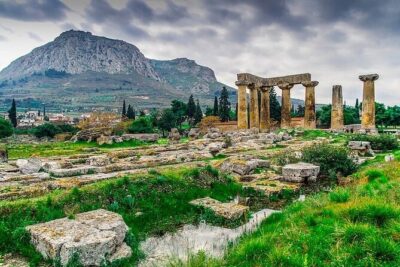
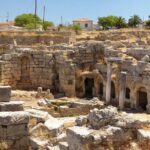
Ancient Corinth (Archaia Korinthos) is a city-state location on the Isthmus, roughly halfway between Athens and Sparta. The modern city sits about 5 kilometers away, so you’re really leaving today’s bustle behind.
For Christians, Corinth is well known for the letters of Saint Paul—First and Second Corinthians—and it appears in Acts as part of Paul’s missionary journeys. Corinth is also referenced in Pausanias’ Description of Greece, which signals just how central it was in the storytelling tradition around Greek places.
What I like about how this stop is packaged is that you get a full hour at Ancient Corinth. That’s enough time to do more than glance at foundations. You can slow down and actually read the site in layers: where major public areas likely stood, how the city functioned, and why this place mattered.
Roman history adds another layer. The description notes that the Romans destroyed Corinth in 146 BC, rebuilt it in 44 BC, and later made it a provincial capital. That matters when you look at ruins because it helps you understand why the city that’s left looks the way it does—Roman influence, later rebuilding, and long archaeological visibility.
Drawback to keep in mind: the Ancient Corinth entrance fee is not included (it’s part of the €15 per person museum/ruins portion). Also, since your driver won’t be inside with you, plan to ask them questions on the road so you arrive with context.
Archaeological Museum of Corinth: Worth It, Especially If You Like Objects
Right at Ancient Corinth, you’ll also visit the Archaeological Museum of Corinth, where the exhibits are tied to excavations done in the area.
The museum itself is described as built between 1931–1932, intended to display the results of archaeological digs. You’ll spend 45 minutes there, and the museum entrance is included under the same fee category as Ancient Corinth (again: €15.00 per person is indicated).
If you’re the type who loves artifacts—items that make ancient life feel more concrete—this stop is a strong match. Ruins tell you what the space was like. A museum helps you understand what went on inside and around it.
If you’re more into views and walking than indoor viewing, you still shouldn’t skip it entirely. But you may want to keep an eye on your time so you don’t get museum fatigue before Acrocorinth.
A practical tip: use the museum to pick one theme for the rest of the day, like everyday life, religious practice, or civic organization. Then when you look at Acrocorinth, you’ll connect the dots faster.
Temple of Apollo: A Short Stop With Big-Name Weight
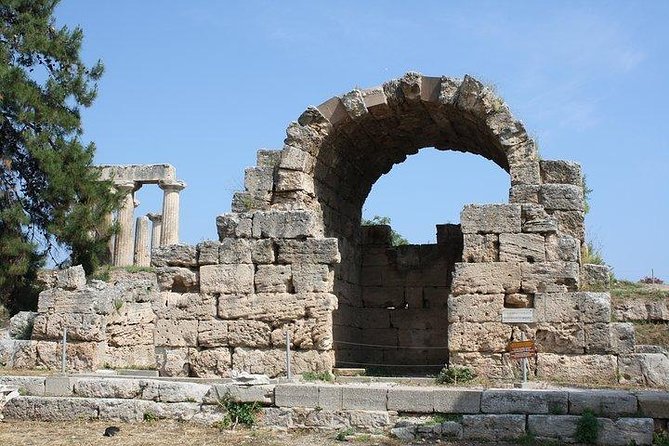
After the museum, the loop includes the Temple of Apollo.
The temple is dated to 550 BC, which is early enough to feel like you’re seeing the deep roots of Corinth’s sacred landscape. The stop time is 20 minutes, which makes it more of a focused glance than a long sit-down.
Still, short doesn’t mean insignificant. Apollo is one of those anchor deities across Greece, so even a brief look helps you understand that this wasn’t just a commercial city. It had spiritual gravity too.
If you like history as a chain—then you’ll appreciate how these stops link: canal (routes), city (people), museum (objects and evidence), fortress (control), and sacred spaces (belief).
Acrocorinth: The Fortress That Turns the View Into a Story
Then comes the real wow moment for many people: Akrokorinthos (Acrocorinth), the acropolis of ancient Corinth.
It’s described as a monolithic rock overlooking the city, with a fortress that had a secure water supply. That detail matters, because it explains why the fortress was repeatedly used as a last line of defense in southern Greece. It controlled the Isthmus and helped repel foes from entering the Peloponnese by land.
You’ll spend 30 minutes here. That’s a good chunk for viewpoints and short exploring, but it’s also a reminder to be efficient. Acrocorinth can take energy because you’re dealing with uneven stone and height.
I recommend you treat this stop like a mini climb, not a quick photo stop. Take a few minutes to get your bearings. Look outward first to understand what it protected, then look back toward where you’d imagine the city spread below.
This is the place where Corinth stops feeling like a named destination and starts feeling like a strategic landscape—sea routes, land routes, and a fortress watching both.
Lunch With Greek Traditional Food: A Simple Reset Mid-Day
Lunch is included, and you can choose a Greek traditional food option.
Even if you’re not a foodie, included lunch is a big deal on a half-day tour. It removes the common problem: you arrive hungry, then rush through ruins because you’re worried about finding food next.
A well-timed meal also helps you stay engaged through Acrocorinth. If you’ve ever done archaeology after skipping lunch, you know it drains attention fast. Here, you’re covered.
Who Should Book This Private Corinth Tour?
This tour is a great fit if:
- You want a half-day that covers major Corinth highlights without needing to plan buses and timing
- You care about the St. Paul / early Christianity connection and want the sites framed for that context
- You prefer a private setup where your group can move at your own pace rather than getting swept along in a larger group
- You like seeing both “big engineering” and ancient ruins in the same day
It may be less ideal if you expect a licensed guide at the sites. The driver can answer questions and explain things, but they won’t enter the archaeological spaces with you. If you want that fully guided, ask about adding a licensed guide when you book.
Should You Book It? My Straight Answer
Yes, I’d book it if your goal is a high-impact Corinth visit with minimal stress. The best part is the structure: canal first, ancient city next, fortress last. It’s easy to build understanding as the day progresses.
I’d also book it if you value comfort—air-conditioned transport, Wi‑Fi, bottled water, and pickup handled door-to-door.
Skip it (or at least adjust your expectations) if you’re traveling specifically for a fully guided museum-and-ruins experience led by a licensed site expert. If that’s what you want, request that option in advance.
Bottom line: for most people with limited time in Athens, this is one of the cleanest ways to see Corinth in a single focused stretch.
FAQ
How long is the Ancient Corinth and Canal half-day private tour from Athens?
It runs for about 5 hours.
What’s included in the price besides transportation?
Private transportation, air-conditioning, hotel/port pickup and drop-off, onboard Wi‑Fi, bottled water, and lunch (with a Greek traditional food option).
Do I need to pay any entrance fees?
Yes. Entrance fees are listed as not included for Ancient Corinth and the Archaeological Museum of Corinth, at €15.00 per person. Other stops are listed with free admission.
Is pickup available from hotels and the port?
Yes. You can be picked up from your hotel, apartment, Airbnb, Athens airport, or Piraeus port, and you’ll be dropped back at the same place or a point you prefer.
Is this tour with a licensed guide inside the sites?
No. The driver can provide fluent English commentary, but they are not licensed tour guides and they will not enter the archaeological sites with you.
Can I add a licensed tour guide?
A licensed tour guide can be requested depending on availability.
Is the lunch included vegetarian or special diet options?
The tour states lunch is included and offers a Greek traditional food option. Specific dietary details are not provided in the tour data you shared.
Does the tour run in English?
Yes, the tour is offered in English.
What’s the cancellation policy?
Free cancellation is available up to 24 hours in advance for a full refund.
Is the tour private or shared with other people?
It’s private. Only your group participates.
More Private Tours in Athens


More Tours in Athens


More Tour Reviews in Athens
- All Day Cruise -3 Islands to Agistri,Moni, Aegina with lunch and drinks included
★ 5.0 · 4,958 reviews