REVIEW · ATHENS
“Tour of Ancient Corinth:Follow in the footsteps of Apostle Paul”
Book on Viator →Operated by Greece Athens Taxi GAT · Bookable on Viator
Corinth hits you fast, and then sticks with you. This private half-day brings you from the Isthmus of Corinth to ancient ruins and up to Akrokorinthos where Paul’s footsteps are part of the story. I especially like the hassle-free pickup and the smooth, air-conditioned ride that keeps the day easy—though there’s one catch: the driver is not a licensed museum guide, so ticketed sites rely on what you and your driver can cover on the spot.
My other favorite part is the pacing. You get enough time to look around at Ancient Corinth and the Museum, then climb to the fortress viewpoints without the rush you get on big buses. If you’re the kind of traveler who likes to ask questions and linger where it matters to you, this format tends to work well.
In This Review
- Key highlights at a glance
- From Athens to Corinth with zero stress
- Isthmus of Corinth: where land and sea routes squeeze together
- Ancient Corinth: the polis behind Paul’s letters
- The Corinth Archaeological Museum: artifacts that explain the ruins
- Temple of Apollo, the market area, and the healing sanctuary feel
- Akrokorinthos: Paul’s step, fortress defense, and the big viewpoint payoff
- Price and tickets: what €204.50 really covers
- Choosing your driver: the big difference is how they pace the day
- Who this private Corinth tour is best for
- Should you book the Ancient Corinth and Akrokorinthos experience?
- FAQ
- How long is the Ancient Corinth tour?
- Is pickup included, and where can they pick you up?
- Are tickets included in the price?
- How much is the Archaeological Museum of Ancient Corinth ticket?
- Will the driver act as a licensed tour guide in the museums?
- Is this tour private?
Key highlights at a glance
- Private, in-car comfort with A/C, WiFi, bottled water, and mobile chargers
- Easy pickup from hotels or ports, with flexible start times
- Isthmus + Ancient Corinth stops where admission is listed as free
- Archaeological Museum time (1 hour) to connect artifacts to the ruins
- Akrokorinthos fortress views plus the story beats tied to Apostle Paul
From Athens to Corinth with zero stress
This tour is built around convenience. You start with pickup from your hotel, Airbnb, or cruise port area (Port of Piraeus) and you’re dropped back at the end—no hunting for buses, no timed-ticket scrambling. The ride is in a Mercedes with A/C, WiFi onboard, and bottled water, which matters because you’ll spend time traveling between sites and standing in open-air areas.
Because it’s private, you’re not forced into a one-size-fits-all schedule. You still have set stop times for the main points (about 30 minutes at each of the first two stops, then about an hour at the museum and an hour at Akrokorinthos), but you can shape how you use that time. In particular, the driver’s role is practical: they share history on the drive and while you’re walking between points, but they’re not meant to replace official licensed guides inside museums.
In the best versions of this experience, drivers like Andreas, Spyros, and Ted help you make sense of what you’re seeing without turning the whole day into a lecture. That mix—story plus flexibility—is what makes Corinth feel personal instead of just educational.
You can also read our reviews of more tours and experiences in Athens.


Isthmus of Corinth: where land and sea routes squeeze together
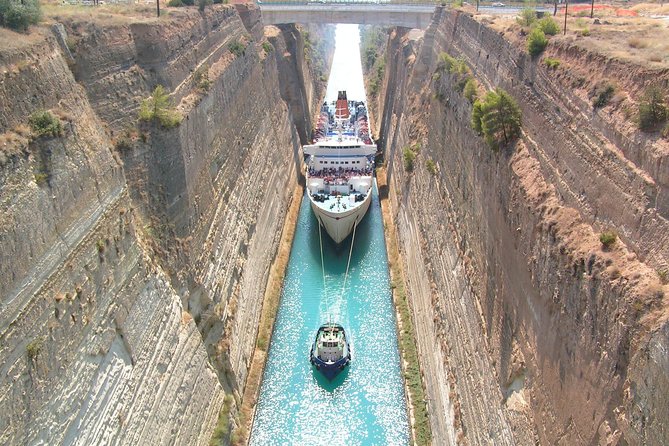
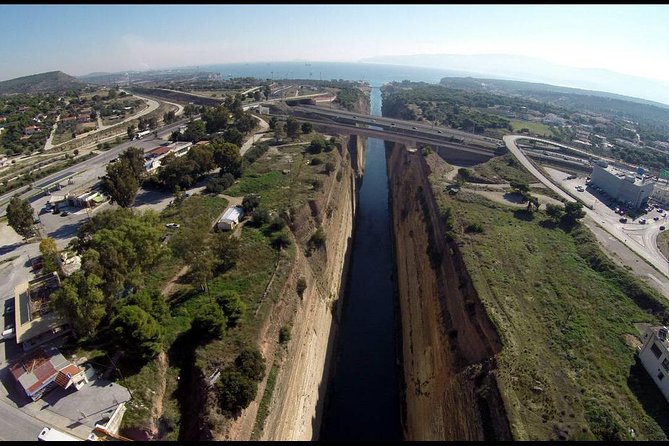
Your first stop is the Isthmus of Corinth, the narrow land bridge connecting Central Greece to the Peloponnese. This isn’t just geography trivia. It’s the reason Corinth mattered for centuries: whoever controlled this pinch point controlled movement.
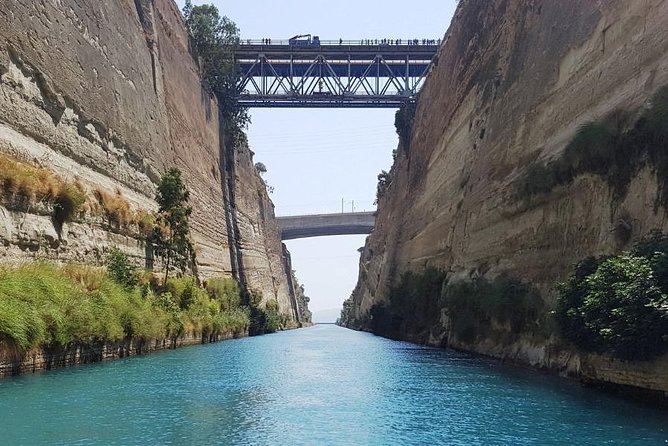
A big modern feature here is the Corinth Canal, opened after construction spanning 1880 to 1893. It runs between the Saronic Gulf and the Gulf of Corinth, and it’s one of the clearest reminders that Corinth has always been about routes—trade, war, and strategy.
What I like about starting here is the context. From the Isthmus, you can grasp why the ancients built defenses almost immediately. There was already a wall in ancient times (end of the 5th century BC), known as the Hexamilion, and it was preserved into Byzantine times. Standing near the Isthmus makes the later fortress story at Akrokorinthos feel logical: the landscape practically invites defense.
This stop is also listed as free for admission, which is a nice early win when you’re still warming up.
Ancient Corinth: the polis behind Paul’s letters
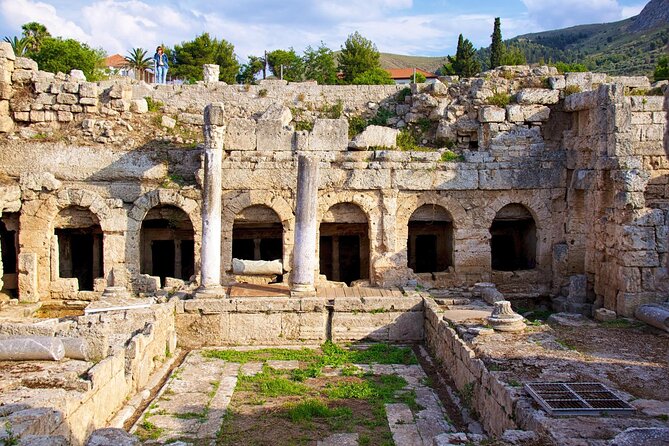
Next comes Archaia Korinthos, the ancient city-state (polis) that sat along the same narrow corridor that still defines travel here. Corinth was positioned roughly halfway between Athens and Sparta, and its location helped it become a major hub.
What makes this stop compelling is the layering of time. The modern city of Corinth is about 5 kilometers northeast of the ruins, so you’re not walking on an abstract “maybe this is it.” You’re stepping through a site tied to ongoing archaeology.
A key detail: systematic excavations began in 1896 by the American School of Classical Studies at Athens. You’re also told that more recent excavations by the Greek Ministry of Culture have revealed additional facets. Translation: the site isn’t treated like a finished museum object. It’s still being understood.
If you care about the Apostle Paul connection, this is where it helps to slow down and connect places to ideas. You’re not only seeing stone foundations; you’re seeing the kind of environment where religious debate, travel routes, and city life all intersected.
This stop is also listed as free for admission.
The Corinth Archaeological Museum: artifacts that explain the ruins
After the outdoor ruins, you’ll have about one hour at the Archaeological Museum of Ancient Corinth. Admission here is not included, with a listed entry fee of €20 per person.
The museum is built in 1932 by the American School of Classical Studies. For me, it works because you’re not just looking at pretty objects. You’re seeing how different periods connect—Prehistoric collections, finds from the Asklepieion healing sanctuary, and artifacts running from Geometric times through the Byzantine period. That time span helps if you want to understand Corinth as more than a single slice of antiquity.
One highlight called out in the exhibits is the Twin Kouroi from ancient Tenea, described as an exquisite example of archaic plastic art. Even if you’re not a “statues person,” it’s the kind of piece that gives you a real visual anchor for Greek art development.
You’ll also see mention of the museum’s Atrium, which matters because the museum isn’t only for closed-gallery viewing. It’s part of how the site experience holds together.
Important practical note: the museum has listed closure dates—January 1st, March 25th, May 1st, Easter Sunday, December 25th, and December 26th. If your dates land on one of those, you may need to adjust your plan.
Temple of Apollo, the market area, and the healing sanctuary feel
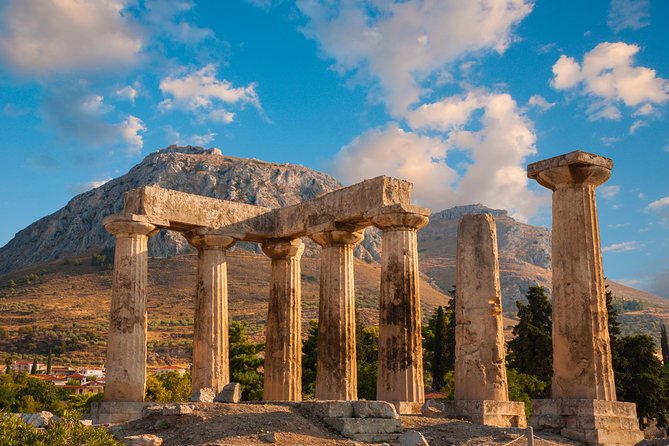
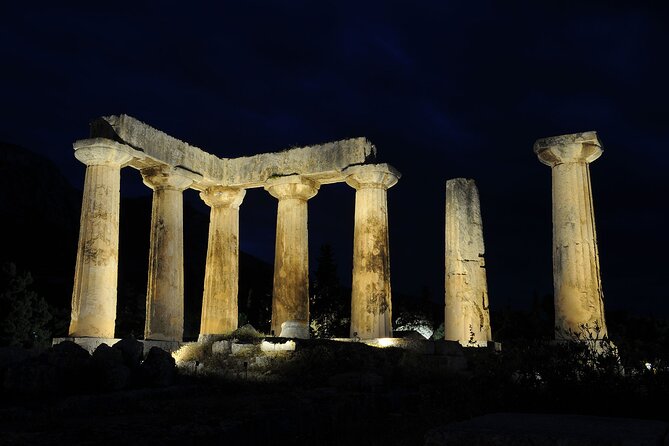
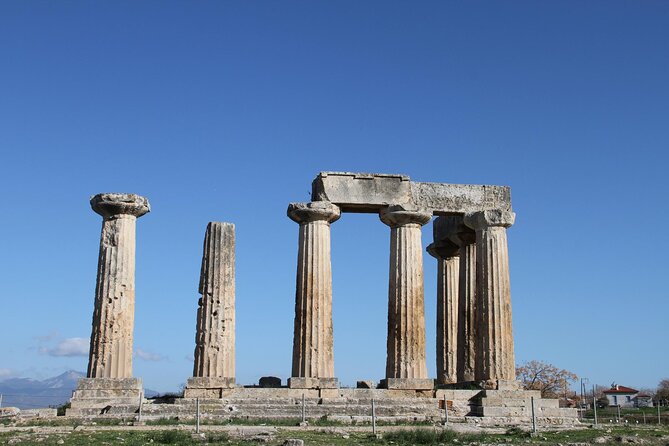
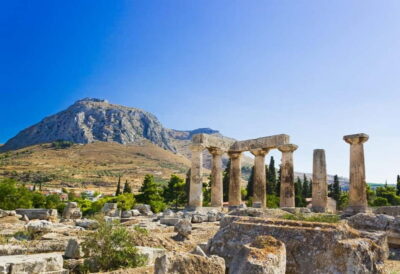
Back at the archaeological complex, the day shifts into ruins and site story beats. One of the major focal points mentioned is the Temple of Apollo: originally built of 40 monolithic Doric columns, with only seven remaining over the ruins of what’s described as the ancient market area.
It helps to know what you’re looking at. The original temple dates to between the early 7th and early 6th century BC. Construction materials included stone, bricks, and wooden beams, supporting a four-pitched roof made with clay tiles. The notes also suggest it was probably simpler in some structural choices than later column-heavy temples (including the idea of fewer external columns).
Even if those technical details don’t mean much to you, the practical payoff is this: you can look at the surviving columns and imagine the scale without needing a specialist in the room. For many people, that’s exactly what transforms ruins from “cool rocks” into a place with logic.
This area is also where you’ll encounter key thematic anchors tied to the region’s identity:
- the Asklepieion, the healing sanctuary
- Corinth described as a Roman colony in the site context
- and the museum’s Atrium as part of the overall visitor flow
- All Day Cruise -3 Islands to Agistri,Moni, Aegina with lunch and drinks included
★ 5.0 · 4,958 reviews




Akrokorinthos: Paul’s step, fortress defense, and the big viewpoint payoff
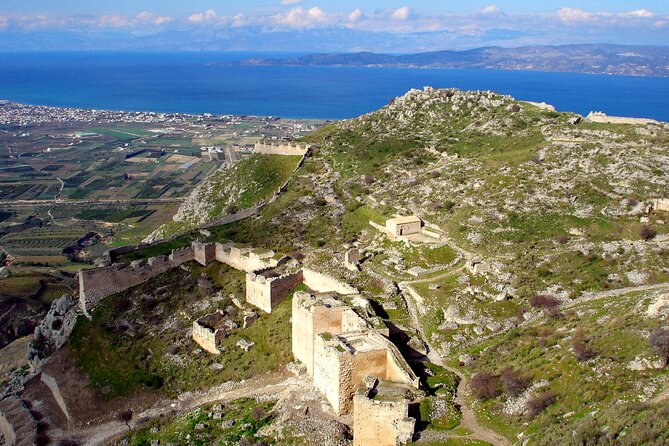
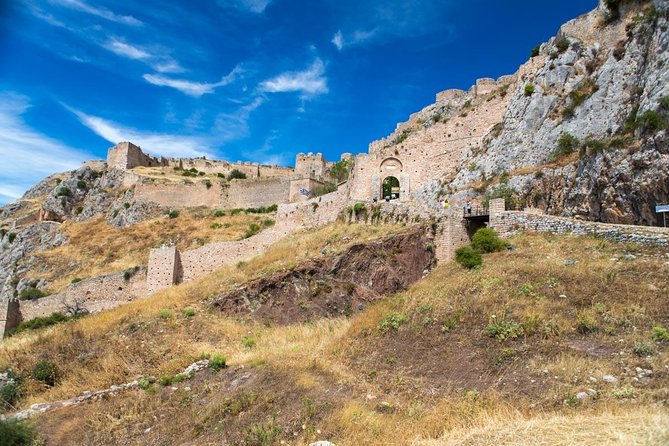
Your final main stop is the star for views and story: Akrokorinthos (also called Acrocorinth), a steep rock rising to about 575 meters. This place is described as a natural “viewport” used as an acropolis in ancient times, especially as a lookout for raids coming from central Greece or from the sea.
What I love about Akrokorinthos is that it answers the question, why was Corinth so defensible? The fortress sat above the city and controlled access to the Isthmus, so it could act as the last line of defense repelling foes trying to enter the Peloponnese.
The list of site highlights here is long, which is great if you like variety, but it also means you’ll want to choose your emphasis. The areas called out include:
- Apostle Paul’s step
- an amphitheater and a theater
- Sanctuary of Asclepius
- Sanctuary of Demeter and Koris
- Fountain Glavki
- Temple of Apollo
- Temple of Octavia
- Early Christian Basilica of the Skull
- Early Christian Basilica of Lechai
- Pirine and a Conservatory
If you’re coming for the Paul connection, this is where it becomes more than background. The “step” reference gives you a physical moment to tie to the life and movement of the story.
If you’re coming mainly for views, remember this is a fortress high above everything. You’ll likely get a better payoff if you’re comfortable walking on uneven ground and dealing with a steep setting. The good news: this stop is only about one hour, so you’re not committing to an all-day hike.
Also, one of the notes here attributes a strong opinion to George Forrest, describing Akrokorinthos as one of the most impressive acropolis sites on mainland Greece. Even if you don’t go into that with a name in mind, the altitude and the defensive feel do the persuasion for you.
Price and tickets: what €204.50 really covers
The listed price is $204.50 per person for a tour lasting about 4 to 5 hours. For that money, you’re paying for private transportation and someone to manage the “how do we get there and what do we look at” part.
What’s included:
- English-speaking driver with history knowledge (not licensed for museum narration)
- Hotel/Airbnb/Piraeus port pickup and drop-off without extra charge
- Private transport in a Mercedes with A/C
- WiFi, mobile chargers, and bottled water
- Help purchasing skip-the-line tickets, with you covering the actual ticket costs
- Mobile ticket
What’s not included:
- Licensed tour guide (only if availability allows, and then separately)
- Tickets for archaeological sites and museums
The museum cost is specifically stated: the Archaeological Museum of Ancient Corinth charges €20 per person and it’s not included. Entrance fees for sites also vary by season (winter vs. summer), so you should expect that the final day cost depends on when you go.
Here’s how I’d think about value. This tour is best if you want a quieter, more controlled experience: a private vehicle, pickup where you actually stay, and time at the places that matter to the Paul/Corinth story. If you’re the kind of traveler who already loves planning and doesn’t need help with ticket timing, you might spend less DIY. But if you want the day to run on rails—with A/C and a driver who can explain what you’re seeing while you ride—this price can make the whole thing feel worth it.
Choosing your driver: the big difference is how they pace the day
Even though the vehicle and timing do a lot of the heavy lifting, the driver’s “on the ground” style is what turns this into a memorable afternoon.
In the experience highlights shared with the company, names like Andreas, Spyros, and Ted come up for balancing explanation with comfort. One person emphasized that Andreas went above and beyond to tailor what they wanted to see. Another highlighted Spyros for conversation plus just the right amount of detail.
There’s also a practical kindness factor mentioned: mobile chargers are included, and at least one guest described getting extra help when a phone needed power. That small detail matters when you’re up on Akrokorinthos and your camera and maps eat battery.
Who this private Corinth tour is best for
This is a strong fit if:
- you want a private tour rather than joining a large bus crowd
- you’re doing Athens on a schedule and want one focused half-day away
- you care about the Apostle Paul connection but still want time to look at art, architecture, and artifacts
- you’re coming from a cruise port and want pickup handled for you
It’s also a good option for couples or small family groups because you’re not stuck with strangers’ pace. And since the company notes that most travelers can participate, it generally works for typical visitors who can manage walking through historic sites.
Should you book the Ancient Corinth and Akrokorinthos experience?
I’d book this if your ideal day is: pickup without hassle, a comfortable ride, clear context for what you’re seeing, and enough time to absorb both ruins and museum displays. The private format is the key value—Corinth is easy to do “in passing,” but it rewards a slower, guided-with-freedom approach.
I’d hesitate if you’re expecting a fully licensed guide inside every museum room. Here, the driver can explain and guide the overall flow, but museum-level narration from a licensed specialist isn’t included by default. In that case, you’d want to rely more on what’s available onsite or on any optional licensed guide availability.
If you want Corinth with less stress and more meaning, this is a solid bet—especially for the Akrokorinthos finale and the Paul-linked stop that gives the whole route a narrative spine.
FAQ
How long is the Ancient Corinth tour?
It runs about 4 to 5 hours.
Is pickup included, and where can they pick you up?
Yes. Pickup is offered from hotels, Airbnb locations, and from the Port of Piraeus, with no extra charge mentioned for Athens-area pickup/drop-off.
Are tickets included in the price?
Tickets for archaeological places and museums are not included. Skip-the-line ticket help is included, but you pay the ticket cost.
How much is the Archaeological Museum of Ancient Corinth ticket?
The museum admission fee is listed as €20 per person, and it is not included in the tour price.
Will the driver act as a licensed tour guide in the museums?
No. The driver is English-speaking and provides historical context, but they are not a licensed tour guide to accompany you inside museums/sites.
Is this tour private?
Yes. It’s a private tour/activity, so only your group participates.

More Tours in Athens

More Tour Reviews in Athens
- All Day Cruise -3 Islands to Agistri,Moni, Aegina with lunch and drinks included
★ 5.0 · 4,958 reviews