REVIEW · ATHENS
Private Luxury Tour: Unveiling the Sacred Mysteries of Eleusis
Book on Viator →Operated by Pericles Century · Bookable on Viator
Eleusis starts with a road, not a theater. This private luxury tour links the Sacred Way to the heart of the Eleusinian Mysteries, with story-led stops from modern Athens to the ancient sanctuary. I especially like the English-speaking driver-guide style of teaching as you travel, and the comfort perks: air-conditioning, bottled water, and onboard Wi-Fi for the ride.
You’ll also get tight timing (about 4 to 5 hours total), with short stops that keep you moving but not rushed. One possible drawback: archaeological-site entrance fees are not included (listed as €10 per person), and the tour does not include a separate licensed guide for inside the sites.
In This Review
- Key highlights you’ll feel right away
- Why this Sacred Mysteries tour feels different from a basic day trip
- The Sacred Way (Iera Odos): where mythology meets modern Athens
- Iera Odos near Iera Odos / Iera Odos at the Iera Odos area: the Kifisos River crossing
- Another Iera Odos fragment in Aigaleo: the pilgrimage line
- Daphni Monastery: Byzantine mosaics on the same sacred corridor
- Sanctuary of Aphrodite at Skaramagkas: a quick myth stop with access limits
- The Roman bridge at Eleusis: Hadrian’s engineering in limestone
- Eleusis archaeological site: Telesterion, Propylaea, Demeter’s world
- The Telesterion: the hall at the center of the Mysteries
- The Great Propylaea: the monumental entrance into another realm
- Kallichoron Well: Demeter’s myth stop
- Ploutonion cave: a sacred Underworld entrance
- Admission fees apply for these core site elements
- Museum of Eleusis: turn ruins into artifacts you can picture
- Price and value: what $192.23 per person buys you
- Best for: myth lovers who want comfort and story continuity
- Should you book this Eleusis Sacred Mysteries private tour?
- FAQ
- How long is the Eleusis Sacred Mysteries private tour?
- Is pickup and drop-off included?
- Are entrance fees included in the tour price?
- Do I get a licensed guide inside the archaeological sites?
- Is this tour private?
- What vehicle do we ride in?
- What happens if the weather is poor?
Key highlights you’ll feel right away
- English commentary as you drive: you learn the Eleusinian story while the scenery changes between stops
- Private comfort, matched to your group: sedan for 1–4 people, mini van for 5–7
- Historic Sacred Way fragments visible right where modern Athens built around them
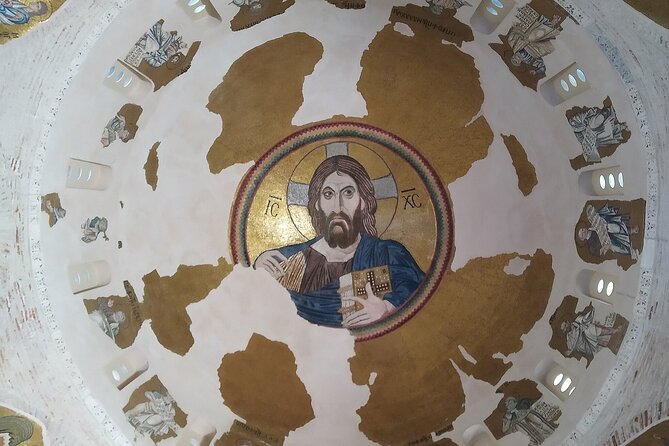
- Daphni Monastery (UNESCO) with standout Byzantine mosaics like Christ Pantocrator
- Eleusis ritual landmarks in sequence: Telesterion, Propylaea, Kallichoron Well, and the Ploutonion
- End at the Eleusis museum to connect artifacts and symbolism to what you just saw outside
Why this Sacred Mysteries tour feels different from a basic day trip
Eleusis has a big reputation, but most visitors only get the “final stop” version. This tour’s strength is the pacing and the route logic. You move along the ancient journey—starting at pieces of the Sacred Way (Iera Odos) in the Athens area—so the mythology doesn’t feel like it landed out of nowhere.
For me, the best part is how learning happens on the move. You’re not just staring at stones; you’re being pointed toward why those stones mattered for pilgrimage and ritual. And since it’s private, you can actually hear the explanations instead of playing phone-tag with a crowd. If your driver-guide is someone like Demetrios or Pericles (names that have come up in feedback), you’re likely to get calm, practical guidance rather than a lecture that races ahead of you.
One more comfort factor that matters: this is a luxury, air-conditioned vehicle experience. Eleusis and the surrounding stops can mean sun, heat, and uneven walking. Having the option to reset between locations keeps the day enjoyable, not exhausting.
You can also read our reviews of more private tours in Athens

The Sacred Way (Iera Odos): where mythology meets modern Athens
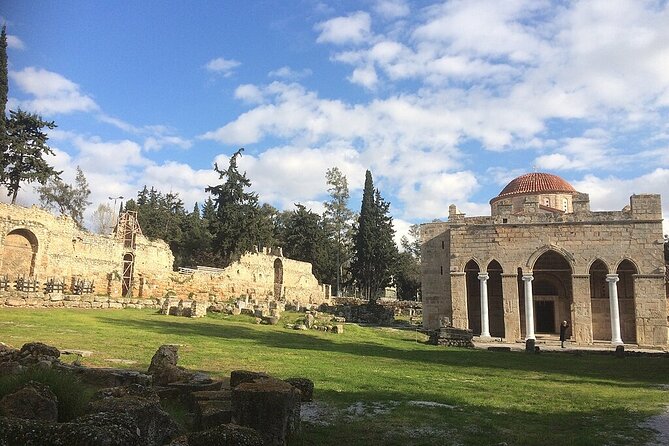
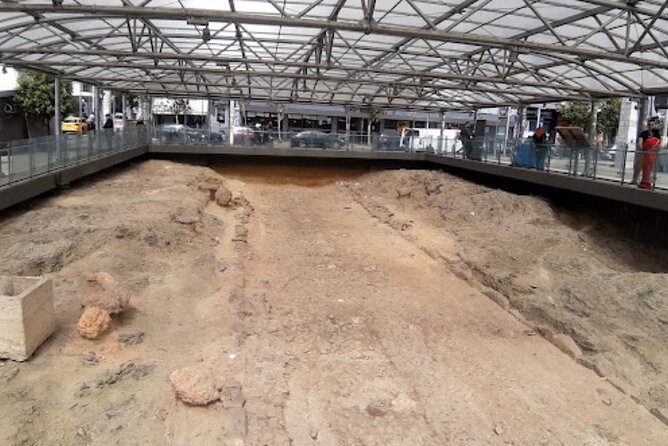
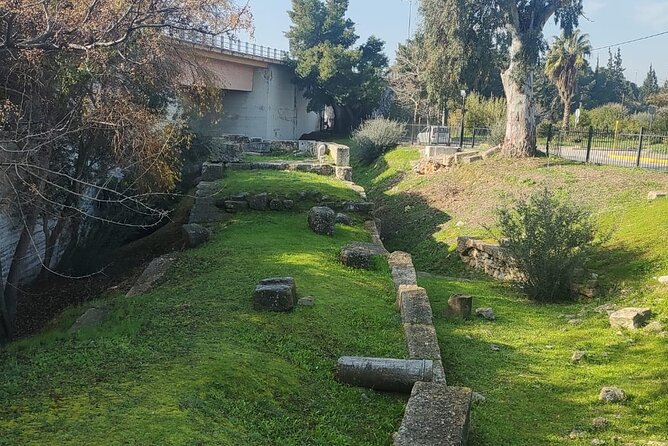
The first time you encounter Iera Odos, it’s not in some quiet countryside. It’s inside the modern cityscape, tucked into an archaeological glimpse tied to construction work.
Iera Odos near Iera Odos / Iera Odos at the Iera Odos area: the Kifisos River crossing
One stop reveals a fragment of the Sacred Way that connects Athens to Eleusis. This section is tied to the ancient crossing at the Kifisos River, where an arched stone bridge once helped pilgrims move through the route. During the construction of the Eleonas Metro Station, remnants of the bridge were found, including three surviving piers (suggesting a structure with at least five arches).
Why I like this stop: it reminds you that ancient routes didn’t vanish. They got folded into later Athens. You’re standing where the pilgrimage motion once continued—trade, travel, and thousands of worshippers passing on a journey with religious meaning.
Practical note: this is a short stop (about 10 minutes) and the “wow” factor comes from context. If you’re the type who likes to know what you’re looking at, this stop sets the mental map for the rest of the day.
Another Iera Odos fragment in Aigaleo: the pilgrimage line
A second stop keeps you on the Sacred Way, this time in the Aigaleo area. Here, you’re walking along remnants of the road that pilgrims used during the Eleusinian Mysteries. The route is tied to hymns, sacred objects carried toward Demeter and Persephone, and a sense of ritual procession.
You’ll also get a sense of the terrain that once shaped the walk. The views in this area matter because pilgrims weren’t just going from point A to point B—they were moving through a landscape associated with myth and ritual.
The small walking portion is part of why this works as a private tour. In a big-group setting, you’d spend half your time stopping and starting. Here, you can actually hear the story and then step forward at your own pace.
Daphni Monastery: Byzantine mosaics on the same sacred corridor
After the Sacred Way road-reading, the tour shifts to a different kind of spiritual art: the Monastery of Daphni. This is a UNESCO World Heritage Site and a standout contrast to the ancient cult route.
Built in the 11th century, Daphni is famous for its Byzantine mosaics. The dome features an awe-inspiring depiction of Christ Pantocrator. The monastery sits along the historic corridor of Iera Odos, so you’re seeing how sacred space keeps getting reused and reinterpreted through time.
A practical advantage: the stop is about 30 minutes, so you can slow down a bit, take in the cypress setting, and let your brain switch from “ancient pilgrimage road” to “how later generations turned the spiritual dial.”
One consideration: mosaics and stone work can be detail-heavy. If you’re short on patience for art history, still go. Even if you skim, Daphni gives you that visual reminder that Eleusis isn’t the only layer of meaning in this region.
You can also read our reviews of more tours and experiences in Athens



Sanctuary of Aphrodite at Skaramagkas: a quick myth stop with access limits
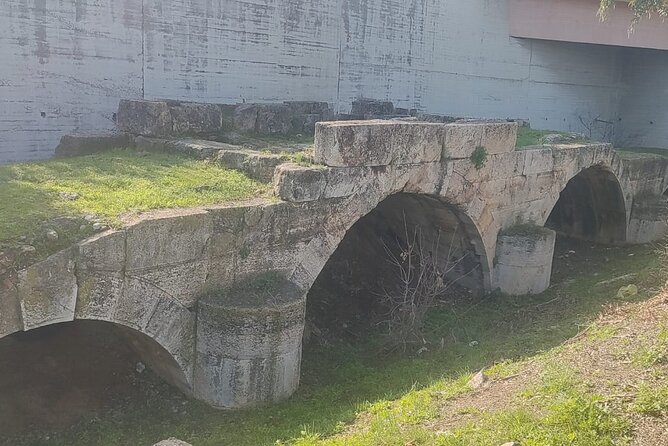
Next up is the Sanctuary of Aphrodite in Skaramagkas. You won’t see a fully intact complex. Instead, you’ll encounter remnants tied to worship of the goddess of love and beauty.
This stop is interesting for two reasons:
- It shows how the Sacred Way corridor supported more than one kind of devotion.
- It connects mythic geography to real pilgrimage behavior—pilgrims traveling from Athens toward Eleusis passing through areas with other sacred sites.
Access note you should plan for: the sanctuary is open to the public on weekends, so interior exploration may be possible then. On weekdays, interior access isn’t permitted, and you’ll get a brief outside viewing stop that’s still good for photos and context.
This means your “expectation level” should be flexible. Treat it as a short myth-flavored breather, not a major museum stop.
The Roman bridge at Eleusis: Hadrian’s engineering in limestone
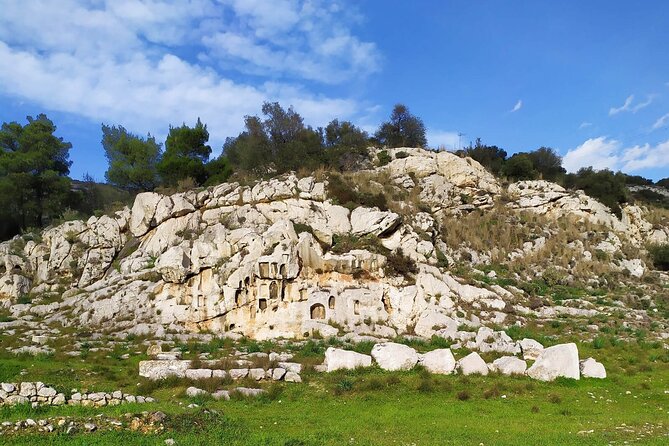
When the day gets closer to Eleusis proper, the tour adds something very physical: Roman bridgework. You’ll stop at an archaeological site near the sanctuary area, where a well-preserved Roman bridge crosses an important connection route.
This bridge was built from Piraeus limestone and measures about 50 meters long and 5.30 meters wide. The design includes a central section with four arches—two wider in the middle and two narrower toward the ends—with inclined approaches on both sides. Dating to Emperor Hadrian’s reign (around 125 AD), it played a key role in linking the Sacred Way with the Eleusinian Kephisos River.
Why this matters: it bridges the “ritual journey” idea with the “infrastructure made it possible” reality. Pilgrimage depended on roads, crossings, and durable construction. Roman engineering here is what kept the ancient flow moving.
Also, because this stop is about 10 minutes, you won’t burn the day on one structure. You’ll see the bridge, understand what it was doing, and then move on—exactly how you want a history tour to feel when you’re managing heat and walking.
Eleusis archaeological site: Telesterion, Propylaea, Demeter’s world
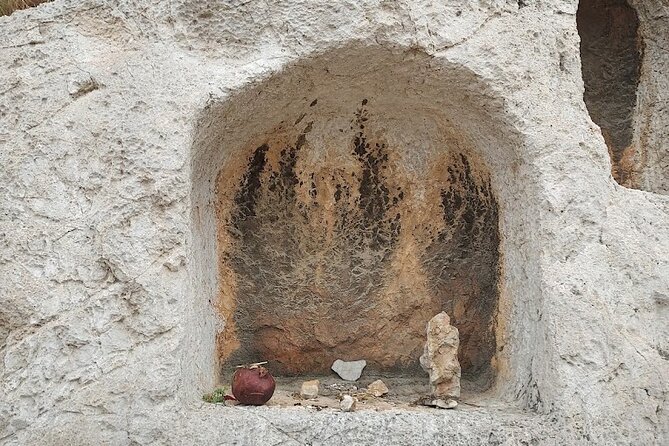
Now you’re in the zone that most people associate with the Eleusinian Mysteries. The tour focuses on major landmarks tied to the rituals honoring Demeter and Persephone, including the places that shaped initiation ceremonies.
The Telesterion: the hall at the center of the Mysteries
The Telesterion was the grand ritual hall at the heart of the Mysteries. It’s described as the center where initiation ceremonies took place, inside an environment surrounded by walls and sacred precincts.
Even without getting lost in technical architectural details, you’ll understand the emotional point. This wasn’t a town square. It was a purpose-built space for transformation and sacred gathering. The tour gives you about 10 minutes here, which is enough time to connect the symbolism to the physical setting—especially since you’ve already learned how pilgrims approached the sanctuary.
The Great Propylaea: the monumental entrance into another realm
Then comes the Great Propylaea, the monumental entrance to the sanctuary. Built in the 2nd century CE under Emperor Marcus Aurelius, it mirrored the Propylaea of the Acropolis in scale and design. It’s known for impressive Doric columns and the big statement of transition: from the mortal world into the divine one.
This stop is about 10 minutes as well, but the effect is strong because you’re looking at how architects staged movement. You’re not just seeing ruins; you’re seeing a designed threshold.
Kallichoron Well: Demeter’s myth stop
The tour also includes the Kallichoron Well, tied to a very specific moment in the myth. It’s linked to Demeter resting while searching for Persephone after her abduction by Hades. The well’s name is associated with a myth where local women danced to comfort the grieving goddess (a clue you might like if you enjoy myth details beyond generic descriptions).
Again, time is short (about 10 minutes), but the symbolism is clear. This is the kind of place where you can stand still and let the story settle.
Ploutonion cave: a sacred Underworld entrance
Next is the Ploutonion Cave, dedicated to Hades (Plouton). The cave is described as a mythical entrance to the Underworld and connects to Persephone’s descent. For mythology fans, this is one of the most emotionally charged stops on the day.
If you like thinking about how ancient people explained life, death, and rebirth, this is the moment where it clicks. You’ll see why the Eleusinian Mysteries mattered: they were built around the emotional logic of the myth.
Admission fees apply for these core site elements
Keep an eye on costs here: entrance fees for the archaeological site area and the museum are listed as €10 per person and are not included in the tour price. The tour descriptions also flag that some of these landmarks have admission requirements, so it’s smart to budget ahead.
Also, note that while your driver-guide is an expert in historical context, a licensed guide inside archaeological sites is not included. Translation: you’ll likely get excellent explanations, but you’ll be moving through the site independently for your own pacing.
Museum of Eleusis: turn ruins into artifacts you can picture
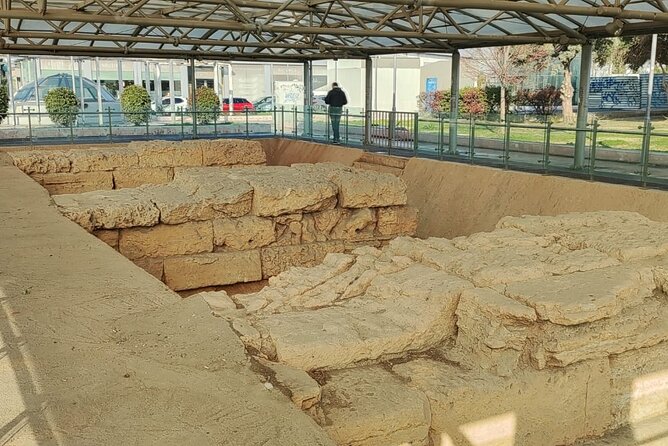
To make the day complete, the tour ends at the Archaeological Museum of Eleusis inside the wider site area, with about 30 minutes here.
This museum helps you stop “reading ruins” and start “seeing what people left behind.” Highlights include statues of Demeter and Persephone, sacred offerings, and reliefs showing scenes connected to the Eleusinian Mysteries. If you’ve ever felt like myth descriptions stay abstract once you’re in front of stones, the museum is what gives you sharper images.
It’s also a good practical choice for the later part of your day. After standing and walking outdoors, the museum offers a more controlled environment where you can take your time with details.
Price and value: what $192.23 per person buys you
This is priced at $192.23 per person, with a 4 to 5 hour duration and pickup offered. On paper, that might look high if you compare it to a basic bus tour. But the value here is the private, comfort-first structure.
You’re paying for:
- A private, air-conditioned vehicle matched to group size (sedan for 1–4, mini van for 5–7)
- Onboard Wi-Fi plus bottled water
- Door-to-door style convenience via hotel or cruise ship pickup and drop-off
- An English-speaking driver-guide with extensive historical knowledge who keeps you oriented across multiple stops
Then there’s the “budget reality” part: entrance fees are extra (€10 per person). Your cost might land above the headline price by the time you reach the museum and archaeological core areas. Still, for a private route that covers multiple sacred-history stops, it often feels like paying for time, comfort, and context.
If you’re traveling as a couple or small group, the private format tends to feel more worth it. If you’re alone, you may want to compare how quickly you’d otherwise spend the same time jumping between sites on your own.
Best for: myth lovers who want comfort and story continuity
This tour fits best if you want:
- A single-day line through Eleusis and the Sacred Way instead of scattered ticket-buying
- English explanations that connect the “what” (sites you see) with the “why” (pilgrimage and ritual meaning)
- A relaxed pace: short stops, time to reset in the vehicle, and no need to manage navigation across multiple locations
It also works well if you’re not trying to do a huge walking marathon. The tour includes walking, so you’ll want comfortable shoes, but the stop style is short and structured.
One more tip that’s practical: bring a hat and sunscreen. Greece can be sunny, and the experience recommends exactly that.
Should you book this Eleusis Sacred Mysteries private tour?
Book it if you want Eleusis to feel like a journey, not a checklist. The strongest reason is the route approach—starting with fragments of Iera Odos and then moving into the Telesterion and the ritual landmarks at Eleusis. Add private comfort, Wi-Fi, and an English driver-guide, and you get a day that stays enjoyable even if you’re heat-sensitive.
Skip (or at least rethink) it if you’re trying to travel ultra-budget or you dislike paying separate entrance fees for the archaeological site and museum. Also consider that on weekdays, the Aphrodite sanctuary stop is an outside viewing moment, not an inside exploration.
If your goal is story continuity plus comfort, this one is a smart pick.
FAQ
How long is the Eleusis Sacred Mysteries private tour?
It runs about 4 to 5 hours, including travel time between stops.
Is pickup and drop-off included?
Yes. Pickup is available at designated locations, including hotel or apartment locations and cruise ports. The tour ends back at the original meeting point.
Are entrance fees included in the tour price?
No. Entrance fees for archaeological sites and museums are listed as €10.00 per person.
Do I get a licensed guide inside the archaeological sites?
A licensed guide to accompany you into archaeological sites is not included. You will still have an expert English-speaking driver-guide for historical context.
Is this tour private?
Yes. It’s private, and only your group participates.
What vehicle do we ride in?
Groups of 1 to 4 are transported in luxurious sedan vehicles. Groups of 5 to 7 ride in comfortable mini vans.
What happens if the weather is poor?
The experience requires good weather. If it’s canceled due to poor weather, you’ll be offered a different date or a full refund. You can also cancel for free up to 24 hours in advance for a full refund.
More Private Tours in Athens


More Tours in Athens



More Tour Reviews in Athens
- All Day Cruise -3 Islands to Agistri,Moni, Aegina with lunch and drinks included
★ 5.0 · 4,958 reviews