REVIEW · ATHENS
Panorama of Athens in 6 hours
Book on Viator →Operated by Andrew's Unique Tours · Bookable on Viator
Athens hits hardest when you do it in big, clear chunks. This private tour stacks the must-sees into one focused half day, built around the Acropolis and the classic sites that define the city. I like the hotel pickup and drop-off, because it removes all the stressful guesswork. I also like that you’re traveling in a private, air-conditioned vehicle with bottled water, so you can stay comfortable while you bounce between neighborhoods.
One thing to weigh: entrance tickets aren’t included, especially for the Acropolis area. You’ll need to plan ahead (and budget for it) so your time on-site doesn’t get eaten by ticket lines or ticket confusion.
In This Review
- Key highlights worth knowing before you go
- Private Athens in a half day: what you’re really buying
- The vehicle and driver setup: smooth logistics, limited “on-site guide” time
- Price and value: $459.74 per group can be a bargain
- Stop-by-stop Athens: how the route feels in real time
- Acropolis first: Propylaea, Temple of Athena Nike, Parthenon, Erechtheion
- Theatre of Dionysus and the Odeon of Herodes Atticus
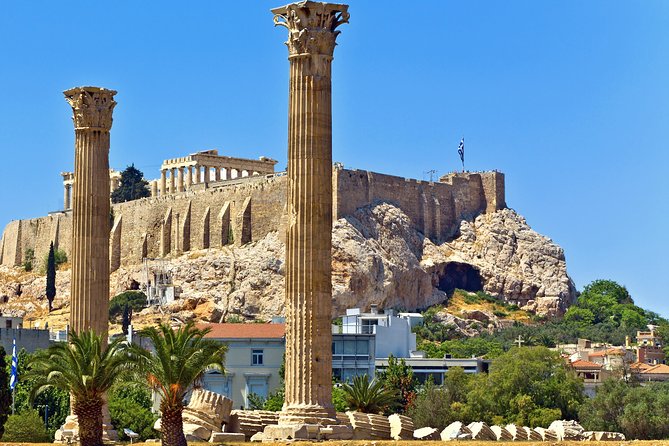
- Olympieion (Temple of Olympian Zeus): the columns you can still feel
- Change of the Guards at the Presidential Mansion
- Mount Lycabettus: a quick view from 277 meters up
- Panathenaic Stadium: where the ancient form still shows
- National landmarks: Academy of Athens, University, National Library
- Monastiraki Flea Market and Plaka: the Athens you actually walk
- Ancient Agora and key temples: Stoa of Attalos and Temple of Hephaestus
- Who this tour suits best (and who should choose something else)
- Tips to make the most of your half day
- The best parts: what tends to impress people most
- Should you book Panorama of Athens in 6 hours?
- FAQ
- How long is the Panorama of Athens tour?
- What’s the group size for this private tour?
- Is hotel pickup and drop-off included?
- Is the tour guided by a licensed tour guide inside the sites?
- Are entrance tickets included?
- What language is the tour offered in?
- What’s the schedule for the Change of the Guards?
- Can I cancel for a full refund?
Key highlights worth knowing before you go
- Private group, up to 3 people: more control over your pace than a big group bus.
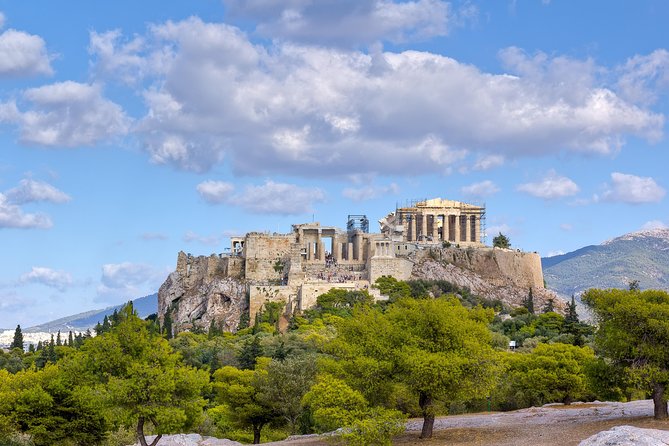
- Acropolis-focused timing: you’ll hit Propylaea, Parthenon, Erechtheion, and the key viewpoints fast.
- Driver-led touring style: drivers share history and route tips, but a licensed site guide is not included.
- Big-city variety in one loop: Olympieion, Change of the Guards, Lycabettus views, stadium, Agora, Plaka.
- Affordable flexibility for small groups: the price is per group, not per person.
- Comfort included: SUV or luxury vehicle, air-conditioning, and bottled water.
Private Athens in a half day: what you’re really buying
For $459.74 per group (up to 3 people), you’re basically paying for three things: comfort, efficiency, and a route designed to hit the classics without burning hours in transit. With hotel pickup and drop-off, you start already in vacation mode. You’re not negotiating buses, taxi lines, or where to park.
This isn’t a long, slow “take your time” Athens day. It’s a vision of Athens: the Acropolis spine first, then a clean arc through central Athens highlights—Olympieion, the presidential area, viewpoints, the stadium, and down into Monastiraki and the Ancient Agora, finishing with Plaka stroll vibes.
Because it’s private, it tends to work best when you have clear priorities. If you want museum-level time inside every site, you’ll likely want extra hours. But if your goal is to see the right places and understand what you’re looking at, this format is a strong value.
You can also read our reviews of more tours and experiences in Athens.


The vehicle and driver setup: smooth logistics, limited “on-site guide” time
You’ll ride in a private air-conditioned vehicle (often an SUV like a Kodiaq, or a luxury vehicle / C-Class taxi cab depending on the setup). Bottled water is included, which sounds small until you’re walking in Athens sun for hours.
The tour’s history comes from the professional drivers. They’ll share context and help you make smart route choices. One key detail: the driver isn’t licensed to accompany you inside every site. Also, a licensed tour guide isn’t included. So expect this to be a driver-led experience with time for your own walking and independent entry inside the places that require tickets.
In practice, this can still feel very “guided,” especially if your driver explains what to look for before you step in. Just don’t expect a separate, licensed guide to be holding your hand inside every archaeological stop.
Price and value: $459.74 per group can be a bargain
The headline price can look high until you break down who’s paying. It’s per group (up to 3), not per person. For a couple plus a friend (or a family of three), the cost per person can drop quickly compared with multiple tickets for a large-group tour.
Here’s the part to plan for: entrances are not included. The Acropolis access is listed at about €30 per person, and the Acropolis & Slopes ticket is also indicated at €30 per person (with under-18 free). If you’re budgeting, treat admissions as the main extra cost—then think of the tour price as transportation + route + human guidance.
If you’re visiting Athens for the first time and want to see a lot without paying for a licensed guide at every stop, this is a sensible way to spend your limited time.
Stop-by-stop Athens: how the route feels in real time
This itinerary is built like a highlight reel. Times are short at several stops, so you’ll want to decide what matters most to you before you arrive.
Acropolis first: Propylaea, Temple of Athena Nike, Parthenon, Erechtheion
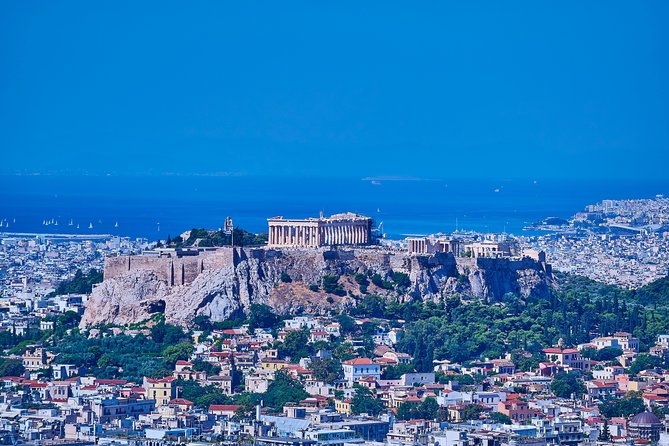
Your tour starts at the Acropolis, the naturally fortified hill that anchors Athens’ myth and museum cases alike. You’ll walk through the monumental entry zone and reach the big-name structures without needing to figure out directions on foot.
Propylaea is your “gate moment.” It’s the grand entrance, built and rebuilt through different eras, and it sets the tone for what’s coming. Even a few minutes here helps you orient your eye before you move deeper into the sacred space.
From there you pass the Temple of Athena Nike, noted as an early fully Ionic temple on the Acropolis (built around 420 BC). It’s smaller than the Parthenon, but it helps you see how Greek architecture worked beyond the biggest headline names.
Then comes the Parthenon itself. You get about 20 minutes at this centerpiece. That’s enough time to take in the scale, notice how the whole thing sits on the hill, and line up a few views. The Erechtheion follows, with its complex history and the split of sacred spaces inside. Even at around 5 minutes, you’ll understand why it’s famous for its design.
The catch with the Acropolis is simple: you’re going to be looking at a lot in a short period. Wear good shoes, bring water, and don’t try to “win” the whole hill. Instead, pick one or two structures to study with attention, and let the rest be quick inspiration.
- All Day Cruise -3 Islands to Agistri,Moni, Aegina with lunch and drinks included
★ 5.0 · 4,958 reviews




Theatre of Dionysus and the Odeon of Herodes Atticus
Near the Acropolis slopes, you’ll touch the sites that turn the hill into a living stage.
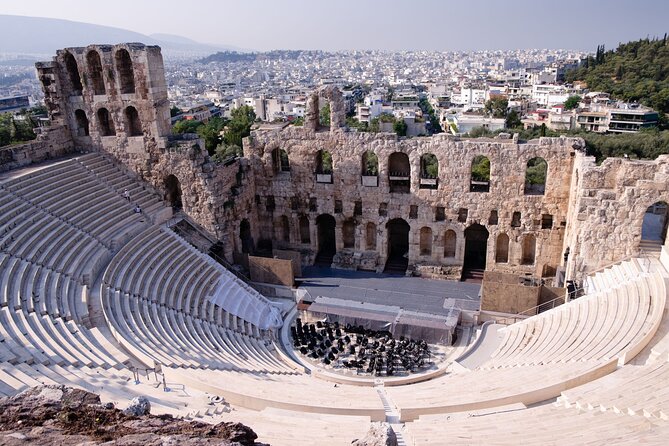
The Theatre of Dionysus Eleuthereus is described as the oldest open-air theatre in the world. You won’t spend long here (around 5 minutes), but it’s enough time to understand that tragedy and comedy weren’t distant art forms—they were civic events.
Then you’ll see the Odeon of Herodes Atticus, a stone Roman theatre structure on the southwest slope. It’s a reminder that Athens didn’t stop when the classical period ended; later rulers used the same dramatic terrain.
If you love performances, literature, or the idea that politics and art were braided together, these quick stops are a satisfying hit.
Olympieion (Temple of Olympian Zeus): the columns you can still feel
Next you’ll head to the Temple of Olympian Zeus, also called Olympieion. Construction began in the 6th century BC and wasn’t completed until Roman Emperor Hadrian’s era in the 2nd century AD. That long timeline matters: it explains why what you see now is partial and monumental, not “fully intact.”
This stop is short (listed without a specific minute block), but it’s worth it. The remaining columns give you a real sense of scale, and it helps you connect the Acropolis story to the broader idea of “temples as power.”
Change of the Guards at the Presidential Mansion
One of Athens’ most theatrical traditions is the Change of the Guards (evzones). This is listed as happening every day, every hour, and you’ll get about 15 minutes.
This is a fun palate cleanser from archaeology. It’s also an easy win because it’s predictable. Just arrive ready to stand and watch, and keep your phone ready for photos—this is one of those moments where your camera will get better results than your feet.
Mount Lycabettus: a quick view from 277 meters up
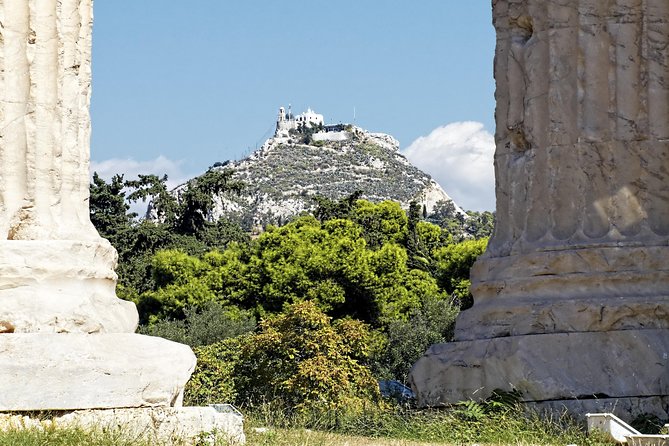
Then it’s to Mount Lycabettus, the highest point in central Athens (277 meters). You’ll have around 15 minutes here for views.
At this stage in the day, the viewpoint matters more than the climb. The time is brief, so go with a simple goal: capture the horizon and understand how Athens spreads from the Acropolis area across the city. This is also a good spot to reorient mentally before you head into the next historic zones.
Panathenaic Stadium: where the ancient form still shows
The Panathenaic Stadium is next, with about 15 minutes. The standout detail here is that it’s not just an archaeological ruin. It was renovated for the first modern Olympics in 1896, with marble covering funded by Georgios Averof, but the present shape matches the ancient 4th-century BC stadium.
If you like sports history or the way modern Athens tries to keep an ancient thread, this stop delivers quickly.
National landmarks: Academy of Athens, University, National Library
You’ll also pass the Academy of Athens building area (described as a copy of Propylaea of the Acropolis) as well as the University of Athens and the National Library of Greece. These are more “look and learn from the street” moments than deep-site stops based on the information provided.
They work as a bridge between ancient Athens and modern Greek identity—education and scholarship living in the same city.
Monastiraki Flea Market and Plaka: the Athens you actually walk
After the historic anchors, the tour goes straight into the neighborhoods.
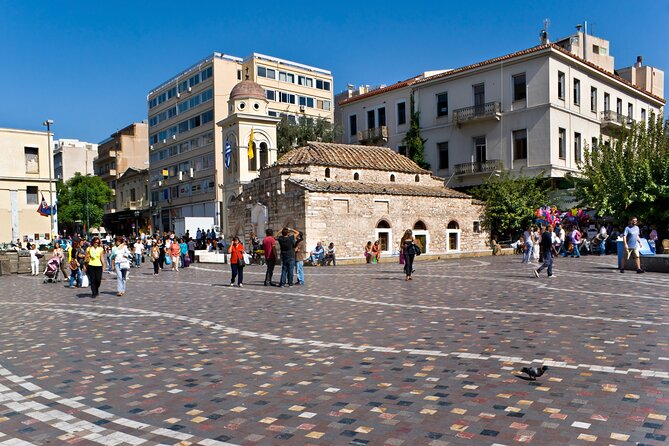
Monastiraki Flea Market gets about 30 minutes. It’s described as the biggest and most popular flea market in Athens, right by Monastiraki Square. This is where you’ll see everyday street life, souvenir browsing, and the energy of central Athens.
Then you’ll reach Plaka, an old neighborhood under the Acropolis. You get about 10 minutes. Think narrow streets, neoclassical buildings, cafes, souvenir shops, and the feel of a place that lives year-round.
These are short stops, so go with a plan: decide whether you want photos, a snack break, or a quick souvenir lap. Don’t try to shop like you have an entire evening.
Ancient Agora and key temples: Stoa of Attalos and Temple of Hephaestus
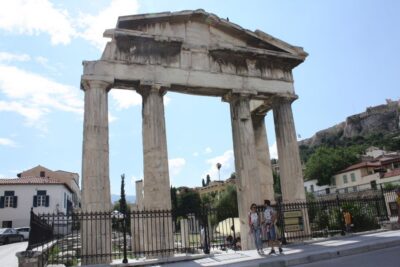
Next is the Ancient Agora of Athens, with about 20 minutes. The Agora is described as the heart of ancient Athens—political, commercial, social, religious, and even a seat of justice. That’s a big claim, but you’ll feel it once you connect it to the city’s role as a democracy and civic center.
You’ll also stop at the Stoa of Attalos (around 30 minutes). It’s described as the main monument and museum at the Ancient Agora after the Temple of Hephaestus. Then you’ll see the Temple of Hephaestus, listed as among the best-preserved ancient temples in Greece, dedicated to Hephaestus.
These are great “how the city worked” stops. If you only come to Athens for the Acropolis photos, you’ll miss the sense of everyday civic life that the Agora area provides.
Who this tour suits best (and who should choose something else)

This works really well if you’re:
- Visiting Athens for the first time and want a big, memorable overview
- Traveling with limited time (about 5 to 6 hours)
- Prefer private logistics and a comfortable ride over public transport
- The kind of person who likes to understand what you’re seeing as you walk
It may not be the best fit if you:
- Want long stays inside multiple ticketed sites
- Plan to spend hours in museums
- Don’t want to think about entrance fees ahead of time
Given the pace, I’d say it’s an excellent “first pass” Athens tour. Then you can come back later for slower, deeper exploring.
Tips to make the most of your half day
Here’s how I’d set you up for success with what’s known about this experience:
- Pre-plan tickets for the Acropolis area. Entrance tickets like the Acropolis access are not included, and buying ahead helps you move faster once you’re there.
- Pick a priority list. With short time windows, you’ll enjoy the tour more if you know your top three structures to linger at.
- Bring water and sun protection. Bottled water is included, but you’ll still want sunscreen and a hat.
- Wear shoes you can trust. You’ll be walking around ancient stone paths and uneven terrain.
- Ask your driver for route and viewpoint tips. The driver-led history and route thinking is part of the value—especially for avoiding the worst crowd moments.
The best parts: what tends to impress people most

The stand-out strengths you can count on from how this tour is run are:
- The human feel. Guides like Andreas and Evangelos are praised for patience and flexibility, including tailoring the tour to what you want to see.
- The smooth city navigation. Drivers like Alex are noted for knowing where to park and how to move through a busy town efficiently.
- The storytelling approach. Many people enjoy a running explanation that makes the ruins feel less like disconnected stone and more like a timeline.
- The comfort factor for challenging moments. One guest specifically highlighted help getting access to an elevator at the Acropolis when mobility was an issue.
Even with short stop times, the tour aims to make your time count.
Should you book Panorama of Athens in 6 hours?
If you want a smart, efficient Athens highlight run with private comfort, I think this is a good choice. The price per group can be very fair, especially for small groups, and the Acropolis-first structure makes sure you don’t miss the big story.
I’d book it if your goal is: see the icons, learn what you’re looking at, and still have energy left to explore on your own after. I’d skip it if you hate ticket planning, need lots of museum time, or want a licensed guide inside every site rather than driver-led context plus independent entry.
FAQ
How long is the Panorama of Athens tour?
It runs about 5 to 6 hours.
What’s the group size for this private tour?
It’s a private tour for your group, up to 3 people.
Is hotel pickup and drop-off included?
Yes, hotel pickup and drop-off are included.
Is the tour guided by a licensed tour guide inside the sites?
No. A licensed tour guide is not included. The driver provides history and guidance, but they’re not licensed to accompany you in every site.
Are entrance tickets included?
No. Entrance tickets are not included, including Acropolis access. You’ll need to book them on your own (the tour provides a link with details).
What language is the tour offered in?
The tour is offered in English.
What’s the schedule for the Change of the Guards?
The Changing of the Guard occurs every day, every one hour.
Can I cancel for a full refund?
Yes. Free cancellation is available up to 24 hours in advance for a full refund.



More Tour Reviews in Athens
- All Day Cruise -3 Islands to Agistri,Moni, Aegina with lunch and drinks included
★ 5.0 · 4,958 reviews