REVIEW · ATHENS
Mystical Delphi & Hosios Loukas Byzantine Wonder Luxury Day Tour
Book on Viator →Bookable on Viator
Delphi is easier when you’re not fighting logistics. This day tour pairs the ancient star of Greece with a major UNESCO Byzantine stop, plus a mountain town break in Arachova. You’re set up for independent exploring, while the drive stays comfortable and connected.
I especially like the pickup-and-drop convenience from central Athens areas and the onboard Wi‑Fi that helps you make the long drive feel less like a chore. Second, the small group in a luxury mini van (2–4 guests) keeps things calm and makes the day feel more personal than a big bus.
One thing to weigh: you’ll visit many archaeological areas on your own time, and Delphi site tickets and the museum are not included, so plan on paying extra once you arrive.
In This Review
- Key points worth knowing
- Why this tour works as a first Delphi day
- Pickup, ride comfort, and how the 8-hour day actually feels
- Driving past Mount Parnassus: what you’re looking at between stops
- Hosios Loukas monastery: Middle Byzantine UNESCO and the story of St. Luke
- Arachova break: black wine, textiles, and that ivy-covered bell tower
- Delphi archaeological site: you’ll see the core—then keep control
- The Tholos of Athena Pronoia: a photo stop with real architecture behind it
- Delphi Museum and Temple of Apollo: where you slow down
- Delphi Archaeological Museum
- Temple of Apollo
- Treasuries, the Ancient Theater, and the Stoa: details you’ll remember
- Treasuries and the Sacred Way area
- Ancient Theater of Delphi
- Stoa of the Athenians
- Other Delphi reminders: Hippodrome, Serpentine Column replica, and polygonal wall
- Hippodrome and the Pythian Games
- Serpentine Column replica
- Polygonal wall and manumissions
- Price and value: what you pay for at $225.85 per person
- Who this tour fits best
- Should you book this Delphi & Hosios Loukas Luxury Day Tour?
- FAQ
- How long is the Mystical Delphi & Hosios Loukas day tour?
- Does the tour include hotel pickup and drop-off?
- Is Wi‑Fi provided during the drive?
- Are entry tickets to Delphi included in the price?
- Is Hosios Loukas admission included?
- Will the driver guide you inside the archaeological sites?
- Is free cancellation available?
- Is this tour private?
Key points worth knowing
- Door-to-door pickup in Athens saves time and avoids the hassle of transit to a departure point.
- Wi‑Fi, A/C, and bottled water keep the long drive comfortable, especially when you’re juggling a full day.
- Hosios Loukas is included (and it’s a UNESCO-class masterpiece of Middle Byzantine art).
- Arachova is a real stop—panoramic views, cobbled streets, and time to shop for local goods.
- Delphi is self-paced inside the sites, so bring your curiosity and comfortable walking shoes.
Why this tour works as a first Delphi day
If you only have one day for Delphi, the biggest problem is timing. Delphi is spread out, tickets add up, and getting there from Athens takes real time. This tour handles the hard part for you: getting you out of the city, back again, and to the right places in a logical order.
The day also balances two different types of awe. Delphi gives you the grand scale of sacred ruins tied to oracles, games, and politics. Hosios Loukas gives you the quieter, human scale of monastic architecture and Byzantine religious art. You get both, without feeling rushed in a way that makes you hate your life by 2 p.m.
This is a small-group luxury mini-van tour with private transport. That matters because it reduces friction: fewer passengers, smoother timing, and a driver who can manage the day as a single unit.
You can also read our reviews of more tours and experiences in Athens


Pickup, ride comfort, and how the 8-hour day actually feels
The schedule is built for an 8-hour day (approx.), with Delphi reached after about a 2.5-hour drive. In real terms, you’re spending a lot of the day on the road—so the comfort package isn’t a gimmick.
You get:
- pickup and drop-off at central Athens hotel, Airbnb residence, or the Piraeus port
- modern first-class private vehicle
- A/C, bottled water, and onboard Wi‑Fi
- fuel and tolls included
You also get an English-speaking driver for commentary during the trip. One useful detail from past experiences: drivers like Panos and Costas have been praised for being punctual and for having strong English, with conversation that helps pass the drive. That matters because you’ll come into Delphi mentally warmed up, not just jet-lagged and staring at your phone.
A practical tip: since your driver is not an official tour guide and won’t go into the sites with you, keep your phone charged and switched on so you can reach them if needed during your free time.
Driving past Mount Parnassus: what you’re looking at between stops
You’re traveling through an area dominated by Mount Parnassus, a limestone mountain that towers above Delphi. Even if you don’t stop for photos, it helps to understand what you’re seeing. The slopes include olive groves and rolling hills, and in seasonal cycles they support hiking in warmer months and skiing in winter. The mountain’s melting snows feed water to surrounding communities, reaching as far as Athens.
Parnassus is also where Delphi sits, and the region has a long trail of cultural and historical importance. If you like small “wait, that’s why this place matters” moments, this tour gives you enough context to connect the road scenery to the sacred sites ahead.
Hosios Loukas monastery: Middle Byzantine UNESCO and the story of St. Luke
Hosios Loukas is one of the anchors of the day, and it’s included. This historic walled monastery is near Distomo in Boeotia and is UNESCO-listed as part of the wider Byzantine monastic group (along with Nea Moni and Daphnion).
What makes it worth your time is how much meaning is packed into the design and the legends:
- founded in the early 10th century AD
- established by Hosios Luke of Steiris, a hermit whose relics are kept at the monastery
- the main shrine centers on the tomb of St. Luke, originally in a vault, later placed at the junction of two churches
- the monastery’s reputation for miracles connects to a story about myron, a perfumed oil said to heal and work wonders
It sits on slopes of Mount Helicon, so you tend to feel the monastery not just as a building, but as part of a landscape and religious worldview.
Time is short—about 30 minutes in the schedule—so you won’t be able to read every inscription or admire every corner like you’re on a museum date. Still, the inclusion is smart: you get a major stop without paying extra for entry there.
Arachova break: black wine, textiles, and that ivy-covered bell tower
Arachova is a mountain town near Delphi, and it’s a welcome change of pace between ancient sites and religious architecture. You’ll get about 45 minutes, which is enough for a quick reset and some light wandering.
What you can expect:
- a hillside town with uphill small houses and cobbled streets
- a central area featuring a steep cliff and a bell tower covered in dense ivy
- a large clock at the top of that tower, with the clock described as roughly 10 meters
- a local focus on traditions and crafts, including black wine, textiles, carpets and rugs, and handicrafts like woodcut work
The town name is said to be of South Slavic origin, tied to walnut trees. That kind of detail may sound minor, but it helps you see the town as more than a tourist pit stop. It’s a real community that has built a local economy around its mountain identity and proximity to Delphi.
Also, the timing is practical. You’re not sent to Arachova “just because.” It’s positioned to break up the drive and keep the day from turning into one long archaeological blur.
- All Day Cruise -3 Islands to Agistri,Moni, Aegina with lunch and drinks included
★ 5.0 · 4,958 reviews




Delphi archaeological site: you’ll see the core—then keep control
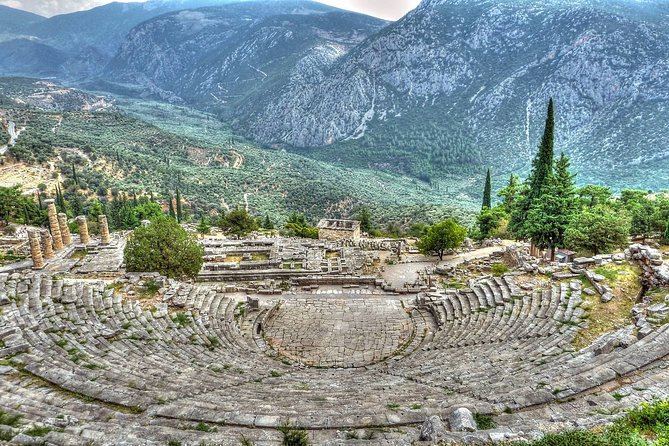
When you arrive at Delphi, you get time for a walk in key areas, including the sanctuaries of Apollo and Athena Pronaia, plus the ancient stadium and theater area. You’ll have around 30 minutes for that first exploration window.
Delphi’s big picture is the reason it draws people again and again. The place was sacred to Gaia first, and then Apollo took the local identity tied to the story of Pytho, the snake/dragon Apollo slays. Over roughly a thousand years, pilgrims came for guidance. Delphi’s fame peaked between the 6th and 4th centuries BCE when major political influence arrived through the Amphictyonic League, a federation controlling the sanctuary after the First Sacred War.
Even if you don’t read every sign, this context helps your brain do pattern-matching while you walk: you start connecting temples, treasuries, and performance spaces to the role Delphi played in both religion and politics.
The trade-off is clear. You’re not being escorted inside by a licensed archaeology guide. You’re free to move at your own pace, but the depth of interpretation depends on what you bring (or what you read on-site). If you love being guided step-by-step through myths and architecture, you might want to add an official guide during your Delphi time. If you’re comfortable exploring independently and using signage, the setup is ideal.
The Tholos of Athena Pronoia: a photo stop with real architecture behind it
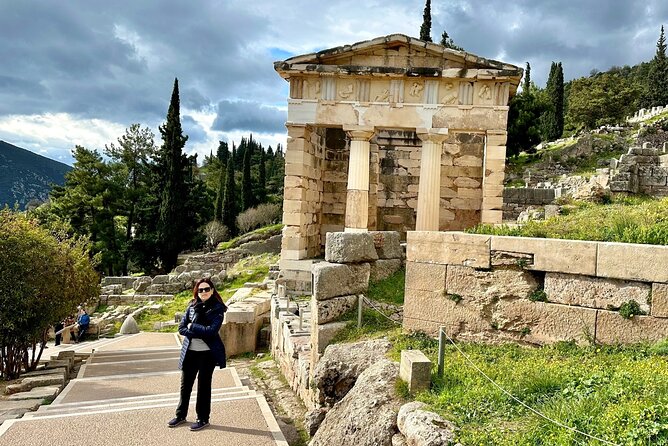
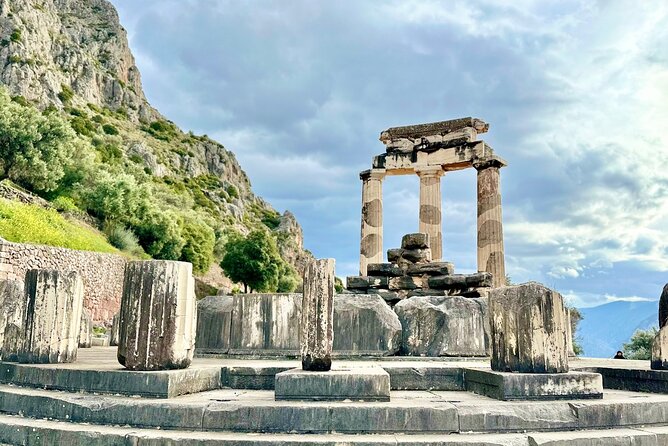
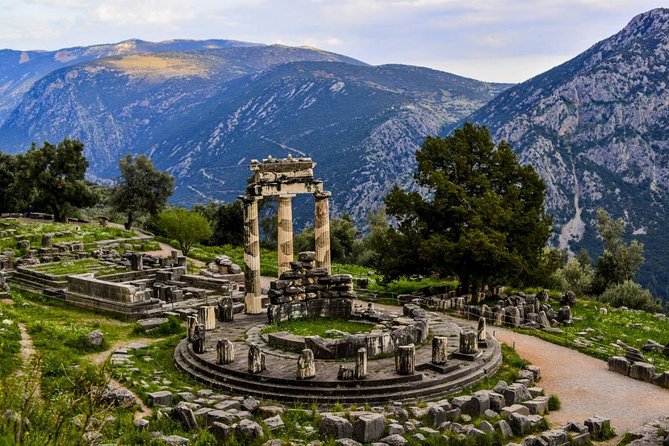
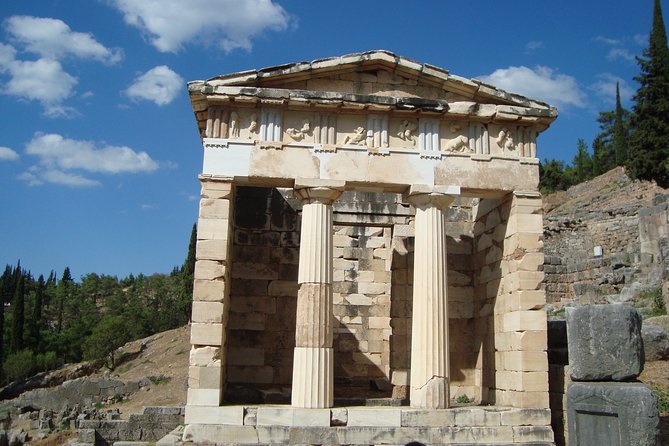
Delphi includes a couple of stops connected to the Tholos of Athena Pronoia. This circular structure is frequently a highlight because it’s architecturally distinctive and because it’s near enough for quick visits.
Here’s what makes this building more than a quick picture:
- constructed between 380 and 360 BC
- designed as a circular sanctuary with 20 Doric columns arranged around the outside (and 10 Corinthian columns in the interior)
- located about half a mile (800 meters) from the main ruins, so it’s slightly apart from the densest area
You’ll also hear about the gymnasium complex nearby, including a legend about pools and baths with magical powers tied to the idea of connecting with Apollo.
One practical note: it’s a short stop on a long day, so wear shoes with traction. Delphi terrain can be uneven, and you don’t want a sore ankle ruining the rest of your time.
Delphi Museum and Temple of Apollo: where you slow down
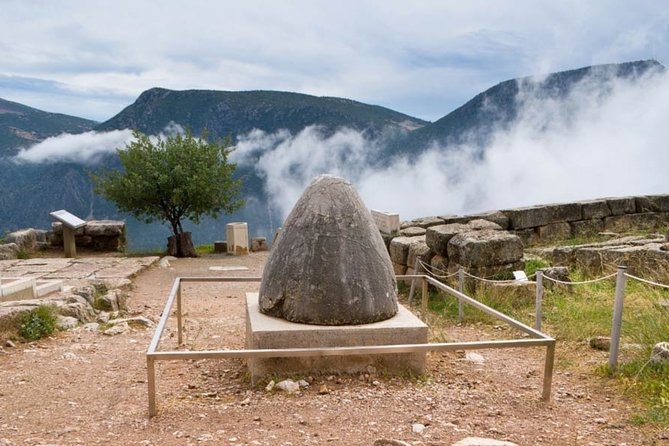
The tour gives you options beyond the open-air ruins, and those are the best places to make your day feel complete.
Delphi Archaeological Museum
You’ll have about 1 hour here, though entry is not included in the tour price. The museum is run by Greece’s Ministry of Culture and was founded in 1903, with rearrangements over time.
Inside, the museum is organized across 14 rooms on two levels, and it focuses on discoveries from Delphi. You’ll see statues and architectural elements, including the famous Charioteer of Delphi. There are also ex-votos and offerings connected to the sanctuary of Pythian Apollo, such as the Sphinx of Naxos and architectural pieces like the frieze of the Siphnian Treasury.
There’s also a modern museum location described as about 500 meters east of town, designed to complement the ancient site experience. The nice thing is you’re not forced into a single order. If you end up doing ruins first and museum second, that works.
Temple of Apollo
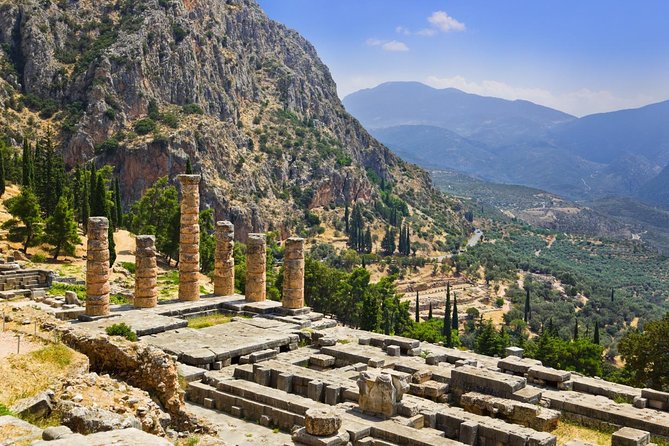
The Temple of Apollo is the centerpiece. The partially restored colonnade you see today dates to the 4th century BC and represents the third temple at that location.
A few myth-and-function details help you interpret what you’re seeing:
- the oracle, the Pythia, operated within the temple area
- one ancient tradition links the chosen location to a sacred chasm emitting vapors, which the Pythia inhaled
- stories describe the Pythia entering a state of delirium, and priests translating her utterances into oracles
The Temple of Apollo stop is about 1 hour, and entry is not included. If you’re paying extra anyway, I’d treat this hour as your “anchor” visit—the place you spend your best attention.
Treasuries, the Ancient Theater, and the Stoa: details you’ll remember
Delphi can feel like a lot of stone unless you know what type of stone story you’re looking at. This tour’s free-time pacing helps because it hits multiple categories of building.
Treasuries and the Sacred Way area
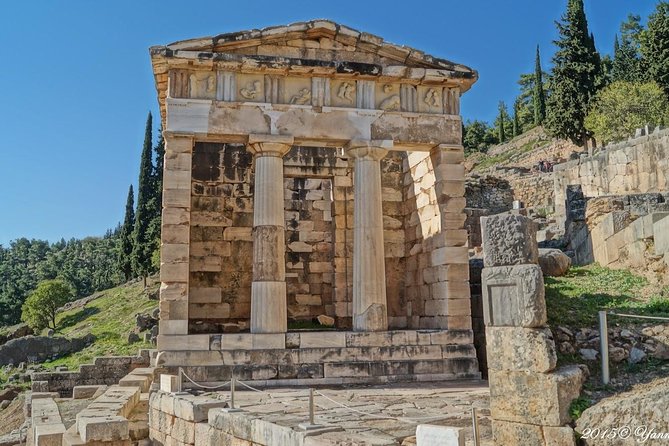
One highlight area is the Treasury of the Athenians, tied to the Battle of Marathon (490 BC). Treasuries like this were built by city-states to commemorate victories and to thank the oracle, often using offerings as a tithe of battle spoils.
Other treasuries you may pass include:
- the Siphnian Treasury, funded through the yield of silver mines until the sea flooded them
- references to a restored Athenian focus and other city offerings
If you like architecture that doubles as political messaging, this is where Delphi becomes more than mythology.
Ancient Theater of Delphi
You’ll also find the Ancient Theater, built in the 4th century BC. It was built higher up so spectators had views over the sanctuary and valley.
Some numbers and function:
- it could hold about 4,500 spectators
- it was used for vocal and musical contests linked to the Pythia
- the orchestra started as a full circle about 7 meters in diameter
- the scene building ended up with preserved foundations from alterations over time
You’ll also see details about the theater’s setting, including how the natural slope and creek Cassotis relate to the foundations. Those facts make the theater feel engineered, not just artistic.
Stoa of the Athenians
The Stoa is an open-sided porch area that connects to the Sacred Way and the market-like feel of this quarter. It’s described as being near polygonal walls tied to terraces and temple construction.
You’ll find an interesting architectural contrast: while Delphi’s broader architecture is generally Doric and plain, the Athenians preferred Ionic style here. The remaining porch structure includes seven fluted columns described as carved from single pieces of stone, plus an inscription tying it to an Athenian naval victory over the Persians in 478 BC.
If you enjoy “why did they build it that way” questions, the stoa helps answer them.
Other Delphi reminders: Hippodrome, Serpentine Column replica, and polygonal wall
Delphi’s story keeps expanding the farther you walk. This tour includes several extra touchpoints that help you build the full mental map.
Hippodrome and the Pythian Games
This area connects to chariot races held during the Pythian Games. It’s the kind of monument archaeology loves because it hides for a long time.
The tour information includes a key modern research detail: in 2012, Professor Panos Valavanis announced the hippodrome’s location at Gonia. It’s described as about 1.5 km from Itea, running parallel to the Kefali mountain range, and located near olive groves with nearby hills. That’s the sort of detail you can remember later when you read about Delphi in a book.
Serpentine Column replica
Near the site, you’ll see a replica of the Serpentine Column (Tripod of the Plataeans), erected in 2015. The original bronze column is described as commemorating Greeks who defeated the Persian Empire at the Battle of Plataea (479 BCE). It was removed by Constantine the Great in AD 324 and now resides at the Hippodrome of Constantinople in modern Istanbul. The replica gives you a sense of what used to be here.
Polygonal wall and manumissions
Another stop focuses on the polygonal wall, a retaining wall supporting terraces tied to construction of the second temple of Apollo in 548 BC. Later, from about 200 BC onward, stones were inscribed with manumission contracts for slaves consecrated to Apollo. The information states roughly a thousand manumissions are recorded.
That shifts Delphi from “oracle drama” to everyday social systems—freedom granted, contracts written, and religion tied to real legal life.
You also have a mention of Castalian Spring and the remains of monumental fountains that received water from the spring, dating to the Archaic and Roman periods. It’s the kind of detail that helps you understand why Delphi was a sacred place beyond the buildings.
Price and value: what you pay for at $225.85 per person
At $225.85 per person, this is not the cheapest way to see Delphi. The value comes from the combination:
- private pickup/drop-off in Athens (and from Piraeus port)
- modern vehicle with A/C, Wi‑Fi, and bottled water
- fuel and tolls included
- a small group in a luxury mini van (2–4 guests)
- an English-speaking driver who provides commentary during the drive
But here’s the part you should plan for: archaeological site tickets are not included, including Delphi’s archaeological site entry listed as €20 per person, and the Delphi museum entry is also not included. Some specific features have included entry windows, but much of the core Delphi experience still requires separate payments.
Also, your driver does not enter the archaeological sites with you. Drivers can answer questions, but they don’t operate as licensed guides inside temples and museums. So you’re paying for transport and interpretation on the road—not for a full inside-guiding service.
If you’re traveling as a couple or a small group and you want the calm of a private van plus the freedom to roam Delphi on your own schedule, the price can feel fair. If you need someone to lead you sentence by sentence through every ruin, you may end up feeling that you paid a premium for what is, in many ways, independent touring.
Who this tour fits best
This tour fits you best if:
- you want a one-day Delphi + UNESCO Byzantine mix without planning routes and schedules
- you like flexible exploring instead of being marched through a site
- you value comfort for the long ride—especially Wi‑Fi and A/C
- you’re traveling in a small group and can share the mini-van cost
It may not fit as well if:
- you strongly prefer a licensed guide inside each archaeological space
- you’re trying to keep every euro under control, since key Delphi entries are extra
In the end, this is a day built for travelers who enjoy the sites directly, then use signage, pacing, and short stops to connect the dots.
Should you book this Delphi & Hosios Loukas Luxury Day Tour?
I’d book it if you want door-to-door convenience, a comfortable private van, and a day that hits both Delphi’s sacred core and the standout Byzantine monument of Hosios Loukas. The Arachova stop is also a smart reset, not just a quick photo.
But book with eyes open: you’ll pay extra for major Delphi entries, and your time in the archaeological sites is largely self-paced. If that sounds like your kind of travel, you’ll likely feel the day moves with your pace instead of against it.
If you want, tell me your travel month and whether you prefer guided storytelling or on-your-own exploring—I can help you decide if adding a site guide during Delphi makes sense for your style.
FAQ
How long is the Mystical Delphi & Hosios Loukas day tour?
It runs for about 8 hours.
Does the tour include hotel pickup and drop-off?
Yes. Pickup and drop-off are available from central Athens hotel, Airbnb residence, or the Piraeus port.
Is Wi‑Fi provided during the drive?
Yes. The vehicle includes onboard Wi‑Fi, along with A/C and bottled water.
Are entry tickets to Delphi included in the price?
No. Entry fees for the Delphi archaeological site and the Delphi Archaeological Museum are listed as not included. Delphi archaeological site entry is noted as €20 per person.
Is Hosios Loukas admission included?
Yes. Hosios Loukas admission is listed as included.
Will the driver guide you inside the archaeological sites?
No. The drivers are not official tour guides, and they will not enter the archaeological sites with you, though they can provide commentary and answer questions in fluent English.
Is free cancellation available?
Yes. You can cancel up to 24 hours in advance for a full refund.
Is this tour private?
Yes. It’s a private tour/activity, and only your group participates (luxury mini van for 2–4 guests).
More VIP Experiences in Athens


More Tours in Athens


More Tour Reviews in Athens
- All Day Cruise -3 Islands to Agistri,Moni, Aegina with lunch and drinks included
★ 5.0 · 4,958 reviews