REVIEW · ATHENS
Explore Central Greece with an affordable 2 days tour to Meteora
Book on Viator →Operated by Athens Tours Greece · Bookable on Viator
A two-day trip that hits the biggest Greek stories. You start in Athens’ wider world and work your way through Thermopylae and Delphi, then end up among the cliff monasteries of Meteora. I like that this is set up for an easy pace for a private group: you get pickup, door-to-door transfers, and a professional driver who keeps things moving.
Two things I especially like: the feel of a private vehicle (less waiting, more control of timing), and the balance of ancient battle history with the very different mood of Eastern Orthodox monasteries. One thing to consider is that the program includes real walking and stairs. If you don’t like height, steps, or uneven paths, you’ll want to think twice and plan shoes carefully.
In This Review
- Key takeaways before you go
- A private Athens-to-Meteora plan that feels built for real time
- Day 1: Attica to Thermopylae, then on to Delphi
- Thermopylae: the Hot Gates stop that sets the mood
- The drive through Sterea Ellada: Thebes, Livadia, and Arachova
- Delphi’s archaeological site: how to make the most of limited time
- Where Hosios Loukas fits: Byzantine calm between two ancient highs
- Delphi to Meteora: your one-night stay that actually helps
- Day 2 morning in Kastraki: warm-up walk before the cliffs
- Meteora monasteries: UNESCO rocks, six different stops, one shared wow
- Great Meteoron (Grand Meteor): the big first anchor
- St. Stephen: a compact monastery with long historical layers
- St. Nicholas Anapafsas: quieter details and a sense of adaptation
- Varlaam: a spiritual anchor and a strong visual presence
- Holy Trinity: the one with the 145 carved steps
- Rousanos (Saint Barbara): restoration and today’s use
- What Meteora costs you on top of the tour price
- Who should book this Athens-to-Delphi-and-Meteora loop
- Should you book it?
- FAQ
- What is included in the price?
- Are entrance fees included for Delphi and Meteora?
- Do you have an English-speaking licensed guide inside museums and archaeological sites?
- How does pickup work in Athens?
- Where does the tour return?
- What kind of hotel will you stay in overnight?
- How late can I cancel for a full refund?
Key takeaways before you go
- Private driver, not a big-bus shuffle: you spend less time standing around and more time where you want to be.
- Thermopylae and Leonidas make history feel close: quick stops, but the meaning sticks.
- Delphi + Meteora in one compact loop: two UNESCO-style “wow” stops without backtracking.
- One included night in the Meteora area: it helps you do monasteries the next day with less stress.
- Stairs are part of Meteora: the Holy Trinity monastery route includes a long stair climb.
A private Athens-to-Meteora plan that feels built for real time
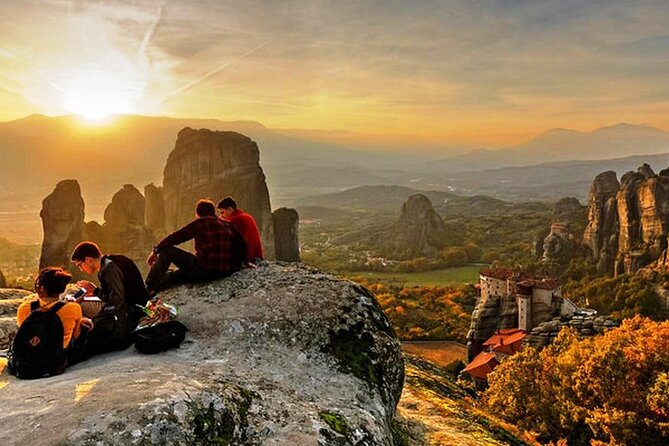
This tour is designed around convenience first. You’re picked up at your hotel main entrance (or the cruise terminal exit if that’s your situation), then transported in an air-conditioned vehicle sized for your group. You’re not dealing with a long “bus timetable” or repeated meet-up points.
The driver approach also matters. You get a professional English-speaking tour driver who shares history and culture during the drive and at the stops, but there’s an important limitation: drivers are not licensed to walk you inside archaeological sites and museums. That doesn’t ruin the day. It just means you should be a little more proactive inside each site about what you want to see, and you can request an additional state-licensed guide if you want someone to accompany you indoors.
Value-wise, I like that the tour includes the basics that usually cost extra when you travel independently. Transportation is handled, bottled water is included, breakfast is included, and you get that one-night stay in the Meteora area.
You can also read our reviews of more tours and experiences in Athens


Day 1: Attica to Thermopylae, then on to Delphi
Day 1 is your “big road day,” with history threaded through the drive. You start with the broad sweep of Attica—Athens and the surrounding region tied to everything from ancient monuments to later eras. The goal here isn’t to cram museums into the itinerary. It’s to set the tone so that when you hit the major sites, they feel connected, not random.
Thermopylae: the Hot Gates stop that sets the mood
Thermopylae is famous for a narrow ancient passage, and the name ties to hot sulfur springs (the Hot Gates). Myth and history overlap here: the battle in 480 BC between Greeks and Persians is the headline moment. There’s a clear sense of strategy in the way this place is described—high ground, limited access, and a defense plan built around geography.
You also get a short, meaningful stop at the Leonidas Monument near the national road connecting Athens to Thessaloniki. It’s a statue with an inscription telling a stranger to report that the Spartans lay here, faithful to Spartan laws. Even if you’re not a “battle history” person, this stop lands because it’s direct and readable. No guesswork.
Practical note: this is a stop where you’ll want to stand, look, and take photos without rushing. The tour gives you enough time to do that, and then you’re back on the road.
The drive through Sterea Ellada: Thebes, Livadia, and Arachova
As you leave the Thermopylae area behind, the tour works its way through Sterea Ellada (Central Greece). On the route, you pass places like Thebes, Livadia, and Arachova. Arachova is especially known in this region as a mountain town, so even if you’re not doing a long visit, it helps you feel the shift from coastal lowlands to the uplands.
Your final landing on Day 1 is Delphi, with time to visit the archaeological site.
Delphi’s archaeological site: how to make the most of limited time
Delphi is big. The archaeological site covers a lot of ground, and the terrain can include slopes. That’s why comfortable shoes are not optional here.
What I’d prioritize if you want maximum impact in limited time:
- The central sacred area and major temple remains (you’ll see why Delphi mattered as a religious and cultural center)
- The viewpoints and surrounding area where you can grasp the setting
- Any museum time you can fit in if it’s available during your schedule window
Even without a separate licensed guide indoors, the driver’s background explanations help you “read” what you’re seeing. You’ll likely walk through multiple layers of ancient life—ritual spaces, structures, and artifacts tied to Delphi’s role in the ancient world. The big win is that you’re doing it on Day 1 after a long drive, so the tone for the rest of your trip clicks fast.
One more practical tip: at Delphi, avoid anything that makes you nervous on uneven ground. In particular, plan for footwear you trust on slopes.
- All Day Cruise -3 Islands to Agistri,Moni, Aegina with lunch and drinks included
★ 5.0 · 4,958 reviews




Where Hosios Loukas fits: Byzantine calm between two ancient highs
Your highlights include Hosios Loukas Monastery, and it’s a smart addition to this itinerary. Delphi is ancient Greece. Meteora is later Eastern Orthodox monastic life. Hosios Loukas sits in that middle zone and helps you see how the sacred idea evolves over time.
Think of it as a change in pace. If you want one stop that breaks the “ancient only” pattern without getting so short it feels pointless, this is the kind of stop that does that. Even when time is tight, monasteries like Hosios Loukas tend to give you more atmosphere per minute: quiet space, stone details, and a clear religious purpose.
(Exact timing varies by traffic and closures, so I’d treat this as one of those “be ready when you get there” stops rather than something you can predict down to the minute.)
Delphi to Meteora: your one-night stay that actually helps
Between the two days, you get a B&B style night in a 3-star or family-style boutique hotel in the Meteora area. That’s not a throwaway inclusion. It’s what makes the whole itinerary work.
Here’s why: if you tried to do Delphi and Meteora as a single straight day trip from Athens, you’d lose too much time to transit and too much energy to stress. With the overnight stay, you start Day 2 in position to see Meteora with fewer time crunches.
The next morning breakfast included also keeps you from hunting for food between road stops and monastery steps. You don’t need a gourmet breakfast to enjoy the views next day—you just need fuel and time.
Day 2 morning in Kastraki: warm-up walk before the cliffs
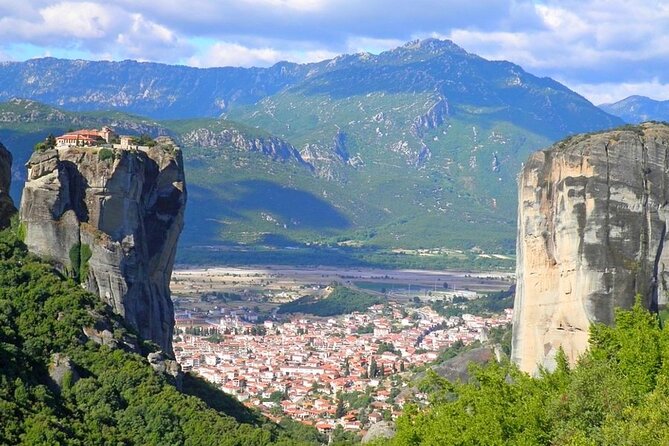
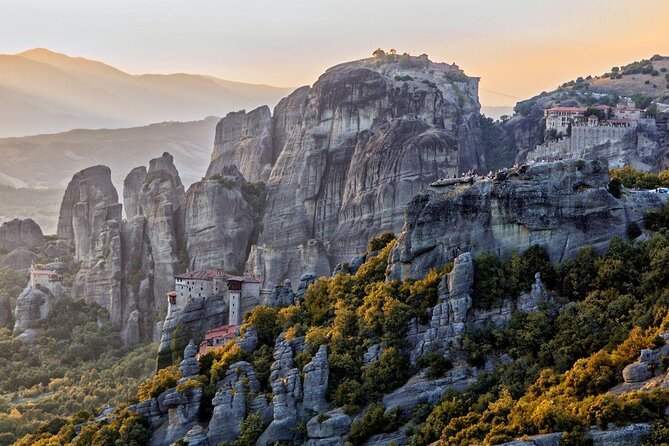
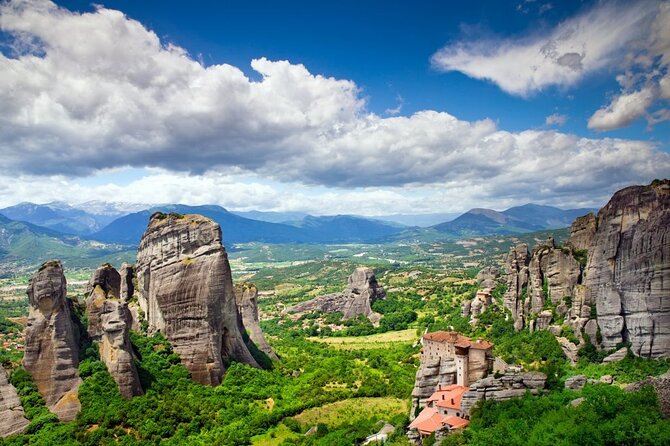
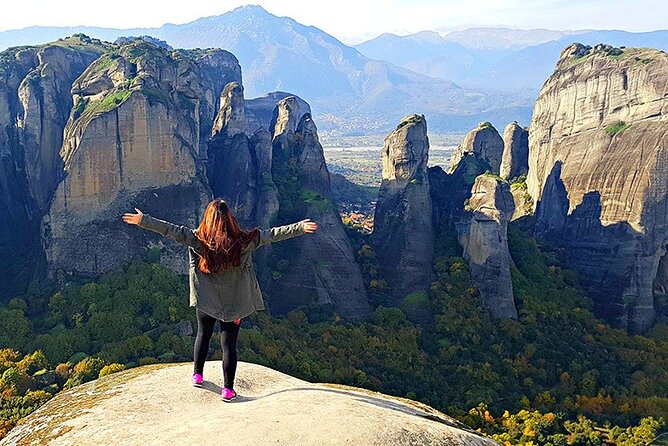
Day 2 starts in Kastraki, a town built at the base of the Meteora rocks. It sits among towering cliffs, and it functions as a gateway area for the monasteries above. Kastraki has a picturesque older district and a modern visitor feel with guest houses and taverns.
This stop is useful because it gives you context before you climb. You see where the roads lead, you get your bearings, and you can appreciate what makes Meteora so dramatic: those immense rock pillars rise directly from the plains.
If you like taking photos, this is a good place to do it early while the light is fresh and before the day’s crowds build.
Meteora monasteries: UNESCO rocks, six different stops, one shared wow
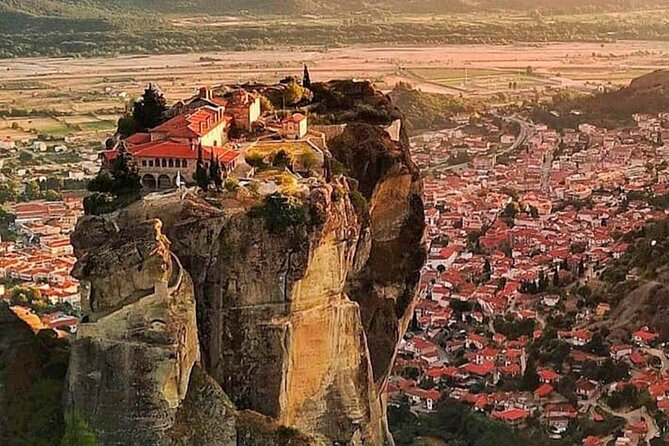
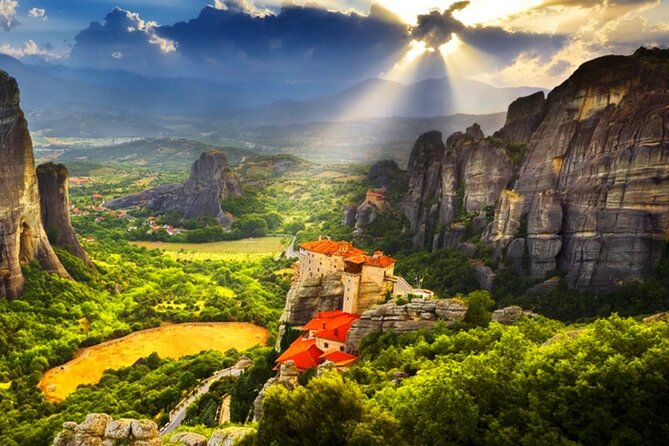
Meteora is a rock formation in central Greece with one of the largest sets of Eastern Orthodox monasteries built on huge natural pillars. Six main monasteries occupy the area, second in importance within Greek Orthodoxy only to Mount Athos.
The core experience is the same at each stop: you’re looking up at monasteries perched at impossible angles. But the details differ monastery to monastery, and that variety is why the program schedules multiple sites rather than just one.
Also, note the logistics: entrance fees are not included for the monasteries listed, and you’ll want to plan for stair access. Meteora isn’t a “sit and look” experience. It’s walking, climbing, and moving on.
Great Meteoron (Grand Meteor): the big first anchor
Great Meteoron is the oldest and largest monastery in the Meteora complex. It’s described as the starting point of organized monastic life at Meteora. If you want one monastery that feels like the main event, this is it.
Expect around 1 hour 30 minutes here. That’s enough time to take in the structure and absorb why it became the centerpiece of the monastic community.
St. Stephen: a compact monastery with long historical layers
Holy Monastery of Saint Stephen has roots in habitation from the late 12th century, with later construction phases completed in the 15th and 16th centuries. The stop is shorter—about 40 minutes—so focus on the most visible features: the church areas and the overall layout.
This is a good match for travelers who like monasteries but don’t want to spend the entire day inside.
St. Nicholas Anapafsas: quieter details and a sense of adaptation
St. Nicholas Anapafsas is another 40-minute stop. It’s built on a tiny plateau adapted to the site’s limitations, so you get a strong sense of how monastic life worked in extremely constrained space. This is where the architecture feels practical, not showy.
Varlaam: a spiritual anchor and a strong visual presence
Varlaam is also about 40 minutes. It’s named after a hermit-anchorite who inhabited the rock in the 14th century, with major organization and later renovations in the early 1500s onward.
If you like monasteries that combine storytelling with visible structure changes over time, Varlaam is a good stop.
Holy Trinity: the one with the 145 carved steps
Holy Trinity Monastery comes with a major practical detail: visitors reach it by crossing a pedestrian path downhill and then climbing 145 carved steps. That’s the kind of line that matters when you’re deciding what to wear and how fast you can move.
If your legs are strong and you’re comfortable with stairs, this stop delivers one of the most memorable views from the complex area. It’s also timed at about 40 minutes, so pacing is important.
Rousanos (Saint Barbara): restoration and today’s use
Holy Monastery of Rousanos – Saint Barbara is described as having been restored and operating today as a nunnery. That adds a different feeling compared to the male monasteries in the list. The stop is also about 40 minutes.
This is a good option if you want the monastic story to feel like a living tradition rather than just an exhibit.
What Meteora costs you on top of the tour price
The tour price for the whole 2 days is $1,781.17 per group (up to 3). That’s the big number you’re looking at, so here’s how I’d judge the value.
What you get for that price:
- Door-to-door transfers from Athens (pickup at your hotel)
- A private vehicle and your own driver for the route
- A professional English-speaking tour driver
- Breakfast included
- One included night in the Meteora area (B&B)
- Bottled water
- Mobile tickets
What you pay separately:
- Entrance fees to archaeological sites and museum
- Food and drinks
- Optional English-speaking licensed tour guide inside sites (not included by default)
- Meteora monastery entrance fees (listed as not included)
In plain terms: this is priced like a private itinerary, not a budget bus deal. If you have three people, it can feel like good value because you split transportation and driver time. If you’re traveling solo or as a couple, you’ll feel the per-person cost more—but you’re also paying for not dealing with crowds, repeated schedule coordination, and long waits.
This kind of setup is strongest if you care about timing and want to spend energy on the sites, not on logistics.
Who should book this Athens-to-Delphi-and-Meteora loop
Book it if you:
- Want Delphi + Meteora in two days without switching hotels or adding extra transport
- Like a private-driver style of travel
- Are happy with short visits when the payoff is big (Thermopylae, Leonidas monument, multiple monasteries)
- Have decent physical stamina for stair-heavy sites
Think twice if you:
- Struggle with stairs or uneven paths. Meteora includes a stop with 145 carved steps.
- Want long, slow museum-style time inside multiple indoor exhibits. The driver handles timing and context, but you may need an optional licensed guide if you want deep, indoor explanation everywhere.
Should you book it?
If you want a smart, time-efficient Central Greece experience, I’d say yes—with one condition. Go in prepared for movement. Bring supportive shoes, and plan to pay entrance fees once you’re on site.
The big win is the mix: Thermopylae’s battlefield meaning, Delphi’s sacred ancient setting, and Meteora’s cliffside monastery world in one compact loop. Add a one-night stay and door-to-door transfers, and this feels like a real itinerary, not a rushed drive-by.
FAQ
What is included in the price?
You get a professional English-speaking tour driver, transportation by air-conditioned vehicle, private vehicle use, bottled water, breakfast, and one night of B&B accommodation. Entrance fees, food and drinks, and a licensed English-speaking tour guide inside sites are not included.
Are entrance fees included for Delphi and Meteora?
No. Entrance fees to the archaeological sites and museum are not included, and the monastery entrances listed are also marked as not included.
Do you have an English-speaking licensed guide inside museums and archaeological sites?
The driver is English speaking, but the driver is not licensed to accompany you inside archaeological sites and museums. If you want one, you can arrange a state-licensed tour guide for an extra cost, depending on availability.
How does pickup work in Athens?
Pickup happens at the main entrance of your hotel. If you’re in a small hotel, you should inform the receptionist. If you’re arriving by cruise, you meet outside the terminal exit where the driver is waiting with your name on a sign.
Where does the tour return?
The return point is the same as the pickup spot.
What kind of hotel will you stay in overnight?
You’ll have one night’s B&B accommodation in a 3-star hotel or a family-style boutique hotel in the Meteora area.
How late can I cancel for a full refund?
You can cancel up to 6 days in advance for a full refund. To get a full refund, you must cancel at least 6 full days before the experience’s start time.

More 2-Day Experiences in Athens

More Tours in Athens


More Tour Reviews in Athens
- All Day Cruise -3 Islands to Agistri,Moni, Aegina with lunch and drinks included
★ 5.0 · 4,958 reviews