REVIEW · ATHENS
Biblical Corinth in 7 hours private tour
Book on Viator →Operated by Athens Tours Greece · Bookable on Viator
Corinth, minus the stress. This private 7-hour trip links Athens-area viewpoints with the Corinth Canal and the places tied to early Christianity, without you juggling buses, ferries, or confusing timing. I like that it’s built for small groups, and I also like the clear, focused order of stops—so you’re not just “seeing ruins,” you’re getting the story stitched together by the drive.
The main catch is practical: entrance fees aren’t included, and the driver can guide you up to the sites, but not inside as a licensed museum/archaeology guide.
What makes it work well is the door-to-door feel. You get picked up from your Athens hotel or directly at your Piraeus cruise pier, and you’ll be in an air-conditioned vehicle with a driver who knows Greek history and culture well enough to set context before you walk in. In one standout experience, the guide was Peter—friendly, flexible, and sharp with details when the group had questions.
In This Review
- Key highlights worth caring about
- A private Corinth circuit: what you’ll actually get in 7 hours
- From Piraeus to Athens viewpoints: setting the scene fast
- Corinth Canal: the geography that shaped power and travel
- Ancient Corinth (Archaia Korinthos): where the early story gained real ground
- Acrocorinth: the fortress that towers over everything
- Cenchrea (Kechries): the Paul connection you can point to
- Submersible Bridges: modern canal life at eye level
- Price and logistics: is $433 per group good value?
- Who this tour suits best (and who should consider alternatives)
- Should you book this Biblical Corinth in 7 hours tour?
- FAQ
- How long is the Biblical Corinth in 7 hours private tour?
- How many people are included in a group?
- Where do you get picked up?
- Is the tour in English?
- Are entrance fees included?
- Will the driver guide us inside the archaeological sites?
- What’s the return plan after the tour?
- What’s the cancellation policy?
Key highlights worth caring about
- Door-to-door Athens and Piraeus pickup, with return drop-off at the same place
- Corinth Canal in the right mood: short, efficient time with real geography and shipping history
- Ancient Corinth + Acrocorinth: you see the hilltop fortifications that dominate the area
- Cenchrea/Kenchries stop tied to Paul’s journey, including the hair-cut vow detail
- Submersible bridges: a quick look at how modern engineering adapts the canal
- English service for a private group of up to 3, so you can move at your pace
A private Corinth circuit: what you’ll actually get in 7 hours
This tour is designed as a single, tight corridor from Athens or Piraeus into the Corinth region and back. That matters because travel time on your own can balloon—especially if you’re starting from a cruise or you want a clean day without guesswork. Instead, you’re carried along a planned route in a comfortable vehicle, with stops spaced so you don’t feel rushed at every single point.
The “private” part is also real value. Up to three people share the same ride and same guide guidance. That can turn a day that would be chaotic in a big group into something calm and conversational—questions included, not just during a pre-packaged lecture.
You also get a mobile ticket, which is a small thing but useful. Less time hunting paperwork. More time getting out the door and onto the road.
You can also read our reviews of more private tours in Athens

From Piraeus to Athens viewpoints: setting the scene fast
If you start from Piraeus, you’re not just waiting for the day to begin. You’ll drive along the coastal road of the Saronic Gulf with views of the Athens riviera. This is a good opener because it shifts you from cruise-traffic mode into travel mode.
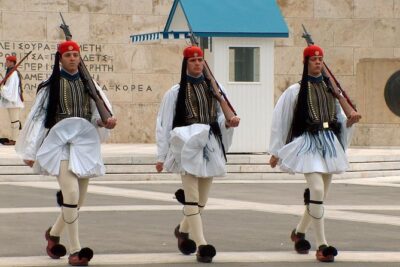
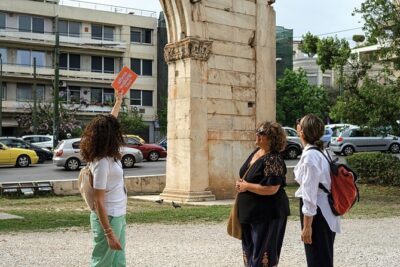
Then you’ll head toward the Acropolis area to admire the Temple of Democracy (listed as free). You’re not paying for this stop, and it’s timed as a quick, high-impact “get your bearings” moment before the longer drive into the Peloponnese.
A small, smart point: coming from the water (Piraeus) helps you understand why these routes mattered. Corinth wasn’t only a city on land. It was part of a wider network that moved people and goods between sea lanes and interior roads.
Corinth Canal: the geography that shaped power and travel
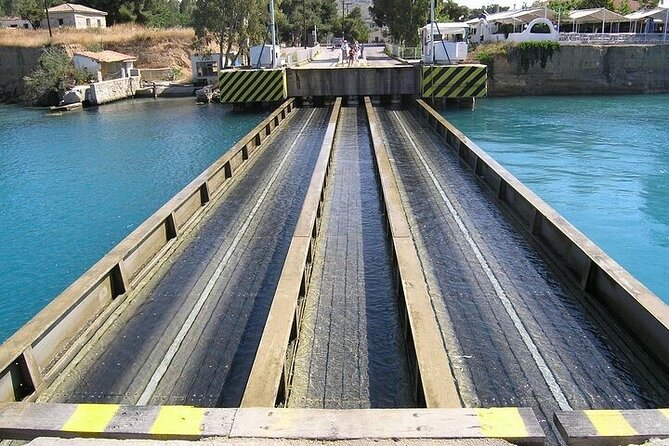
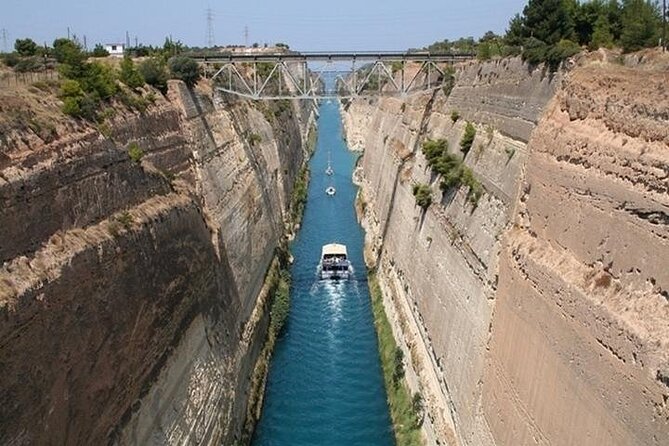
The Corinth Canal stop is short—about 15 minutes—but it’s the kind of stop that pays off when you understand what you’re looking at.
This canal cuts across the narrow isthmus of Corinth, linking the Gulf of Corinth with the Saronic Gulf. The effect is big: it turns the Peloponnese into something like an island, and it changes shipping patterns. Before the canal existed, ships that wanted to travel between the Aegean and routes toward the Adriatic had to go the long way around the Peloponnese—adding about 185 nautical miles.
A couple of details here make the canal feel more than scenery. The canal is 6.4 kilometers long and only 25 meters wide. It was dug at sea level, and while it was executed in the late 19th century, the dream had lived for roughly 2,000 years. The tour includes the backstory of Periander, the tyrant of Corinth (602 BC), and his earlier concept of moving ships across using the diolkós (a stone road where vessels were transferred on wheeled platforms).
Practical tip: because the time is brief, be ready to take photos quickly and listen first. You’ll get more out of it if you mentally place the canal in the bigger map of Mediterranean travel.
Ancient Corinth (Archaia Korinthos): where the early story gained real ground
Ancient Corinth takes about 2 hours, and this is where you’ll spend your real walking time. Entrance fees for the archaeological site are not included, so plan on paying that separately.
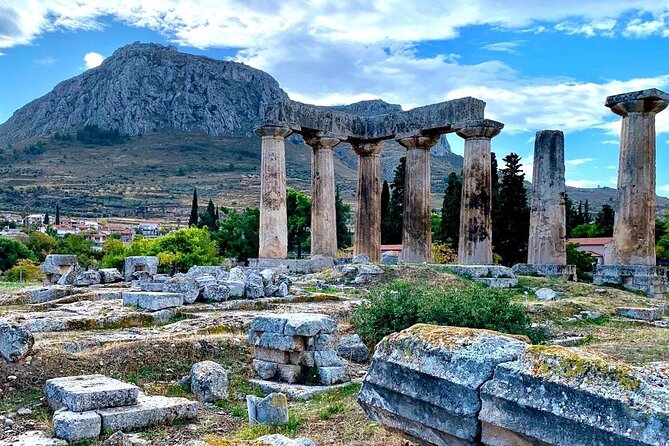
Corinth’s appeal isn’t only that it’s old. It’s that it sits at a crossroads. The area was inhabited as far back as the Neolithic period (6500–3250 BC). Later on, its strategic location—between land routes and water routes linking the western Mediterranean with the eastern side—helped fuel growth, trade, and a steady flow of people.
The tour frames Corinth as a place that mattered across eras. It references the Mycenaean period, then the rise of trade output and expansion in agricultural goods. By the 8th century BC, Corinth even founded colonies across the Mediterranean, with examples like Corfu, Syracuse, and other points that helped shape the ancient world.
For anyone interested in the Biblical angle, this stop is the anchor. You’re standing where a network of Roman-era and earlier life overlapped with the movement of letters, travelers, merchants, and preachers. Even without over-romanticizing, it’s a strong setting because it was built for connection—between people and between places.
Acrocorinth: the fortress that towers over everything
After Ancient Corinth, the tour climbs to Acrocorinth (the Upper Corinth). You’ll get about 50 minutes here, and it’s listed as free.
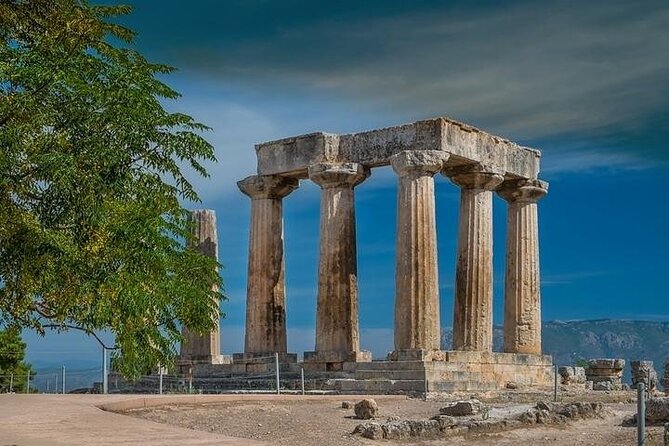
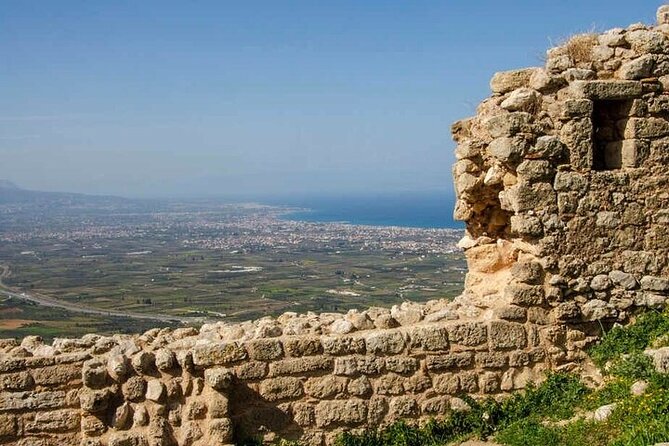
Acrocorinth is described as a monolithic rock overlooking the ancient city—basically the defensive brain of the region. The fortifications span multiple periods, and the tour highlights that layered history: ancient pre-Christian sections, then Byzantine, Frankish, Venetian, and Turkish occupation phases.
A helpful way to picture what you’ll see: three circuit walls reinforced with towers. And within those precincts, the remains of churches, mosques, houses, fountains, and cisterns show how the same commanding ground kept serving new rulers and new uses.
There’s also a religious layer on the highest peak. The tour notes traces of the temple of Aphrodite, which later became a church site and then a Turkish mosque. That’s the kind of continuity that makes a hillside feel alive—history doesn’t reset. It repurposes.
Practical consideration: plan for some walking on uneven terrain. Even if you keep it relaxed, you’ll be on an elevated site with viewpoints. Good shoes help.
- All Day Cruise -3 Islands to Agistri,Moni, Aegina with lunch and drinks included
★ 5.0 · 4,958 reviews





Cenchrea (Kechries): the Paul connection you can point to
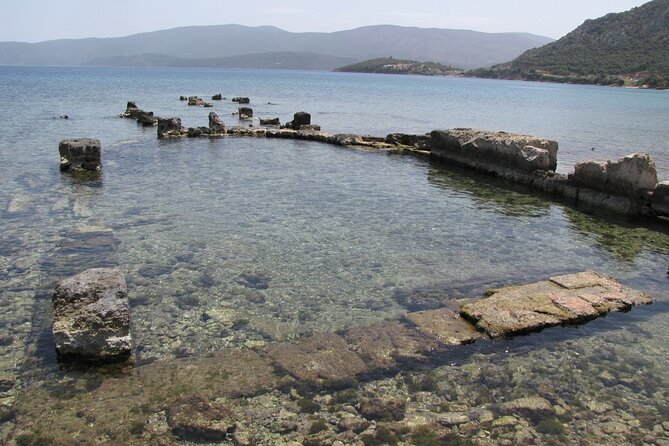
This stop is about 1 hour and listed as free. It’s also the most explicitly Biblical-feeling part of the day.
Cenchrea (sometimes spelled Kechries/Cenchrea in guides and materials) is described as one of two controlled harbors on the eastern side of the isthmus. The harbor mattered for goods moving between Asia Minor and Italy, plus areas like Achaia and Macedonia.
Then the tour moves to the Bible connection. It references Paul’s second missionary journey. Paul stopped at Cenchrea to fulfill a vow before sailing onward to Ephesus. The tour also includes the detail that the vow was Nazirite-like, which required not cutting his hair. In Cenchrea, he had his hair cut off, signaling the end of the vow.
Even the church aspect is handled carefully: it notes that a church may have been organized there, but doesn’t claim Paul definitely founded it. Still, since Paul was in Corinth for some time and Cenchrea sits nearby, it’s a plausible setting for ministry that flowed out from Corinth.
What I like about this stop is that it gives you a concrete geography for a scriptural detail. Instead of Paul being just a name, the harbor becomes a place you can imagine him moving through—tethered to shipping routes and real travel rhythms.
Submersible Bridges: modern canal life at eye level
You’ll finish the Corinth Canal story with a short look at the submersible bridges—about 15 minutes, listed as free.
The tour explains what a submersible bridge is: the deck lowers below water level to let waterborne traffic pass. That differs from lift bridges that raise the roadway.
The canal itself runs with a one-way system where ships pass one at a time, and larger ships need to be pulled by tugboats. The tour also notes that the canal sees heavy tourist use today, with almost 11,000 ships per year.
Then you see the engineering answer to the problem of keeping the shipping channel open. In Isthmia and Corinth, two submersible bridges were built across the canal in 1988. The deck lowers 8 meters beneath the water level so water traffic can continue. The advantage is clear: there’s no height restriction from structures above the shipping channel.
It’s a nice “bridge” between ancient logistics and modern logistics—literally. Corinth keeps solving the same problem across centuries: how do you move through this tight geography efficiently?
Price and logistics: is $433 per group good value?
The price is $433.48 per group, up to 3 people, for about 7 hours. That’s the kind of pricing where the value swings based on your group size.
- If you fill all 3 spots, your effective cost is about $144.49 per person.
- If it’s just 2 of you, you’re closer to $216.74 per person.
- If you’re solo, it becomes $433.48 for the day.
That can still be worth it if you want a calm, private schedule and direct pickup from your hotel or cruise terminal. It’s also useful if you’re trying to keep a cruise day controlled. The tour’s structure is simple: pickup, drive, several timed stops, then drop-off at the same place.
Two additional notes affect your real “all-in” budget:
- Entrance fees are not included for archaeological sites and museums.
- An English-speaking licensed tour guide inside the sites is not included. The driver guides up to the sites, but isn’t licensed to accompany you inside the archaeological areas and museum spaces. Licensed guides can be arranged for an extra cost, subject to availability.
One more practical detail: the tour lists a formal dress code. That doesn’t mean you need to wear a suit everywhere, but do pack smart layers and avoid anything that feels wildly out of place for a sightseeing outing that might include more formal presentation expectations.
Who this tour suits best (and who should consider alternatives)
This experience fits best if you want:
- Biblical Corinth context tied to geography, not just general sightseeing
- A private day with a driver who can explain what you’re seeing during the drive
- A schedule that works well from either Athens hotels or a Piraeus cruise departure day
It may be less ideal if you’re the type who wants a fully licensed guide in every museum space without any add-ons. In that case, you’ll likely want to arrange that extra licensed guide portion so the storytelling can continue inside, not just at the entrances.
Should you book this Biblical Corinth in 7 hours tour?
I’d book it if you’re traveling as a small group and want a clean, efficient day connecting Corinth Canal, Ancient Corinth, Acrocorinth, and Cenchrea—especially if you’re coming from Piraeus. The private format keeps the day from feeling like a checklist, and the stop sequencing helps you build a mental map quickly.
I’d hesitate only if your main goal is to spend long hours inside archaeological sites with a licensed guide included automatically. Since entrance fees and licensed site guiding aren’t included, you should budget for that reality and consider adding a licensed guide if you want maximum depth at every indoor/outdoor ruin moment.
FAQ
How long is the Biblical Corinth in 7 hours private tour?
It runs for about 7 hours (approx.).
How many people are included in a group?
The tour is priced per group for up to 3 people.
Where do you get picked up?
Pickup is offered from your accommodation in Athens or from your cruise ship pier at Piraeus port.
Is the tour in English?
Yes, it’s offered in English.
Are entrance fees included?
No. Entrance fees to archaeological sites and museums are not included.
Will the driver guide us inside the archaeological sites?
No. The driver can guide you with history and culture until you enter the sites, but tour drivers are not licensed to accompany you inside. A licensed tour guide can be arranged for an extra cost, subject to availability.
What’s the return plan after the tour?
You’ll be dropped off at the same spot where you were picked up.
What’s the cancellation policy?
You can cancel for free up to 24 hours in advance for a full refund.

More Private Tours in Athens


More Tours in Athens


More Tour Reviews in Athens
- All Day Cruise -3 Islands to Agistri,Moni, Aegina with lunch and drinks included
★ 5.0 · 4,958 reviews