REVIEW · ATHENS
Athens Private Tour Acropolis and Highlights & Athenian Riviera
Book on Viator →Operated by Great Greece Tours · Bookable on Viator
Athens hits different when you see it in one smooth run of stops, not a rushed pile of bus crowds. This private route connects the Acropolis legends with a taste of the Athenian Riviera, so you get both iconic ruins and those postcard coastal views in about six hours. I like how the pacing feels flexible, with a real guide steering you toward the details that make Athens make sense.
Two things I especially like: you travel in an air-conditioned private vehicle with onboard WiFi, and your English-speaking guide explains what you’re looking at (not just where to stand for a photo). One thing to plan for is that major sites usually require separate entrance tickets (and a licensed guide inside isn’t included), so you’ll want to budget extra and pre-book Acropolis tickets before you go.
In This Review
- Key things worth planning for
- Private Acropolis and Athenian Riviera: why this route feels efficient
- Getting picked up in comfort: what your day starts like
- Victory of Nike and the Acropolis climb: what to watch for
- Parthenon to Temple of Olympian Zeus: from Athena’s world to Zeus’ scale
- Hephaestus area and Plaka: Athens behind the main stage
- Changing of the Guard at the Tomb of the Unknown Soldier
- Arch of Hadrian and Panathenaic Stadium: marble athletics and civic pride
- Stoa of Attalos and Ancient Agora: the city as a working brain
- Lycabettus Hill and the Saint George Church viewpoint
- Vouliagmeni on the Athenian Riviera: the easiest end-of-day win
- Price and what to budget beyond the tour rate
- Who this private tour suits best
- Should you book this Athens private tour?
- FAQ
- How long is the Athens Private Tour Acropolis and Highlights & Athenian Riviera?
- What is the group size for this private tour?
- Is pickup included, and how do you meet the driver?
- What language is the tour guide?
- Are entrance fees included for the Acropolis and other sites?
- Do I need to pre-book Acropolis tickets?
- Is bottled water and air-conditioned transport included?
- Is airport pickup available?
- Is free cancellation available?
Key things worth planning for
- Private pickup with a name sign: easier than hunting meeting points with luggage.
- Acropolis focus with real storytelling: you’ll hear the who-and-why behind statues, temples, and famous myths.
- A classic ceremony stop: the Evzones Changing of the Guard at the Tomb of the Unknown Soldier.
- Marble in three acts: Parthenon area, then Panathenaic Stadium, then Attalos-area glimpses of the city’s craft.
- You still need site tickets: entrances cost extra, especially for the Acropolis.
- Riviera photo drive at the end: Vouliagmeni’s natural lake is a quick but scenic payoff.
Private Acropolis and Athenian Riviera: why this route feels efficient
This tour works because it strings together Athens’ main “themes” without making you backtrack all day. You start in the Acropolis zone, where the city’s power and beliefs were built in stone. Then you pivot down to the neighborhoods and landmarks that show how Athens lived day to day—markets, ceremonies, and civic spaces. Finally, you finish with a coastal moment at Vouliagmeni, so the day ends less like an exam review and more like a vacation.
It’s also private, which matters here. Athens is spread out and full of one-way streets and tight lanes. With a dedicated driver-guide and a small group (up to 2), you’re not stuck at the mercy of a giant bus schedule. You can spend a little more time where your curiosity lands—especially if you like architecture, sculpture, and the stories behind them.
You can also read our reviews of more private tours in Athens

Getting picked up in comfort: what your day starts like

Pickup is part of the deal. You’ll be met with a sign that has your name, and the group travels in a private, air-conditioned vehicle. There’s WiFi on board, plus bottled water, so you don’t feel like you’re burning the whole day just managing logistics.
From the on-the-ground perspective, this kind of start helps you actually enjoy the first hour. Athens can feel chaotic on your own, especially if you’re trying to get from one hilltop site to the next. Instead, you’re already moving with a plan, and your guide can shape the flow based on the day.
Also, you’re not stuck with a script. One guest highlighted how the guide brought passion and detailed context, and steered them onto streets big group tours typically can’t reach. That flexibility is hard to get with a standard hop-on hop-off setup.
Victory of Nike and the Acropolis climb: what to watch for
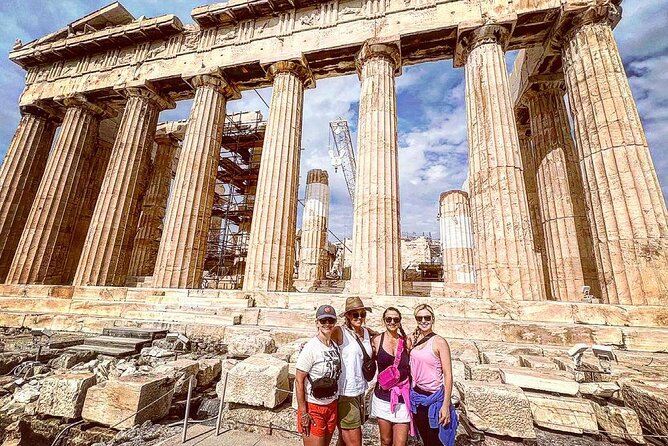
The day often begins with the Victory of Nike area. The story attached to this spot is part poetry, part politics: it’s tied to the idea of victory staying with Athens after major battles. You’ll get the feeling that this wasn’t just a monument, but a message carved in stone—beliefs and military confidence wrapped into marble architecture.
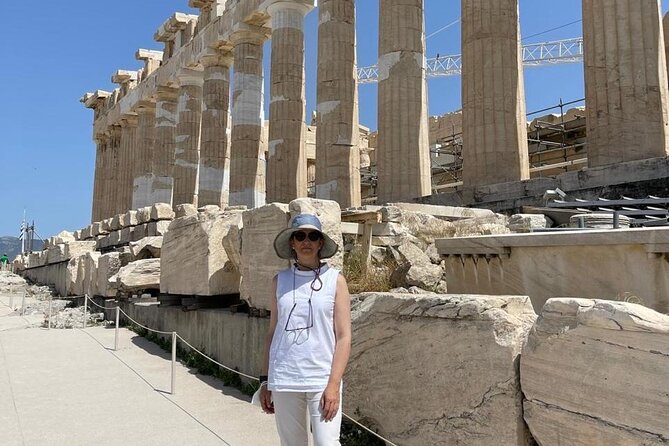
Next comes the Parthenon stop, the one you expect to see, but that still rewards your attention when you hear what to look for. You’ll hear the timeline (built in 447 B.C., finished 438) and the people behind the project: sculptor Phidias, architect Iktinos, and the mechanic Kalikratis. You’ll also get a clear nod to the Parthenon being dedicated to Athena, the city’s protector and goddess associated with wisdom.
If you want a practical tip for this stop: don’t treat it like one long photo line. Move with your guide’s cues and focus on the big idea: this complex was built during Athens’ classical peak, when civic identity, religion, and power were tied together so tightly you can still feel it.
One more detail to keep in mind: Parthenon entrance is not included in the tour price. You’ll need an entry ticket for the site, and the tour strongly suggests you pre-book Acropolis tickets ahead of time.
Parthenon to Temple of Olympian Zeus: from Athena’s world to Zeus’ scale
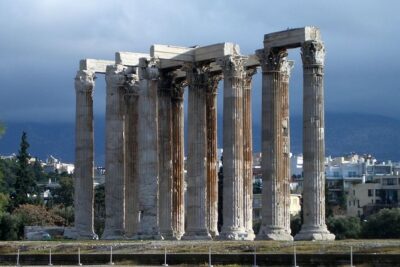
After the core Acropolis monuments, you pivot to Temple of Olympian Zeus, which feels like a different scale of ambition. You’ll be pointed to its dedication to Zeus and how it connects to Roman-era rule, with the temple associated with the second century and Adrian (the Roman king). The guide also connects it to the Panathinaia games, which were dedicated to Athena, showing how Athens kept recycling its identity through festivals—even as rulers changed.
Again, the tour uses what’s still standing to tell you what used to exist. You’ll hear the column story (the temple once had many more, with only a smaller number remaining). Even if you don’t memorize the exact count, the point lands: this was built to look massive enough to impress gods and emperors.
Time here is shorter than at Parthenon, so use this moment strategically. If you’re architecture-focused, look for how the surviving columns frame your view of the city. If you’re story-focused, listen for the guide’s links between Zeus, Olympic identity, and Athens’ public rituals.
Hephaestus area and Plaka: Athens behind the main stage
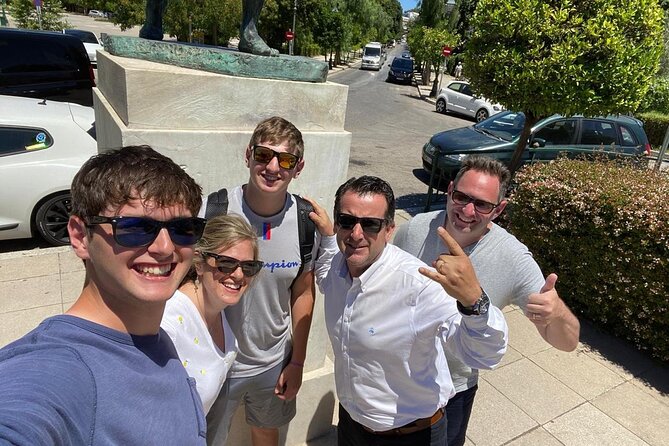
Between the big-ticket monuments, you’ll pass through a more local-feeling layer of Athens. The itinerary includes a stop connected to Hephaestus (and Athena Pronoia). The story attached here is that Athenians used the place linked to weapons and small statues to honor Athena. It’s a reminder that religion and daily life weren’t separate categories. They were the same system, expressed through craft, protection, and ceremony.
Then you shift into Plaka, the classic old neighborhood that’s easiest to enjoy when someone points out what’s beneath the surface. Plaka is often described as an ancient area dating back toward the 7th century B.C., and you’ll get a driving-and-explaining style experience here. That means you’re not doing every lane on foot, but you are getting the history stitched to the views.
Because this is a short stop, your best move is to treat Plaka as a context reset. Look up at building lines. Notice how the neighborhood feels tucked and human-sized compared to the monumental Acropolis world above.
- All Day Cruise -3 Islands to Agistri,Moni, Aegina with lunch and drinks included
★ 5.0 · 4,958 reviews




Changing of the Guard at the Tomb of the Unknown Soldier
One of the most satisfying stops in Athens is the Changing of the Guard at the Tomb of the Unknown Soldier. You’ll hear the meaning of Evzone—armed soldier—and you’ll watch the guards during the hourly ceremony.
This is a great stop because it’s not about ancient ruin alone. It’s about Athens performing identity in public. Even if you’ve seen ceremony videos before, you’ll feel the rhythm more clearly in person, especially if you arrive a bit ready to watch instead of rush.
Practical note: this stop is timed and takes around 20 minutes. If you’re the type who likes to soak in atmosphere, show up early, then settle. If you need a tight schedule, this is actually helpful—short, clear, and memorable.
Arch of Hadrian and Panathenaic Stadium: marble athletics and civic pride
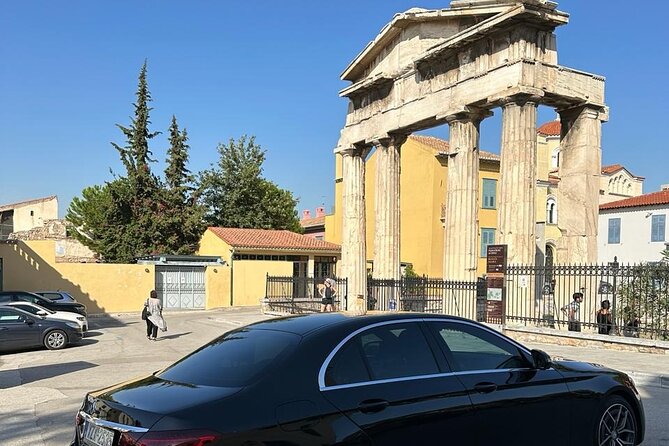
After the ceremony, you’ll pass by landmarks tied to Hadrian, including the Arch built to honor him for completing the Temple of Olympian Zeus. The stop is also framed as a link between different ancient city areas and names you might hear in Athens history (like Theseus and Adrian’s city references). Even if you don’t memorize every label, it helps you understand how Athens and its rulers were mapped in the old days.
Then comes Panathenaic Stadium, and this is a stop you’ll remember because it’s so uniquely Athens. You’ll hear the stadium began in 335 B.C., and you’ll get the specific marble scale: capacity around 65,000, with the stadium made of marble. The guide ties it to marathon history and to major games.
Here’s what makes it especially cool for modern visitors: the story connects the Panathenaia games to the modern Olympics starting in 1896, with names like George Averof and Baron Pierre de Coubertin included in the narrative. It’s one of those rare moments where ancient civic tradition and modern global sport share the same physical thread.
Time is around 30 minutes at this stage, so you’ll likely do more looking and listening than deep museum-style exploration. If that’s your style, you’ll love it.
Stoa of Attalos and Ancient Agora: the city as a working brain
Next, you move into the zone that feels less like a temple complex and more like where ideas and commerce met. The Stoa of Attalos is tied to King Attalos of Pergamos and a fleet-market concept. You’ll also hear that there are statues of heroes involved in the space, which gives you a sense that the stoa wasn’t just a wall—it was a social engine.
From there, the Ancient Agora of Athens rounds out the day’s “civic” theme. You’ll see references to the Temple of Theseus and the Library of Hadrian, described here as the second largest library in the world after Alexander the Great’s library. The guide connects it to philosophers walking through the area—so the message is clear: this wasn’t only government or shopping. It was thinking space.
A practical consideration: entrance tickets and licensed guide support aren’t included for archaeological sites. So if you want the full interior experience at the Agora-type stops, budget time and money for that reality.
Still, even in a shortened visit, the Agora area works well because you can stand in the open space and instantly understand why Athens built so much here: the city needed a place to talk, learn, and argue.
Lycabettus Hill and the Saint George Church viewpoint
After the historic core, you get a change of pace with Lycabettus Hill, described as the highest point of Athens. This stop is about views, and it also includes Saint George Church.
This is the moment where you see the city’s structure like a map. You’ll get the sense of how the Acropolis sits above everything else, and how the modern sprawl wraps around the ancient spine. For many people, this is the “aha” stop, the one that makes the earlier ruins click into your mental model.
Time is brief (about 20 minutes), so pick what you need: if you’re chasing photos, get your angles fast; if you’re chasing understanding, pause and let your guide point out the landmarks you’ve already visited and the ones you can still imagine.
Vouliagmeni on the Athenian Riviera: the easiest end-of-day win
To finish, you head to Vouliagmeni, where the highlight is a natural lake said to have been formed about 2,000 years ago. This is a drive-and-photo stop designed for a relaxed payoff.
Even if you don’t spend hours by the water, this kind of ending matters. Athens can be heavy on stone and stairs. A coastal change in scenery resets your eyes and makes the whole day feel like more of a trip and less of a checklist.
It’s also a simple win for photography. If you’re the type who wants one last “vacation shot,” this is where you can get it without adding another major attraction.
Price and what to budget beyond the tour rate
The tour price is listed at $223.50 per group (up to 2) for about six hours, and it includes the basics that make a private day actually comfortable: air-conditioned vehicle, bottled water, WiFi, and an English-speaking driver-guide, plus private transportation and pickup.
Here’s the value angle: you’re paying for convenience and for someone to explain what you’re seeing in plain language. That’s especially valuable on the Acropolis and Agora-type stops, where the story can feel confusing if you’re reading it alone on your phone.
What to budget extra:
- Entrance fees for archeological sites/museums: listed as €30.00 per person.
- Licensed tour guide inside archaeological sites: not included, so you may need additional support once you’re at specific locations.
- Airport pickup: available for an additional €50.00 per booking.
So, this tour is best when you plan your entrances ahead and treat it as a guided day, not a ticket bundle.
Who this private tour suits best
This is a strong fit if you:
- Want a private Athens day with less waiting and less navigation stress.
- Like your history told with clear explanations tied to architecture and meaning.
- Prefer a mix of major sights (Parthenon area, Panathenaic Stadium) plus a couple of Athens “life” moments (Plaka drive-by, the Evzones ceremony).
It’s also a good choice if you’re short on time but don’t want only the top one or two landmarks. The route gives you more story per hour.
If you hate driving time or you only want long, slow museum visits, this might feel too structured. But if you want a well-paced highlights circuit, it’s right on target.
Should you book this Athens private tour?
Yes, if you want a guided highlights route that connects Acropolis monuments with the atmosphere of Athens streets and ends with a scenic coast moment. The private pickup, the English-speaking guide, and the way the day links stories to specific landmarks make it feel like more than a sightseeing transfer.
Book it especially if you’re the type who likes details—architect names, the purpose of temples, and what public ceremonies mean—because that’s where this tour tends to deliver. Just do yourself a favor and pre-book Acropolis tickets, and budget for €30 per person entrance costs and any licensed site-guide needs once you’re inside.
If you tell me your travel dates and whether you want a more relaxed pace or a more photo-heavy one, I can suggest what to prioritize during the limited time at each stop.
FAQ
How long is the Athens Private Tour Acropolis and Highlights & Athenian Riviera?
It lasts about 6 hours.
What is the group size for this private tour?
It’s a private tour/activity for your group, listed as up to 2 people per group.
Is pickup included, and how do you meet the driver?
Pickup is offered. You’ll be picked up with a sign showing your name.
What language is the tour guide?
The driver-guide provides service in English.
Are entrance fees included for the Acropolis and other sites?
No. Entrance fees for archeological sites/museums are listed as €30.00 per person, and a licensed tour guide to accompany you into archeological sites is also not included.
Do I need to pre-book Acropolis tickets?
Yes. The tour information advises you not to forget to pre-book your Acropolis tickets.
Is bottled water and air-conditioned transport included?
Yes. Bottled water, an air-conditioned vehicle, and WiFi on board are included.
Is airport pickup available?
Airport pickup is available for an additional cost of €50.00 per booking. It’s not included in the base price.
Is free cancellation available?
Yes. You can cancel up to 24 hours in advance for a full refund.


More Private Tours in Athens


More Tours in Athens


More Tour Reviews in Athens
- All Day Cruise -3 Islands to Agistri,Moni, Aegina with lunch and drinks included
★ 5.0 · 4,958 reviews