REVIEW · ATHENS
Athens Full Day Private Tour with pick up
Book on Viator →Operated by Great Greece Tours · Bookable on Viator
Athens deserves more than a rushed checklist, and this private day is built for that. I like the easy hotel pickup/drop-off and smooth pacing between top sites. I also like that you get real storytelling along the route, with the guide meeting you at the right spots and giving you time to explore. One thing to consider: entrance fees for many stops aren’t included, so you’ll want to budget around that.
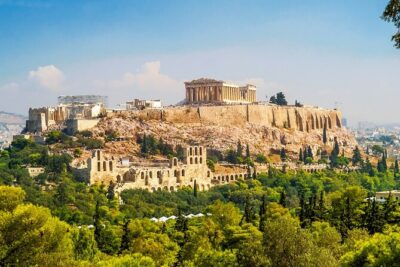
You’ll see the big names plus the in-between places that help the city make sense: the Acropolis temples, the Olympic Zeus complex, the Panathenaic Stadium, and the views from Mount Lycabettus. Then you drift into the older neighborhoods and civic spaces around Plaka, the Roman Agora, and the Ancient Agora. The tour is private, so you’re not stuck waiting for strangers to finish photos.
Guiding is in English, and you ride in an air-conditioned vehicle with bottled water and onboard WiFi. One more detail I appreciate: guides aren’t allowed inside every site, so your driver-guide does a lot of explaining outside, then helps you line up your visit where you can go in. People share great experiences with guides like Kostas/Konstantinos, especially for staying flexible with families and even mobility needs.
In This Review
- Why this Athens route works (and what to watch for)
- Pickup, comfort, and the “private” part that matters
- Acropolis first: Temple of Athena-Nike and how it changes the day
- Temple of Olympian Zeus: Roman-era scale with Olympic symbolism
- Panathenaic Stadium: where the Marathon story lands
- Mount Lycabettus: the view stop that makes the whole route feel worth it
- Changing of the Guard: Evzones and the Tomb of the Unknown Soldier
- Temple of Hephaistos: weapons, heroes, and a quieter feel
- Roman Agora and the Tower of the Winds: ancient timekeeping made real
- Plaka: quick photo time and the feel of old Athens streets
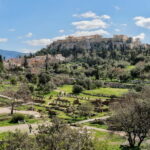
- Ancient Agora: the marketplace city inside the marble
- Aristotle’s Lyceum: a shorter stop with a big name
- Price and value: what $127.56 covers, and what you pay on top
- Practical tips that make the day smoother
- Who this tour is best for
- Should you book this Athens full-day private tour?
Why this Athens route works (and what to watch for)
- Hotel pickup with a name sign: you meet the driver-guide at your lodging, then head out in a black limo or mini-van.
- A 6 to 7 hour “best-of” plan: you hit the Acropolis zone, a major stadium, and two central agoras without feeling like you’re sprinting across the city.
- City-view payoff at Mount Lycabettus: you get a quick but high-value stop for photos and Athens-wide perspective.
- Ceremony stop that’s genuinely timed: the Changing of the Guard happens every hour, so your schedule has a built-in moment to plan for.
- Most big sites are admission-controlled: several stops list admission tickets as not included, so budget time and money for entry.
- Private pacing for families: the tour is shaped for your group’s speed, which matters with kids or anyone needing breaks.
Pickup, comfort, and the “private” part that matters
This isn’t a shared-bus day. It’s a private tour, with your group traveling together the whole time. Pickup is offered from hotels or an Airbnb-style place, and the driver holds a sign with your name.
You travel in an air-conditioned vehicle, get bottled water, and there’s onboard WiFi. Those sound like small perks, but they add up on a long day of walking and sun. When you’re moving between multiple ancient sites, the ride time is part of the experience—especially when your English-speaking driver-guide is narrating what you’re about to see.
Before you go, one practical note: many Athens sights work best when you’re not improvising at the entrance. The tour mentions pre-ordering tickets at hhticket.gr and specifically reminds you to pre-book the Acropolis tickets. If you’ve ever watched a group stall while tickets sort themselves out, you’ll understand why that matters.
You can also read our reviews of more private tours in Athens
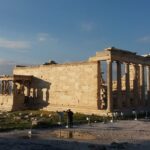

Acropolis first: Temple of Athena-Nike and how it changes the day
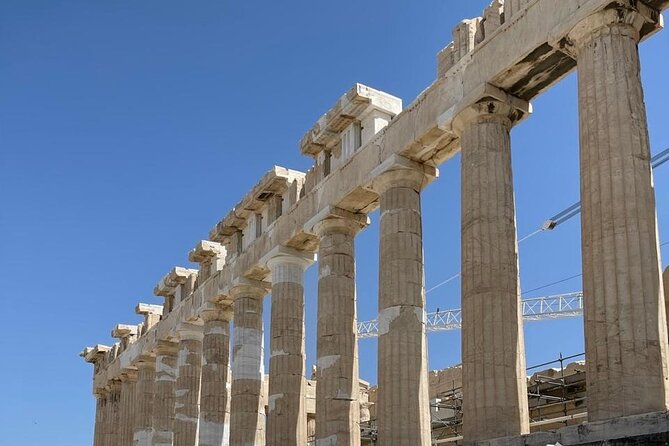
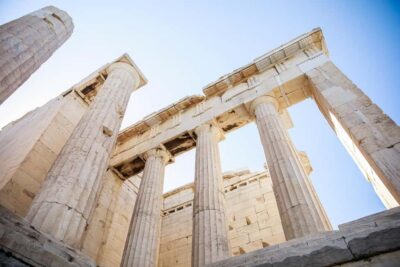
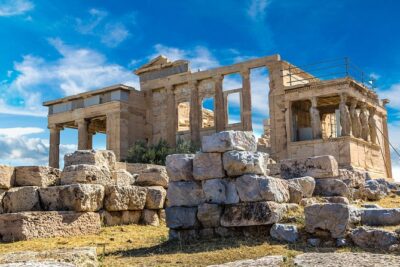
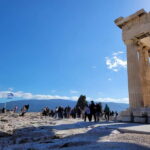
Your first stop is the Acropolis area, starting at the Temple of Athena-Nike. This is one of the smaller but meaningful structures on the hill, tied to the idea of victory. The tour frames it as a 5th-century B.C. monument, connected to Athenians praying to Athena before battles.
Even if you’ve seen photos of the Acropolis before, this start helps you focus. It’s not just about the “most famous” ruins—it’s about understanding what each temple was trying to communicate. That theme carries through the rest of the day: Athens as a city of civic beliefs, worship, and power.
Time on this stop is about 1 hour. You’ll want comfortable shoes here; the Acropolis area is often uneven and sunny. Entrance tickets aren’t included for this site, so make sure your Acropolis entry is ready before you arrive.
Temple of Olympian Zeus: Roman-era scale with Olympic symbolism

Next you’ll go to the Temple of Olympian Zeus. The tour explains it as the King of Gods space and connects it to the birthplace of the ceremony for the Olympic Games in Athens. Construction is attributed here to the Roman king Hadrian, with 104 columns listed and a tall height figure given in the tour details.
They also mention the 2nd-century A.D. role of the area in hosting baths for athletes who were purified for the Olympic Games. That’s a useful lens. When you look at a ruin like this, it can feel generic—just big stones. But with that context, you start noticing the “why” behind the size and the setting.
You’ll have about 1 hour at this stop. Like the Acropolis, admission tickets aren’t included, so budget entry fees and plan for time at the site. It’s worth it: this is one of the most dramatic jumps in scale on the route.
Panathenaic Stadium: where the Marathon story lands

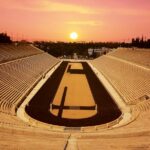
Then it’s on to the Panathenaic Stadium, where the tour calls out the first Olympic Games (335 B.C.) and the idea of the stadium as the birthplace of the Games. The capacity is listed as 65,000, and the tour also points out that the end of the Marathon is here.
Even if you know the name, it’s one of those Athens stops that can hit harder in person. Stadium seating lines give you a sense of how these events were staged. And because the tour connects it to both ancient Olympics and the Marathon finish, you get a simple story you can carry with you.
Time is short here—about 15 minutes—with admission listed as free. That makes it a high-efficiency stop. The tradeoff is that you’ll likely move through quickly, so if you want extra time for photos or a slower walk around, you’ll rely on your guide’s flexibility.
Mount Lycabettus: the view stop that makes the whole route feel worth it

For a break from ruins, you’ll head to Mount Lycabettus, one of the highest points in Athens. The tour lists it at 250 meters and says you can see all Athens from up there for photos.
This is the moment where the day turns from “temples and stones” into “city in context.” From high ground, Athens becomes a map—how neighborhoods sit, where major routes run, and how far the views reach. It also helps your brain connect Plaka and the central agoras to the bigger picture.
Time is about 15 minutes and admission is listed as free. That means the stop is likely more about the viewpoint and photos than extended wandering. If weather is hazy or windy, you might get a weaker view, so I’d treat this as a photo-and-breathe stop rather than a long hike.
You can also read our reviews of more tours and experiences in Athens
- All Day Cruise -3 Islands to Agistri,Moni, Aegina with lunch and drinks included
★ 5.0 · 4,958 reviews


Changing of the Guard: Evzones and the Tomb of the Unknown Soldier
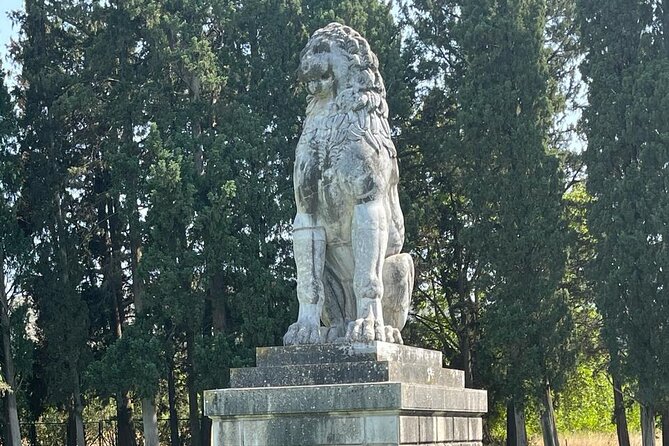
Next you’ll catch the Changing of the Guard ceremony. The tour notes it happens every hour. The guards are called Evzones, meaning armed soldiers in this context, and they guard the Tomb of the Unknown Soldier, alongside the Temple of Democracy.
This is a stop that’s easy to enjoy even if you’re not a ceremonial-fan. It’s visual, it’s structured, and it adds a modern Athens layer to a day packed with ancient sites. You’ll have about 20 minutes here, with admission listed as free.
The big practical thing: because it’s hourly, your schedule matters. This is one reason a private tour can be more satisfying than a self-guided day—your guide can aim your timing. Still, expect crowds around the ceremony area. If you’re sensitive to noise or have limited mobility, plan to arrive a few minutes early and pick a position thoughtfully.
Temple of Hephaistos: weapons, heroes, and a quieter feel
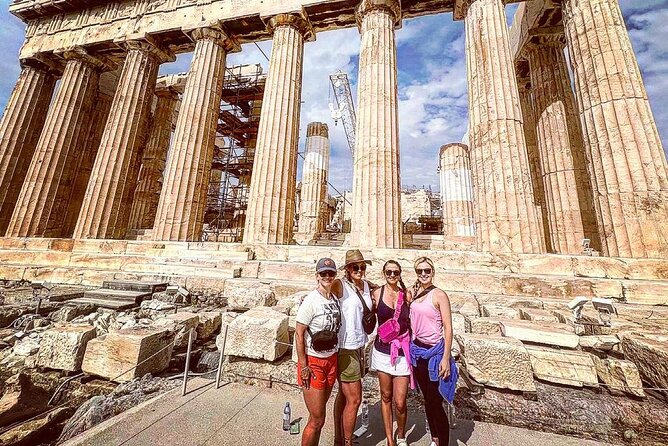
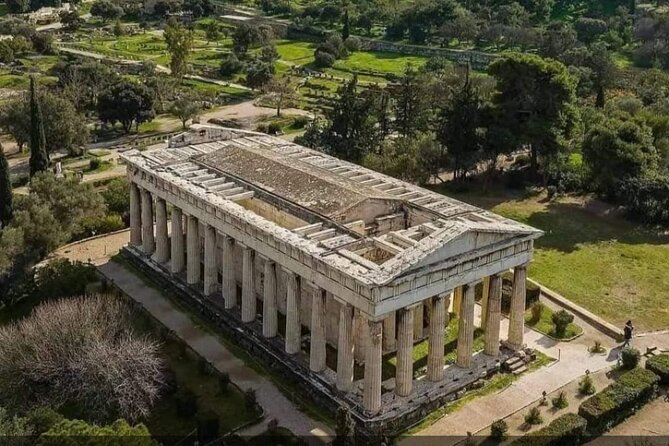
Then comes the Temple of Hephaistos, described here as dating back to the 6th century B.C. The tour presents Hephaistos as the god of weapons, with Theseus mentioned, and calls the site tied to Theseus as one of Athens’ greatest heroes.
This stop is about 1 hour, with admission tickets not included in the tour price. Compared to the Acropolis and Zeus, Hephaistos can feel less “showy” on arrival, but that’s part of the appeal. It gives you a chance to see how Athens kept myth, craft, and hero stories embedded in sacred spaces.
If you like your ruins with meaning—names, symbols, and links to famous figures—this is one of the stops that helps the day feel coherent instead of random.
Roman Agora and the Tower of the Winds: ancient timekeeping made real
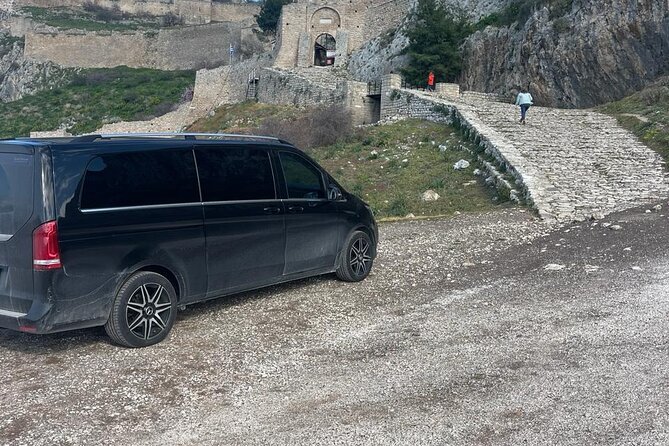
After Hephaistos, you’ll move to the Roman Agora. This part of the day includes the Tower of the Winds and the mention of a very specific claim: the first computer of the world, linked with Archimedes and Andronikos, measuring days and time.
The tour also notes wind gods inside the Roman Agora, dated here to the 2nd century A.D., and describes the Roman-era forum as marble from Thassos Island, connected with Hadrian again. It also points out that Adrians Library is inside the complex.
You’ll have about 30 minutes. Admission is listed as not included for this stop, so factor in entry. The time is short, but the Tower of the Winds is the kind of place where the story does heavy lifting. You don’t just see an old building; you learn what people used it for and why it mattered in daily life.
Plaka: quick photo time and the feel of old Athens streets
Now you switch gears to Plaka. The tour describes Plaka as the ancient Greek city from the 7th century B.C., and says the name means peace of marble. You’ll also get a short drive through the area for photo opportunities of ancient Athens.
Time here is about 20 minutes, with admission listed as free. This is a “reset” stop. You’re not meant to feel like you’ve fully explored Plaka in 20 minutes—you’re meant to get your bearings, see the feel of the neighborhood, and then keep moving.
If you want to linger, you’ll be watching the clock. That said, a short Plaka break is often what keeps a long day from turning into a blur.
Ancient Agora: the marketplace city inside the marble
Next is the Ancient Agora of Athens, described as a Greek marketplace space from the 5th century B.C., where people came to buy goods. The tour mentions activities like buying animals and references to a kind of bazaar setup, with goods and even slaves/weapons mentioned in the tour description. You’ll also see the Temple of Volcano God of Weapons mentioned here.
Time is about 30 minutes, and admission is listed as not included. This is one of those stops where good narration can make a big difference. Without context, an agora can look like “more ruins.” With context, it becomes a city engine—trade, public life, and civic identity under the open sky.
If you’re tired from the earlier walking, this is a good place to pace yourself. There’s enough to look at that you can stop, scan, and move without feeling like you missed the point.
Aristotle’s Lyceum: a shorter stop with a big name
Finally, you reach Aristotle’s Lyceum. The tour notes it as famous and says it was recently discovered in its own way, though the details are brief. Time here is about 20 minutes, and admission is listed as not included.
This is a stop that feels symbolic. Even if your time is short, the name alone ties the day to philosophy and learning rather than only politics and worship. Treat it as a closing “mind” moment after a day of temples, ceremonies, and civic spaces.
Because the stop is brief, you’ll likely focus on orientation and understanding rather than deep study.
Price and value: what $127.56 covers, and what you pay on top
At $127.56 per person for a private day, this tour can be a good value if you compare it to the hassle of planning transport and timing across multiple sites. You get pickup and drop-off, private transportation, a driver-guide in English, bottled water, WiFi, and an air-conditioned vehicle.
The catch is the common one in Athens: entrance fees. The tour lists about €30 per person for entrances to archeological sites/museums, and notes that many stops have tickets not included. So your total spend depends on which entries you’ll need and how many you’re using during the day.
Here’s how I’d think about it for your group:
- If you want a clean route with fewer decision points, the price for private coordination adds up fast.
- If you’re already comfortable ticketing and navigating between sites, you might pay more than you need.
- If you’re traveling with kids, older adults, or anyone who benefits from a slower, guided pace, the private format can be worth it even after adding entrance fees.
Practical tips that make the day smoother
A few things will help your day feel effortless instead of chaotic:
- Pre-book Acropolis tickets as the tour recommends, and use the pre-order channel listed (hhticket.gr) if that’s your style.
- Wear shoes that handle uneven ground. This route includes multiple walking zones even with driving between stops.
- Plan for sun. You’ll be outdoors for ceremonies and viewpoints, including Mount Lycabettus.
- Lunch isn’t included, so decide how you’ll handle food before you go. A shorter day with a planned meal beats a “we’ll find it” day every time.
Also keep an eye on how much time you have at each stop. Many are strong for a photo and a focused visit, but the best moments come from pairing the storytelling with the right amount of time on-site.
Who this tour is best for
This works especially well for people who want the highlights—Acropolis, Olympian Zeus, Panathenaic Stadium, Plaka, and the central agoras—without doing the planning math.
It’s also a strong match for families. In one experience, Kostas helped a family of four with kids and kept the pacing comfortable. Another shared experience with Konstantinos described support for an older traveler using a cane, including careful help getting close to entrances. Your own needs may vary, but it signals that the guide is paying attention to how people move.
If you’re the type who loves structure, timing, and a guide to connect the dots across centuries, you’ll likely enjoy this a lot.
Should you book this Athens full-day private tour?
Book it if you want a single-day Athens hits plan with pickup, English guiding, and a route that ties major sites together—from victory temples to Olympic symbolism to marketplace life. The value improves when you’re not excited about doing logistics, ticketing, and timing between far-flung neighborhoods.
Skip it or reconsider if you’re determined to keep costs low and you’re comfortable building your own route, handling ticketing, and managing your own timing for places like the Changing of the Guard. Also, if your priority is deep museum-level exploration, the short stop times may feel limiting.
If you do book, do one thing that matters: pre-book the Acropolis tickets, then treat the day like a guided story with photo-and-walk stops. You’ll leave with a clearer sense of Athens as a city that remembers its past in public spaces, not just in ruins.

More Private Tours in Athens

More Tours in Athens




More Tour Reviews in Athens
- All Day Cruise -3 Islands to Agistri,Moni, Aegina with lunch and drinks included
★ 5.0 · 4,958 reviews