REVIEW · ATHENS
Athens & Acropolis Highlights: Greek Mythology Small-Group Tour
Book on Viator →Operated by Alternative Athens · Bookable on Viator
Myths turn Athens ruins into real places. This small-group Athens walk links big sights like the Acropolis to the stories people told there, so the stone stops feeling random and starts feeling meaningful. I like the small-group size, which keeps the pace human even when you’re climbing and squeezing through crowds.
The best part for me is the way the guide ties myth to what you’re actually seeing—details like how Athena Nike is tied to victory imagery, or what the Erechtheion was built to hold. Guides such as Irene/Irini and Michael are praised for explaining clearly and answering niche questions, often with helpful visual aids, but one thing to plan for is real uphill walking plus stairs. Also note that at the Acropolis, strollers and big bags aren’t allowed, so you’ll want light day-bag habits.
In This Review
- Key things that make this Athens mythology tour work
- Temple of Olympian Zeus to Acropolis: start smart in the right part of town
- The Acropolis stops: Parthenon, Athena Nike, and Erechtheion with story context
- Parthenon: why the guide’s framing makes it click
- Temple of Athena Nike: the “victory” angle you can actually see
- Erechtheion: built for a statue, not just for beauty
- Small-group pacing matters here
- Theatre of Dionysus Eleuthereus: where myth turned into performance
- Ancient Agora of Athens: politics, justice, trade, and everyday life
- Temple of Hephaestus finish: one of the best-preserved Ancient Athens temples
- Price and value: what $54.42 buys (and what you’ll still pay)
- Walking reality check: shoes, bags, and hearing the guide
- Guides and style: why the storytelling gets praised
- Who should book this Acropolis Greek mythology tour?
- Should you book this Athens Acropolis Greek mythology small-group tour?
- FAQ
- How long is the tour?
- Where does the tour start and end?
- Are entrance fees included?
- What sites will I see?
- Is this tour a small group?
- Is it offered in English?
- What if weather is poor?
Key things that make this Athens mythology tour work
- Small group (max 15) helps you hear stories and keep up on uneven ground
- Greek myths tied to specific monuments makes Parthenon and Agora feel less like a checklist
- Well-paced stops include time for shade and slower moments on steeper sections
- Top picks for architecture watchers: Parthenon, Athena Nike, Erechtheion, and the well-preserved Temple of Hephaestus
- You get an Athens map to help you keep exploring after the tour
Temple of Olympian Zeus to Acropolis: start smart in the right part of town
Your tour meets near the Arch of Hadrian on Leof. Vasilisis Amalias, then you begin with an outside look at the colossal Temple of Olympian Zeus (Olympeion). Even without entry, it’s a great first stop because it sets the “big power” theme of Athens—this was meant to be one of the greatest temples of its kind, and you can see why it became a landmark in the ancient world.
From there, you head toward the Acropolis area. The trick on this tour is that you’re not just moving from one photo spot to the next. You’re learning what each place means first, so when you arrive at the high ground, the view and the symbolism land at the same time.
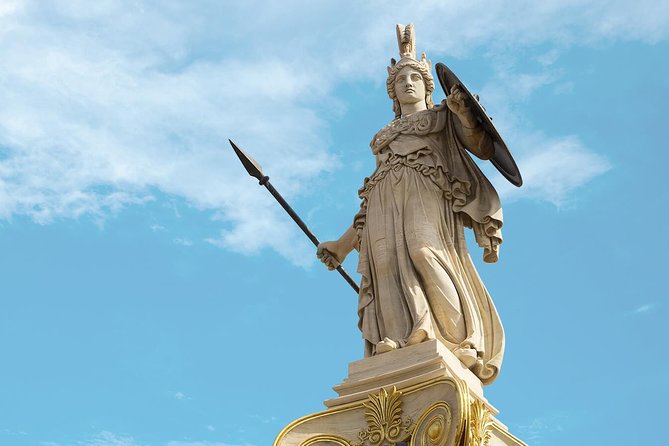
This is also where you’ll feel why the guide matters. With Greek mythology, Athens can turn into a blur of names fast. A good guide slows it down into digestible pieces, then gives you something to remember—like who Athena was worshipped as, or why a temple would be designed for the way a cult statue was presented.
You can also read our reviews of more tours and experiences in Athens.


The Acropolis stops: Parthenon, Athena Nike, and Erechtheion with story context
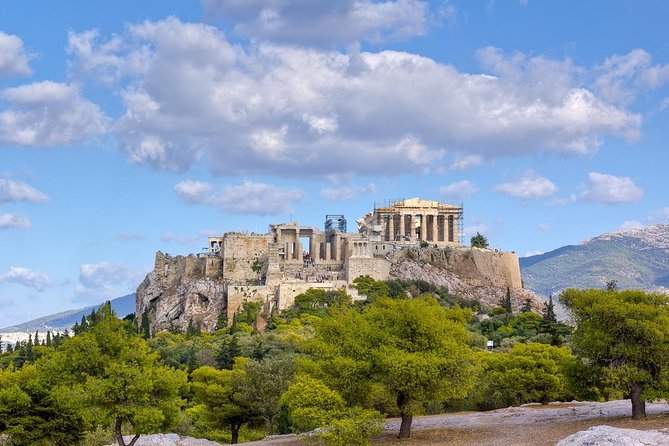
Expect about 1.5 hours on the Acropolis area, where the tour focuses on the core masterpieces you came for: the Parthenon, Temple of Athena Nike, Erechtheion, and the main sanctuary setting overall.
Parthenon: why the guide’s framing makes it click
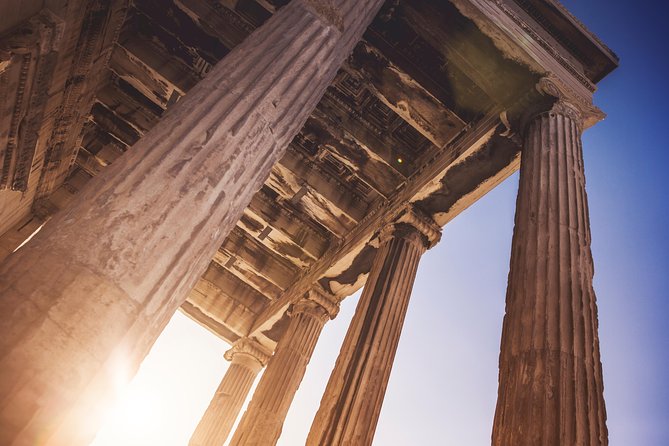
The Parthenon sits at the heart of the experience. You’ll learn it was built in the mid-5th century BCE and dedicated to Athena Parthenos—Athena the Virgin. The guide also connects the temple to the evolution of Doric architecture, so it’s not just a pretty ruin. It becomes a statement about taste, politics, and religious identity at a peak moment in Athens.
A practical benefit: once you know what the Parthenon is dedicated to, you’ll look longer. You stop hunting for the next landmark and start noticing shapes, proportions, and what the architects were trying to communicate.
Temple of Athena Nike: the “victory” angle you can actually see
At Athena Nike, the focus is on victory in Greek mythology. The tour explains how Athena was worshipped in this form connected to winning in war, and even shares the story that the cult statue was said to have no wings so it would never leave Athens.
That kind of myth detail does more than entertain. It gives you a lens for reading the imagery and thinking about what Athenians hoped their symbols would do.
Erechtheion: built for a statue, not just for beauty
The Erechtheion is highlighted as a temple meant to house the ancient wooden cult statue of Athena. When you understand that a temple’s job included protecting and presenting a specific religious object, the architecture feels more purposeful. You’re not only looking at design; you’re imagining ritual use and why this spot on the Acropolis mattered so much.
- All Day Cruise -3 Islands to Agistri,Moni, Aegina with lunch and drinks included
★ 5.0 · 4,958 reviews




Small-group pacing matters here
You will climb on uneven ground and deal with stairs. That’s normal for the Acropolis. Guides are often praised for keeping the group together and making the climb in manageable stages, sometimes with reminders to rest in shaded areas and take water breaks—exactly what you need when the sun is doing its job.
One more practical note: Acropolis admission is required for the tour’s Acropolis portion, and it’s not included in the base price. Plan to add it to your budget and to your schedule so you’re not stuck sorting tickets at the last minute.
Theatre of Dionysus Eleuthereus: where myth turned into performance
On the way through the wider Acropolis area, you get a focused stop at the Theatre of Dionysus Eleuthereus. Dionysus is tied to wine and the grape harvest, but the real takeaway is the theatre’s role in culture.
This theatre is described as the oldest founded in Athens for its type, and it’s linked to first performances by major playwrights such as Aeschylus, Sophocles, Euripides, and Aristophanes. Even if you’re not a theatre person, it helps you understand why stories mattered in ancient Athens. Myths weren’t only for temples and songs. They were staged, argued, and shared in public.
If you’ve ever wondered why Athens is so famous for ideas, this is one of the places where the answer becomes tangible.
Ancient Agora of Athens: politics, justice, trade, and everyday life
After the Acropolis, the tour shifts down to the Ancient Agora of Athens. You spend about 1 hour here, and the guide frames it as more than ruins in a field.
You’ll hear how the Agora was the heart of ancient Athens: political, commercial, administrative, social activity, religious and cultural center, and even a seat of justice. That wide list is the point. The Agora wasn’t a single-purpose site. It was where everyday life collided with power and belief.
This is also where the mythology angle still helps. You start to connect worship and civic life, rather than treating the religious and political worlds like separate categories. And because the Agora is spread out compared to the Acropolis hill, it’s often easier to slow your pace, take in details, and ask questions.
One practical detail: Ancient Agora admission is required for the 4-hour tour option and is not included in the base price. If you want the easiest day, consider pre-purchasing tickets so you can keep moving.
Temple of Hephaestus finish: one of the best-preserved Ancient Athens temples
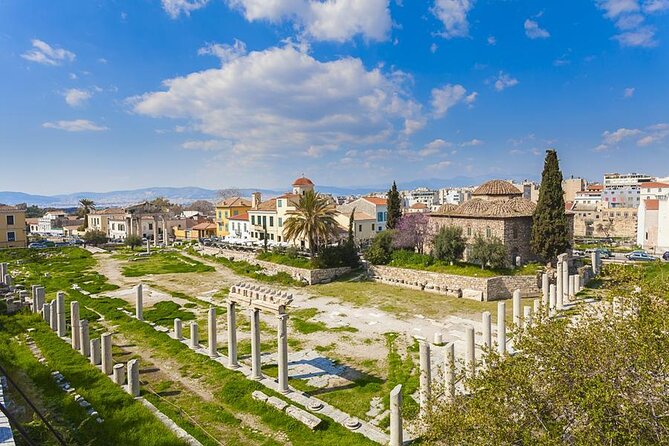
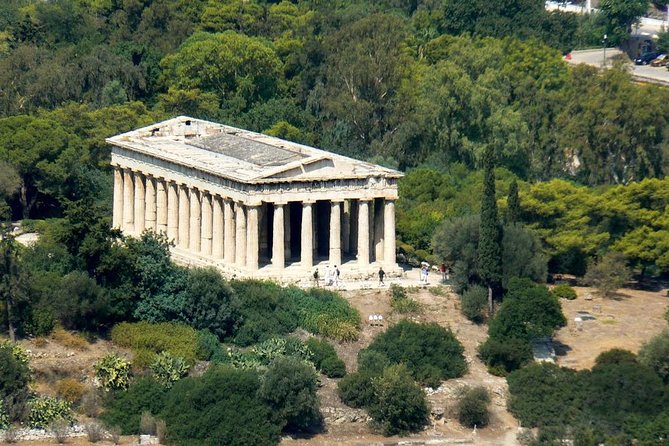
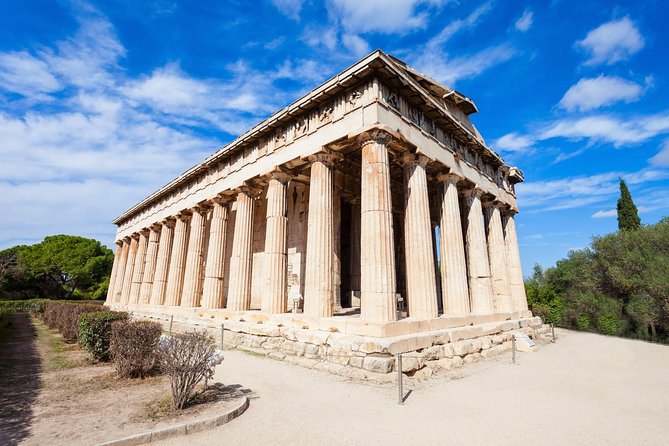
To cap things off, the tour ends at the Temple of Hephaestus, listed in the route details as the Temple of Aries but described as Hephaestus’ temple in the Ancient Agora area. This is one of the best-preserved ancient temples in the world, which means it’s a great final stop when you want a clear sense of what these buildings looked like when they were in use.
The guide ties the site to worship for Hephaestus (protector of metallurgists) and Athena Ergani (protector of potters and cottage industries). That’s a smart thematic ending. After learning about temples high on the Acropolis and the big civic role of the Agora, you finish with a temple connected to crafts and daily work—very grounded, very Athens.
If you like your history with real-life texture, this ending lands well.
Price and value: what $54.42 buys (and what you’ll still pay)
The tour price is listed at $54.42 per person, lasting about 4 hours. That base cost covers the expert certified guide, a small group setup, and an Athens map, plus the structure that keeps you from spending your best time guessing what to see next.
Here’s the part you should budget for:
- Acropolis admission is necessary for the 2h & 4h option: €30 per person
- Ancient Agora admission is necessary for the 4h tour option: €20 per person
So your real cost depends on the site tickets. Still, value-wise, the guide time is doing real work. You’re paying for interpretation—myth tied to monuments, stories tied to architecture, and explanations that help you keep track of what matters. If you’re the type who gets more from a good lecture than from an audio guide, this is where that pays off.
Also, there’s a way to reduce friction: the tour notes you can pre-purchase entry tickets if you let the operator know. That’s often the difference between a calm morning and a stressful one.
Walking reality check: shoes, bags, and hearing the guide
This tour is doable for most travelers, but it’s not a stroll. The Acropolis section includes uneven surfaces and stairs, and reviews also warn about a steep climb and heat. Bring good walking shoes, plus water and a hat, and expect to pause more often than you would on a flat city walk.
At the Acropolis, there’s also a strict practical rule: strollers, backpacks, and big bags aren’t allowed. Plan to carry a small day bag, and keep what you need easy to reach. It will save you time at checkpoints and reduce your stress when you’re moving through narrow paths.
One more listening tip: a few comments note there can be issues hearing if there’s no microphone. If you tend to get lost in crowds, stay a few steps closer to the guide and make sure you can see where they’re pointing when you enter denser areas.
Guides and style: why the storytelling gets praised
The strongest pattern in the feedback is simple: guides who teach with clarity and energy get remembered. Named examples include Irene/Irini, Michael, Dani, Alexandros, Angie, Kristina, Demi, Theo, and Chrysanthi.
What shows up repeatedly is that the guide doesn’t just toss out myths. They link them to what you see—temple function, cult statues, victory symbolism, and how theatre connects to Dionysus. Some guides use visual aids like printed photos to explain how monuments looked in their original form, which helps a lot when ruins are all you have to work with.
You also get interaction. Guides are described as asking questions, making the group feel included, and answering even niche follow-ups. If you’ve ever wished a tour would let you go past basics, this tour’s approach can feel more like a good class than a scripted march.
Who should book this Acropolis Greek mythology tour?
This works best if you:
- want mythology explained in plain language tied directly to monuments
- like a small group and a guide who answers questions
- care about architecture and want a story lens, not just snapshots
- want an Athens morning that leaves you with a mental map for the rest of the day
It may feel less ideal if you:
- hate steep climbs and long stair sections
- need a totally hands-off day with no restrictions around bags at the Acropolis
- struggle hearing in crowds and prefer tours that always use amplification (you might want to confirm the setup when you book)
Should you book this Athens Acropolis Greek mythology small-group tour?
If you’re choosing between a self-guided Acropolis plan and a guided one, I’d lean guided—especially for first-timers. The reason is simple: the myths are part of the meaning of the ruins, not a separate add-on. When a guide connects Athena, Dionysus, victory imagery, and cult statues to the stones in front of you, the whole day makes more sense.
Book it if you can handle walking and you’re ready for a bit of ticket math. Get it if you want to come away knowing what you saw and why Athenians cared. Skip it (or adjust expectations) if you’re hoping for a flat, casual route with minimal stairs.
FAQ
How long is the tour?
It runs for about 4 hours.
Where does the tour start and end?
It starts at the Arch of Hadrian area on Leof. Vasilisis Amalias (Athina 105 58) and ends at the Ancient Agora of Athens (Athens 105 55).
Are entrance fees included?
No. Acropolis admission is necessary for the Acropolis portion, and Ancient Agora admission is necessary for the 4-hour option. You can pre-purchase tickets.
What sites will I see?
You’ll visit the Temple of Olympian Zeus from the outside, the Acropolis area with major monuments like the Parthenon and Erechtheion, the Theatre of Dionysus Eleuthereus, the Ancient Agora, and end at the Temple of Hephaestus.
Is this tour a small group?
Yes. It’s a small-group tour with a maximum of 15 travelers.
Is it offered in English?
Yes, it’s offered in English.
What if weather is poor?
The tour requires good weather. If it’s canceled due to poor weather, you’ll be offered a different date or a full refund.


More Tours in Athens


More Tour Reviews in Athens
- All Day Cruise -3 Islands to Agistri,Moni, Aegina with lunch and drinks included
★ 5.0 · 4,958 reviews