REVIEW · ATHENS
“All day tour of Athens-8h:Exploring its most popular landmarks”
Book on Viator →Operated by Greece Athens Taxi GAT · Bookable on Viator
Athens is a city you can feel in layers, and this tour maps them for you. You start with the Acropolis and its big-name temples, then you shift to museums and classic central Athens stops, all with pickup and an itinerary you can adjust. I like that it mixes must-see icons (Parthenon viewpoints, Panathenaic Stadium) with the smaller context stops that make the whole day click. The main thing to watch is that the big ticket entries (including the Acropolis) are not included, so you’ll budget for admissions.
Two details I really appreciate: you get hotel/Airbnb/Port Piraeus pickup with no extra charge, and the experience includes practical comfort like Wi‑Fi on board, bottled water, and mobile chargers. The tour also offers help with skip-the-line tickets, which can save you time when you’re facing long entrances. A possible drawback is that the driver is not a licensed site guide inside museums and archaeological areas, so you’ll still be relying on the history talk during the ride and any guide help that’s arranged on request.
If you want an organized day without feeling rushed, this kind of private, all-day loop is a strong fit. And based on the praise around guide Andreas, you can expect a strong focus on Athens details—plus a friendly habit of answering questions even after the tour ends.
In This Review
- Key points worth knowing before you go
- A private Athens highlights route that actually feels efficient
- How the day flows: from the Acropolis rock to Syntagma and back down
- Acropolis first: Parthenon views, Erechtheion details, and the Theatre of Dionysus
- Acropolis Museum vs. National Archaeological Museum: choose the depth that fits your curiosity
- Option A: Acropolis Museum (great if you want the Acropolis story)
- Option B: National Archaeological Museum (great if you want the broad Greek-antiquity sweep)
- Panathenaic Stadium and Temple of Olympian Zeus: the Athens you see from street level
- Panathenaic Stadium
- Temple of Olympian Zeus and Hadrian’s Arch
- Syntagma Square, Zappeion, and the changing of the guard you can plan around
- Mount Lycabettus and Plaka: a second Athens, on purpose
- Mount Lycabettus
- Plaka
- Monastiraki and the Ancient Agora stops that connect the dots
- Price and comfort: is $261.89 per person good value?
- Who this Athens tour fits best
- Should you book this 7–8 hour Athens highlights tour?
- FAQ
- Is the tour private, or shared with other groups?
- How long is the Athens all-day landmarks tour?
- What’s included in the price?
- Are tickets and museum entry fees included?
- Do I have to choose between museums?
- Is there free cancellation?
Key points worth knowing before you go
- Private pacing: you can tailor the sightseeing to your tastes and move through stops at your pace.
- Hotel pickup included: start from hotels, Airbnb, or right at Port Piraeus when you’re on a cruise.
- Wi‑Fi, A/C, and chargers: comfort matters when your day runs 7–8 hours.
- Skip-the-line help (tickets paid by you): assistance is included even though admissions aren’t.
- Museum choice: you must pick between the Acropolis Museum and the National Archaeological Museum.
A private Athens highlights route that actually feels efficient
This is built like a greatest-hits day, but not a rigid bus shuffle. The promise is simple: you get a full-day Athens circuit with private transportation, and you can slow down or speed up depending on what grabs you. That’s the difference between “seeing Athens” and actually understanding how the city pieces fit—especially when your day includes both the ancient skyline and modern landmarks around Syntagma.
The practical setup is strong for first-timers. Pickup means you don’t waste your morning hunting for a meeting point. The car support helps too: Mercedes with A/C, child seats if needed, mobile chargers, and Wi‑Fi on board so you can keep maps and tickets handy.
The other big “value” clue is the lineup. You’re not only hitting the Acropolis. You’re also getting Panathenaic Stadium, the Temple of Olympian Zeus and Hadrian’s Arch, plus central Athens points like Syntagma Square and the changing of the guard. Then the day extends beyond the obvious tourist spine into Plaka, Monastiraki-adjacent sights, and optional museum depth.
You can also read our reviews of more tours and experiences in Athens
- All Day Cruise -3 Islands to Agistri,Moni, Aegina with lunch and drinks included
★ 5.0 · 4,958 reviews

How the day flows: from the Acropolis rock to Syntagma and back down
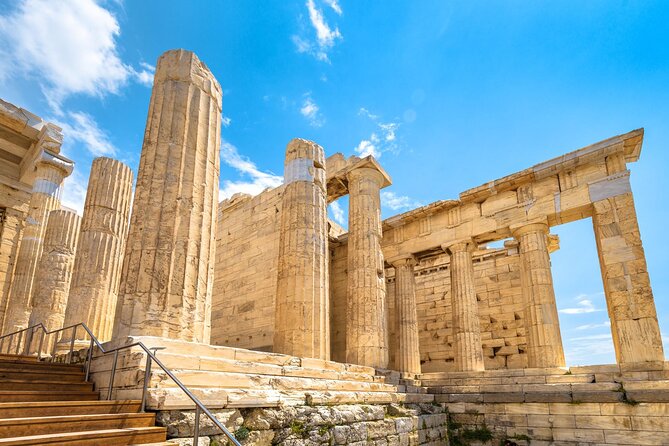
The itinerary has a smart rhythm. It begins with the Acropolis complex—because it’s the visual anchor of Athens. From there, you head toward the museum option (Acropolis Museum first), then you move outward to classic city landmarks: stadium, Zeus, Hadrian’s Arch, gardens, and Parliament Square.
Later, the tour shifts into neighborhoods and urban Athens icons: Mount Lycabettus (cable car nearby, with a church at the top), Plaka’s stair-and-balcony vibe, and the Monastiraki/Agora area. That sequencing matters. You get the big view moments, then you transition into streets and archaeological spaces where you can slow down and actually feel the city.
One note: the itinerary includes multiple “short stop” items like Panathenaic Stadium and the Temple of Olympian Zeus, each around 10 minutes. That doesn’t mean they’re throwaway. It means the tour is designed for highlights without eating your whole day in single-ticket lines and long transfers.
Acropolis first: Parthenon views, Erechtheion details, and the Theatre of Dionysus
The Acropolis stop is the headline. You’re visiting the rocky hill that rises about 156 meters above sea level and roughly 70 meters above the city. That vertical drama is part of why the Parthenon and its neighbors feel so commanding even from a distance.
You’ll see key structures tied to Athens’ classical identity:
- The Parthenon, dedicated to Athena, patroness of the city. Construction began in 447 BC and finished in 438 BC, with decorative work continuing until 432 BC. It’s considered the high point of Doric order sculpture and architecture.
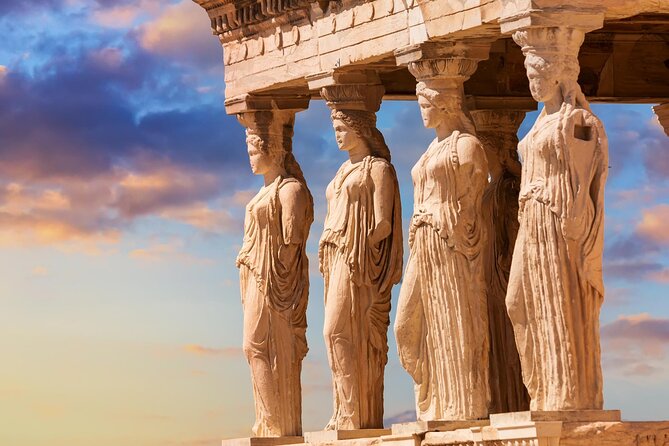
- Erechtheion, the Ionic temple on the north side of the Acropolis. It’s closely linked to Athena and is famous for its Caryatid figures (the named Karyatidis aspect in your route).
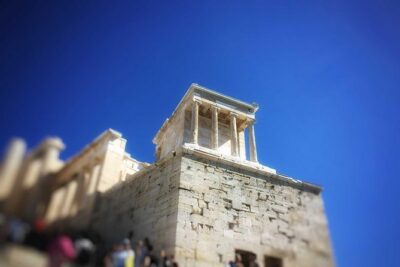
- Temple of Athena Nike, another Acropolis landmark dedicated to both Athena and Nike.
- The Theatre of Dionysus, built on the south slope and originally tied to the sanctuary of Dionysus Eleuthereus.
- Odeon of Herodes Atticus (Herodion), a stone Roman theatre structure on the southwest slope.
Why this stop feels worth the time: the Acropolis isn’t just “one site.” It’s a whole cluster that tells you how Athens thought about religion, performance, civic pride, and artistic ambition. Even if you don’t read every inscription, the variety of buildings and their purposes gives you a mental map.
What to watch: your Acropolis time is about 1 hour, and the ticket isn’t included. You’ll want proper footwear and a plan for shade/water. Also keep in mind the Acropolis closure dates listed for the tour: January 1, March 25, May 1, Easter Sunday, and December 25–26. If your trip lands on those days, you’ll want to confirm alternate planning.
Acropolis Museum vs. National Archaeological Museum: choose the depth that fits your curiosity
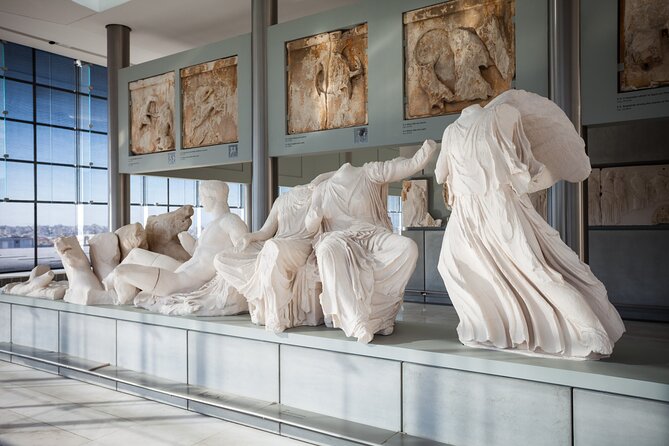
This tour includes a museum block with a rule: you must choose between the Acropolis Museum and the National Archaeological Museum. That’s a good design choice. Two top-tier museums in one day can turn into “two quick glances” instead of real learning time.
Option A: Acropolis Museum (great if you want the Acropolis story)
The Acropolis Museum is built specifically to house finds from the Acropolis sacred rock and from its area at the foot. It covers a wide span—from Mycenaean to Roman and Early Christian Athens—and it opened June 20, 2009. It also sits on the archaeological site of Makrigianni Byzantine Athens, which adds a layer of “you’re standing on history about history.”
If you love when the city makes sense in order, this museum option is satisfying. You’ll get context for why the Acropolis looks the way it does, and you’ll connect the sculptures and architecture you saw above with the objects kept inside.
- All Day Cruise -3 Islands to Agistri,Moni, Aegina with lunch and drinks included
★ 5.0 · 4,958 reviews




Option B: National Archaeological Museum (great if you want the broad Greek-antiquity sweep)
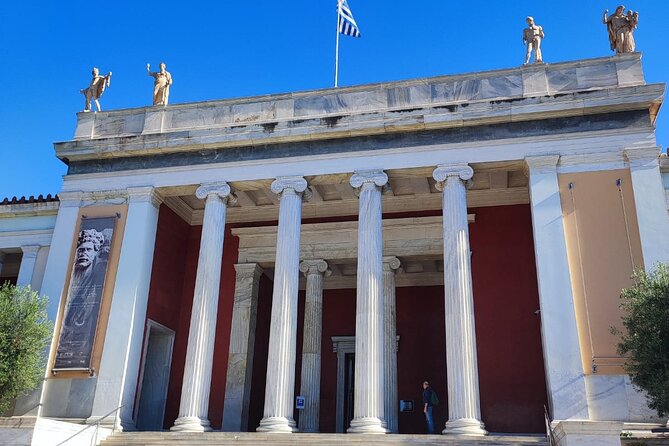
The National Archaeological Museum houses important artifacts from prehistory through late antiquity. It’s described as one of the greatest museums in the world and holds what’s presented as the richest collection of Greek antiquities worldwide.
This option is ideal if you want to see Athens as a doorway to the broader story of Greece, not only the Acropolis-era peak. You’ll come away with a wider sense of time periods and themes, even if your day’s first stop is still the Acropolis.
Practical budget note: museum admissions aren’t included. Ticket prices are listed in your tour info (Acropolis Museum €20 per person, National Archaeological Museum €12 per person), and museum costs can vary by season (winter vs. summer).
Panathenaic Stadium and Temple of Olympian Zeus: the Athens you see from street level
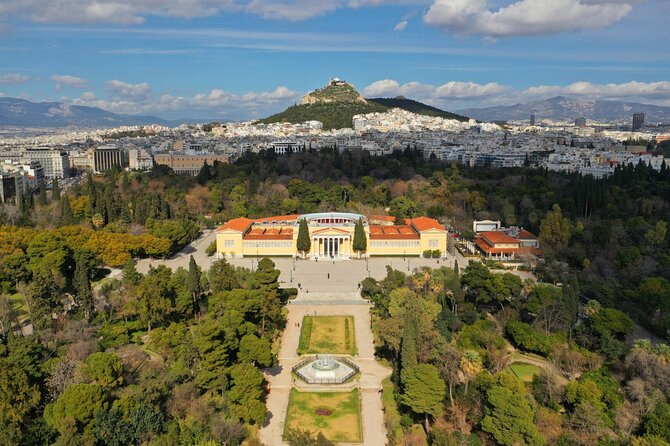
After the Acropolis, you drop to landmarks that show how Athens kept rebuilding its identity over centuries.
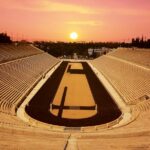
Panathenaic Stadium
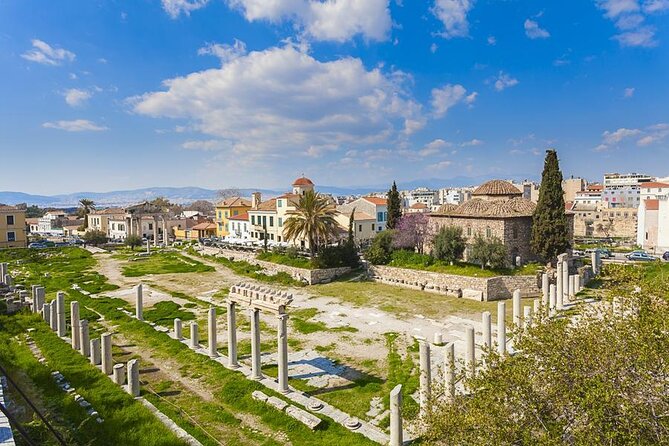
You’ll pause at Panathenaic Stadium, also called Kallimarmaro. It’s described as the oldest stadium still in operation and one that hosted the Olympics three times. The standout detail is that it’s the only major stadium built entirely of white marble.
In a day that otherwise leans heavily ancient-temple focused, this stop gives you a different kind of classical Athens: organized public spectacle and civic ritual, built into a sports venue. It’s also fast—about 10 minutes—so it doesn’t steal time from the places you’ll remember longer.
Temple of Olympian Zeus and Hadrian’s Arch
Next is the Temple of Olympian Zeus, a half-complete monumental temple dedicated to Zeus. Its ruins and scale make it an easy visual win, especially because it’s surrounded by other landmarks. You’ll also see Hadrian’s Arch (Hadrian’s Gate), a monumental gateway that once spanned a road from central Athens to the eastern complex tied to the Temple of Olympian Zeus.
Why these stops work together: they connect religious awe with the city’s imperial-era planning. You’re not only seeing “old stones.” You’re seeing how power moved through streets and structures.
Short stop, big payoff: the tour treats each as a quick, clear visit—enough to orient you on the city layout without spending your whole day hunting for the best photo angle.
Syntagma Square, Zappeion, and the changing of the guard you can plan around
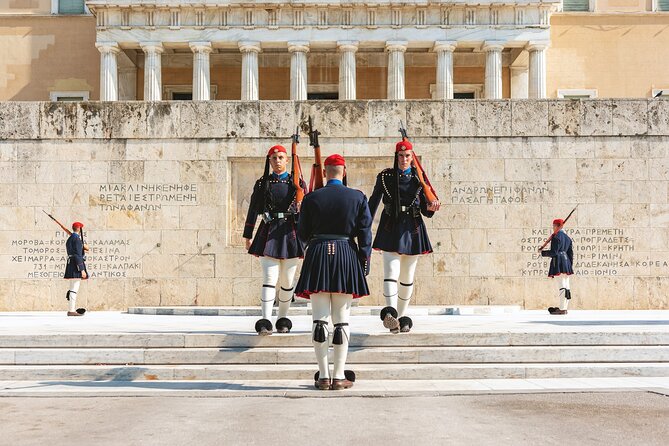
This is where Athens starts to feel like a living capital. The route includes Syntagma Square, the Hellenic Parliament, and the Monument to the Unknown Soldier, with the changing of the guard by the Euzones in front of the Old Palace.
Syntagma Square is the central political hub and named after the constitution granted after the 1843 uprising. The Parliament building sits in what used to be the old Royal Palace of King Othon, and the Unknown Soldier Monument is guarded 24 hours a day by the Presidential Guard.
Why I think this stop is worth it on a highlights day: the Acropolis gives you antiquity, but Syntagma gives you the Athens of today. You feel the national identity in a single square—especially with the ceremony element.
You’ll also pass:
- Zappeion, a palatial building used for meetings and ceremonies, next to the National Gardens.
- National Gardens (Royal Garden), a 38-acre green space right behind Parliament, including ancient ruins and busts of notable figures like Ioannis Kapodistrias and Jean-Gabriel Eynard.
These pauses are brief, but they add breathing room. And for many people, that break is what keeps the day enjoyable instead of tiring.
Mount Lycabettus and Plaka: a second Athens, on purpose
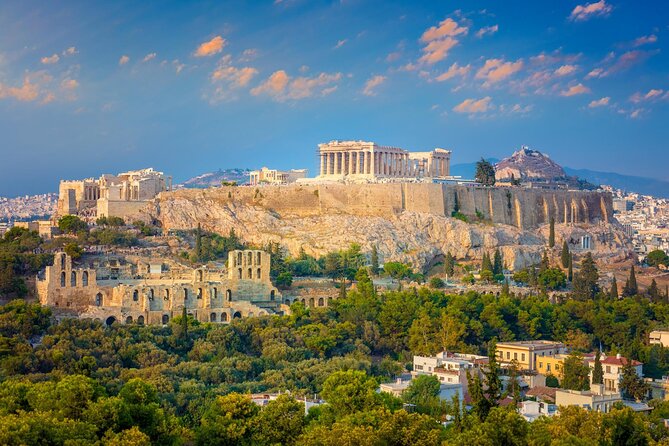
Toward the later part of the day, the tour shifts into “walk and wander” mode. You go to Mount Lycabettus, then down into Plaka.
Mount Lycabettus
Lycabettus rises to about 277 meters above sea level and is the second-highest point of the Attica basin. Your route notes the small church of Agios Georgios at the top, and that a cable car operates.
Even with a short visit (listed as about 20 minutes), this works as a perspective reset. You’re already seeing Athens from the heights at the Acropolis, but Lycabettus gives you a different angle—one that feels more like the whole city spreading out below you.
Plaka
Then comes Plaka, described as Athens’ oldest and charming district, directly below the Acropolis. The look-and-feel is classic: winding medieval alleyways, neoclassical houses, red tiles, balconies with colorful flowers, and plenty of Greek taverns and street cafés, including places serving ice-cold frappés.
This portion is a mental reward. After structured sites, Plaka gives you room to choose your pace, stop for a photo, and pick a side street without needing a schedule to justify it.
Monastiraki and the Ancient Agora stops that connect the dots
The tour folds in central archaeological stops near Monastiraki, including:
- Hadrian’s Library ruins, erected around AD 132 with a courtyard and pool bordered by 100 columns.
- Ancient Agora of Athens, described as the administrative, philosophical, educational, social, cultural, and economic center in antiquity.
- Stoa of Attalos, rebuilt, named after Attalos II of Pergamon (159 BC to 138 BC), and paired with a museum exhibiting Athenian artifacts.
Why these are valuable on a single-day loop: once you’ve seen the Acropolis and stadium, you still need the civic “everyday Athens” piece. The Agora is where the city’s ideas and daily life meet. It’s the bridge between temples on a hill and the crowds in public spaces.
Price and comfort: is $261.89 per person good value?
At $261.89 per person for a 7–8 hour private day, you’re paying for organization, transport, and reduced friction—not just sightseeing.
Here’s what’s included in a way that matters:
- Hotel/Airbnb/Port Piraeus pickup and drop-off with no extra charge
- Private Mercedes-Benz transportation with A/C
- Wi‑Fi on board, bottled water, and mobile chargers
- Assistance with skip-the-line tickets (you pay the ticket cost)
- An English-speaking driver with history knowledge (and again, not licensed to accompany you inside sites)
Where costs can add up:
- Acropolis admission (€30 per person) is not included
- Acropolis Museum (€20) or National Archaeological Museum (€12) is not included
- Tickets for other archaeological places/museums are also not included
Season can affect ticket prices, and the Acropolis closure dates listed in the tour info can force plan changes.
So is it worth it? If you’re traveling with two people or you dislike the stress of finding the right entrance times, this private format usually pencils out better than trying to self-coordinate multiple tickets and transit legs on your own. The comfort features (A/C, chargers, Wi‑Fi) sound small until you’re halfway through a warm day and still need your phone battery and map access.
Who this Athens tour fits best
This tour is a strong match if you:
- Want a private day with only your group and a pace that you control
- Like a structured route that still leaves you room to linger
- Prefer comfort and pickup over hopping between transit stops
- Are short on time and need classic Athens landmarks grouped into one day
It may feel less perfect if you:
- Are hoping for a fully licensed guide inside every museum and archaeological site. The driver can explain history, but inside-site licensing isn’t included.
- Want a long, slow museum day that ignores other stops. Here, museums are about 1 hour, and many landmarks are shorter pauses.
Should you book this 7–8 hour Athens highlights tour?
Yes, you should consider booking if you want one day to cover the core Athens story—from the Acropolis to street-level landmarks like Syntagma and Plaka—without the stress of ticket logistics and transit planning. The value comes from pickup, comfort, private pacing, and the fact that you get history talk from a driver who clearly knows the material. The praise around Andreas is a good sign that you’ll get helpful, ongoing explanations, not just a checklist.
Book this tour if your priority is: see a lot, understand a lot, and stay comfortable while doing it. Choose the Acropolis Museum if you want the Acropolis-focused follow-up. Choose the National Archaeological Museum if you want a wider Greek-antiquity sweep.
FAQ
Is the tour private, or shared with other groups?
The tour/activity is private, and only your group participates.
How long is the Athens all-day landmarks tour?
It runs approximately 7 to 8 hours.
What’s included in the price?
Pickup and drop-off, private transportation (Mercedes-Benz with A/C), Wi‑Fi on board, bottled water, mobile chargers, and assistance with purchasing skip-the-line tickets (ticket cost is paid by you). It also lists an English-speaking driver.
Are tickets and museum entry fees included?
No. Entrance fees are not included, including Acropolis admission (€30 per person) and museum tickets (Acropolis Museum €20 per person, National Archaeological Museum €12 per person). Ticket prices can vary by season.
Do I have to choose between museums?
Yes. You must choose one of two museums: the Acropolis Museum or the National Archaeological Museum.
Is there free cancellation?
Yes. You can cancel up to 24 hours in advance for a full refund.



More Full-Day in Athens
- All Day Cruise -3 Islands to Agistri,Moni, Aegina with lunch and drinks included
★ 5.0 · 4,958 reviews

More Tours in Athens


More Tour Reviews in Athens
- All Day Cruise -3 Islands to Agistri,Moni, Aegina with lunch and drinks included
★ 5.0 · 4,958 reviews