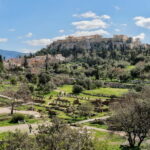
REVIEW · ATHENS
Acropolis Guided Tour with Skip-the-Line Access
Book on Viator →Operated by Olive Sea Travel · Bookable on Viator
Evening at the Acropolis feels like a back-row seat. This skip-the-line tour gets you onto the Sacred Rock with a licensed guide, so you can focus on the big monuments instead of waiting and guessing what you’re looking at. Starting at 5:30 pm also means better light than the harsh midday crush.
One catch: you’ll walk on uneven marble and rock surfaces, so plan for steady steps and bring shoes with grip. In summer, it can still feel hot even later in the day, so water and patience help.
In This Review
- Key highlights worth planning for
- Why 5:30 pm changes the whole Acropolis visit
- Meeting at the Herodion Hotel and what your group day feels like
- Skip-the-line access: how it affects your time on-site
- The walk itself: your guided route through the Acropolis monuments
- Acropolis hill: the Sacred Rock with Pericles-era meaning
- Propylaea: the ceremonial gateway to Athena
- Temple of Athena Nike: Wingless Victory and the story behind it
- Parthenon: your main event (and why the details matter)
- Erechtheion: the Karyatides and the myth-by-stone details
- Theatre of Dionysus: the stage that shaped the city’s culture
- Pro tips that actually help: shoes, timing, and heat
- Price and value: what $156.20 buys you
- Who this tour suits best
- Should you book this Acropolis guided tour with skip-the-line access?
- FAQ
- FAQ
- What time does the Acropolis guided tour start?
- How long is the tour?
- Where do I meet for the tour?
- Is skip-the-line access included?
- What’s included in the price?
- How many people are in the group?
- Do I need to bring good walking shoes?
- What is the cancellation policy?
Key highlights worth planning for
- Skip-the-line entry so you start seeing monuments sooner
- Licensed English-speaking guide who connects architecture to the story of Athens
- Evening timing for calmer pacing and great views over the city
- Parthenon time built in (about 30 minutes) rather than a rushed photo stop
- Karyatides and the Erechtheion for a different look at Acropolis-era design
- Small group (max 15) for questions and a less crowded feel
Why 5:30 pm changes the whole Acropolis visit
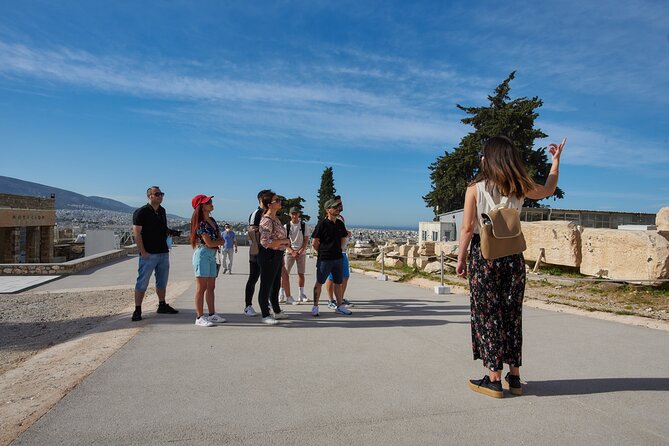
The Acropolis is famous for a reason, but the experience can swing wildly depending on when you go. This tour starts at 5:30 pm, and that timing matters. You’re more likely to get comfortable temperatures than you would at the top of the day, and the light off the marble can look dramatically different. It also helps with crowd energy. Instead of fighting for space, you get a guided flow through the site.
You’re not just “seeing ruins.” You’re viewing a symbolic skyline piece of ancient Athens—then watching the city spread out below as the evening settles in. That shift in atmosphere is what makes an evening slot feel special, even if you’ve visited Greece before.
And with a licensed guide leading the way, you’ll understand why the buildings are placed where they are: the Sacred Rock wasn’t just chosen for drama. It was chosen for meaning—political, religious, and artistic.
You can also read our reviews of more guided tours in Athens

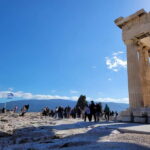

Meeting at the Herodion Hotel and what your group day feels like
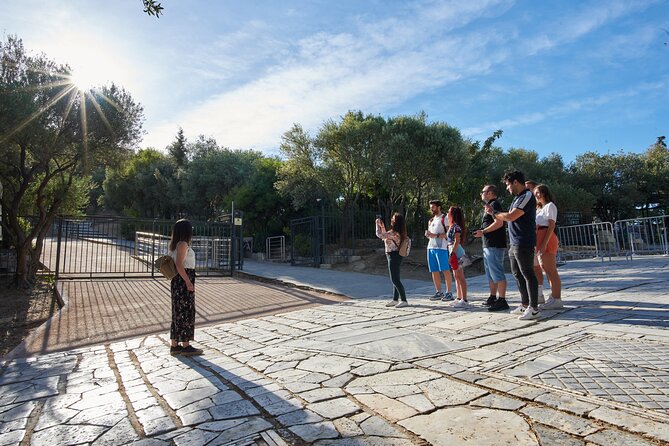
You meet at the Herodion Hotel, Rovertou Galli 4, Athens (near public transportation). The tour ends back at the meeting point, so you’re not juggling transfers after you’ve climbed and walked your legs off.
Group size is capped at 15. That’s a sweet spot. Big enough that you meet other people, small enough that your guide can keep an eye on the pacing and answer questions without the whole group turning into a slow-moving line of identical camera poses.
There’s no hotel pickup or drop-off included, so you’ll want to arrive at the meeting point a bit early—especially if you’re trying to avoid last-minute stress in the late-day light.
English is the offered language, and the ticket is handled via a mobile format, which keeps things simple when you’re standing outside in sun, wind, or both.
Skip-the-line access: how it affects your time on-site
Skip-the-line access is included, which is the practical difference between a day that feels rushed and one that feels manageable. At the Acropolis, waiting isn’t just annoying—it can eat up the time you’d rather spend at the Parthenon and Erechtheion, the two places where you’ll naturally want to slow down.
This tour also includes an Acropolis admission ticket, so you’re not hunting for tickets while everyone around you is getting herded forward. You’ll start the experience with the key piece already covered, and you can focus on walking and listening.
Skip-the-line doesn’t mean you ignore the site’s physical reality. You still climb, walk, and step over uneven ground. But it does reduce the amount of time you spend doing nothing but standing and hoping your phone battery survives.
The walk itself: your guided route through the Acropolis monuments
This is a true highlights route. You’ll cover the main buildings on the hill, with short, focused stops that add up to a smart overview in about 2 hours (approx.). Each stop matters, and the guide’s job is to connect the dots.
Here’s what you can expect, in the order you’ll see it.
Acropolis hill: the Sacred Rock with Pericles-era meaning
Your first stop is the Acropolis itself—the Sacred Rock of Athens. Even if you’ve read the history before, seeing it in person helps you grasp scale and placement. The Acropolis is the most important site of Athens and a symbol for the city itself.
You’ll get context about the 5th century BCE, especially Perikles’ Golden Age. That’s when ancient Greek civilization represented itself in a big, idealized way on the hill. The architectural “message” is clear: power, faith, and artistic ambition all packed into stone.
This is where the site’s nickname matters. Acropolis literally relates to an edge or height overlooking a city. Standing there, you understand why.
You can also read our reviews of more tours and experiences in Athens





Propylaea: the ceremonial gateway to Athena
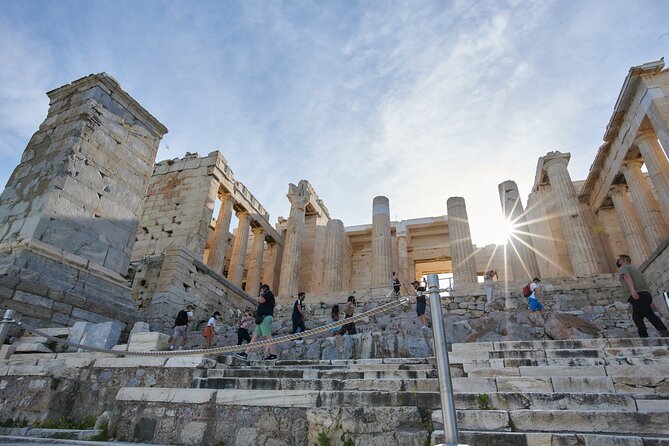
Next comes the Propylaea, the monumental entrance to the sacred area dedicated to Athena, the patron goddess of Athens.
Built by architect Mnesicles with Pentelic marble, the Propylaea is described as avant-garde in design for its time. That’s the kind of detail you might miss if you just rush from viewpoint to viewpoint. A guide helps you look at the shapes and materials like a designer, not just a tourist.
On the rampart near the main entrance, you’ll also spot the Ionian temple of Apteros Nike, or Wingless Victory. It’s brief, but it sets up one of the tour’s best themes: victory doesn’t always look like what you expect.
Temple of Athena Nike: Wingless Victory and the story behind it
At the Temple of Athena Nike, you’ll see a structure built between 426 and 421 BC. It replaced older temples, with earlier remains preserved inside the bastion.
This is where the name Athena Apteros makes sense. Nike is usually shown with wings, but in this case the statue is wingless. So the temple ties religious symbolism to the specific artistic choice made here.
Even in a short stop, it’s worth slowing down. Athena Nike is small compared to the Parthenon, but it’s packed with meaning—and the guide can explain how the site’s “victory theme” is woven into the larger Acropolis complex.
Parthenon: your main event (and why the details matter)
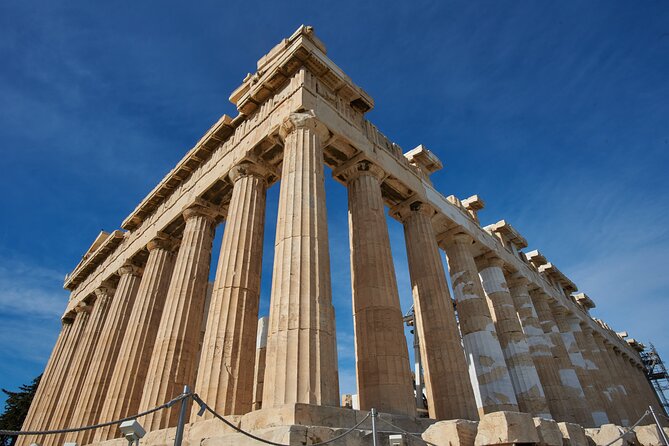
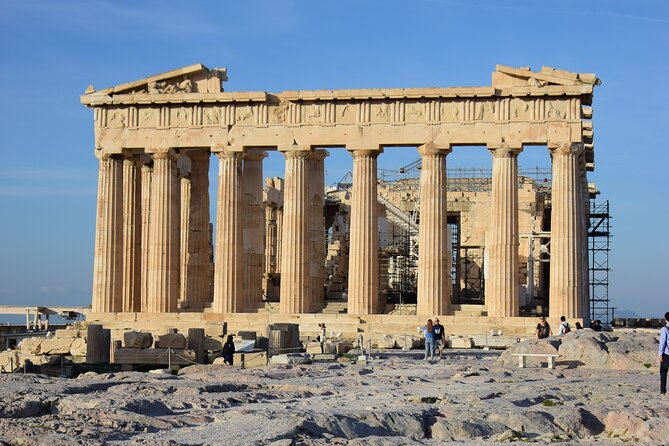
Then you reach the Parthenon. This is the monument most people come to see, and for good reason. It’s the international symbol of ancient Greek civilization and still the building that helps people picture Athens as an idea.
The Parthenon was dedicated to Athena Parthenos, the Virgin, and built between 447 and 438 BCE. The Doric design is a key part of its identity: eight columns on each narrow side and seventeen on each long side. You may not count them on your own at first glance, but you’ll know what you’re looking for once the guide points out the system.
One reason this stop feels worth the time is the sculptural decoration. You’ll learn how the Doric metopes and triglyphs work together on the entablature, then how the Ionic frieze brings a different rhythm across the cella walls.
The subject matter is dramatic:
- Gigantomachy on the east side
- Amazonomachy on the west
- Centauromachy on the south
- Trojan War scenes on the north
Even if you only catch pieces through your view angle, understanding the theme helps you see the Parthenon as a storytelling wall in stone, not just a big temple.
Expect about 30 minutes here—enough time to read the architecture and take photos without feeling like you’re being marched off to the next stop every 30 seconds.
Erechtheion: the Karyatides and the myth-by-stone details
The Erechtheion is where the Acropolis starts feeling less like one style and more like a set of problem-solvers. It was built between 421 and 406 BCE and tied to Erechtheus, the mythical king of Athens.
Materials and details give the building its character. Pentelic marble is part of it, along with a frieze made of Eleusinian grey stone with white relief figures attached. The foundations include Piraeus stone. If you enjoy seeing how different materials were chosen (and why), this stop rewards you.
The story gets even more specific. There’s stone paving associated with Poseidon’s trident strike—traces said to be preserved from when the god’s trident hit the ground and produced salt water.
And then comes the headline feature: the porch of the Karyatides. Instead of columns, the roof is supported by six female statues. You’ll hear that five are in the Acropolis Museum and another is in the British Museum, while those on the building are casts. That detail helps you understand what you’re seeing: part original context, part later preservation.
The frieze likely related to mythical kings of Athens too, which makes the Erechtheion feel like a myth machine: religion, identity, and leadership myths built into a structure.
Theatre of Dionysus: the stage that shaped the city’s culture
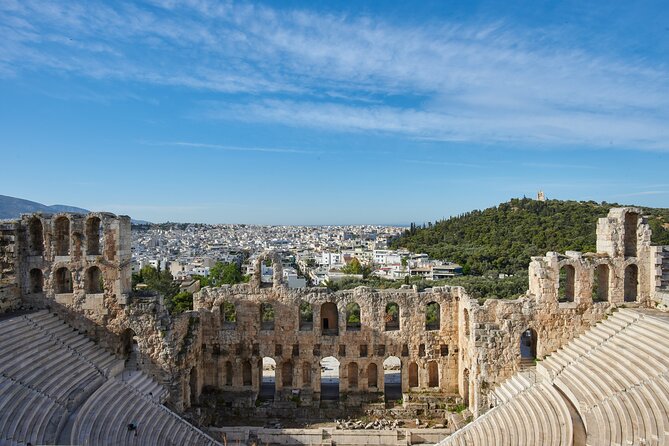
Your last stop is the Theatre of Dionysus, on the south slope of the Acropolis hill. It originally belonged to the sanctuary of Dionysus Eleuthereus. The first orchestra terrace dates to around the mid- to late-sixth century BCE, and it hosted the City Dionysia.
This is a quieter stop than the Parthenon, but it adds a key piece to the puzzle: Athens wasn’t only about temples and politics. It was also about performance and civic culture—where plays and festivals helped shape public life.
Even from the remains, you can picture how people gathered and how the slope created seating and sight lines. If you’re the type who likes cultural context, this final bit often lands well.
Pro tips that actually help: shoes, timing, and heat

The site is not a smooth museum floor. One review tip that really fits the reality here: wear comfortable shoes with good grip. You’ll be walking on rocks and marble ground, and the texture can be slick or uneven depending on wear and foot traffic.
Also, the walk up may look steeper than it feels. Reviews describe the incline and stairs as gradual, but that doesn’t mean it’s effortless. Think steady pace, short breaks if needed, and don’t sprint for viewpoints.
As for timing, late afternoon helps, but it’s not magic. In summer, Athens can still be hot even at 5:30 pm. Bring water and plan for sun exposure during your climb and waits between stops.
If you hate carrying things, keep your bag light. Your “hands-free” option will be the difference between enjoying the view and constantly adjusting straps.
Price and value: what $156.20 buys you
At $156.20 per person, this is not a budget excursion. The value comes from how the cost is spent, not just the price tag.
You get:
- Skip-the-line access
- A licensed tour guide
- A small group experience (max 15)
- The Acropolis admission ticket included
For a site like the Acropolis, skip-the-line isn’t a perk—it’s time. And time at the Parthenon and Erechtheion is the real product here. A guide also changes what you take away. Without one, you might see the monuments as pretty stone. With one, you start noticing orders, placements, symbols, and the story behind the choices.
There’s another practical value angle: this tour tends to be booked well in advance (an average of about 82 days). That often means evening slots are in demand. If you want this exact timing, earlier booking is smart.
Who this tour suits best
This tour fits you if you want the big Acropolis monuments without guessing your way through them. It’s also a strong pick if you care about architecture and symbolism—Propylaea’s role as a ceremonial gateway, Athena Nike’s wingless victory detail, and why the Parthenon’s design and sculptural program matter.
You’ll likely like it even more if:
- You prefer guided structure over wandering
- You want the evening feel and city views
- You’re traveling solo or with friends and like small-group pacing
It might not be ideal if you’re looking for a slow, fully relaxed stroll with lots of free time at each stop. This route is focused and efficient. The trade-off is you’ll see the highlights and learn the meaning, not just linger wherever you want.
Should you book this Acropolis guided tour with skip-the-line access?
Yes, book it if your priorities are a licensed guide, skip-the-line entry, and a real chance to experience the Acropolis in evening light. The timing, plus the fact that the admission ticket is handled for you, makes it feel like a clean, low-drama way to do the Sacred Rock.
Consider a different option if you want a long, independent exploration with lots of unstructured time. Also, if you have trouble walking on uneven surfaces, you’ll need to think hard about the stairs and marble/rock ground before committing. The tour is described as suitable for most travelers, but the physical reality still comes down to your comfort level.
FAQ
FAQ
What time does the Acropolis guided tour start?
It starts at 5:30 pm.
How long is the tour?
The duration is approximately 2 hours.
Where do I meet for the tour?
Meet at the Herodion Hotel, Rovertou Galli 4, Athens 117 42, Greece.
Is skip-the-line access included?
Yes. Skip-the-line Acropolis access is included.
What’s included in the price?
The price includes a licensed tour guide, small-group guided access, skip-the-line entry, and the Acropolis ticket. A mobile ticket is provided.
How many people are in the group?
The tour has a maximum of 15 travelers.
Do I need to bring good walking shoes?
It’s strongly recommended to wear comfortable shoes with good grip because you’ll walk on rocks and marble ground and climb stairs and uneven surfaces.
What is the cancellation policy?
You can cancel for a full refund up to 24 hours before the experience start time. If you cancel less than 24 hours before, you won’t receive a refund.

More Guided Tours in Athens


More Tours in Athens



More Tour Reviews in Athens
- All Day Cruise -3 Islands to Agistri,Moni, Aegina with lunch and drinks included
★ 5.0 · 4,958 reviews