REVIEW · ATHENS
The Best Way to See and Learn about Athens in 6 hours
Book on Viator →Operated by Timeless Athens Tours · Bookable on Viator
One day in Athens can feel like a shortcut to everywhere you want. This private 6-hour highlights trip lines up the Acropolis area, top museums, and classic neighborhoods without you juggling maps or bus transfers. I like that you stay comfortable in a car while the city flows past, then step out for the key sights.
My favorite part is the way the day is structured for first-timers. You get big-name stops like the Parthenon hill views and the Acropolis Museum, plus quick hits around modern Athens like Syntagma and Monastiraki. The second thing I really appreciate is the private setup (up to 3 people), so you can move at a pace that fits your group and ask questions along the way.
One thing to consider: entrance fees are not included. Plan for about 30 euros per person for the sites and museum, and if you want a licensed guide inside museums and archaeological areas, that’s an extra add-on.
In This Review
- Key things you’ll notice on this tour
- Why 6 hours can feel like a smart Athens plan
- Private driver-guide in the car: comfort plus context
- Acropolis hill first: Parthenon views, Propylaea, and the Caryatids
- Acropolis Museum: where statues and fragments actually make sense
- Zeus Olympios, Panathenaic Stadium, and the threads between eras
- Syntagma, Evzones, and the modern squares you’ll actually walk through
- Plaka and Monastiraki: where your photos turn into wandering
- Ancient Agora: Hephaestus plus the Agora museum
- Neoclassical Athens: the Academy and the culture trilogy vibe
- Petralona, optional lunch, and the local-food angle
- Price and value: what $505.23 per group really covers
- The guides: how names help you spot what you’ll get
- Who should book this Athens highlights day
- Book it or skip it: my take
- FAQ
- Is the tour private?
- How long is the Athens highlights tour?
- What does the price include?
- Are entrance fees included?
- Can the driver-guide explain inside museums and archaeological sites?
- Where will I be picked up from?
- Is there a language option?
- FAQ
- What should I bring for the Acropolis portion?
- How much time do you get at the Acropolis Museum?
- Is lunch included?
- Do I need to pay extra for the squares and neighborhoods?
Key things you’ll notice on this tour
- Private transport keeps you out of traffic and reduces walking time between far-flung stops
- Acropolis-first timing helps you experience the main views before the day gets crowded
- Acropolis Museum focus so the stones and statues have context, not just photos
- Real Athens neighborhoods at Plaka, Omonia, and Monastiraki, not only postcard angles
- Ancient Agora plus Hephaestus gives you a strong historical “why” behind Athens’ ideas
Why 6 hours can feel like a smart Athens plan

Athens is one of those cities where you can easily burn an entire day just getting around. This tour attacks the problem head-on: pickup, a private car, and a route that stacks the most important places close enough to do in one day. You’re not trying to “do it all” on foot; you’re doing the right parts fast.
Also, the private format matters more than it sounds. With only your group in the vehicle, guides can adapt the flow around what you want to see—my biggest “yes” for couples, friends, and anyone with limited time like layovers or cruise days.
The day is long enough to feel complete, but short enough that you won’t spend your vacation exhausted. That balance is why this works well even if you’re visiting Athens for the first time.
You can also read our reviews of more tours and experiences in Athens.


Private driver-guide in the car: comfort plus context
You’ll start with pickup from your hotel, apartment, or a key arrival point like the port at Piraeus, a cruise ship, or a specific city location. The tour uses private transport with parking and baggage charges handled, so you don’t have to think about logistics once you’re on the clock.
A driver-guide (service included) helps you learn along the route, but there’s an important Greece rule to know. In archaeological sites and museums, drivers can’t provide guiding inside those premises—only licensed guides can. So you’ll get excellent narration from your driver-guide outdoors and in between stops, and you can add a licensed guide separately if you want deeper commentary inside.
I also like the practical touch of mobile tickets. You’re not hunting for paperwork when you’re already dealing with crowds, stairs, and sun. And since the tour is offered in English and is designed for most travelers to participate, it’s an easy way to get oriented quickly.
Acropolis hill first: Parthenon views, Propylaea, and the Caryatids
The Acropolis part of this day is built around one idea: see it from the right angles, then fill in the story. You’ll start at the top area where the key buildings of the Golden Age sit close together, including Erechtheion, Temple of Athena Nike, and Propylaea.
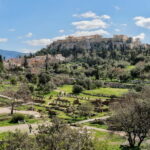
From the Acropolis hill, you also get sweeping outlooks over places like the Odeon of Herodus Atticus, the Theatre of Dionysus, and the Areopagus (Mars Hill). That matters because Athens isn’t just one monument—it’s an entire civic landscape layered over centuries. Even a short look from above helps you understand why people built where they built.
When you reach Erechtheion, focus on the Karyatides—the female statues often called Maidens dedicated to Athena and Poseidon. These are the “how did they even do this?” moments that make the visit feel real. Nearby, you’ll see the Temple of Athena Nike, the so-called Wingless Nike, sitting in front of Propylaea.
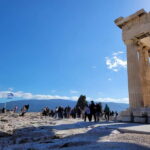
And yes, you’ll get your chance to see the Parthenon itself—one of the most recognizable sights in Europe. The tour doesn’t try to rush you through it. You’ll have enough time to look, read the basics, and absorb how the architecture fits the hill.
Practical note: the Acropolis walk involves real steps and uneven surfaces. If you’re sensitive to heat or mobility limits, plan to take breaks and bring water.
Acropolis Museum: where statues and fragments actually make sense
Next you’ll head to the Acropolis Museum, described as dedicated completely to the Acropolis hill. This is a big deal because you’re not only looking at buildings—you’re learning how art, religion, and everyday power came together on this rock.
Expect about an hour here. That’s enough time to understand the highlights without turning it into an all-day museum marathon. You’ll see artifacts tied directly to what you just climbed and photographed, which helps you connect what’s outside with what’s preserved inside.
If you care about details—inscriptions, sculpture styles, and what survives from different eras—the museum time is what turns the Acropolis from scenery into meaning. If you’re mainly into photos, the museum still improves your angle-taking, because you’ll notice what to look for when you’re outside again.
Entrance tickets aren’t included, so budget for it when you plan the day.
Zeus Olympios, Panathenaic Stadium, and the threads between eras

After the Acropolis, the itinerary shifts into “bigger than you expect” territory. The Temple of Zeus Olympios gets a quick stop—about 20 minutes—yet it’s enough to appreciate the scale. It’s known as the biggest temple ever built in Athens, and even partial ruins can feel enormous when you see them in person.
Then you go to the Panathenaic Stadium. This is where ancient Athens meets modern Olympic myth. You’ll learn it’s the first stadium of the first modern Olympics, and you’ll hear the story tied to Pheidippides announcing victory from the Battle of Marathon. It’s a compact stop, but it adds a cultural bridge between ancient events and later European identity.
These quick stops work well because they break up the day. You’re not repeating the same type of site, and you get a wider picture of Athens across time.
- All Day Cruise -3 Islands to Agistri,Moni, Aegina with lunch and drinks included
★ 5.0 · 4,958 reviews




Syntagma, Evzones, and the modern squares you’ll actually walk through
Athens isn’t all ruins. The tour takes you into the city’s living center with stops around major squares.
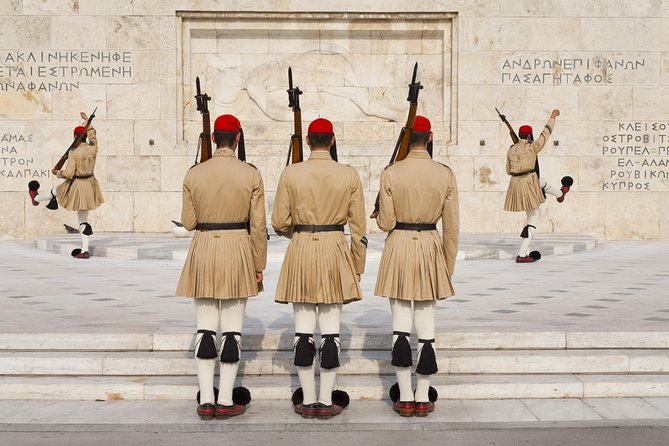
At Syntagma, you’ll see the Parliament building and the Tomb of the Unknown Soldier. The Evzones guarding it wear traditional uniforms associated with 1821. This is one of those moments where the city performs history in plain sight—less about architecture and more about ceremony and national identity.
You also pass through or stop for time around Omonia and Monastiraki. These are key squares in the city’s layout, surrounded by neoclassical-style buildings and close to everyday life. Monastiraki is especially useful on a highlights day because it sits right near the flea market area, plus it’s a crossroads for people, food, and browsing.
If you like the feeling of being in the middle of the city instead of parked next to it, these stops do a lot of work.
Plaka and Monastiraki: where your photos turn into wandering
Plaka is the oldest neighborhood area in Athens, and the tour gives you time to walk. You’re under the sacred hill of Acropolis, with a blend of older buildings, shops, and places to eat. The goal isn’t to shop hard—it’s to get a sense of how tourists and locals share the same streets.
About 30 minutes at Plaka is enough to do a loop, spot good photo angles, and grab a snack if you want. It also helps you understand the visual contrast: dramatic ancient stone above, softer street life below.
Then you end up around Monastiraki, which is part of the historic triangle. This area pulls you into the market vibe fast—souvenir browsing, food smells, and the constant hum of people moving through narrow lanes.
Ancient Agora: Hephaestus plus the Agora museum
One of the most satisfying parts of this day is the transition from “top-of-hill monuments” into the more grounded civic center: the Ancient Agora of Athens.
You’ll spend about 40 minutes at the Agora area, which makes time for the key piece: the Temple of Hephaestus. It’s often described as the best preserved temple in Athens today, and standing in that space gives you a different kind of awe than the Acropolis. This is architecture tied to daily public life—philosophy, debate, and a market setting where ideas mattered.
There’s also a Museum of the Ancient Agora, with time reserved for around 20 minutes. Even if you’re not a museum fanatic, this is a good stop because it helps connect what you see in the open air with what’s been preserved from the area.
You might need entrance tickets for the Agora sites and museum, depending on what you choose to enter fully that day. Budgeting about 30 euros per person keeps you covered.
Neoclassical Athens: the Academy and the culture trilogy vibe
Between ancient stops, the tour includes the Academy of Athens area—three neoclassical buildings grouped together: the Academy of Arts and Sciences, the University, and the National Library. Even with short time (around 10 minutes), it’s a smart photo-and-walk break because it shows a different Athens identity.
This is the Athens that wanted to brand itself as heir to classical culture, but with institutions fit for modern education. You see it in the architecture, and it gives you a more complete picture when you later think about why the Acropolis still dominates the city’s image.
Petralona, optional lunch, and the local-food angle
If you choose to add lunch plans, the tour may take you toward Petralona, an Athens neighborhood outside the main tourist belt. The idea here is straightforward: eat somewhere local instead of default tourist places.
Lunch is optional and not included in the base price. Still, this is often where the day stops feeling like a checklist and starts feeling like an actual Athens experience.
You’ll also get a chance to visit or reference the central open food market area for meats and fresh fish. The pitch is about quality and price—good food, handled like locals care about it. Even if you don’t buy much, it’s a useful window into how people feed themselves in Athens.
Price and value: what $505.23 per group really covers
The tour price is listed as $505.23 per group, up to 3 people. That pricing shifts the math in a good way if you’re traveling as a small group or as a couple plus one friend.
What’s included:
- Private driver-guide service
- Parking fees and baggage charges
What’s not included:
- Licensed guide for inside archaeological sites and museums
- Entrance fees
- Drinks and meals
- Any accommodation or gratuities
Entrance fees are estimated around 30 euros per person, which you should treat as a baseline rather than a guarantee. If you do the museum and major sites on the timetable, that estimate is a reasonable starting point.
Here’s the value question: you’re paying for time saved and for guidance that keeps you from wandering in circles. If you’re the type who hates map stress, rides between sites can turn a chaotic day into a calm one. If you’re comfortable navigating on your own and don’t mind crowd queues, you might spend less solo. But you’ll likely spend more energy.
For people short on time, the private format is where the cost starts making sense.
The guides: how names help you spot what you’ll get
This tour is driven by experienced people, and the reviews make it clear that the personality of the guide matters.
I’ve seen names like Markos, John, Dem, Yanis, Makis, and Natalia tied to stand-out experiences. You might get an especially story-focused guide who uses tools to make ancient life feel less abstract, or one who keeps things fun and practical, like pointing out where to stand for photos and how to pace breaks.
One theme pops up: guides often go beyond basic facts—helping with comfort in hot weather, stopping for coffee, and recommending authentic places to eat. Not every guide may do all of that, but you can expect friendly, helpful expertise while you’re in the car.
If you want extra depth inside sites and museums, ask about arranging a licensed guide add-on for the exact places that matter most to you.
Who should book this Athens highlights day
This tour fits best if you:
- Are visiting for the first time and want the headline sites with less planning stress
- Have a cruise ship day or flight layover and need efficient timing
- Prefer a private setup instead of joining a larger group
- Want a mix of ancient monuments and modern Athens squares and neighborhoods
It’s also a good match if you’re not trying to win a marathon. You’ll still do walking where needed, but the car reduces the “between-stop fatigue” that ruins highlights days.
Book it or skip it: my take
Book it if you want structure, comfort, and fast learning. The route is designed so you can see the Acropolis monuments, understand them better at the Acropolis Museum, then round out the day with Agora and the city squares. For many first-timers, that’s the sweet spot.
Skip it if your priority is long museum time, deep archaeological study with a licensed guide everywhere, or you already have the energy to build your own route from scratch. In that case, you may prefer independent ticketing plus a separate guide inside just the sites you care about most.
If you do book, my one practical tip is simple: plan for a start time that helps you beat the crowds. And bring water for the Acropolis steps.
FAQ
Is the tour private?
Yes. This is a private tour/activity, and only your group participates. Pickup is offered, and the group size is up to 3.
How long is the Athens highlights tour?
The duration is about 6 hours (approx.).
What does the price include?
The price includes a private driver-guide service, plus all parking fees and baggage charges. You’ll also receive mobile tickets.
Are entrance fees included?
No. Entrance fees are not included, and the tour notes an estimate of about 30 euros per person for entrance fees.
Can the driver-guide explain inside museums and archaeological sites?
Drivers are not permitted to provide guide services inside archaeological sites and museums. Licensed guides are an extra service if you want that level of inside commentary.
Where will I be picked up from?
You can be picked up from your hotel (any hotel), apartment, Piraeus port, your cruise ship, or a specific location in Athens.
Is there a language option?
Yes, the tour is offered in English.
FAQ
What should I bring for the Acropolis portion?
Bring water and plan for walking on uneven ground and steps. Entrance tickets are separate, so keep a budget for site admissions.
How much time do you get at the Acropolis Museum?
You typically get about 1 hour at the Acropolis Museum.
Is lunch included?
Lunch is optional and not included in the tour price. The tour mentions the possibility of lunch in Petralona with a local taverna.
Do I need to pay extra for the squares and neighborhoods?
The stops around Syntagma, Omonia, Monastiraki, and Plaka are described as free from an admission-fee standpoint, but you’ll still pay for any ticketed sites you choose to enter.

More Tour Reviews in Athens
- All Day Cruise -3 Islands to Agistri,Moni, Aegina with lunch and drinks included
★ 5.0 · 4,958 reviews